Tag Archives: Game of Thrones

A Vindication of Piracy

A while ago (and with great reluctance from Evan), I posted a defense of piracy.

Understanding how much Evan and I differ on the subject, I wouldn’t have written anything more about it- had the BBC not just put forth an article kinda vindicating my entire position.

Oh, you better believe I’m gonna be cocky about this…

Continue reading

Shame Day: Spoilers

Today’s post is going to be a little shorter than most, primarily because I am, well, not writing this from home. Take from that what you will.

spoilersspoilersspoilersspoilers

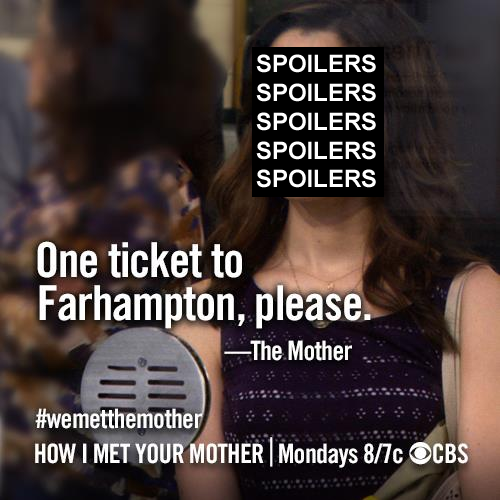
I write this because last night, while perusing Facebook, the page for CBS’s How I Met Your Mother posted an image of a certain someone [seen on the right]. The caption for the image was as follows:

A secret 8 years in the making! You just met… wait for it… the mother! Like this post if you were surprised!
http://bit.ly/10K4e18

But here’s the thing, I hadn’t seen the episode. I was busy talking about short stories with my writing group, which was swiftly followed up by reviewing the season finale of the other CBS sitcom. As the description of the image reads, this was a reveal “8 years in the making.” I may not have started the year the show came out, but I  have seen every episode. That’s 183 episodes; that comes out to something like 3660 minutes, or 61 hours, or 2.5 full days of television. Continue reading

Beyond Good and Evil

Act 2, Scene 2 of William Shakespeare’s Hamlet has the titular character declare that “there is no good or evil, but thinking makes it so.” Years later, this same sentiment would be echoed by Milton’s Lucifer in Paradise Lost, vowing “The mind is its own place, and itself, can make a heaven of hell, a hell of heaven.”

Moral ambiguity, in case you haven’t caught the drift, is the subject of today’s post. Our culture is becoming increasingly saturated with concepts and figures embodying this general rejection of our traditional measures of what right and wrong is. Jump back twenty years, and the definition of a bad guy would be fairly straightforward. A bad guy breaks the law. A bad guy hurts people. A bad guy lies. A bad guy uses people.

Today, all those things would describe five minutes of screen time with Breaking Bad’s Walter White…

Or Sin City’s John Hartigan…

Or The Walking Dead‘s Rick Grimes…

Or even any of these guys…

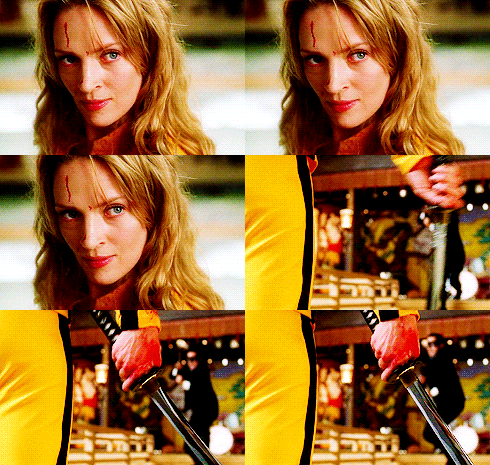
And lest anyone think that women are excluded from this mentality…
Now this isn’t the first time we’ve had a run of morally questionable heroes/antiheroes dominating popular culture. If I were to describe tough, unflappable, characters struggling against each other for their own ends and agendas, often in contradiction of the law- you’d probably assume I was talking about characters from some film noir piece.

And it makes sense, doesn’t it? Throw a mass of people in an economic depression with no end in sight, mix in distrust of the powers that be, add cynicism in regards to any progress or change, and when else can you expect but a tacit respect for the handful of people who do manage to carve themselves out a living. When you’re living paycheck to paycheck, “right and wrong” doesn’t quite seem so relevant as “effective or not.” When you feel helpless and voiceless, chances are anyone whose managed to be independent and powerful is going to be attractive- be he/she a suave criminal, a cunning businessman, a shrewd politician (à la Game of Thrones), or even just an all-around tough guy (see Sons of Anarchy).

And we’re not just talking about TV shows here.

Who are the good guys and bad guys in Inception?

Think about it- exactly which characters were representing the side of justice, truth, and freedom? Or Killing Them Softly? The Godfather SeriesThe Big Lebowski?

Our heroes today aren’t crusaders, they’re survivors. They’re those who manage to carve out a slice for themselves in spite of law, society, and conventional morality. “Good and evil” simply aren’t relevant.

And y’know what? I’m not hear to pass judgement on any of that.

There’s strong arguments to be made on all sides for whether or not this is a good or a bad thing or, to put it into morally ambiguous terms, a productive or a destructive thing. There’s even a strong case to be made for the “morally ambiguous” characters on TV and in the movies still never straying too far from anything truly socially unacceptable. Alternatively, you could (and I would) potentially argue that the moral system we had before all this wasn’t actually all that moral to begin with.

And what about the issue of cultural plurality in our ever-shrinking world? When what is right according to my moral code wrong according to yours, how do we proceed? Do we try to find some sort of umbrella system to keep us from fighting each other? Maybe we should declare moral anarchy and simply duke it all out based on the strength of our convictions. Certainly Nietzsche would approve of that.

All that’s to say that the issue’s complicated.

I don’t know, Michael Cera gif, I don’t know…

Speaking for myself, it is nice to see some kind of conviction, even if I don’t agree with the cause at hand. There’s a case to be made for apathy being the pinnacle of all evil. In a world where the greatest battles the average person (or rather, Westerner) faces are over such petty, empty things as getting a dinner order right or having to wait in line, seeing any kind of drive makes for a nice change. As with so much in this past year, it might not be great, but it’s a start.

Game of Thrones translates better to the screen than Lord of the Rings


I read Game of Thrones back when it was a relatively nerdy thing to do (I’m not bragging; the geekiness of it at the time cancels out any hipster cred I could claim now) – back when I had to tell people that it was “fantasy, but also good”. So seeing the books translated into an HBO series (insert shout-out to the casting directors for being awesome) is pretty exciting, and seeing it done well is even more exciting.

During the (EDIT: second-to-last episode) of Season 2 – specifically, the siege scene – there was this shot of Stannis’ army lifting up ladders to the walls of King’s Landing, and one of my friends said that it looked like the Two Towers. Upon further thought, I realized that I liked the film representation of the King’s Landing siege – and the Game of Thrones books in general – better than I liked the Lord of the Rings adaptations. As the LotR movies were the most significant and noticeable film event in my life so far, this was a pretty strange realization. So I tried to figure out why I thought that Game of Thrones was doing a better job on screen.

I do love extravagant battle scenes, and the LotR movies delivers, but I always feel kind of jerked around by the battle scenes in LotR. I was watching The Two Towers and noticed how formulaic the Helm’s Deep battle sequence is. The tactics are interesting enough, but the camera just focuses on giving us series of tantalizing deaths to push my hopes one way or another – we’ll see a handful of individual “good team” deaths accompanied by tragic music, only to then be fed a series of orcs getting killed by archers to keep us hopeful and interested. Tactically, Helm’s Deep isn’t a very interesting battle – good team is losing/bad team is scary, Gandalf comes back with Eomer, good team is winning again.

EDIT: I have been informed that I am woefully underinformed, and this giant scary battering ram’s name is Grond and is NOT from the battle of Helm’s deep. I’m keeping this picture up, though.

In terms of effects and extravagance, the LotR team did an incredible job. The scenes are beautiful. But the use of repeated grisly deaths and cruelly interesting kills just to jerk around the viewers’ emotions started to feel like a cheap tactic.

A quote you wouldn’t hear in Lord of the Rings: “Those are brave men knocking at our door. Let’s go kill them!”

In Game of Thrones, however, I noticed the battle in the Season 2 finale was different. For one thing, there wasn’t a specific side to cheer for – I mean, everybody likes Tyrion and Sansa, but it probably wouldn’t be a terrible thing if Joffrey were kicked off the throne, and what’shisface’s (the Stag guy’s) bitterness is relateable, and not necessarily borne of some intransigent evil. The scene also depicted more of the tactics and the actual progression of the battle, I thought, than dragging the viewers along by alternately dashing and keeping up their hopes.

The whole story of Game of Thrones, I think, falls short of the story of LotR. Martin relies too much (like Ayn Rand in We the Living) on making us disappointed – true, the events are appropriately random and unexpected, but (is it ridiculous to say this?) random and unexpected for 1200 pages gets sort of predictable. Or at least, rhythmic. But the honesty of the characters and the anti-gloriousness of their predicaments makes it more suited to visual media than LotR. The broad, mythic scope of LotR made for beautiful movies that would never quite live up to the epicness of the books. In the end, even after all of the stunning shots of New Zealand, the story was too big to be sold.

In LotR, we know , essentially, that the good team is going to win. In Game of Thrones, while the Stark family is pretty unabashedly Good, the rest of the characters are up for grabs. Villanous actions in LotR are generally due to some inherent evil (orcs, Uruk-Hai, Sauron), but villainous actions in Game of Thrones are usually the product of a relateable motivation (love, fear, greed) and aren’t generally limited to specific characters. Game of Thrones is morally messier, and while LotR calls upon values like honor and steadfastness, the characters in Game of Thrones are constantly questioning the actual merits of those values

Questioning the merits of virtue
Jaqen: “A girl has no honor!” Arya: *shrug*

LotR is a myth. Grittiness of character is not its thing – it excercises a style of storytelling that requires suspension of disbelief and an appreciation value of behavioral archetypes. In LotR, Aragorn becomes king and is reunited with Eowyn – in Game of Thrones, Eddard Stark dies in the middle of the first book. LotR’s plots make for fabulous books, and the prose and the world Tolkien created is LotR’s real strength. Game of Thrones by no means compares to Tolkien’s prose, but it makes for interesting characters, engaging dialogue, and non-predictable battles. Because of this, Game of Thrones is way, way better for visual media.

In Game of Thrones, Robert says of killing people: “They never tell you how they all sh** them selves, They don’t put that part in the songs.” Lord of the Rings was the song, and Game of Thrones is showing us the parts the songs leave out. Each type of story is legitimate in its own right – but Game of Thrones seems to translate better to the screen.