Tag Archives: Muslim

Eight Things I Learned in Indonesia

A little over a year ago I spent four months in Indonesia. I didn’t really travel across the country, at least not in the way you would expect during that much time abroad. Instead I had the great privilege to live in Indonesia, and see it from the inside. It’s hard to put to words all that I learned, and impossible to do justice to the people I met and the experiences I had. Here is my attempt to share are a few things I learned while I was travelling.

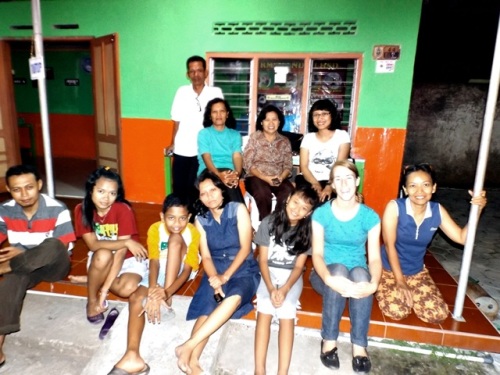
DSCI0220

1) Hospitality

The first notable quality of almost every Indonesian I encountered, and especially of my host family, was their hospitality. Within 12 hours of arriving my concept of generosity and hospitality had been put to shame. My hosts not only shared their home, they shared their family, lives, and friends with me. I was adopted into their social circle, taken for day- or week-long trips by their friends while I was there. I was honoured to be one of the first people to greet the family’s first grandson alongside the immediate family.

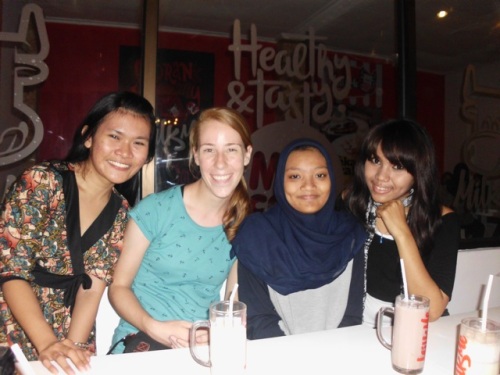
DSCF0815

2) Hijabs aren’t scary

This is a fairly potent topic these days so I won’t comment too much. Over half the women on Java wear hijabs, a head covering worn by Muslim women. When I asked why they wore them, all the women I asked answered with “I wear it because I choose to.” I began to recognize beauty and comfort in these headdresses, as well as freedom of expression. These women were neither ashamed nor pious in their religion, it was simply a part of their life.

DSCI0470 Continue reading

What Wouldn’t Jesus Do?

“Would Jesus have carried a gun?”

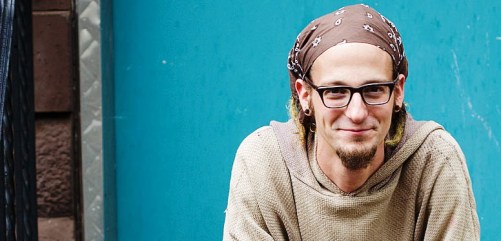
That was the question Christian activist Shane Claiborne posed in an article this Saturday.

The Jesus I worship did not carry a gun. He carried a cross.  Jesus did not tell us to kill our enemies. He told us to love them.”

These words come as a response to the shocking and repulsive comments by Liberty University’s president Jerry Falwell Jr. who, in a speech to his institution’s students, sneering declared that “if more good people had concealed-carry permits […] we could end those Muslims before they walked in and killed them.”

I shouldn’t have to explain how despicable those words are. And readers- I’m not going to.

If you’re reading this blog, I’m going to assume (to hope) that you have an iota of humanity in you. A speck of morality. A single shred of basic decency. I don’t think I need to describe what vile, bigoted, demonic filth that statement is. I don’t think I could even begin to. The heinous, cancerous insanity that Falwell spouts doesn’t merit a response.

Shane Claiborne, on the other hand, does.

shane-claiborne-believes-the-gospel-is-about-being-close-to-those-who Continue reading

Pro-Israel vs Pro-Palestine: Can There Be a Third Option?

About a year ago I wrote a paper on media bias in coverage of the Israel-Palestine conflict. In her feedback, my professor accused me of being a Palestinian sympathizer and in the same breath called me pro-Israel. This conversation, in my mind, highlights the fact that no matter how careful I am, neutrality on this issue has become nearly impossible.

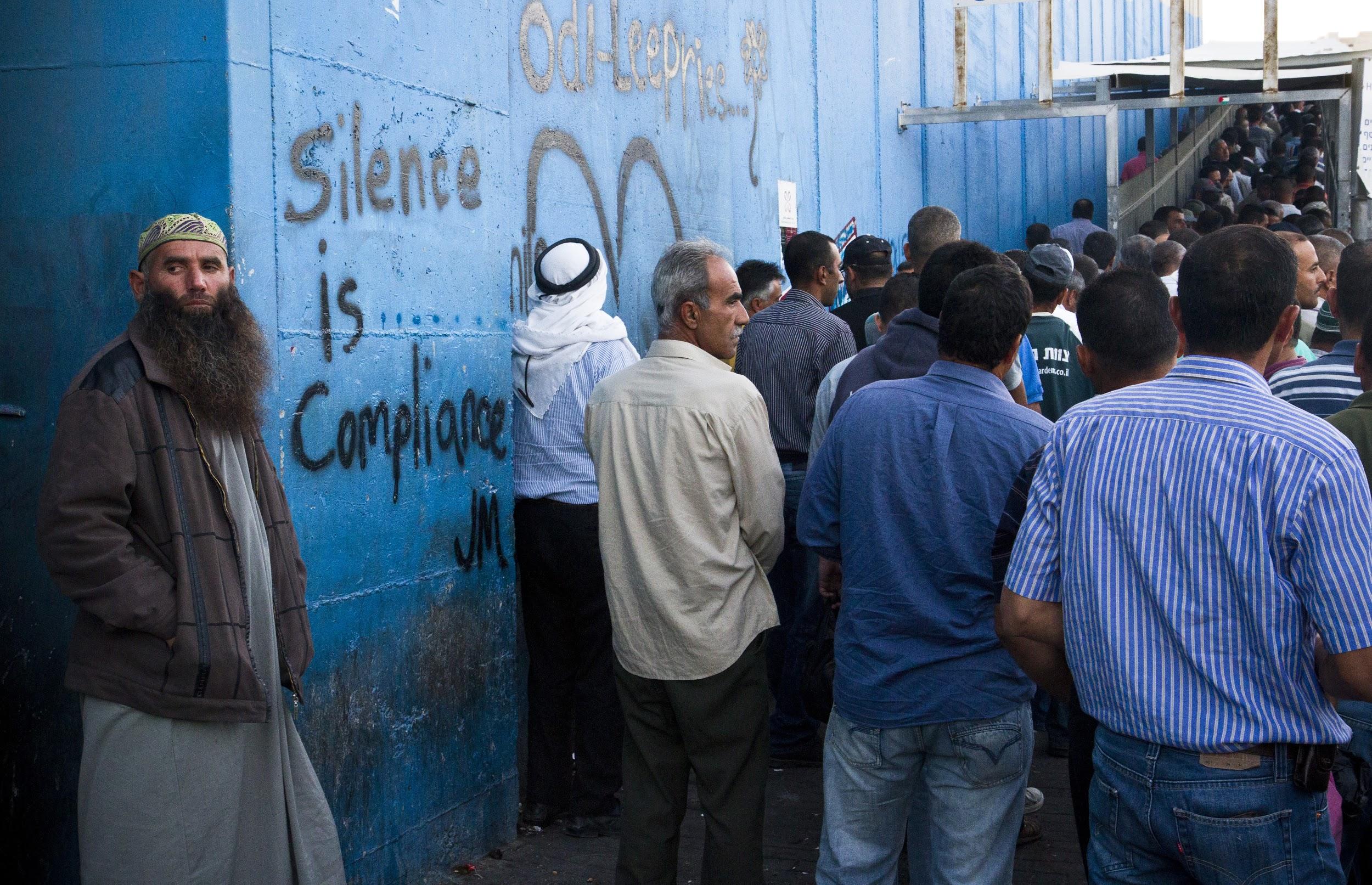
bethlehemwestbank

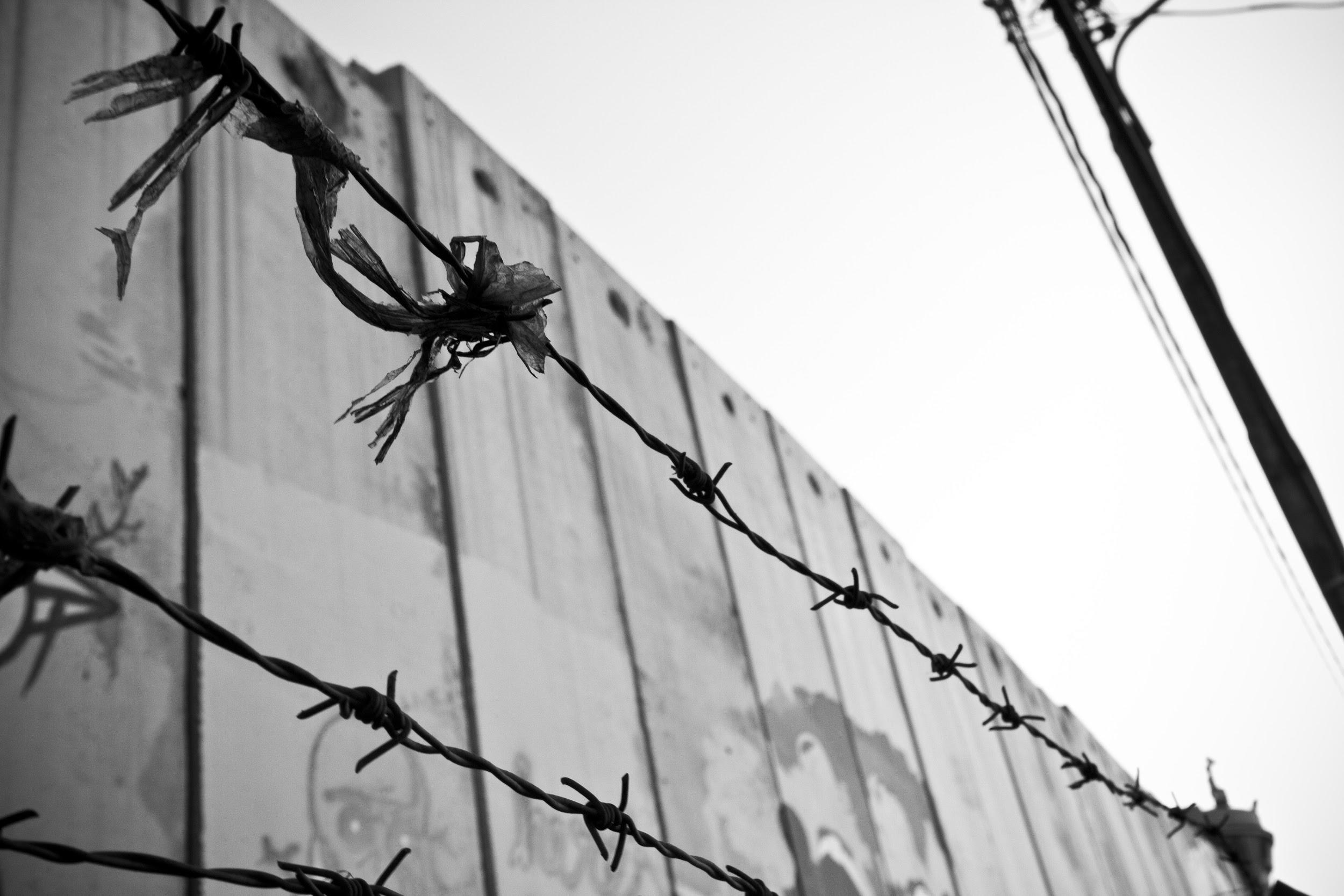
Bethlehem, The West Bank: Every morning hundreds of Palestinians line up at the barrier to make it through the checkpoint in time for work in Jerusalem. It often takes 3+ hours to make it through.

Let’s face it, no one wants to talk about the Israel-Palestine conflict. No matter what stance you take, you’re going to offend someone. Since violence and tensions have somewhat lessened since last year, or at least have become overrun by other more flashy news stories, there hasn’t been a whole lot of coverage on the conflict. Though governments may be in a constant process of peace talks and negotiation the situation for most Israeli and Palestinian citizens remains unchanged.

westernwall

The Western Wall, Jerusalem

About three years ago I spent some time living in both Israel and the West Bank. As a writer and photographer I naturally blogged about my experience, and the response I got was both shocking and highly predictable. This conflict touches on so many aspects of history and culture that it has become absolutely polarizing on the fronts of ethnicity and religion. Like the situation with my professor I managed to piss off people on both sides as I desperately clung to what I liked to think was middle ground, searching for a “pro-peace” option.

propeace Continue reading

Rachel Brown on Food, Religious Identity, and the Appeal of Muslim Extremists

A few months ago, I had the opportunity to hear PhD candidate Rachel Brown speak about her research on food and religious identity in French and Quebecois Muslim immigrant communities. I found Brown’s talk fascinating and contacted her soon afterwards; I wanted to find out if her work was publicly available so I could write about it here on the blog. While Brown has written a chapter on her work for an academic publication it hasn’t been published quite yet. Lucky for me, Brown was willing to share a draft with me. Throughout this interview I will be referring to, and occasionally quoting, that draft in order to give you context for the questions I ask Brown.

According to Brown, her “primary research interest lies in the study of immigrant religious experience and how members of immigrant communities negotiate their religious identities through food and food practices in their host countries.” In order to write on this topic, Brown conducted fieldwork and semi-structured interviews in both Paris, France and Montreal, Quebec.

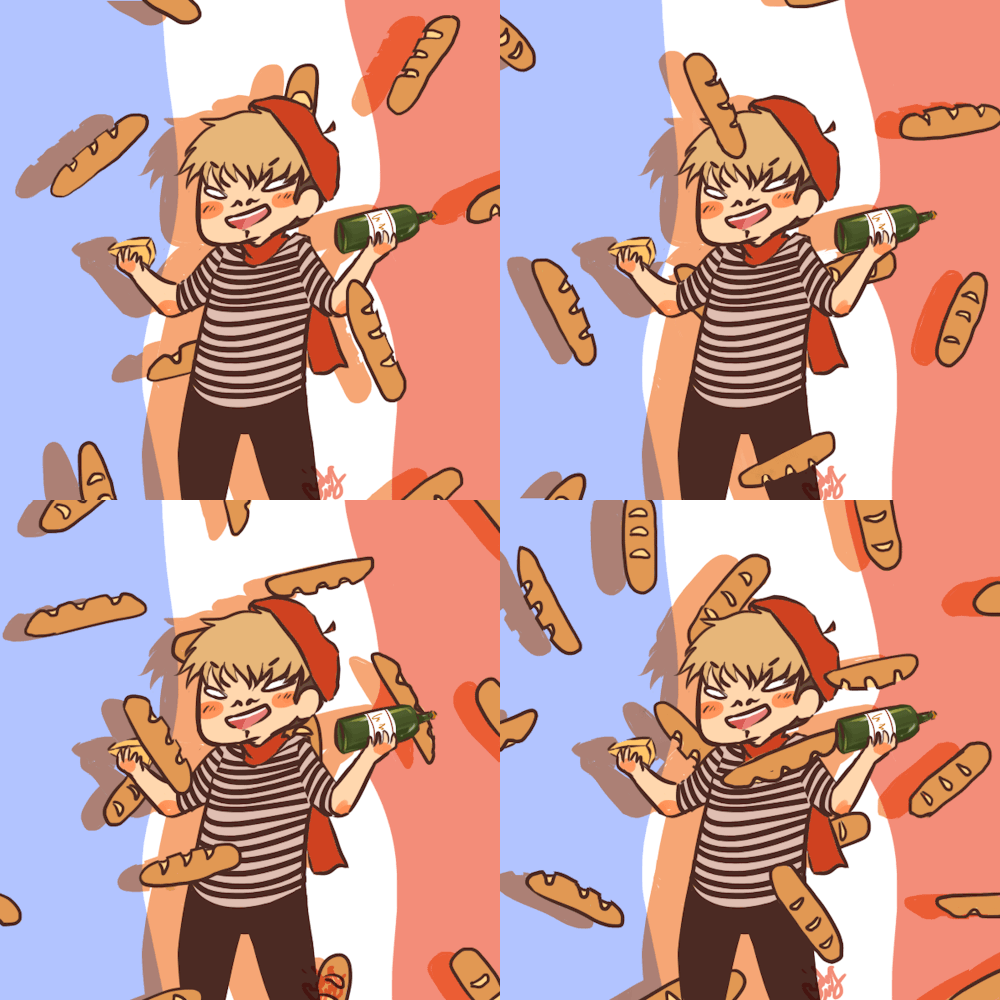
This was the most French gif I could find.

Kat: Hi Rachel, thanks again for being willing to share your research with me and our readers. Before I dive into the questions I have from reading your draft, can I ask, what drew you to this area of study?

Brown: I came to the project out of a love of all things food and all things France. On one of my many visits, I noticed that how and what the Muslim community in France ate was a point of interest for media, politics, and everyday conversation on the street between friends and neighbours. There was clearly a subject to be addressed. I figured if I was going to be in the field for a year I might as well be somewhere I love and studying something I am passionate about, and so I set out to study the topic of food and religion. As I got further and further into the topic I realized just how essential food practice is to identity, especially religious identity and my research has grown exponentially ever since. The importance of food in religious identity negotiation for immigrants can be seen across a variety of locations and traditions.

Kat: I’m also curious about the technical side of things. Did you intentionally limit your case studies to individuals from the Maghreb? If yes, then why? Also, how did you go about arranging these interviews, or even making these connections in the first place?

Brown: I definitely limited my study to individuals from the Maghreb. I did this because the largest Muslim community in both France and Quebec comes from the countries of the Maghreb. This is not only because of proximity, of the Maghreb to France, but also because of a colonial history between France and the countries of the Maghreb. When one thinks of Muslims in France, this is most often the community that comes to mind.

In terms of arranging the interviews, this was a tough process. I started by going to the Grand Mosque of Paris and just getting to know people there. I had to build up trust, and spent many hours just helping out at the mosque in order to show that I was not a journalist (a profession folks are very hesitant of in France) and that I meant well with my research. After people got to know me, some started to agree to do personal interviews with me. Once I conducted the first interviews the people I interviewed then put me in contact with friends or family members to interview. So I followed a snowball methodology. It was not easy to get people to talk to me, but because my topic is such an approachable one (who doesn’t want to talk about food?), it made it a little bit easier to get people to agree to interviews. Having the personal connection, and a validation from friends or family members that had already done the interview was also key. Continue reading

BURAAQ: Two Brothers, A Superhero, And the Truth About Islam

adilkamil

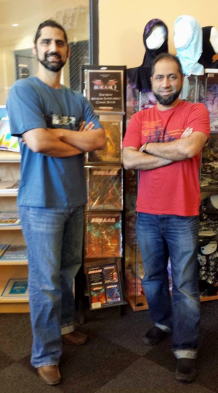
Kamil and Adil Imtiaz.

This past Saturday I had the opportunity to connect with Adil Imtiaz, one half of the two sibling team responsible for the comic book BURAAQ, which stars a Muslim superhero. While he was the illustrator starting out he shared, and continues to share, creative responsibilities with his brother Kamil, and was more than happy to talk to me a little bit more about how this project came to be and why.

Ms. Marvel, as you may have guessed, came up in conversation, and I ended up learning a few things about Islam that I didn’t originally know.
Throughout our talk it was clear that this character and all he presents is a passion for Adil, and that he believes it can, and has done, good things for Muslim youth.

After thanking him for finding the time to speak with me about his work we got right down to questions and answers, the latter of which he was very ready to provide.

Evan: Now I can’t wait to get into talking about BURAAQ, but before we get there would you like to say a few words about yourself?

Adil: Adil Imtiaz is my name. I’m an IT professional, just so you know. And I came here from Pakistan back in 1990; me and my  brother and my family. So we’re here with our families and that’s pretty much it as far as my background is concerned.

Evan: Would you say that your interest in comic books began at a very young age?

Adil: Absolutely. Even in Pakistan as kids, my brother and I used to have a stack of comic books by our bedside. Every night we used to read Marvel, DC, superhero stories. We were, and still are, fascinated with sci-fi and superhero stories and characters.

And movies, of course. Hollywood as you can see is all about superhero films. And we used to draw comics and superhero characters as kids. I got sidetracked when I had to focus on higher education, pursuing a career. I had to put it on the back burner so to speak.
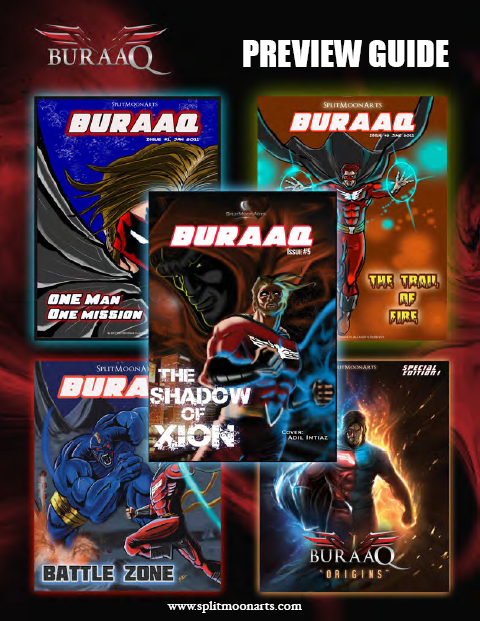
buraaqpreview

Evan: In the PDF I was given to review you and your brother’s mission was very clearly stated, and I’m just going to reiterate it for all my readers:

  • To provide a clean, fun (halal) and positive entertainment media alternative for our Muslim youth.
  • Reconnect our Muslim youth to Islam and make them feel proud to be a Muslim.
  • Enable interfaith dialogue and increase positive Islamic awareness.
  • Our principles are based on the Quran, Islamic values, and the teaching of the Prophet Muhammad (PBUH).

How long this been in the works? It seems particularly relevant now given recent events in North Carolina [with what I’m going to call a hate crime]-

Adil: Well, no, actually. This is something, the idea was born back in 2009 actually. Especially after 9/11 things changed in the US. And in the media, traditionally, Arabs and Muslims have been portrayed in a negative light in Hollywood, but after 9/11 things really picked up steam; a bunch of crazy people around the world who claim to be Muslims and other agencies at play, not to get into politics…

Sammy Sheik as Mustafa in American Sniper.

Continue reading

Clarifying Charlie Hebdo

Let’s face it- there’s no way to avoid this topic. At this point, I don’t know that there’s anything I can say that hasn’t already been said in the past few days. What I’d like to do, if I can’t offer anything new, is at least offer some clarity. Here are the facts, folks:

On the 7th of this month Sayeed and Shareef Kouachi attacked satirical magazine Charlie Hebdo for running cartoons deemed “insulting to Islam”. The Kouachi brothers, armed with AK-47s, a shotgun, and a grenade launcher, killed 12 individuals- most of them magazine staff and cartoonists- in addition to wounding several others. Two days later the Kouachis would be killed by French police after a protracted siege in a warehouse. Other suspects involved in the attack are currently being hunted down.

Since the 7th, we’ve seen an outpouring of indignant outrage over the killings, as well as solidarity marches, both for France and for freedom of speech. Despite the near universal solidarity behind Charlie Hebdo, a myriad of differing conclusions have been voiced in the past few days- some good, some bad, and many missing the point entirely (in spite of genuinely good intentions). Let me try to address a few of these below.

Not All Muslims Are Terrorists/Not All Terrorists Are Muslim

…But I shouldn’t have to tell you that.

At this point, parroting that line is starting to feel almost patronizing. It’s an obvious truth, and it shouldn’t need me to defend it. There are millions upon millions of Muslims in the world, the vast majority of whom want nothing more than to live their lives in peace- among them, Ahmed Merabet, a police officer and the first of the Kouachis victims. Whether the infamous 9/11 attacks (in which American Muslim Mohammad Hamdani died attempting to rescue people from the North Tower) or the thousands of Muslim Arabs and Kurds fighting against ISIS in Syria and Iraq, Muslims shouldn’t have to be “rescued”. From Abdul Haji to Aitazaz Hassan Bangash to Malala Yousafzai– there are just as many heroic actions from Muslims as their are heinous ones.

But this is, again, obvious to anyone actually interested. I don’t know that there’s anybody out there who hasn’t already made up their mind about it (for better or for worse). Continue reading