Author Archives: Kat

Librarian Book Smack: A Culture War Report

The other night my roommate convinced me to join her at our regional library’s “Book Smack” event. At first I was concerned that it would be a tedious affair. After all, why would you want to talk about a book when you could just go ahead and read it? However, the event page promised that the librarians would “let their hair down, take off their glasses and speed review their favourite books” and that it would be “fast, furious and fun” night, so with the image of wild librarians in mind, I decided to go along.

When we arrived at the venue, I wasn’t overly surprised to see that the audience was primarily older women. The featured librarians were also all women, although only two of them sported silver-white hair.

Before the event started the MC set some ground rules. Each librarian would have a certain amount of time to convince the audience to read/watch/listen to a few of their favourite books/movies/audiobooks/CDs. In the first round each librarian was given five minutes, then three, then only one, to review their books. During the intermission audience members would then vote for the librarian who they thought would would win the book smack. Then, for the second round, librarians were only given three minutes, then one minute, then only thirty seconds to defend their choices.

I’m not entirely sure what made this event as fantastic as it was. Maybe it was just the fun of seeing librarians mutter words like “full frontal” and “masturbation warning”. Perhaps it was the appeal of seeing a group of much older women giddy with laugher all around me. Most likely, it was the reminder of just how amazing books are, and how they can bring us together by inviting us into new worlds or allowing us to wrestle with our own struggles. Continue reading

Filmmaker Christine Welsh on Tracing Her Heritage in Women In the Shadows

My Canadian studies class recently watched Women in the Shadows, a documentary by feminist filmmaker and professor, Christine Welsh. Not long after we had watched her film Welsh agreed to visit our class for a question and answer period. Below I’ve included a little of what I learned from her film and her visit.

christine20qu27appelle20valley

1101331

Norbert Welsh’s oral history was recorded by Mary Weekes.

In an article detailing her documentary experience, Welsh explains that her interest had been sparked when her mother recovered a copy of The Last Buffalo Hunter, an oral history by her great grandfather, Norbert Welsh. In the film, however, Welsh attempts to recover more information about her great grandmothers, figures who were much harder to trace.

Along her search, Welsh discovers the name of her great grandmother, Margaret Taylor, and Margaret’s mother, Jane. Welsh surmises that Jane was most likely Cree. Jane’s union with George Taylor meant that Margaret was one of the first generations of Metis women. While documentation about women was lacking during early colonization, Welsh was able to uncover some details about her foremothers because of Margaret Taylor’s connection to Hudson’s Bay Company Governor George Simpson.

In the early period of Canadian colonization, Hudson’s Bay employees often took “country wives”. These women, of First Nations or Metis heritage, would create family ties between the explorers and the local community and were often the reason their husbands survived their first few Canadian winters. In Women in the Shadows, Welsh discovers that Taylor had been Simpson’s “country wife” for many years, only to be cast aside by Simpson when he returned from a trip to England with a new white wife.

Continue reading

“Hymn for the Weekend”: Appreciation, Appropriation, and the Exotic Black Woman

I don’t know about you, but I can’t stop listening to “Hymn for the Weekend” on repeat.

However, before I had even listened to Chris Martin and Queen Bey meld their voices in a divine mesh of harmonies, I was reading about it on Tumblr.

Cultural Appreciation vs. Appropriation

The first thing I heard about the video was that it had some pretty rampant cultural appropriation. Since there have been a number of music videos and performances accused of cultural appropriation over the last few years, I wasn’t too surprised to hear about “Hymn for the Weekend” being added to the list.

The video quickly split viewers into two groups, those who considered it cultural appropriation, and those who appreciated the video’s focus on Indian culture. The clip below highlights a few of the key elements that have been discussed and criticized.

This discussion is tricky for a variety of reasons. For example, there is a time and place when a white person can wear Indian clothing and accessories without coming off as disrespectful. In some cases, it’s actually much more respectful to embrace local dress customs than to ignore them.

There are even music videos where diverse customs and styles have been featured without any backlash about appropriation.

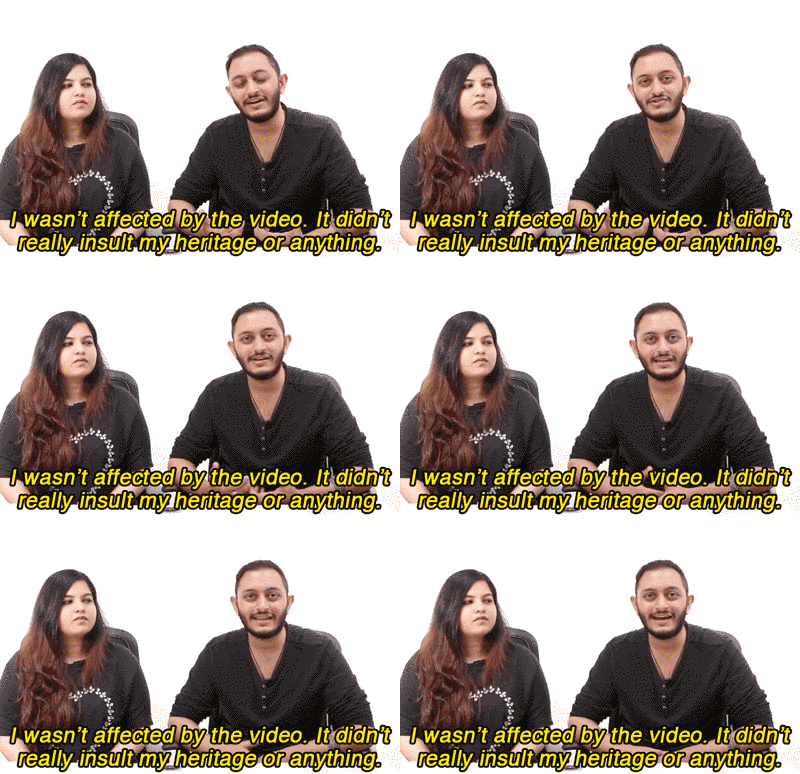
This debate can also seem confusing when Indian fans, or fans with Indian heritage, don’t seem to be bothered by the video’s representation of their culture.

anigif_optimized-20745-1454418987-1 Continue reading

The Remnants of Colonization in La Loche: What Factors Lead to Tragedy?

On January 22nd, a 17-year-old student killed four individuals in La Loche, Saskatchewan.

8521289_1453768082-5629

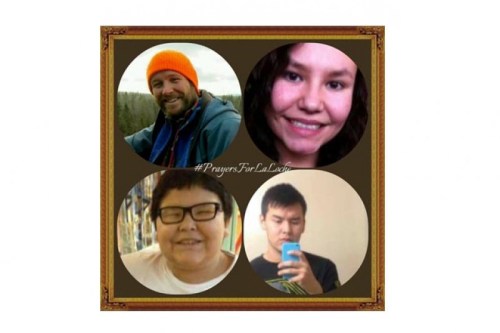
The four victims of the La Loche shooting, Adam Wood, Marie Janvier, and Dayne and Drayden Fontaine.

When I first heard about this heartbreaking tragedy I was shocked. Since then, I’ve been reading more and more about the town of La Loche in order to better understand the context of what happened. Below I’ve shared some of what I’ve learned about the situation this small Northern town has faced.

1. Rural isolation

Canada has become an urban nation, so the city is where most of our jobs and resources are.

figure1_e

In some ways the popular Canadian cliche of a “vast, empty wilderness” is still true today. Just like the “discovery” of Canada – when a country filled with many different nations was considered “empty” by explorers – today Canadians still consider the jobless pockets of Northern Canada “empty”.

While settler-Canadians have congregated primarily in the region of Canada closest to the American border, First Nations peoples still tend to be the majority in Northern rural areas. In La Loche, for example, more than 2,400 of the 2,600 community members identify as First Nations or Metis.

However, these communities have changed considerably since “the discovery” of Canada. Generations of First Nations peoples were forced to give up their cultural practices during their time in the Residential school system, which lasted from the 1870s all the way into the 1990s. They also gave up huge portions of land to white settlers. Not as a gift, but in an exchange drafted out in treaties that the Canadian government has yet to honour.

First Nations communities continue to survive, despite the loss of many traditional practices and lands. While these communities struggle to overcome their isolation, many settler-Canadians continue to ask why they don’t move south to find more jobs and a “better lifestyle”. In her article responding to this question, Susanna Kelley argues that many rural reserve members are forced to give up their land and community support if they want to find employment and education.

“First of all, the overwhelming majority of [rural] reserve residents have not completed high school and have no place to work once they hit the urban south. And many fly in reserves don’t have high schools.  Would you like to send your 13-year-old to live 70 km. away for months at a time?

Many who do come to the cities end up in the sex and drug trade.  They simply are unqualified to make a living other ways…

Which is why many [First Nations] people stay where they are, close to family and their community.

But what most Canadians don’t know is that our nation is legally bound to provide housing, health care and education to [First Nations people] who live on reserves.

The federal government isn’t just doing it out of the goodness of its heart.

The obligation comes from legally binding agreements made by treaty many years ago.”

Continue reading

What the Modern Sitcom Says about Millennials, Our Fears, and Our Obsession with Love

The Mindy Project, New Girl, Crazy Ex-Girlfriend, Man Seeking Woman, and How I Met Your Mother.

What do all those shows have in common?

Well, for one, they all feature a millennial as their main protagonist. This protagonist is also single. In fact, most of them even kick off their pilot with a break-up of some sort.

tumblr_nzs57cvbas1r9a32bo1_1280

This introductory break-up signals that love is going to be the end goal of the series. Of course there will be other ambitions and goals to meet along the way- especially for female protagonists (apparently women still have to prove that marriage isn’t our only goal in life)- but each of these comedies revolves around a quirky protagonist’s struggle to find a partner.

The “searching for love” trope has become even more common in contemporary sitcoms than the “quirky but loveable family” trope that was so common when we were kids.

p183957_b_v8_ahmv5bmti4mdqzodm0nv5bml5banbnxkftztcwnzgxndq0mq-_v1_sy317_cr70214317_al_16962053_140x187

Even just by comparing hit TV shows, I think it’s safe to say that we Millennials tend to struggle with different issues than our parents did at our age.  After all, what is a sitcom for but to mock our deepest fears and help us laugh at ourselves?

Having binge watched most of The Mindy Project, New Girl, Crazy Ex-Girlfriend, Man Seeking Woman, and How I Met Your Mother, I’ve noticed a couple of common themes running through these shows.  

1. Women worry that they’ve been too successful, while men worry that they haven’t been successful enough

Mindy (The Mindy Project) is a OB/GYN, Jess (New Girl) is a school principal, Rebecca (Crazy Ex-Girlfriend) is a lawyer, and even Liz (sister of main character Josh in Man Seeking Woman) is a lawyer. When all of these women find themselves unexpectedly single, they are introduced to a kind of panic none of the male protagonists are forced to face: will I be too old to have kids by the time I find someone?

In contrast, Nick (New Girl) and Greg (Crazy Ex-Girlfriend) are bartenders, Josh (Man Seeking Woman) is a temp, Josh (Crazy Ex-Girlfriend) works at a “laid-back” tech store, and even Mindy has dated the occasional DJ.

tumblr_n5w9q36bqk1revk8bo1_500

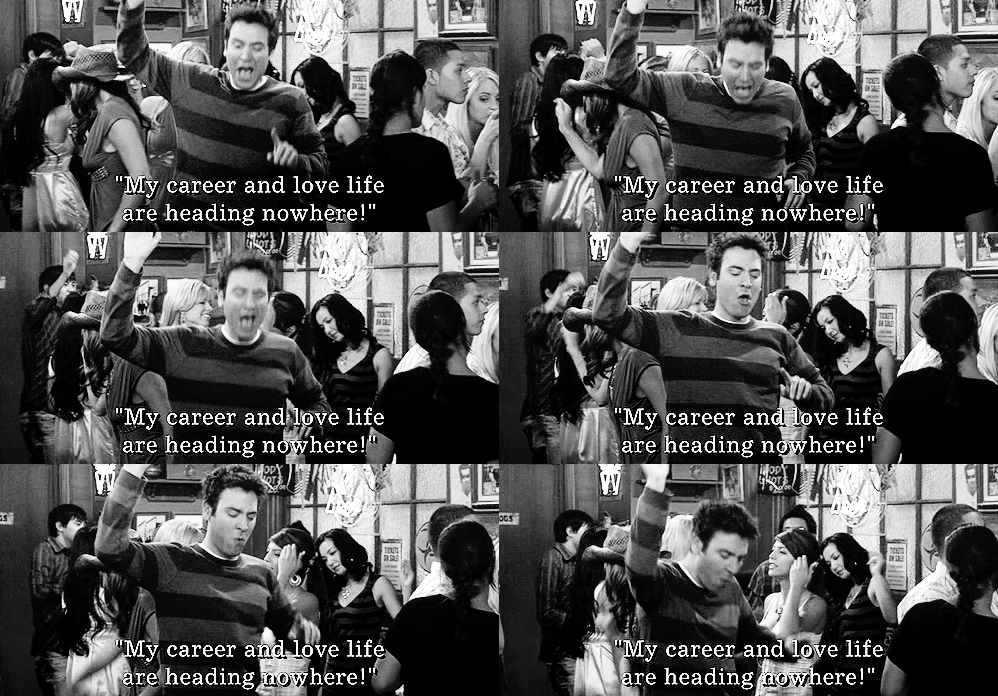
This is a bit of a red herring, since Ted did eventually become a pretty successful architect.

Continue reading

In The Force Awakens White Women get Representation, but Black Women get CGI

I loved Star Wars: The Force Awakens. I loved it so much that the first thing I thought about doing when I walked out of the theatre was hash out everything that this Star Wars reboot had done right.

Like including legitimately humorous dialogue rather than slapstick CGI sidekicks.

Unfortunately, everyone on the blogosphere had already come to the same conclusion long before I was back from my Christmas break. Still, I couldn’t stop thinking about the film, or reading articles about it. So I’ve decided to write about one of the few things that bothered me about the film, rather than many aspects of the film that I loved.

If you’ve been reading this blog for some time, you probably already know that we at CWR were excited to hear about the diversity of casting in The Force Awakens.

I was especially excited when I heard that Lupita Nyong’o had been cast. Ever since she won best supporting actress for 12 Years a Slave and was declared the most beautiful person of 2014 by People magazine, I’ve been keeping my eyes peeled for Nyong’o. After witnessing her sudden rise to fame, I was curious to see if she would continue to find roles in major films, or if she would slowly be pushed out of Hollywood because of her dark skin. As Gregg Kilday explains in his article about Nyong’o, few black actresses have ever managed to secure a spot as a permanent Hollywood heavyweight:

While the stage would appear to be set for [Nyong’o] to ascend to the A-list — just as Jennifer Lawrence did after her best actress win for Silver Linings Playbook last year — it’s not that simple. For while there have been a handful of African-American actors, from Sidney Poitier to Eddie MurphyDenzel Washington and Will Smith, who have reached that status, there’s never been a black actress who has become the equivalent of a Julia Roberts or Angelina Jolie. Whoopi Goldberg came closest, following her best actress Oscar nomination for 1985’s The Color Purple and supporting actress win for 1990’s Ghost, but despite an occasional hit like 1992’s Sister Act, she didn’t maintain that momentum. Hollywood also flirted with Angela Bassett, Thandie Newton, Halle Berry and, most recently, Mandela‘s Naomie Harris, without ushering any of them into its very top tier.

It seems like a habit for major blockbuster films to tick off their diversity checklist by casting a white woman and/or a black man. Meanwhile, actors from other minority groups, especially women of colour, get overlooked because all the non-white, male roles have already been taken. As Evan pointed out in his post about the Martian and racebending, this seems to be the impulse, even when it means casting a white women to play a Korean- American character and a black man to play an Asian- Indian character. Continue reading