Author Archives: Evan

Shame Day: Video Game Companies

eaeaI am a dude who loves video games. I’ve played so much Team Fortress 2 in the past few weeks that it’s essentially become a ritual for me, something to do while and after I eat dinner. What I don’t always love are the business practices these  companies  engage in.

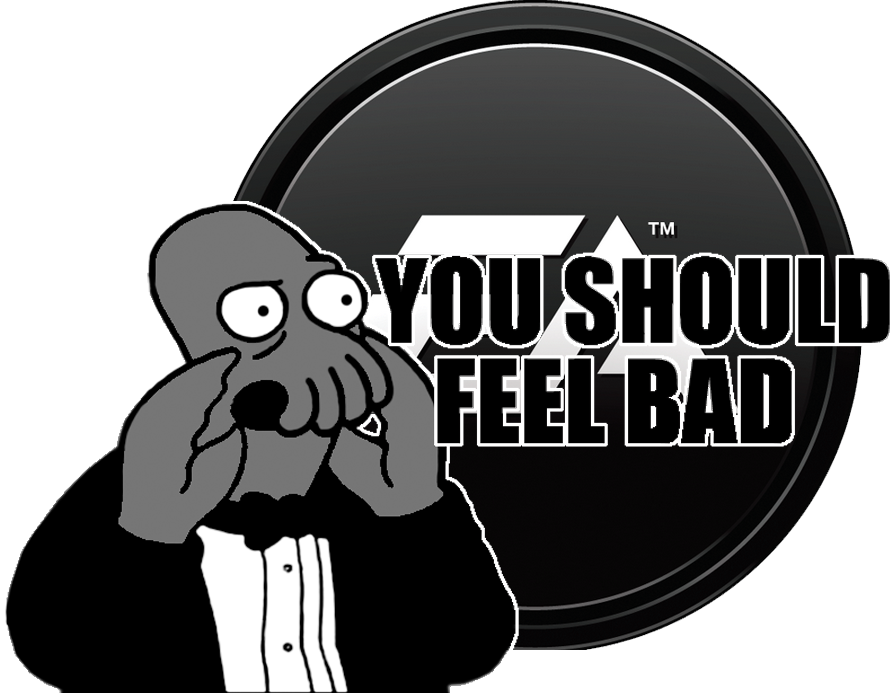
The image I Photoshop’d together depicts the EA [Electronic Arts] logo because they’re a company that I’m positive some of the blame lies with when it comes to generally being horrible to its employees.

I was turned onto this flagrant abuse of humanity through a webcomic Scott Kurtz [of PvP] and Mike Krahulik and Jerry Holkins [of Penny Arcade] put together. The comic, titled The Trenches, follows the life of a QA [quality assurance] guy whose name escapes me at the moment. The important part is that below the comic is a feature called Tales From The Trenches, which catalogues nightmare stories from those who toil within in the industry.

Below is one of my favourites, entitled “Weekend Funtimes.” My favourite not in that I enjoy reading it, but in that it encapsulates some of the horror of working  for large corporations:

We were about two months into “crunch” when they decided to up our hours AGAIN, taking us to over 80/week. The only available day to squeeze these extra hours in? Sunday!

I arrive at the building Sunday morning, only to find it locked—no other businesses had Sunday hours. I call my supervisor, who proceeds to fuss at me about interrupting his “family” time. My team had all arrived for work by that point, which just seemed to make him angrier. He tells me he is on his way and hangs up.

Flash forward ten minutes. We’re all still freezing (it was winter and -10 windchill) when we see his car come around the corner at the end of the block. He drives up the road, rolls his window down, and THROWS the office key at me—all without ever slowing down.

He calls me twenty minutes later to make sure we had gotten in, then informed me we would have to make up the time we had “wasted” waiting on him. He ended the call telling me to never interrupt his family time again.

That’s fairly despicable, and definitely up there among the worst of them. It was posted last month, and while it’s unknown when the event actually happened there is a date we can pinpoint: November 10th, 2004. The date that “EA: The Human Story” was posted to LiveJournal by user “EA Spouse.”

The post is a thorough examination of EA’s policies, especially regarding the infamous “crunch time” that its employees have to go through as the game nears its impending launch. She writes with a genuine, heartfelt voice that stems from being the wife of an EA employee. This is definitely present in the penultimate paragraph of her piece:

If I could get EA CEO Larry Probst on the phone, there are a few things I would ask him. “What’s your salary?” would be merely a point of curiosity. The main thing I want to know is, Larry: you do realize what you’re doing to your people, right? And you do realize that they ARE people, with physical limits, emotional lives, and families, right? Voices and talents and senses of humor and all that? That when you keep our husbands and wives and children in the office for ninety hours a week, sending them home exhausted and numb and frustrated with their lives, it’s not just them you’re hurting, but everyone around them, everyone who loves them? When you make your profit calculations and your cost analyses, you know that a great measure of that cost is being paid in raw human dignity, right?

Better known by her blogging handle, little did Erin Hoffman know what sort of action her post would lead to. In part it resulted in the filing of three class action lawsuits against EA and the beginning of many changes within the industry. Her post inspired another entitled “Why Crunch Modes Doesn’t Work: Six Lessons” which garnered a fair amount of attention within the online community.

That being said, Tales From The Trenches continues on into 2013, and it’s undeniable that many are slaving away in gaming companies because they love the final product. Their devotion to video games means that they’re stuck in jobs where they’re treated poorly by anyone and everyone a rung above them on the corporate ladder. Yes, this can be said of many work environments, but few have the same number of young, eager individuals so passionate to take part in what they’ve enjoyed their entire lives.

So shame on EA, and shame on any and all video game companies that treat their employees like dirt. No one said starting a career was easy, but no one should have to toil away thanklessly for an abusive system, either.


2 Broke Girls, S2E15 “And the Psychic Shakedown”: A TV Review

2asdgawefa

Turns out 2 Broke Girls [and the other, better CBS sitcom] took some time off for some reason or another, so last week was a nice break for me. And now we’re back.

SURPRISE: Max and Caroline are in the diner! The latter complains about only getting $2 for her last tip, because it means that they don’t have enough money to buy supplies for their store. Before we move on, I’d like to point out that tips  and surviving on them to bolster a waiter’s/waitress’ meagre salary is great material for an entire episode [see the Ryan Reynolds film Waiting…]; it’s bizarre that this hasn’t come up sooner. Anyway, the girls steal their ingredients from the diner.

There’s also an exchange that occurs between the two that prompts a particular response from me [see gif on the right]:

Caroline: And we have to sneak all this stuff out. Han’s staying late to do inventory.

Max: Dammit, why does he always have to be so Asian?

Cue laugh track. Cue me wishing everyone involved in this show’s writing would die a slow, painful death. Then everyone conspires to help the girls steal from their employer and that’s the cold open for you.

Back in the shop Caroline has found a site where the two can apply for a small business grant. Why they need the money, I don’t know; the last episode ended with them at $4900. Since they’re technically minorities [“according to the last presidential election”] all they need is a letter of recommendation from another start-up business.  Enter Candy Andy, Caroline’s dreaded ex.

Exit Candy Andy, Caroline’s dreaded ex. Apparently he just up and left, unbeknownst to either of the girls. Middle Eastern guy Amir [played by Amir Talai] braves Max’s onslaught of racism to tell them that he helped Andy move out in the middle of the night. He also dishes out just about as much as he takes, which is nice but still not ideal.

Seven minutes in and the premise of our episode shows up in the form of a pushy psychic who talks Caroline into spending $50 on a reading [that she will die alone] and crystal “you can’t snort.” One midnight talk between the girls later and they’ve come to get their money back. Max’s snark causes the psychic to point a fork at them and say “psst”; this means they are now cursed.

As sitcom law would dictate, Max doesn’t believe in the curse while Caroline insists they pay the woman another $50 to nix their bad juju. Then a man jumps out of a window and smacks the pavement near where they’re standing.

Earlier on in the episode Han refuses to sign Caroline’s pre-written note of recommendation due to having morals, a decision Earl negates by just forging his signature as part of a vast conspiracy by all to work for the man but not respect him in the least. Han writes his own letter since he is a decent guy, which reads as saying that Caroline will die alone because she loves business.

After Jennifer Coolidge [Sophie] hams it up like crazy after hearing they’re cursed and Max breaks the glass shelf with all the booze, the girls are back at the psychic’s place. Two “pssts” and the curse is lifted. She does decide to give Max a free reading, though, and it is as follows: a happy life, over $10,000 in her near future [the grant!], and great love and children. Caroline will still die alone, but “with nothing but her great success.”

She’s pretty thrilled about this until they see a mailbox being unbolted from the sidewalk. The mailbox in which Caroline put their grant application. Oh well. It snows like the psychic predicted, though, so Caroline isn’t sure what’s up. The two agree that their readings are two parts of a whole [success + love] and that maybe things aren’t so bad after all. The end.

Since this is supposed to be a review and not just a play-by-play of the episode, let share a few thoughts. Thought #1: this episode was horrible. I do believe that much of the blame for this lies on the writing credit given to co-creator Michael Patrick King. This is probably also the reason for the excessive amount of racist and rape-related jokes this episode. Please remember that this is a man who is sort of a horrible person. For him edginess equates comedy, and it explains a lot of the terrible dialogue that was present.

Lastly, I mentioned in my last review that I’m not sure what the final tally is supposed to indicate anymore. Wikipedia dubs it “Final tally for cupcake business venture,” but shouldn’t it now read “Final tally from cupcake business venture”? The episode ends with them having been shysted out of $100 by the psychic, leaving them at $4800.

Stray Observations:

  • I would actually like to see a lot more of Amir in the future. He had great chemistry with both of the girls, and it takes a talented actor to rise above the material given [and targeted at] him.
  • The audience members cheering at Sophie’s entrance were barely audible, it’s like their hearts just aren’t into it anymore.
  • Max’s essentials: food and the penguin statue at the dollar store that says “Chill Out!”
  • 2 Broke Girls Cheesecake Menu: Pretty weak this time around. Caroline stuffs eggs into the front of her shirt. Sophie is dressed pretty provocatively as usual, but I feel that shouldn’t count anymore.

Blog News Blog News Blog News

This just in, Gordon has finally moved out his parents’ place! This means that, due to not having internet in his new digs, he will be absent from the blog for a little while.

If you wake up on Wednesday mornings expecting to dig into a little E&GT [Evan and Gordon Talk] like a new box of cereal, Gordon’s move can be likened to the following gif:

No cereal for you.

This just means that I’m going to be pulling double-duty for the next little while, doing a Shame Day and a 2 Broke Girls review today, as well as finding some way of filling in Wednesday’s post. And then Thursday and Friday after that.

Basically look forward to a lot of me.

Evan out.

More Writing On Sexual Standards

The dearth of creativity that went into titling this post aside, I thought I’d tackle yet another double standard that appears to exist in our culture. To begin with, let me refer you all to my primary example, Season 4 Episode 5 of Top Chef: Masters, “Holly Madison’s Pool Party.”

In this case, the background behind the show itself is pretty inconsequential: 12 award-winnings chefs compete against each other to raise money for charity, et cetera. On this season the chefs spent the vast majority of their time in Sin City [Las Vegas, aka where Gordon resides] and rubbed shoulders with quite a few celebrities. The superstar for this episode was Holly Madison, of Playboy’s “The Girls Next Door” fame, and their task was to cater her pool party.

Enter James Oseland, editor of Saveur and one of the show’s judges. At the party musclebound hunks abound, and after one is encouraged to sit next to the critic he somehow manages to ask “how are you guys gonna like, keep the, this thing [abs], going with, wha- all this food.” As he refers to the man’s midsection he gives it a few pats, prompting responses like the following [which I found on The A.V. Club, of course]:


And Larrybaby’s points are all incredibly valid. Thankfully the guys and girls who peruse the TV Club reviews weren’t the only ones to notice this, and celebrity chef website [yes, it is a real thing] The Braiser did a short bit on the episode. Oseland’s antics are described there as follows:

So, naturally, the daytime cocktails start flowing, the croque madames sizzle on the griddle, and James Oseland starts giddily stripping pool boys. Wait, what?! Yes, Saveur editor-slash-very esteemed and shmancy Top Chef: Masters judge James Oseland gets a little on the trashed side of tipsy at brunch and takes matters into his own hands when a cluster of bikini-clad women fail to get a pool boy to take his shirt off.

James marches right on over to the ripped hunk of manflesh (née “Warren”) and strips his shirt right off. And then he grabs another equally buff guy and steals his shirt, too! James Oseland is shameless, you guys.

Of course, the article then goes on to describe how they’d love Oseland to be their celebrity BFF, but we won’t go into that. The point I’m trying to make is that this man, who, yes, is a homosexual, acted in a way that was inappropriate. More than that, he wasn’t stopped but was actually encouraged by those around him with cheers.

I’m not saying that I dislike watching homosexual characters on television, or that they make me uncomfortable; far from it. Max is easily my favourite part of the sitcom Happy Endings, and his adventures in romance  are both engaging and hilarious. I’m still waiting [and I know I’m not the only one] for Raj on The Big Bang Theory to come out of the closet, and more and more I’m realizing that it really is just art imitating life. Living in Toronto I’m very aware that there’s a gay population  out there, and it just so happens that TV has finally gotten around to representing them.

What I don’t want to see is gay people, men or women, being handsy when they shouldn’t be. I don’t really appreciate it in heterosexuals, and the same extends to all other orientations. If James Oseland thinks a pool boy is cute that is fine. If he wants to touch him, that is also fine. If he touches him in front of others and without the permission of said pool boy, to flirt openly in a physical way, that is not fine. It’s kind of gross.

There’s not much more I can add to what larrybaby said, because he [or she, I don’t know] sums it all up really well. I’m not a homophobe by any means, but I’d like the world as a whole to keep people to the same standards. Let’s not cheer someone on when they paw at another person they’re attracted to. If we’re going to acknowledge homosexual urges and relationships as on par with heterosexual ones let’s treat them the same way.

I end with another comment highlighting the actions of both Oseland and his fellow critics [context: the hunks were asked about sit-ups, and one actually did push-ups for the critics’ benefit a little later]:

jmann

Evan and Gordon Talk: Why Christian Media Is So Bad

EVAN: The particular topic of discussion that comes to us today is more one that finds itself passed back and forth within Christian circles, and that is: “Why is Christian media so bad?”

GORDON: I think the problem is self-imposed by the religion (I use the term loosely) itself. We’re not talking about a lack of funding (we’ve got plenty of good low-budget films), or a lack of good directors (there’s plenty of decent talent out there), we’re talking about an issue that runs right down the core of it all.

“Christian” media can’t just be media- they have to drag in everything that goes with it.

EVAN: So basically what you’re saying, and we talked about this a little earlier, is that Christian media more often than not has an agenda, correct?

GORDON: I’d say plenty of it has an agenda, but no, I don’t think that’s the core issue-  there’s plenty of other preachy movies out there.

EVAN: So what are you saying, exactly?

GORDON: I’m saying that “Christians” can’t make good media because they won’t allow themselves to. Every protagonist has to fit the moral code to a tee, so that they wind up as either Aslan 2.0 or the epitome of Christian morality: John Smith, the middle class suburban, patriotic family man. Which is why I keep putting “Christian” in quotation marks.

We’re not talking about Catholic peasants in El Salvador or the East Orthodox Church in Ethiopia.

EVAN: Okay, I like that a lot, this idea that those creators of Christian media [and primarily I think we’re talking about films] box themselves in. They’re telling the same sorts of stories to who they perceive to be their audience [and they’re not wrong]: white suburban middle class families.

To sort of break this up a little, I actually saw a Christian film that was reasonably passable at some point last summer.

GORDON: Was it related in any way to Steve Taylor?

EVAN: Is that any way related to “End of the Spear”? It was not, if that’s what you’re referring to.

GORDON: Steve Taylor is the only good Christian musician who ever has or ever will have existed.

But anyway, what was the movie you saw?

EVAN: It was called “To Save a Life,” and it stood out for a couple of reasons:

1) The cinematography was shockingly good for something produced and made by Christians. You can tell which movies they are within the first few seconds.

2) The “villain” of the piece was actually the pastor’s kid. Which was- refreshing, and kind of nice.

It kind of broke out of the whole stereotype you introduced earlier.

GORDON: Huh- interesting. I’ll have to check out the trailer. But let me ask you this:

Can a Christian make a James Bond movie?

EVAN: You mean a movie starring a suave, debonair British man who beds women and guns down henchmen as naturally as he dons his suit jacket every morning?

I’d say no, probably not.

GORDON: I think that’s the problem. It’s not just that you can’t have any explicit sex or graphic violence or excessive profanity (which are overused and abused as is), you can’t have anything even remotely sensual or rough or crude. It rips away reality and humanity in the name of not stepping on anyone’s toes.

Self-imposed legalism.

EVAN: Well, I’d say the difference is that you can’t have a protagonist who glorifies such things as wanton sexuality-

I say that Christian filmmakers will never produce anything like James Bond because of who the character is.

GORDON: Did you like the movie “Fight Club”?

EVAN: I liked it a fair amount.

GORDON: Did you like “Ocean’s 11” or “Snatch”?

EVAN: I haven’t seen the latter, but I very much enjoyed the former.

GORDON: Did you like “Superbad”? “Kick-Ass”? “Ironclad”?

EVAN: I enjoyed aspects of the first, thought the second was a shaky, though fairly decent adaptation of the source material, and thought the third was pretty unfair in its depiction of “strong female characters.”

But I think you’re going to have to get to your point-

GORDON: Could a Christian make any of these movies?

EVAN: I think a Christian could, yes. In relation to “Fight Club”, at least, Christian author Ted Dekker has penned novels [sold both in and out of Christian bookstores] which offer a fairly decent psychological thriller aspect to the reader.

GORDON: Ah, Dekker. The whole reason he stands out as an exception is- I believe- that he grew up among Indonesian headhunters, and not in Middle America. Again, it’s about having that different perspective on life.

EVAN: And I think what he’s realized, as a creator of the arts, as someone who has a hand in shaping Christian media, is that you can have these other sorts of exciting, thrilling stories told with a faith-built worldview. People of every religion want a little excitement.

GORDON: Of that there’s no question. The heavy use of the video library at our school stands in testament to that.

But again I think the issue is that “Christian” self-imposed isolation inevitably leads to the vast majority of their work winding up as “White People Problems” or “Chronicles-of-Narnia-minus-the-good-stuff”…

EVAN: Or “Lord-of-the-Rings-but-way-more-heavy-handed.”

GORDON: Exactly.

EVAN: I mean, we’ve talked a little bit about why Christian media can be bad [terrible production values, cookie-cutter story lines, sheer absurdity], but how could it be better [to harken back a little to our last talk]?

GORDON: They have to stop being terrified of the big bad world. They have to realize they can show characters with flaws- real flaws- not drunkard stereotypes and the occasional swear word.

Saying this will get you expelled from Liberty, Pensacola, and BJU

EVAN: I mean, a deeply flawed person who finds redemption is a much more compelling story than a white bread sort of guy with his middle class problems.

And they have to stop coddling their audience. Yes, Christians turn to Christian media for “better alternatives,” but the odd cuss word won’t negate an overall positive message; neither will a fight scene, or two guys sitting around enjoying a beer.

GORDON: There’s this one scene in a (Christian) movie Steve Taylor directed:

A character hurts his hand loading something into the back of van. He lets loose a cuss word and his buddy chides him for it, saying “God don’t like it when we cuss.”

Later on in the film, the buddy hangs his head and apologizes, saying “I’m sorry. I was upset that you cussed- I should’ve just been upset that you hurt your hand.”

EVAN: Wow. That is very, very good.

GORDON: That right there is the problem not just with Christian media, but with the whole religion.

EVAN: Misplaced priorities.

GORDON: More obsessed with present clean-cut paragons of middle class etiquette than anything really real.

That’s why we turn to “secular” movies for actual substance. The struggle for identity in “Fight Club”, the heroism in “Kick-Ass”, the friendship in “Superbad.”

EVAN: I think what’s really ironic is that Christian media-makers have a Christian-made work out there that’s immensely popular. “The Hobbit: An Unexpected Journey” came out just this past December.

GORDON: I again reference an (alleged) quote by Steve Taylor.

“I’m not a Christian artist- I’m an artist who is Christian- it affects what I do.”

EVAN: Really well-put. And something that a lot of us [I speak for many in our graduating class] as writers, musicians, artists, et cetera would benefit from keeping in mind.

And that puts us more than a little overtime.

GORDON: Well, people, you know what that means. Time to vote on our subject for next week.

EVAN: My contribution this time around is . . . wow, I never think ahead . . . masculinity. You’ve done a post about “Manly Culture” in the past, but I want to talk about what it is at present, and how we feel about the shifts and trends and things.

GORDON: Interesting subject. I submit we speculate on the upcoming Star Wars movies.

EVAN: If you think you’re up for it, then yeah, cool. I’ve read quite a few of the post-original-trilogy books, so I know a reasonable amount about the subject.

GORDON: Nerd.

And with that witty response, we’re out! Have a good night, everyone.

EVAN: Spend it with better friends than Gordon.

Shame Day: Glee

shame gleeTo begin with, I’m not a huge fan of Glee. I am a man who can say with confidence how much he loves musicals and acapella arrangements, but the show’s claim to be a melting pot of diversity [a place where Black people, Asians, homosexuals, and the disabled can belt it out to their hearts’ content] is not one I find myself agreeing with. But that’s the topic of another post.

Last week internet sweetheart Jonathan Coulton, known first and foremost for being the composer of “Still Alive”, the song that plays at the end of the game Portal, wrote a blog post in response to last Thursday’s episode of Glee. Specifically, the post was in response to their cover of “Baby Got Back” by Sir-Mix-A-Lot, which you can listen to here:


The issue being that Coulton released his own version of the song in 2006, which you can check out [and should, for comparison’s sake] here:


If you really want to scrutinize the two side by side, there’s a track on Soundcloud that simply places both tracks on top of one another [and an in-depth audio analysis, for those of you into that]. Coulton’s issue isn’t simply that Glee seems to have stolen his arrangement, but did so to the point where unique elements he added were copied as well. A duck quack is used to censor an expletive, and [this is practically impossible to ignore] the lyric “Mix-a-Lot’s in trouble” is replaced with “Johnny C’s in trouble” in both versions.

As he has kept the blog post constantly updated, four days ago he announced that having gotten in touch with the people at Glee, the following information was relayed to him:

They also got in touch with my peeps to basically say that they’re within their legal rights to do this, and that I should be happy for the exposure (even though they do not credit me, and have not even publicly acknowledged that it’s my version – so you know, it’s kind of SECRET exposure). While they appear not to be legally obligated to do any of these things, they did not apologize, offer to credit me, or offer to pay me, and indicated that this was their general policy in regards to covers of covers.

While Coulton is unsure of his exact copyright claim to the track, he had obtained a Harry Fox license to release it on an album alongside his own original music. His response is, refreshingly, a mature one in response to this whole ordeal.

He has re-released his track on iTunes under the new title “Baby Got Back (In the Style of Glee). “ Thanks to using the same license as before, Sir Mix-a-Lot will collect royalties, and all proceeds from the following month will go to charities The VH1 Save the Music Foundation and The It Gets Better Project.

This has, of course gotten its fair share of media attention. From a Facebook status by webcomic artist Rob DenBleyker to posts by Kotaku and The A.V. Club,  the internet appears to have rallied behind one of its own.

In his interview with Wired magazine Coulton shared a very simple solution for the show that spends millions per episode. He suggests that “they could offer to pay artists whose arrangements they use the same amount of money they would otherwise pay a musical arranger,” and that “if they opened with that, I’m sure a lot of artists would jump at the chance.”

Somehow, this isn’t the first time this has happened. Singer-songwriter Greg Laswell’s cover of a song made famous by Cyndi Lauper, “Girls Just Wanna Have Fun”, was also seemingly ripped off for an episode in November 2011. I’ve embedded the two songs for you to compare once again [and because I’ve gotta break up this wall of text somehow]:


Unfortunately, Laswell did not quite have the fan following that Jonathan Coulton does, and as a result this happened more or less without incident. The Hollywood Reporter did a short piece on it the month following, but from what I can tell it didn’t generate much controversy. Similarly, Petra Haden’s arrangement of “Don’t Stop Believin'” may have been appropriated without permission [i.e. stolen] by Glee as well.

It remains to be seen whether or not Coulton’s lawyers will be able to take legal recourse, but for the time being I’m happy that the show is finally being taken to task by those who believe that creativity should be rewarded and acknowledged, not plundered.