As most of you should know by now, I am a Canadian. And as a Canadian, I actually know very little about American gun control laws. Yes, I know about the Second Amendment and have been somewhat in the know about the encroaching legislation brought about, more or less, due to the tragedy that befell Sandy Hook Elementary.
Now I know what you’re thinking. “Dang, Evan, get to the point already. This doesn’t even have anything to do with comics, which are definitely your forte [and that you probably write about too much].” Well, dear reader, allow me to cut to the chase.
By cartoonist Jimmy Margulies. Also the image that Comics Alliance used, but hey, it’s perfect for the topic.
This morning Comics Alliance released an article titled “14 Editorial Cartoonists Make NRA Blacklist For ‘Endorsing Anti-Gun Positions.’” Its focus was a list that the NRA-ILA had put together of people and organizations who have been known to lend their “name and notoriety to anti-gun causes.” The reason they bring this to attention is that joining the National Black Nurses` Associationand actress Catherine Zeta Jones are 14 political cartoonists. Described as being “journalists [who] actively editorialize in favor of gun controls laws” they are as follows:
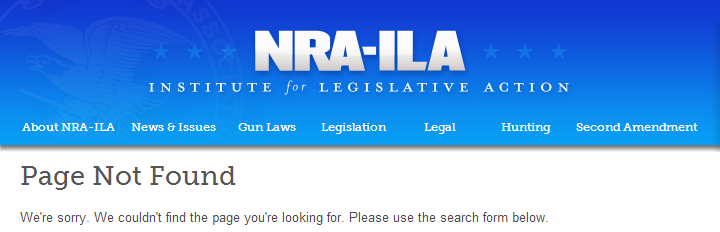
The links provided for each cartoonist were provided by the article on Comics Alliance, and are super useful. Unfortunately, the link they provided for the NRA-ILA’s blacklist was much less useful. The problem is that the link [which you can check here] does not work, by no means due to the fault of the comics news site. It turns out that whoever runs the site has since taken it down.
But wait, there’s more!
Luckily for me [and, consequently, you], Internet Archive exists. By taking the dead-end link and throwing it into their “Wayback Machine,” I was able to retrieve the list, available for your viewing pleasure:
Does anyone else find it disconcerting that a) an organization that is known for promoting the right to tote firearms has a blacklist of any kind, or b) that they’ve since taken down this page due to it receiving media attention?
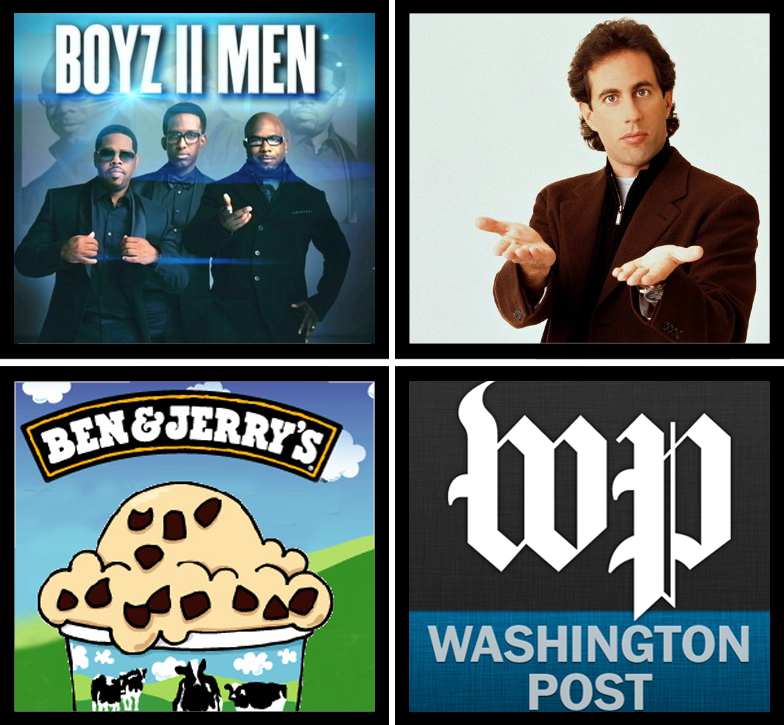
Since the NRA considers gun ownership to be a civil right they have dubbed themselves the “largest and oldest civil rights organization in the United States.” I’m not at all implying that there’s anything inherently menacing or threatening about their list, I’m questioning their transparency. If there’s nothing wrong with the list, then why take it down? Was it to hide the fact that there could exist a list so ridiculous that it lumps together R&B group Boyz II Men, actor Jerry Seinfeld, Ben & Jerry’s Homemade, Inc., and the Washington Post?
I’m not sure why it happened, but I’m letting you know that it did; what you do with this information is entirely up to you. It also has to do with comics on some level, which you know I can’t not write about.
Space marines. I can’t speak for most people, but when I hear those two words two very distinct images come to mind, which have thankfully been drawn together thanks to this image I found on dorkshelf.com:
On the left, a Terran Marine from the popular Blizzard RTS franchise [real time strategy game] StarCraft. On the right, an Imperium of Man Space Marine from the universe of Warhammer 40,000, by Games Workshop. Yes, the are both traditionally depicted as wearing blue armour. It’s fairly common knowledge that Blizzard owes a great visually creative debt to Games Workshop while still branching out on their own, but that’s not the point.
To quickly explain the legal nitty-gritty of all this, in the US Games Workshop owns a trademark on the term that covers “board games, parlor games, war games, hobby games, toy models and miniatures of buildings, scenery, figures, automobiles, vehicles, planes, trains and card games and paint, sold therewith.”
It turns out that in Europe they have a Class 16 trademark, which includes, among a whole slew of other things, “printed matter.” With that in hand Games Workshop brought their complaint to Amazon Kindle Publishing UK, which then caused Amazon Kindle Publishing US to block the e-book in all countries everywhere. A later update states that since the company has since delved into e-books themselves, they own the trademark in that respect as well.
I used to own a registered trademark. I understand the legal obligations of trademark holders to protect their IP. A Games Workshop trademark of the term “Adeptus Astartes” is completely understandable. But they’ve chosen instead to co-opt the legacy of science fiction writers who laid the groundwork for their success. Even more than I want to save Spots the Space Marine, I want someone to save all space marines for the genre I grew up reading. I want there to be a world where Heinlein and E.E. Smith’s space marines can live alongside mine and everyone else’s, and no one has the hubris to think that they can own a fundamental genre trope and deny it to everyone else.
Space marines have been part of the sci-fi cultural landscape for decades at this point, going as far back to Robert A. Heinlein’s 1959 novel Starship Troopers[later adapted into a film in 1997]. While Bungie’s Halo franchise concentrates on their Spartan supersoldiers, fighting alongside these technological titans are members of the UNSC [United Nations Space Command] Marine Corps. In Gears of War the protagonists are infantry soldiers known as Gears, clad in bulky armour and waging war against the same sorts of extraterrestrial terrors the aforementioned servicemen do.
Romeo and Juliet, Act II, Scene 2, lines 43-44:
What’s in a name? That which we call a rose
By any other word would smell as sweet.
Science fiction has long been about exploring what lies beyond the Earth’s gravitational pull, and where there is the unknown there often lies danger. To put together a military force similar to what exists here and now while using the same naming convention simply makes sense.
What Hogarth wants is for science fiction authors, video game creators, etc. to be able to continue use a term that was long made available to everyone. It’s like saying that Blizzard and WarCraft placing a trademark on a term like “paladin” or “shaman,” or Star Wars placing one on “bounty hunter.” Space marines should be free to defend humanity on Tarsonis, Sera, Reach, or Macragge, and go by that title if they wish.
Gordon’s absence has forced me to dedicate yet another Fame Day to a man in the comic book industry [a post on a woman is in the near future] to join the ranks of Anka, McDuffie, and Fraction.
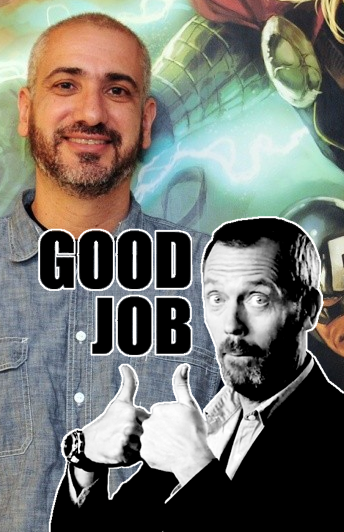
Introducing the Editor in Chief of Marvel Comics, Axel Alonso. Interviewed by FOX News Latino [which I didn’t even know was a thing], he was asked the question: “Is that a new initiative at Marvel Comics is doing? We’re going with the Latinos now?”
This question was in response to a few “new” characters appearing in the publisher’s titles, with Miss America being one of them. First featured in Marvel Mystery Comics #49 in November 1943, Miss America was originally another embodiment of the United States in World War II, a star-spangled powerhouse punching out Nazis. Now, in 2013, Miss America is the moniker for America Chavez, a Latina teenager and new member of the Young Avengers [one of Marvel’s bestselling new titles]. Also mentioned was the new Blatino Ultimate Spider-Man, who has already been covered on this site.
From left to right: Miss America Chavez, Miles Morales [Ultimate Spider-Man]
Alonso, a Mexican-American himself, replied:
“I’d be lying if I said I wasn’t motivated, on a personal level, to have Hispanic characters represented in comic books, but this isn’t some PC initiative, [this is] capitalism.”
He acknowledged that a growing range of people read comics, and that as a publishing company it is their “responsibility to make them feel included.” Going back to his comment about “capitalism,” the fact of the matter is that as a company it’s in their best interest to create a product that appeals to the fastest growing demographic in America.
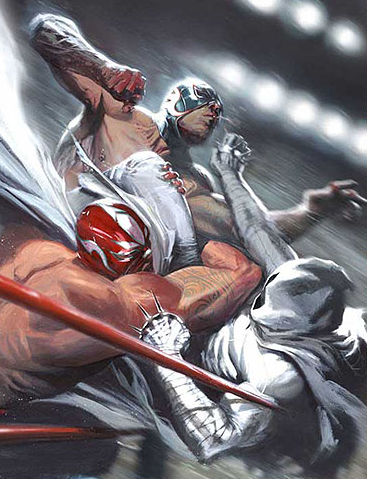
While Alonso agrees that comic books have not always treated minorities with due respect, he also acknowledges that stereotypes are more complex then they might first appear. He took part in helping to create Mexican heroes the Zapata Brothers, who were based on his cousins in Mexico. The two wear full luchador regalia, and while this may be perceived by some as racist, Alonso would argue otherwise. “Is that a little stereotypical?” he says, “Yeah, but it’s also fun and a part of our culture.” Growing up watching these wrestling matches growing up they struck him as being an important part of his culture.
When asked why Latino characters haven’t achieved the same status and notoriety of heroes like Batman and Wolverine, his response was “Why haven’t they become that yet?” His opinion is that, with America’s ever-shifting cultural landscape, it’s an inevitability. You can’t force an audience, or simply make a character big, it just evolves and happens naturally.
Unfortunately, fellow member of “The Big 2” DC declined to be interviewed for this piece. While Marvel has its fair share of seemingly racist characters [Mexican villain/anti-hero Armadillo] DC has a large mark of shame in Extraño, a “gay Latino magician who had HIV and referred to himself as ‘Auntie.’” That being said, it’s a shame that they didn’t offer a means of looking forward through heroes such as Blue Beetle [Jamie Reyes] and Vibe [Paco Ramone] who has his own new title.
Alonso is a man who realizes that comic books are a business, and one that needs to make money and that has an impact on its readers. His joy that Miles Morales exists as a character is in “knowing that there would be a child out there who would see Spider-Man peel back that mask to see a different face and a face that resembled their own.” He understands that, and that’s worth giving him credit for.
GORDON: Moved by your incessant letters, as well as tearful pleas from more than one head of state, yours truly has returned for this and only this installment of Evan and Gordon Talk
You’re welcome, America.
EVAN: Truly, you are too gracious. [Also, we cater to an international readership].
This week the two of us will be discussing men and manliness [or masculinity]. Which makes perfect sense since we are, after all, men.
GORDON: MANLY men. We once made an axe using nothing but things we found in the woods. On the very same day, we built a grave for a drowned beaver.
EVAN: He is not lying. But, moving forward, one of the reasons I brought up this topic is because it’s loaded with possibilities. There’s the idea of the, for lack of a better term, the “Barney Stinson,” the fratbro who watches Spike TV day in and day and out, and this recent ad that appeared in The Times of India due to the gang-rape and murder of a 23-year-old woman [click on the image to visit an article on it].
GORDON: Well, let’s narrow down some the of core qualities that make a man a man. Or at least, commonalities in all cultures and subcultures of what “manliness” is.
EVAN: How about- the ability to provide for one’s family.
GORDON: We’ll take it. Ability to defend oneself, with either words or deeds?
EVAN: I think we could expand that to simply being physically able. Physicality means both being able to defend oneself and loved ones as well as attack others for whatever reason you might have.
GORDON: Assertiveness- that’s it. Not taking guff from any of these swine.
EVAN: Who exactly “these swine” are aside, I’d also like to suggest that, in essentially every culture out there, manliness is directly associated with heterosexuality.
GORDON: The Spartans, actually, were unbelievably gay. Heck, the entire basis of western civilization is pretty gay. I want to strike that one from the record; highly sexual would probably be a better statement.
EVAN: I’m gonna have to stick by it. The majority of cultures out there use the term homosexual derogatorily, I think it’s hard to look past it.
GORDON: I guess I’ll allow it. Tough. A man is tough. Stoic. Potentially emotionless.
EVAN: That sounds pretty good to me. Want to total them up? Really just list ’em all out for us.
GORDON: [AND THEN GORDON LISTEN THEM ALL]
A man is tough.
A man provides for his family [loved ones].
A man doesn’t take **** from anyone.
A man gets it on.
Scratch that last one and you have the stereotype of a black woman.
EVAN: Okay, now rate yourself by that list of qualities.
GORDON: I realize that there are billions of people out there who have hellish existences, but taking in what I’ve dealt with in my own life, I’d say I’m pretty tough.
EVAN: You’re definitely pretty emotionless.
GORDON: I don’t have a family, but I certain provide for myself, proud proletarian that I am.
I’ve yet to be in a situation I’ve been unable to diffuse diplomatically, but I certainly have my limits and lines that I will not allow to be crossed.
And I view my sexuality as my own business. I ain’t exactly good with the ladies (see the emotionless bit), but I also think anyone who judges a man’s worth by his sexual activity isn’t worth the time of day anyhow (see the “no taking crap from anyone” bit).
Yeah, I’m a man. Or a woman. It kinda falls apart.
EVAN: A man is tough: I’m a pretty emotional dude. I distinctly remember crying after I saw A Walk To Remember. I was also 13, but I guess that’s neither here nor there.
A man provides for his family: Like you, I don’t have a family. I live with my granddad, though to be fair I do take care of him, so I’m good in that area.
A man don’t take none: I am not a confrontational person. I also can’t say I’ve been in a fight-or-flight situation, though, This remains to be seen, I guess.
A man get it on: Since I live by a certain religious standard, I have not yet gotten it on. See my post on virginity. I am a virgin.
A man don’t take none: I am not a confrontational person. I also can’t say I’ve been in a fight-or-flight situation, though, This remains to be seen, I guess.
So how do we stack up as men by most cultural standards?
GORDON: I think we stack up well, all things considered.
EVAN: Okay, I just remembered why I wanted to discuss this topic in the first place, and it pertains to the last manly attribute on our list [the one that we both happened to fail]:
Click on the image to read it in a new tab.
GORDON: . . .
How exactly does one respond to that?
EVAN: I’d say an ellipsis sums it up pretty well.
GORDON: Yeah, I’m going to call BS on that. I couldn’t begin to list the number of men who were celibate and achieved more in their lives than this guy ever will.
EVAN: Which I agree with completely. It is pretty messed up, though, how many people [guys] live by this rule of thumb.
GORDON: I think the point remains that this isn’t any reasonable way to spend one’s existence. Nikola Tesla accomplished more than a week than I imagine this guy fishing on Omegle will in his lifetime.
EVAN: To take a line from your book, touché.
GORDON: Going back to the original list, the issue is that most of this could just as easily be said of a woman. I work with people who are in pretty rough situations. Many of the women I work with a single mothers, living below the poverty line, struggling to provide for their families. Pride is really the only thing they have left. They don’t take crap from anyone, and they can’t allow themselves to be dragged down by their circumstances. Are they “manly” woman?
EVAN: I’d say that they fit three of the four categories, but it depends largely on how you want to view the word “tough.” I felt like we sort of defined it as having to do with emotions, which, and I don’t think I’m spouting insanity right now, are something that women seem to be pretty in touch with. Which would then put them at 2/4, or half the qualities.
GORDON: Certainly we can agree that these women quietly endure crap that would have most white-collar executives curled up in the shower weeping.
Barring the issue of promiscuity, everything we’ve covered would be- by our standards today and most standards the world over- “womanly” characteristics.
EVAN: Including the predilection towards physicality and violence towards others?
GORDON: You ever fought a woman?
EVAN: You know neither of us have ever fought anyone.
GORDON: Speak for yourself. I studied Judo for five years, and I had my share of matches against female opponents.
EVAN: We’re talking actual fights, though. Not martial arts matches with set rules and moves without the added chaos of scratching and biting [which I would probably carry out with gusto].
GORDON: Believe me, I got my butt handed to me plenty of times. There’s nothing but prejudice keeping women from being just as effective at fighting as men.
EVAN: Right, but that’s not a cultural expectation, is it?
GORDON: Not in this culture, no, but in other cultures this does exist. I’d point to the high numbers of women in the militaries of countries affected by leftist ideology- Nepal, for example
EVAN: We are talking the majority of cultures, though. Just as I don’t think I’d
equate homosexuality with “manliness” because the Spartans [who were very manly] engaged in it, I’m likewise not willing to accept that most societies placed women in that physically aggressive role.
GORDON: Point taken.
EVAN: But I get what you’re saying.
A number of the key qualities we defined as being “manly” are, in general, key qualities of being successful human beings.
GORDON: Exactly.
My entire issue with contemporary feminism is that it tries spin traditionally “feminine” (i.e. submissive, weak, emotional) traits as being equally as healthy- if not more so- than traditionally “masculine” traits rather than trying to divorce itself from the old “feminine” trait set entirely.
I like my women like I like my men: self-assured, tough, and independent. That probably didn’t come out quite the way I intended.
EVAN: Don’t worry, I took it at face value.
And, since we’ve successfully transitioned away from a discussion on masculinity towards more of one discussing feminism, I’m forced to admit that we are well past our time limit.
GORDON: That we can agree on.
Until we get internet, it’s radio silence on my end.
EVAN: So I suppose you’ll have to say good-bye to these nice people until then, while I scramble to maybe find a replacement writer for the next little while.
GORDON: For whenever I get back, I’d recommend that we talk about our generation’s greatest strength or victory, as we spoke a while ago about our generation’s greatest failing.
EVAN: And I am going to recommend . . . okay, this is ridiculous, but our ideal girl. Just because I know your answer is something everyone wants to read.
That is all for today, folks. I’d like to thank Gordon [who left before this conversation could end] for heading over to his grandparents’ and getting online for this, he’s a real champ. Thanks for reading!
I am a dude who loves video games. I’ve played so much Team Fortress 2 in the past few weeks that it’s essentially become a ritual for me, something to do while and after I eat dinner. What I don’t always love are the business practices these companies engage in.
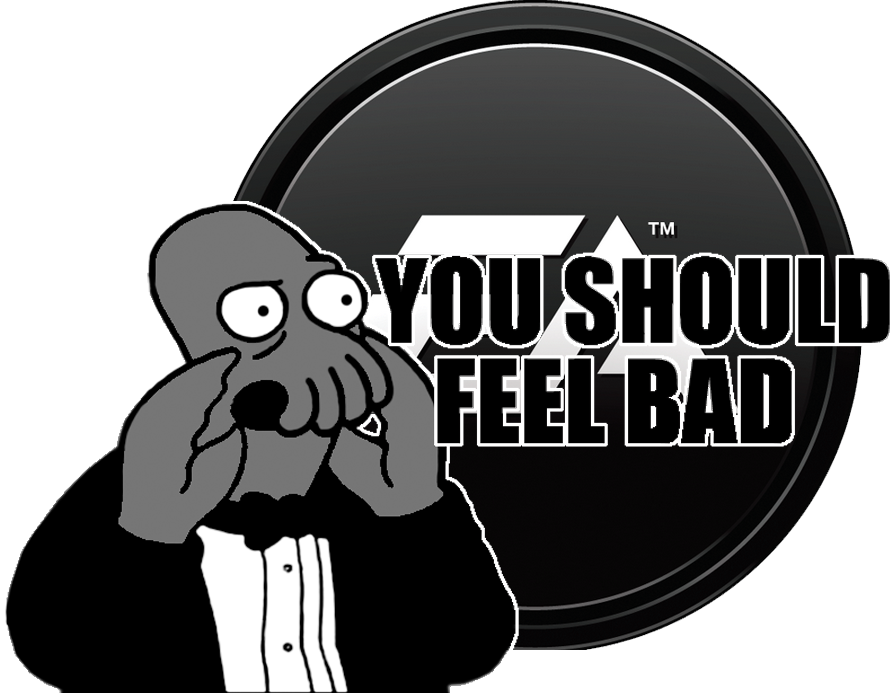
The image I Photoshop’d together depicts the EA [Electronic Arts] logo because they’re a company that I’m positive some of the blame lies with when it comes to generally being horrible to its employees.
I was turned onto this flagrant abuse of humanity through a webcomic Scott Kurtz [of PvP] and Mike Krahulik and Jerry Holkins [of Penny Arcade] put together. The comic, titled The Trenches, follows the life of a QA [quality assurance] guy whose name escapes me at the moment. The important part is that below the comic is a feature called Tales From The Trenches, which catalogues nightmare stories from those who toil within in the industry.
Below is one of my favourites, entitled “Weekend Funtimes.” My favourite not in that I enjoy reading it, but in that it encapsulates some of the horror of working for large corporations:
We were about two months into “crunch” when they decided to up our hours AGAIN, taking us to over 80/week. The only available day to squeeze these extra hours in? Sunday!
I arrive at the building Sunday morning, only to find it locked—no other businesses had Sunday hours. I call my supervisor, who proceeds to fuss at me about interrupting his “family” time. My team had all arrived for work by that point, which just seemed to make him angrier. He tells me he is on his way and hangs up.
Flash forward ten minutes. We’re all still freezing (it was winter and -10 windchill) when we see his car come around the corner at the end of the block. He drives up the road, rolls his window down, and THROWS the office key at me—all without ever slowing down.
He calls me twenty minutes later to make sure we had gotten in, then informed me we would have to make up the time we had “wasted” waiting on him. He ended the call telling me to never interrupt his family time again.
That’s fairly despicable, and definitely up there among the worst of them. It was posted last month, and while it’s unknown when the event actually happened there is a date we can pinpoint: November 10th, 2004. The date that “EA: The Human Story” was posted to LiveJournal by user “EA Spouse.”
The post is a thorough examination of EA’s policies, especially regarding the infamous “crunch time” that its employees have to go through as the game nears its impending launch. She writes with a genuine, heartfelt voice that stems from being the wife of an EA employee. This is definitely present in the penultimate paragraph of her piece:
If I could get EA CEO Larry Probst on the phone, there are a few things I would ask him. “What’s your salary?” would be merely a point of curiosity. The main thing I want to know is, Larry: you do realize what you’re doing to your people, right? And you do realize that they ARE people, with physical limits, emotional lives, and families, right? Voices and talents and senses of humor and all that? That when you keep our husbands and wives and children in the office for ninety hours a week, sending them home exhausted and numb and frustrated with their lives, it’s not just them you’re hurting, but everyone around them, everyone who loves them? When you make your profit calculations and your cost analyses, you know that a great measure of that cost is being paid in raw human dignity, right?
Better known by her blogging handle, little did Erin Hoffman know what sort of action her post would lead to. In part it resulted in the filing of three class action lawsuits against EA and the beginning of many changes within the industry. Her post inspired another entitled “Why Crunch Modes Doesn’t Work: Six Lessons” which garnered a fair amount of attention within the online community.
That being said, Tales From The Trenches continues on into 2013, and it’s undeniable that many are slaving away in gaming companies because they love the final product. Their devotion to video games means that they’re stuck in jobs where they’re treated poorly by anyone and everyone a rung above them on the corporate ladder. Yes, this can be said of many work environments, but few have the same number of young, eager individuals so passionate to take part in what they’ve enjoyed their entire lives.
So shame on EA, and shame on any and all video game companies that treat their employees like dirt. No one said starting a career was easy, but no one should have to toil away thanklessly for an abusive system, either.
Turns out 2 Broke Girls [and the other, better CBS sitcom] took some time off for some reason or another, so last week was a nice break for me. And now we’re back.
SURPRISE: Max and Caroline are in the diner! The latter complains about only getting $2 for her last tip, because it means that they don’t have enough money to buy supplies for their store. Before we move on, I’d like to point out that tips and surviving on them to bolster a waiter’s/waitress’ meagre salary is great material for an entire episode [see the Ryan Reynolds film Waiting…]; it’s bizarre that this hasn’t come up sooner. Anyway, the girls steal their ingredients from the diner.
There’s also an exchange that occurs between the two that prompts a particular response from me [see gif on the right]:
Caroline: And we have to sneak all this stuff out. Han’s staying late to do inventory.
Max: Dammit, why does he always have to be so Asian?
Cue laugh track. Cue me wishing everyone involved in this show’s writing would die a slow, painful death. Then everyone conspires to help the girls steal from their employer and that’s the cold open for you.
Back in the shop Caroline has found a site where the two can apply for a small business grant. Why they need the money, I don’t know; the last episode ended with them at $4900. Since they’re technically minorities [“according to the last presidential election”] all they need is a letter of recommendation from another start-up business. Enter Candy Andy, Caroline’s dreaded ex.
Exit Candy Andy, Caroline’s dreaded ex. Apparently he just up and left, unbeknownst to either of the girls. Middle Eastern guy Amir [played by Amir Talai] braves Max’s onslaught of racism to tell them that he helped Andy move out in the middle of the night. He also dishes out just about as much as he takes, which is nice but still not ideal.
Seven minutes in and the premise of our episode shows up in the form of a pushy psychic who talks Caroline into spending $50 on a reading [that she will die alone] and crystal “you can’t snort.” One midnight talk between the girls later and they’ve come to get their money back. Max’s snark causes the psychic to point a fork at them and say “psst”; this means they are now cursed.
As sitcom law would dictate, Max doesn’t believe in the curse while Caroline insists they pay the woman another $50 to nix their bad juju. Then a man jumps out of a window and smacks the pavement near where they’re standing.
Earlier on in the episode Han refuses to sign Caroline’s pre-written note of recommendation due to having morals, a decision Earl negates by just forging his signature as part of a vast conspiracy by all to work for the man but not respect him in the least. Han writes his own letter since he is a decent guy, which reads as saying that Caroline will die alone because she loves business.
After Jennifer Coolidge [Sophie] hams it up like crazy after hearing they’re cursed and Max breaks the glass shelf with all the booze, the girls are back at the psychic’s place. Two “pssts” and the curse is lifted. She does decide to give Max a free reading, though, and it is as follows: a happy life, over $10,000 in her near future [the grant!], and great love and children. Caroline will still die alone, but “with nothing but her great success.”
She’s pretty thrilled about this until they see a mailbox being unbolted from the sidewalk. The mailbox in which Caroline put their grant application. Oh well. It snows like the psychic predicted, though, so Caroline isn’t sure what’s up. The two agree that their readings are two parts of a whole [success + love] and that maybe things aren’t so bad after all. The end.
Since this is supposed to be a review and not just a play-by-play of the episode, let share a few thoughts. Thought #1: this episode was horrible. I do believe that much of the blame for this lies on the writing credit given to co-creator Michael Patrick King. This is probably also the reason for the excessive amount of racist and rape-related jokes this episode. Please remember that this is a man who is sort of a horrible person. For him edginess equates comedy, and it explains a lot of the terrible dialogue that was present.
Lastly, I mentioned in my last review that I’m not sure what the final tally is supposed to indicate anymore. Wikipedia dubs it “Final tally for cupcake business venture,” but shouldn’t it now read “Final tally from cupcake business venture”? The episode ends with them having been shysted out of $100 by the psychic, leaving them at $4800.
Stray Observations:
I would actually like to see a lot more of Amir in the future. He had great chemistry with both of the girls, and it takes a talented actor to rise above the material given [and targeted at] him.
The audience members cheering at Sophie’s entrance were barely audible, it’s like their hearts just aren’t into it anymore.
Max’s essentials: food and the penguin statue at the dollar store that says “Chill Out!”
2 Broke Girls Cheesecake Menu: Pretty weak this time around. Caroline stuffs eggs into the front of her shirt. Sophie is dressed pretty provocatively as usual, but I feel that shouldn’t count anymore.


 Since the NRA considers gun ownership to be a civil right they have dubbed themselves the “largest and oldest civil rights organization in the United States.” I’m not at all implying that there’s anything inherently menacing or threatening about their list, I’m questioning their transparency. If there’s nothing wrong with the list, then why take it down? Was it to hide the fact that there could exist a list so ridiculous that it lumps together R&B group Boyz II Men, actor Jerry Seinfeld, Ben & Jerry’s Homemade, Inc., and the Washington Post?
![From left to right: Miss America Chavez, Miles Morales [Ultimate Spider-Man]](https://culturewarreporters.com/wp-content/uploads/2013/02/asdgasdga.png)

 EVAN: I think we could expand that to simply being physically able. Physicality means both being able to defend oneself and loved ones as well as attack others for whatever reason you might have.






 Culture War Reporters