If any of you saw X2 [known internationally as the more sensible X-Men 2] I’m sure you remember the following scene starring the very talented Alan Cumming as the mutant Nightcrawler:
The YouTube uploader’s choice of music aside, I think we can all agree that a) that was awesome, and that b) we all like watching people teleport. If we look back a little more recently to the 2006 fever dream that was X-Men: The Last Stand we see that the bamf-ing blue mutant was not actually present among the plethora of mutants presented. Continue reading →
EVAN: Ladies and gentlemen, children with surprisingly discerning taste, Gordon and I have managed to look past the weariness of a day of work to bring you a new installment of Evan and Gordon Talk.
EVAN: This topic arose organically, actually, due to a few posts by Gordon on piracy and my not being able to fully agree with them.
And no, it’s not that kind of piracy, though we did start a new pirate-themed D&D game just this past Sunday.
GORDON: And it shall be awesome- but back to the subject at hand. I’m going to start with some full disclosure:
I am not of the mind that piracy is, in and of itself, a great and noble thing. Any indication or implication of this on my part is usually just in reaction to the mainstream media’s portrayal of piracy as a crime on par with defacing priceless art, grand theft auto, and punching old ladies in the face.
EVAN: And in all fairness from my part, I will admit that I’m no saint when it comes to piracy. I stream a plethora of shows for my viewing pleasure, though I have [and this is likely the voice of Justification speaking] sworn off downloading full-length films, music, books, etc.
GORDON: And Evan, I will attest, is not some twisted chaos-worshiping miscreant devoid of honor or humanity, as the major media industries would have you believe. Well, not entirely, anyways.
Now, Evan, one of the justifications I’ve heard you use in the past is that you’re living in Canada. Many- if not all- US shows are simply unavailable outside of the States through any conventional means.
EVAN: This is true. And while I resided in the States for my post-secondary education I made frequent use of the free streaming service Hulu. I even watched, and somewhat enjoyed, the ads.
In Canada we cannot even watch the episodes on the channels’ respective websites [NBC.com, CBS.com, etc.]
GORDON: And you’re certainly not alone in that. The vast majority of the world is in the same boat, forced to choose between piracy or waiting a few years for the DVDs to come out and then pay an exorbitant fee plus crazy shipping costs. Better hope your purchase isn’t damaged en-route.
EVAN: Since we have been so good about being fair, I will point out that there are options- many television episodes are available to buy via Amazon, online. Before you ask why you should pay for something you would otherwise get for free I’d point out that you pay for these shows by watching ads, and that as someone not in the States you would not “otherwise get it for free” to begin with.
GORDON: And that’s something I can actually tolerate. In spite of my muting ads and/or talking back to them while giving the corporate pigs the finger, I’m perfectly willing to subject myself to ’em if it means cheap and convenient access.
EVAN: If I recall our time together in college correctly [which we both know I can, and do], I distinctly remember you blocking said ads with Adblock.
GORDON: Even though it meant the waiting time was ultimately longer.
EVAN: Which is besides the point. But let’s continue onwards: is piracy damaging?
GORDON: The continued existence of Hollywood, as well as the ever increasing budget of films, would seem to indicate otherwise.
There are people out there who might try to argue that piracy hurts new musicians, who can’t afford to lose profits like big businesses can, but that’s a flawed argument. Truth is, musicians only get a sliver of the profits they generate, and wind up losing the rights to their own songs in the process. Working independently with the consumer is generally a safer and more profitable move.
EVAN: I will not argue with what you have said about musicians for a second. The amount they make through selling single tracks on iTunes is deplorable.
What I will point to, however, are the other areas where piracy can [and does] occur. Television series live and die based on their ratings, and buying them does nothing to help what’s perfectly good [if not great] television. Similarly, if only 1,000 people decided to download a new issue of a comic book instead of simply paying the three or four dollars, that could mean the end of that series; titles that dip below 20,000 are typically cancelled soon afterwards.
GORDON: I agree wholeheartedly. But I think that speaks the whole reason piracy exists- not malice, but rather cost and convenience. These people- especially television producers- have got to understand that their old metrics for measuring the popularity of shows are dead.
It’s the equivalent of saying communication isn’t popular because house phones are dying out. No, we’re just turning to new, cheaper, and more convenient methods. Piracy could be dealt a deathblow if these major industries would just step up their game, rather than trying to use lobbies and buy off politicians to keep us dancing to their tunes.
EVAN: The thing is, I think in arguing for “cost and convenience” you run the risk of defending those who just a) want to get quality products for free b) whenever they want.
It’s not just that people want ease in accessing what they love, the truth is that when given the choice between paying and not paying people will always opt for the latter.
Not to bring it back to comic books [who am I kidding, it’s what I do], but you putting down a few dollars means that a talented writer or artist is able to keep on doing what they do: providing you with high-quality stuff. That’s an actual case where piracy can severely jeopardize both artists and their art.
GORDON: Again, I agree. I do believe in paying for what I love. My record collection stands as a testament to this, as does my choice to spend a few extra bucks buying beer produced by one of the few ethical companies on this blighted earth.
Tell me this- you like the show New Girl, right?
EVAN: Immensely.
GORDON: Would you pay fifty bucks American to watch the show at 4:12 (and ONLY at 4:12) in the afternoon?
EVAN: I would not.
GORDON: How ’bout ten cents to watch it whenever you so desire?
EVAN: Yes indeed.
GORDON: You and millions others, am I right? Ten cents for a crisp, working copy rather than some choppy, blurry pirated version where the sound and video are out sync?
EVAN: Oh, I stream at only the highest quality.
GORDON:That’s my point, I guess. Yeah, there will always be people out there who don’t want to pay the ten cents, but overwhelmingly, that kind of price and convenience will make such a minority negligible.
I assert again that piracy doesn’t exist because millions of people are art-hating maniacs, but because the business plans of these networks and companies are painfully obsolete and short-sighted, especially in regards to the international market. Heck, I’d say such changes could ultimately lead to these companies turning a healthy profit- especially if they just included some advertising à la early Hulu.
EVAN: Here’s the thing, the US already has a working model of what you just said. As I mentioned you can purchase episodes of stuff on Amazon, and I’m talking $2 an episode. That is reasonable. I don’t think your average American would look at that price and think, “There’s no way in Hades I am spending two dollars on a 45-minute episode of television that I can keep forever.”
Yet in spite of that, people in America still download TV shows all the time. If it doesn’t work for them, what makes you think they can extend something like that to the rest of the world?
GORDON: Firstly, I disagree that 2 bucks is reasonable for an episode. That’s the cost of an entire dinner right there. How much more so is that going to be true for the rest of the world, who have even less?
I mean, we’re not talking about a book or a record which goes through an intensive manufacturing process for each copy- we’re talking digital here. Every man, woman, and child on Earth could be given every book, movie, song, and piece of art on earth if the masters so chose…
EVAN: Gordon. It’s two dollars. The average American does not spend that much on a full meal, they spend that much on stuff they don’t need, like gum or coffee or inane tabloids. As a country America is more than able to pay that paltry amount and yet they do not. My point stands.
I’d further argue that since it’s digital that ease of access adds, not detracts, from its value. You can watch it whenever and wherever you want.
GORDON: What I mean about it being digital is that it doesn’t cost money (anything noticeable) to reproduce it, unlike hard copies of things such as books or art. With that mind, charging two bucks an episode seems to me to be unreasonable. I’d cite the fact that for 20 dollars you can get a season of a show with (at least) 20 episodes as proof of this. The cost can, and should, be lowered for great consumption.
EVAN: Like I said, we’re adding availability as a variable. Sure, you can pay 20$ for a full season of a show, but that’s waiting a year or however long it takes for it to come out. People are also paying for the availability of getting it when or soon after it airs.
GORDON: That’s gonna be different from company to company, but for the most part, that’s true. But I’d jump back to my complaint about how little the actual artists get in all this. If anyone- anyone– is gonna set a price, let it be the ones producing the work.
EVAN: Honestly, though, that’s an entirely different argument.
The fact of the matter is that if a writer/artist wanted to print their own comic book there’s no way they’d be able to do it on any significant scale on their own, the cost of printing alone would wreck them.
Different industries pay those who work in them different amounts, and it’s not the topic of our conversation this week.
GORDON: Again, my issue isn’t with the fact that we must pay; we can all get behind this. My issue is with the terms and conditions we’re subjected to- especially when big companies start throwing their weight around to slow progress.
If piracy is the rampant issue that they say it is- and I seriously contest that- then I submit that the fault is on their part for adopting inconvenient, pricey, and exclusionary policies. Let me put it this way: If you say apples can only be purchased by people who’ve climbed Mount Everest, you’re gonna create a lot of apple thieves.
EVAN: We’ve left you a lot to think about, even if you’re not someone who refreshes a website over and over waiting for a new episode of 2 Broke Girls to pop up [did you know I review that show?].
So with that ladies, gentlemen, and genius babies, we bid you a happy Wednesday. We came up with this week’s topic, but you can decide if next week we talk about . . . um . . . Dungeons & Dragons. How we’ve chosen to play it and why we think it works [better?].
GORDON: Alternatively, you may vote that we discuss the role of religion in our (relatively) secular society.
EVAN: Thank you, as always, for reading, and please vote!
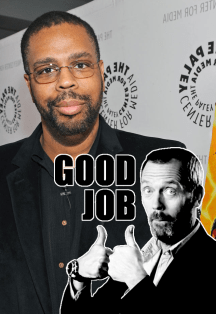
This post is one that I write with both deep respect for its subject, as well as a great sense of loss. His impact on the world of comics is greater than many realize, and it was a truly tragic event when he passed away on February 21st of last year due to complications from emergency heart surgery.
While I didn’t know it at the time, McDuffie had a huge influence on my becoming a fan of comic books. Growing up in the Philippines, my dad got his hands on a bunch of trade paperbacks, one of which was Static [now Static Shock]. The series was one of many that was published my Milestone Media, a comic company co-founded by McDuffie and three others. Their aim was to “express a multicultural sensibility” that he felt was missing from the industry, and they succeeded.
The titular Static was the electric alter-ego of African American teen Virgil Ovid Hawkins, and continues to be one of my favourite comic characters ever. One of the many created by McDuffie for Milestone, he embodied the awkwardness of adolescence and the effects of vigilantism on one’s personal life. His world was realistic and gritty without succumbing to the darkness that other such worlds do. Static was well-written, action-packed, and, most importantly, relatable.
After Milestone had stopped publishing new companies, McDuffie went on to enter the world of television. He was hired as a staff writer for the Justice League animated series, and was promoted to both story editor and producer as the show became Justice League Unlimited. Of the show’s 91 total episodes McDuffie wrote, produced, or story-edited 69. McDuffie also did extensive work on continuing the Ben 10 series, wrote for the Teen Titans show, and scripted a number of DC’s direct-to-DVD animated films.
Dwayne McDuffie also had an extensive career working for both DC and Marvel, and earned three Eisner Awards. In addition he was awarded many others, including Comic Con International’s Inkpot Award. Above all, he was able to affect the entire industry for the better. It’s just a tragedy that he left us as soon as he did.


 The titular Static was the electric alter-ego of African American teen Virgil Ovid Hawkins, and continues to be one of my favourite comic characters ever. One of the many created by McDuffie for Milestone, he embodied the awkwardness of adolescence and the effects of vigilantism on one’s personal life. His world was realistic and gritty without succumbing to the darkness that other such worlds do. Static was well-written, action-packed, and, most importantly, relatable.


 Culture War Reporters