You should write about indie game development and how it’s changing the industry.
And so, after avoiding the topic for a little while, here we are.
GORDON: For the sake of any readers who might not be familiar with what an “indie game” is, while definitions vary, the general consensus is that an “indie game” is any video game developed outside of the major/mainstream video game industry (sometimes called “Triple A”).
EVAN: A pretty good example of this would be Braid. A more well-known example that you’ve probably at least heard about [and that both Gordon and I have played a decent amount of] is Minecraft.
Having just finished an episode of The Big Bang Theory is as good a time as any to write this post, which elaborates on an article I found on Macleans.ca titled “How obnoxious is too obnoxious for a TV character?” In it TV writer Jaime Weinman primarily writes about TBBT and its most popular character, Sheldon Cooper.
Weinman points out that the 12th episode of this season, “The Egg Salad Equivalency,” was actually the highest rated in the show’s history, an astonishing fact when you realize that a large chunk of it features Sheldon being extremely [albeit unknowingly] sexist and racist. I’ve embedded the primary scene in question below:
It’s pretty awful, but the fact of the matter is that Sheldon Cooper is far from being the only popular sitcom character you would actually hate to be around in real life. Two years before TBBT even aired the US version of The Office was around, and the original British version came out four years before that. Michael Scott was a huge draw for people who tuned in weekly to see how a particular Scranton paper company was doing [as well as being solely responsible for repopularizing the phrase “that’s what she said”], but was also one of the most blindly insensitive people on the planet.
Very old television spoilers ahead.
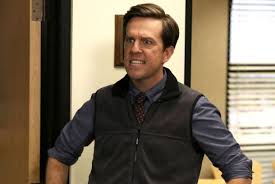
Steve Carrell’s departure at the end of Season 7 meant that someone else had to be the new boss, and in spite of my suggesting that Matthew Perry would fit the bill that role was given to Ed Helms’ Andy Bernard. While his character managed to be a fairly likeable manager earlier on, the current [9th] season has had him transform into what is essentially a terrible human being.
He’s this close to being a moustache-twirling symbol of outright villainy.
He leaves the office to sail a boat out to some island, comes back expecting everyone to have covered for his month-long absence, and then, upon having his girlfriend [understandably] break up with him for another coworker proceeds to make both their lives a living hell. Crazy-talented webcomic artist Anthony Clark tweeted it best when he said:
I hope the next episode of The Office starts w/someone reading a newspaper that says "Andy Died." Then he's never mentioned again
And speaking of Ed Helms, take as another example his companion in the Hangover films, Alan Garner. Essentially just Zack Galifianakis playing the role he always plays [see: Due Date, Dinner For Schmucks, etc.], he is, as we’ve been talking about, a person who is so obnoxious that you wonder how they continue to be alive; there are times when you want to reach through the screen and slap them in the face.
Most TV shows [that’s the end of the movie portion of this post for now] have them, too. Adventure Time has the Ice King, Community has Pierce Hawthorne, Modern Family has Manny Delgado [which you might debate, but I stand by this], and 30 Rock had the one-two punch of Tracy Jordan and Jenna Mulroney. Not only are the prevalent in television, but they also manage to become a huge draw for viewers.
Weinman ends his article by stating that “the show knows Sheldon is a jerk, but it doesn’t seem to know just how big a jerk he is.” I think it’s a fair assessment to say that all of the shows I’ve mentioned are aware that they’ve added obnoxious jerks to their casts, but the exact purpose for this is lost on someone who only had four hours of sleep last night. Sure, they can act as semi-antagonistic friends for our hero, usually the straight man, but eventually as the audience we’re forced to ask ourselves how people can bear having them around.
You could even justify it as being some sort of catharsis, rooted in schadenfreude, for whenever these character get their comeuppance, but it never happens. Sheldon will continue to be unaware of how his actions affect others, Pierce will continue to be extremely racist but get away with it due to his age, and we will continue watching them, amused, annoyed, or somewhere in between.
What it does is speak volumes for the game’s publisher, Deep Silver, and those it hired to advertise the game. There was an emphasis placed on the feelings of terror and loss and the need to protect one’s family; it sought to set itself apart from other zombie games [of which there are so many]. Unfortunately the game turned out to be your fairly standard run-of-the-mill zombie hack and slash, but that’s not the point here.
The point is that this trend was actually continued in the promotion of the game’s sequel, Dead Island: Riptide, the trailer of which can be viewed here. The tone is once again consistent with that of the first, highlighting the terrors of a vacation gone horribly, horribly wrong. Which is great. And which is why the following seems so shockingly out of place.
“We deeply apologize for any offense caused by the Dead Island Riptide “Zombie Bait Edition”, the collector’s edition announced for Europe and Australia. Like many gaming companies, Deep Silver has many offices in different countries, which is why sometimes different versions of Collector’s Editions come into being for North America, Europe, Australia, and Asia.
For the limited run of the Zombie Bait Edition for Europe and Australia, a decision was made to include a gruesome statue of a zombie torso, which was cut up like many of our fans had done to the undead enemies in the original Dead Island.
We sincerely regret this choice. We are collecting feedback continuously from the Dead Island community, as well as the international gaming community at large, for ongoing internal meetings with Deep Silver’s entire international team today. For now, we want to reiterate to the community, fans and industry how deeply sorry we are, and that we are committed to making sure this will never happen again.”
So no harm now foul, right? Dead Silver took back their horrible statuette and we can chalk another victory up for the internet! But why exactly were people upset? An article on Rock, Paper, Shotgun which I linked to but will link to again said this about it:
This is beyond disgusting. It’s as if someone were attempting to demonstrate the most misogynist idea that could possibly be conceived, in an attempt to satirise the ghastly trend. A text book example of the most extreme ends of misogynist fantasy, a woman reduced to nothing but her tits, her wounds hideously depicted in gore, jutting bones, and of course barely a mark covering her globular breasts.
It’s very prevalent in a lot of zombie imagery you can find nowadays, and it’s certainly present in this picture of a zombified Snow White on the left. Her body is mutilated [appropriately so, for a zombie] but her breasts remain completely untouched. There’s this sense of the grotesque from the image as a whole, but her chest remains an object of potential titillation.
I don’t think I have to say too much about how grossly sexist this is, and how prevalent it is in the society we live in. What I am going to say is thank God that on some level we can make enough of a public outcry to stop stuff like this before it happens. The bottom line is this: if we as a community [on the internet or otherwise] care enough about something, we really can do something about it. Even if it’s just stopping the production and sales of a tasteless statue.
Last night The Big Bang Theory aired its 122nd episode, entitled “The Santa Simulation.” News that its premise hit the internet and avid television watchers everywhere began to cry what may one day become a familiar saying, “Community did it first!” Every single one of them was wrong.
A full year before “Advanced Dungeons and Dragons,” [one of the best episodes of Community‘s second season, in my opinion] there was “Jen the Fredo,” the first episode of British sitcom The IT Crowd‘s fourth season. Both of these episodes were some of the best of their respective shows, so I was pretty excited for what TBBT had to offer.
The thing about the D&D-centric episode is how it’s been used as a plot device. As a role-playing game the players are able to reveal aspects about themselves that might not otherwise come out, and you can see this being done with various degrees of effectiveness in each episode. Spoilers for all three episodes past this point.
The IT Crowd [S4E1]
“Jen the Fredo”
I realize that most of you have not seen, or maybe even heard of, The IT Crowd. Let me sum in up in that it is, in my ways, what The Big Bang Theory could be. It’s a show about two, well, nerds that work in the IT department of a large company and their boss, who knows nearly nothing about computers. One of the best aspects of the show is that it brings you into the nerdiness of Moss and Roy, and in watching you begin to feel like you really relate to them, becoming equally frustrated when people ask them for help with their computers.
“Jen the Fredo” is, if you’ve seen The Godfather films [which I haven’t], a clear reference to the character Fredo, whose job it was to take out of town businessman and “show them a good time.” Jen takes on the role of helping to entertain a few business partners, but ultimately fails when she takes them to see “The Vagina Monologues.”
Enter Dungeons and Dragons. Moss has been preparing to DM [Dungeon Master, can be used as a verb] and convinces Jen that it’s exactly what these gentlemen are looking for. The best part is, he succeeds [I had a great YouTube clip here but someone decided to make it private].
While the idea of entertaining [and riveting] a few rowdy businessmen with a little D&D is hilarious in and of itself, but there’s more to it than that. Moss uses the game to confront Roy about the latter’s painful breakup, something he’d been avoiding talking about for a while. The conclusion is tear-filled and, more importantly, immensely funny. You can catch it on Netflix, or here, though you didn’t hear that from me.
Community [S2E14] “Advanced Dungeons and Dragons”
This episode has easily the most actual gameplay of the three, since essentially the entire episode consists of the Greendale Seven playing D&D in the library. It also treats the source material the most lovingly, complete with a voice over and fantastically appropriate score.
The game is set up due to Jeff wanting to help out “Fat Neil,” a young man planning to end his life [understated by the narration] due to his new nickname. Once everything is set up, with Abed as the DM, things really get going.
Each member of the study group essentially plays a version of themselves, with the voice over near the beginning describing them as “Troy the Obtuse,” and “Britta the Needlessly Defiant.” They react to the situations within the game as they normally would, with Jeff impatient and unwilling to put up with nonsense as usual. The best parts, however, are when you discover a little something about the character you thought you knew, well-illustrated in the following scene with Annie:
In this episode Pierce owns his most [as far as I’m concerned] unpopular role: The Villain. Incensed at being excluded from the game he steals Fat Neil’s magical sword and runs away, later using D&D manuals to cheat and garner immense power to himself.
Everything ends, as usual, with a fairly warm and fuzzy conclusion. Pierce is defeated, mostly through his friends forgiving him for his dickishness [hence his title, “Pierce the Dickish]. Neil’s spirits are lifted and he finds the motivation to keep on living.
The Big Bang Theory [S6E11]
“The Santa Situation”
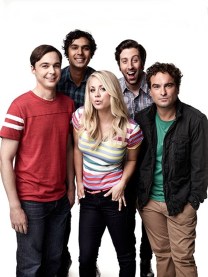
A “guys’ night” is happening and the activity of choice is Dungeons and Dragons, which is territory you’d have expected these characters to have explored in-depth quite a few seasons back. Heck, as far as I can recall they spent more time playing Settlers of Catan than throwing around a 12-sided dice.
The game begins and Leonard, the DM, lets it drop that their quest is to rescue Santa Claus. Queue Sheldon’s disappointed face due to the fact that he a) loves D&D and b) hates Christmas. Also Raj gets shot in the face with a cannon in the first few minutes of the game, highlighting the fragility of life in a world that values perception checks.
Oh, and they ditch their respective girlfriends to play, which led to this scene, the last line of which was delivered excellently:
Using the structure of the game Leonard gets Sheldon to sing [all five verses of] “Good King Wenceslas” and all three remaining players to play “Jingle Bells” using, the obvious instrument of choice, bells.
Upon finding Jolly Old St. Nick in chains they move forward to rescue him, only to have Sheldon cast a paralyzing spell on his companions. He then confronts Santa [or Leonard, in this case] and tells the heartbreaking story of how he asked Father Christmas for only one thing as a child, to have his grandfather back. He then walks out, leaving the old many to die.
In Conclusion
As far as really exploring well-established characters, Community probably succeeds the most, by virtue that it only has the one central plot that revolves around a single game of D&D. While it does feature Pierce continuing on his course to become more cartoonishly evil, Britta’s response to the beleaguered gnomes is a perfect example of how her character will react both in and out of the real world.
The IT Crowd and The Big Bang Theory tread the very similar ground. Moss uses the game to force Roy to come to terms with the love he lost, something that would have been impossible otherwise. Sheldon’s childhood experience with Santa Claus never would have come about without Leonard guiding him to that place where he could talk to the man who disappointed him.
My hope is that there will be a continuation of this trend, with there having being one D&D episode per year from 2010-2012. As the current DM of an ongoing gothic horror campaign I am well-aware of the storytelling capabilities of the game as well as how enjoyable it is to know people you know well deal when presented with fantastical situations. Although 2/3 of the above shows do feature “nerds” I’m sure that this could still appear in the more bizarre sitcoms, such as New Girl and Happy Endings.
EVAN: Today’s topic is something that I hold very near and dear to my heart. Years of research on the topic has made me witness to all of the arguments that can be used against needing to have racially accurate casting, and because of this I’m going to propose something a little different
GORDON: Namely?
EVAN: That I switch sides for this conversation, and speak out against it.
GORDON: Intriguing. Mind starting us off with the first salvo?
EVAN: Statement: Racially accurate casting is not important. The most talented actor should be the one who gets the role.
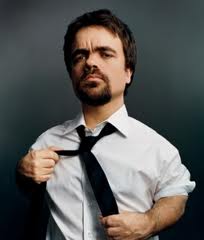
GORDON: Doesn’t appearance play a key role in what makes an actor good? Peter Dinklage is good, but you wouldn’t really find him believable playing Abraham Lincoln or Kareem Abdul Jabbar.
EVAN: In this case his stature, not his race, is what would keep him from playing either role in a convincing manner.
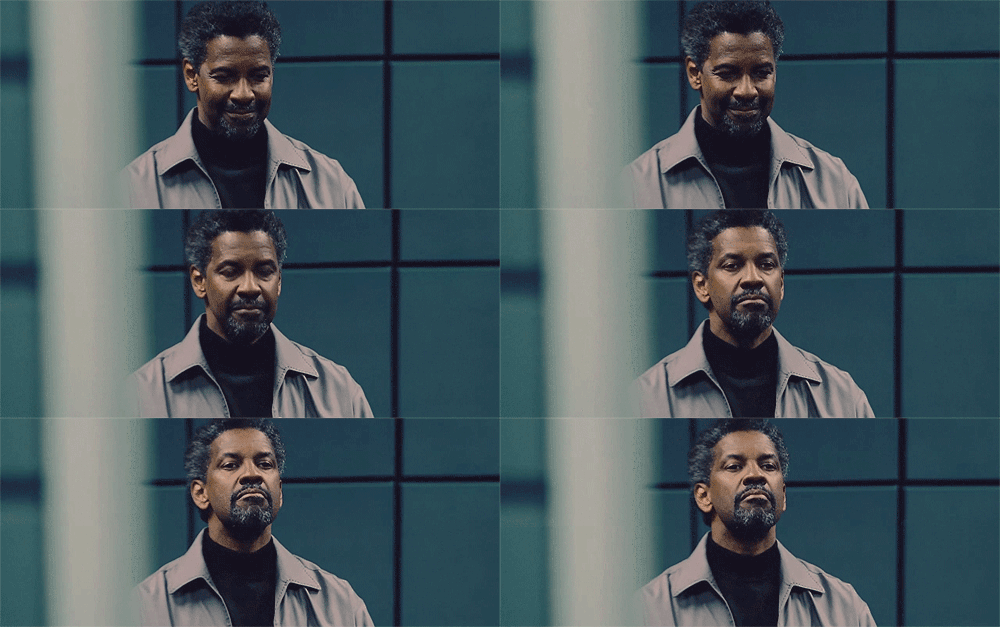
GORDON: But isn’t that essentially the same issue? Imagine the great Denzel Washington playing Lincoln- you’d be sitting there the entire time, no matter how much of a powerhouse Washington would be, taken out of the film because you have to deal with a black guy playing a white guy during the height of the civil war.
In any piece of film where you’re expecting realism, you’re going to expect the actors to conform to the styles and facts of the time. If you portray Georgia in the 1960s, you’re obviously not going to have a largely black cast portraying the upper class or if you were to set the scene in early 1900s Ghana you wouldn’t have a cast comprised of Caucasians. It wouldn’t make sense, no matter how good they are.
EVAN: If anything, Cloud Atlas at least proves that a talented actor can portray whoever they like, given an adequate amount of makeup. Halle Berry plays a Korean Man in the film, and does so in a convincing fashion that doesn’t at all take viewers out of the film in the least.
GORDON: I haven’t seen that film, so I can’t speak to the use of the actors for the parts they play. From my understanding that was a work of fantasy (or science fiction, I’m only going off what I can gather from the trailers). And in one or two movies, it’s probably not a big deal. After all, Cate Blanchett played Bob Dylan.
But imagine this applied to each and every movie, it simply wouldn’t work. Realism would deteriorate- and this would be especially detrimental in a film trying to deal directly with race relations.
EVAN: I personally feel that allowing any race to play any other speaks much more in terms of race relations. That’s a world where colour is a non-issue because it shouldn’t be.
EVAN:I’m dying, Gordon. My life force is seeping out of me.
GORDON: Try to stick with it…
GORDON: And while it’s true that race ought to be a non-issue, that’s simply not how things are or have been in the past. Using black actors to play black characters and white actors to play white characters is fundamental to demonstrating past inequity and injustice with American racism and segregation. And that’s just one element.
Let’s talk about Indians playing Arabs. It happened in Lost and it happened in Community (with multiple actors), but Arabs look nothing like Indians. Indian actors are used simply because they fit the stereotype of what most people think an Arab looks like. It perpetuates an inaccuracy.
EVAN: Isn’t the fact that the role is an Arab important a large enough step? This is a minority with a major role on a TV show, and an opportunity for minority actors to step up, which they have in both cases.
GORDON: Barring Monk and Arrested Development, when’s the last time you saw an Arab actor? I’m not trying to argue against Indian actors, or actors of Indian heritage getting roles, but for the purpose of portraying the world as it is (or at least with some realism) we should have actors with some vague resemblance to the people they’re portraying on film.
After all, would you not be thrown off by guys with German accents playing French resistance fighters during WWII?
EVAN: If they had German accents then they simply wouldn’t be right for the role, which brings me back to my first point.
GORDON: Which, by proxy, brings us back to my first response. Ethnicity (depending on the situation) is just as valid an element of a guy’s candidacy for a role dealing directly with ethnicity as accents, or height, or any other factor (actual talent, of course, being the most important).
Vincent Cassel should probably not play Malcolm X. Adrien Brody should probably not play the Queen of England, though that would be pretty funny.
EVAN: If we’re going to stick with believability, than why is it so important that Indians not play Arabs? No one has ever made a big deal out of this, so clearly people believe that they are what their role calls them to be-
Likewise a Korean can to play a Chinese person can play a Japanese person. Audiences can’t tell the difference and believe that they are whatever the role is, and that’s okay.
GORDON: But Koreans do not look Chinese, Chinese people don’t look Japanese, and Arabs and Indians certainly don’t look like each other. The only reason this happens is because most people either don’t know (partly due to this inaccurate casting) or don’t care (in other words, all non-whites are basically one homogenous mass.
If all your life, you had seen black men and been told “these are Uzbekistanis,” then you’d go your whole life simply assuming that Uzbekistanis are, in fact, indiscernible from guys from Benin.
Your ignorance should not dictate which actors get which parts. Further, no Uzbekistan could really ever get a chance to play and Uzbekistani because of the years of misinformation.
EVAN: But there is a huge difference between a black person and an Uzbekistani. The examples I made have similarities that the example you used clearly does not.
To be such a stickler for accuracy is the other extreme, and just as wrong. You wouldn’t get someone with mental problems to accurately portray a character with mental problems, that just doesn’t make sense. Race should matter if it is noticeable, and like I said in the case of shows like Lost it is not.
EVAN: The logic above was used against me by someone in a thread on Reddit You can check out our exchange here.
GORDON: Granted, my example was extreme, but that doesn’t change the point. Even though a Thai guy and a Japanese guy share more similarities than a Beninese guy and an Uzbekistani guy, there are still distinct differences between people from Thailand and people from Japan.
With regards to being a stickler- I admit, as I have previously, that you don’t have to have an exact replica of the character you’re trying to portray. Jet Li, I imagine, is doing pretty well for himself, and I still wouldn’t doubt his ability to portray a poor man very well. However, while you don’t need to be point for point, you do need to have some general similarity. That’s why we don’t have Emma Stone portraying Fidel Castro.
EVAN: I feel like the extremeness of your examples is damaging your point. If we’re sticking with race we should do that, and not bring in gender.
GORDON: It’s to demonstrate the underlying point in all of this: Verisimilitude. Realism. Accuracy.
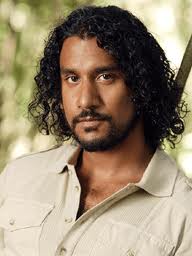
EVAN: And since you said “you don’t have to have an exact replica of the character you’re trying to portray” why isn’t it okay to have Naveen Andrews play Sayid Jarrah on Lost?
GORDON: But the distinction is great enough. The accent is Indian, not Iraqi. Naveen does not look Iraqi. When an actor neither looks nor sounds like the character he is meant to portray, we have a problem.
EVAN: So if Jarrah had managed to sound Iraqi, would that have helped?
GORDON: It would’ve added to the realism and accuracy, yes. But that doesn’t change the fact that he’s very clearly Indian, not Arab.
EVAN: Clear to a very select few. As mentioned, people didn’t seem to notice for the most part.
GORDON: Clear to a very select few. As mentioned, people didn’t seem to notice for the most part.
Most people don’t know what an Arab looks like. Do they know that Monk is Lebanese? That Cousin Maeby is Iraqi? Most do not. Ignorance is not an excuse for inaccurate casting.
EVAN: And that brings our exhausting exchange to an end. Trying to argue for something I so strongly disagree was one of the more difficult things I’ve ever done. I hope that in reading this you were able to see the holes in my argument and the truth in Gordon’s.
GORDON: Booyah.
The past few paragraphs alone have had the same effect on Evan as that life-sucking device in the Princess Bride. Commend him for biting the bullet.
And as for our discussion next time, your options are: What do we make of the upcoming Star Wars sequel?
EVAN: And. . . how about . . . How much artistic merit is there in a show like Adventure Time?
GORDON: I like it.
And to our beloved and devoted followers (who would organize into a vicious and unholy army of darkness if we ever were to ask it of ’em), feel free to suggest your own topic down in the comments section.
Imagine that you haven’t had pizza in a while, and have a hankering for a slice. As luck would have it, your friend is bringing some over as he promised a few days ago. As you sit there in eager anticipation you receive a call, and he lets you know that there’s going to be some delay. Disappointed, you ask him how long it’ll be. He tells you that you should be getting your pizza sometime in 2013.
Angry? You should be.
If you are one of the many, near-rabid Community fans out there, you were probably disappointed when you found out that the fourth season would only be 13 episodes. That being said, you were probably even more distraught to find out that it won’t be actually be airing this Friday.
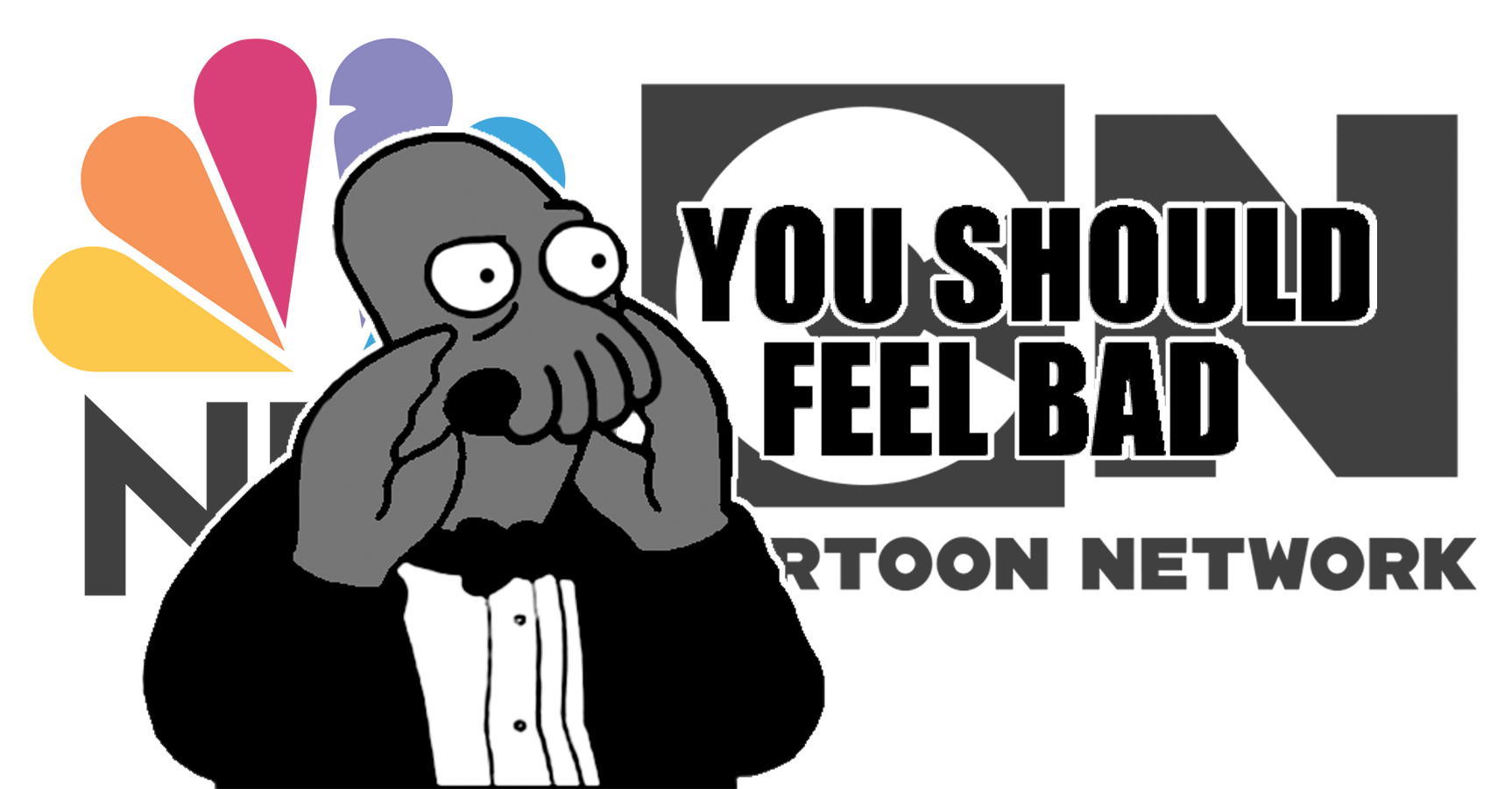
That’s right, NBC has decided to remove Community completely from its 2012 Fall lineup. It’s unknown when the show will return, but the best guess is sometime during the Spring of 2013. I have attached a gif because Gordon is rubbing off on me, and because Troy crying is always funny. Look at him, the dude is sad. To be fair, so are a lot of people. I’m a little disappointed myself.
But not near as disappointed to see that Cartoon Network has pushed all of its DC Nation programming back until January 2013. It’s understandable that room had to be made to celebrate the network’s 20th anniversary, which is definitely something special. The main issue I have is that this decision was made after two weeks of programming had already been aired.
This means that after two episodes of Young Justice and two episodes of Green Lantern: The Animated Series it’s three months before we can get any more. If we can go back to my pizza analogy, that’s like someone letting you take a few bites and then telling you that you can have the rest. In three months.
Quality programming can be hard to come by [see: any episode of 2 Broke Girls], and news that your favourite shows won’t be around until after the predicted apocalypse is sombre news indeed. While Cartoon Network’s reasoning makes some sense, to air a few episodes and then push the rest back is insensitive at best. As for NBC, they seem committed to letting Community fans know that they are really not all that important.






 The Big Bang Theory [S6E11]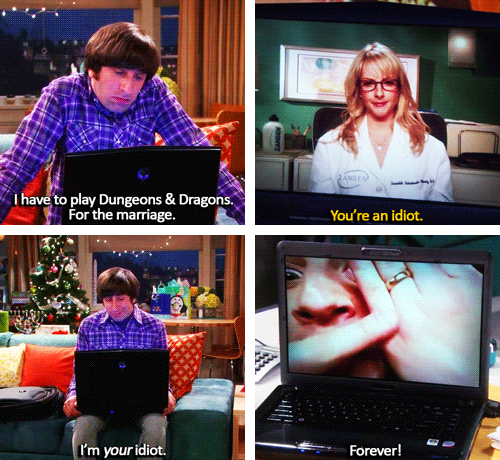





 That’s right, NBC has decided to remove Community completely from its 2012 Fall lineup. It’s unknown when the show will return, but the best guess is sometime during the Spring of 2013. I have attached a gif because Gordon is rubbing off on me, and because Troy crying is always funny. Look at him, the dude is sad. To be fair, so are a lot of people. I’m a little disappointed myself.


 Culture War Reporters