Tag Archives: lgbt

Shame Day: Beyonce, Macklemore and the Grammy Backlash

Apparently I should really start watching the Grammys, primarily because they are THE place to find shameful behavior, or at least that’s what I’ve been hearing from the variety of subcultures that I belong to and/or gather interesting information/perspectives from. So for today I will be shaming three different aspects of the Grammy Awards show:

Beyonce and Jay-Z’s “Drunk in Love” Performance

I’ve been reading various blogs and articles on Beyonce’s since she released her visual album as a big surprise to fans. In news that was a little less surprising, it was an instant best seller.


All over the internet, however, feminists were having a heyday trying to figure out if they could really consider Beyonce a feminist. Continue reading

Duck Dynasty vs. Real Persecution

For those of you who don’t already know, I grew up in a very Christian community. And I had an amazing experience. For any of those people who may be reading this, thank you for helping create such a safe and loving environment for me to grow up it. I still look up to so many people in that community because they are kind and loving people who live their lives striving to serve God and love others.

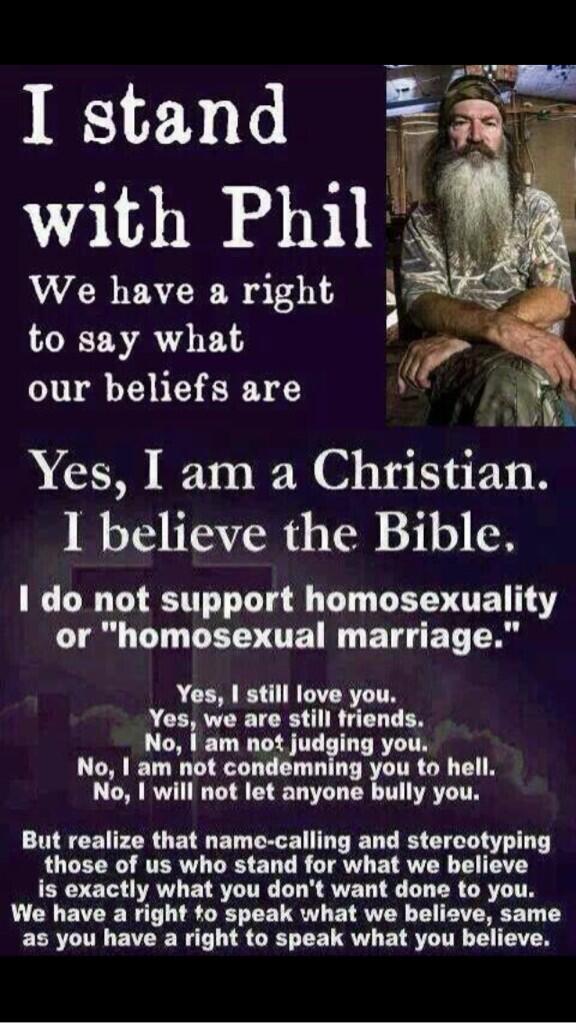
That being said, it’s really frustrating to see a lot of really amazing people re-posting memes like this.

Because I’m pretty sure when any homosexual person reads this meme, what they are going to immediately understand is that you care more about the reality show of a multimillionaire than you care about actual abuse happening to members of the LGBT community around the world. Continue reading

CWR Writers’ Roundtable: No Red Kettles and “Baby It’s Cold Outside”

EVAN: Dearest audience, this week we dedicate our blog posts [more or less] to the holidays, and today’s Writers’ Roundtable is especially festive with not one, but two Christmas-related topics. Seeing as this is the season of giving the first one, website/movement No Red Kettles,  is particularly appropriate.

KAT: Well, I first learned about the debate around the Salvation Army on my Facebook feed where it was causing a pretty big debate. 

The first article I read about it insisted that the Salvation Army “hates gays”, which I immediately thought was pretty fishy. The Sally Ann did release an official response, but the debate has continued, because for many people it has clicked that the Salvation Army is a Christian organization, and they aren’t so sure they want to support it because of that.

This video from No Red Kettles pretty well sums up that argument:

Continue reading

Homosexuality In Comics As Of July 26th

andrewgarfieldspidermancomicconwhatever

At Comic-Con this year Peter Parker/Spider-Man actor Andrew Garfield announced that the character would not, in fact, be gay in the upcoming films. 

Now if you didn’t know, and if you don’t frequent the same news sites I do it may have completely passed you, Garfield actually expressed some interest earlier this month in portraying a flexible aspect of Peter Parker’s sexuality. I’ll let him speak for himself, of course:

“What if MJ is a dude? Why can’t we discover that Peter is exploring his sexuality?  It’s hardly even groundbreaking!…So why can’t he be gay? Why can’t he be into boys?”

While at Comic-Con he  was also able to follow-up these comments with the following statement: 

“It would be illogical for me in the third movie to be like, “You know what? I’m kind of attracted to guys.” That’s just not going to work. It’s clear. It was just more a philosophical question.” Continue reading

Shame Day: Microaggressions

A few weeks ago I stumbled onto a website called The Microaggressions Project and then promptly forgot about it. Returning to it tonight I looked over the “About” page, which had the following paragraph at the top:

This project is a response to “it’s not a big deal” – “it” is a big deal. ”It” is in the everyday. ”It” is shoved in your face when you are least expecting it. ”It” happens when you expect it the most. ”It” is a reminder of your difference. ”It” enforces difference. ”It” can be painful. ”It” can be laughed off. ”It” can slide unnoticed by either the speaker, listener or both. ”It” can silence people. ”It” reminds us of the ways in which we and people like us continue to be excluded and oppressed. ”It” matters because these relate to a bigger “it”: a society where social difference has systematic consequences for the “others.”

A little later on they define what “microaggressions” are, a term that was originally coined to speak about racial experiences. From the essay “Racial microaggressions in everyday life: implications for clinical practice,” which appeared in American Psychologist, Vol. 62, No.4:

“Racial microaggressions are brief and commonplace daily verbal, behavioral, or environmental indignities, whether intentional or unintentional, that communicate hostile, derogatory, or negative racial slights and insults toward people of color.”

One example of this could be a White couple walking down the street and having a Black man pass by them on the sidewalk. The woman clutches her purse tighter against her body, the subconscious idea being, of course, that Black men are prone to crime and should not be trusted.

As an Asian-Canadian I’ve experienced microaggressions plenty of times. I’ve had someone ask me if I was half-White [I am clearly not] with their rationale being that my “English was very good.” It can be an everyday occurrence for non-White people [I deign to use the word minorities, since I do believe that balance is turning the other way], and begs the question: “Why is this such a big deal?”

Writer of the aforementioned article and author of Microaggressions in Everyday Life: Race, Gender, and Sexual Orientation, Derald Wing Sue, PhD, has observed that microaggressions have actually been found to: “(a) assail the mental health of recipients, (b) create a hostile and invalidating work or campus climate, (c) perpetuate stereotype threat, (d) create physical health problems, (e) saturate the broader society with cues that signal devaluation of social group identities, (f) lower work productivity and problem solving abilities, and (g) be partially responsible for creating inequities in education, employment and health care.”

In other words, a Black or Latino man being stopped for a “random vehicle check” by police could be upset, and may even be accused of overreacting. Maybe they should simply be used to this and not let it bother them. The truth is that it makes them feel, even if only subconsciously, like second-class citizens. It’s true in a case as blatant as this one, and in an as subtle an action as hanging a Confederate flag or  having a Native American stereotype as a high school mascot.

To broaden this to the scope that The Microaggressions Project seeks to attain, microaggressions can include people saying to a person with Asperger’s, with no ill-intent whatsoever, “That you seem so normal!” It can be a 17-year-old girl being told by her gynecologist that just because she has access to birth control pills doesn’t mean she can just sleep around.

Microaggressions work in every direction. It’s like going to a Vietnamese restaurant and being given a fork and spoon instead of chopsticks because you’re White and not Asian. Microaggressions are built on assumptions and can make people painfully aware of who they are. They are rarely meant to offend, but often do. 

It truly is a shame that so much of the time we send out microaggressions without so much as a second thought, and then defend ourselves by deeming the offended to be “too sensitive.” While we won’t always be aware of how our words or actions can harm others, we can at the very least listen to the people being hurt, and in doing so try to lessen the presence of microaggressions in our society.

Same Sex Marriage in the Current Context

source: www.theamericanmagazine.com

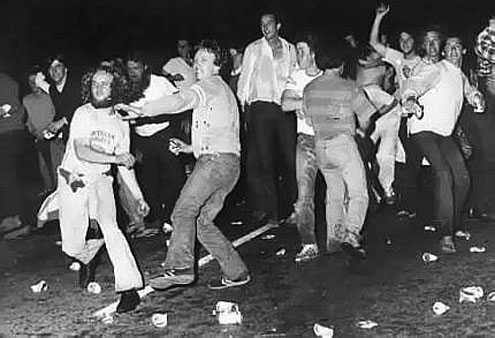
The Stonewall Inn, 1969

The passing of the monumental bill by the NY Senate last Friday (in addition to the UN commitment to protect LGBT rights) demonstrated clearly the increasing social acceptability of same sex marriage. While the movement started and is continuing with the passionate support of marginalized people, the case for same sex marriage is gaining momentum because it is becoming “cooler” to support it – being pro-gay-marriage is slowly becoming the default, and voting against it is more commonly seen as bigoted and discriminatory.

Even just a few years ago, only the more socially liberal Democrats would support same sex marriage (like in 2009, when every Republican and 8 Democratic senators voted the bill down in the New York Senate) – but this last Friday all of the Democrats in the Senate and 4 Republicans voted for gay marriage.  So…what changed? 2011’s bill included that amendment that protects the right of religious institutions who refuse to marry same-sex couples, but that wasn’t the only reason – it’s the slow change of what’s socially expected.

In that strange way that things viewed as “radical notions” can eventually trickle down and become accepted common sense, supporting same sex marriage is becoming the the norm.  Not long ago, anyone who campaigned for same sex marriage in the US had to explain their case persuasively and passionately to be taken seriously, but now the pressure is shifting to the other side – those who oppose gay marriage are the ones who are required to defend themselves. Being pro-gay-marriage is almost universally assumed for Democrats, and some Republicans are “coming out” as supportive of the cause too, like NY Senator Roy McDonald, who said “f*** it, I don’t care what you think. I’m trying to do the right thing.” Apologetic hand gestures and the requisite “But hear me out…” are being reassigned to the “traditional marriage” crowd – especially among academics, the upper middle class, and young adults, it would seem.

Interestingly, as views on gay marriage are shifting, the view of marriage in general is changing too. The “married scene” (or whatever you would call it) is one filled with unmarried couples who refer to their pets as children, couples who live together for decades before getting married, couples who don’t get married at all, divorce cakes, and an annoyingly-often-quoted-and-never-cited 50% divorce rate.The Western idea of marriage is conflicted: we still say “Til death do us part”, we still tend to teach (or at least show) the ideals of marry-young-and-live-Happily-Ever-After, but we’re getting married at an older age2 and marriages don’t tend to last “til death”.  I’m not here to argue the healthiness or unhealthiness of divorce or cohabitation, – the point is that, whether good or bad, the idea of marriage is changing in the West, and we don’t seem to be sure into what.  Same sex couples are fighting and protesting their way into a strange and fickle club; one that (technically and idealistically) promises lifetime commitment and doesn’t really deliver.  It’ll be interesting to see what the statistics will look like for newly married same sex couples in the future.

source: www.nytime.com/slideshow/2011/06/25

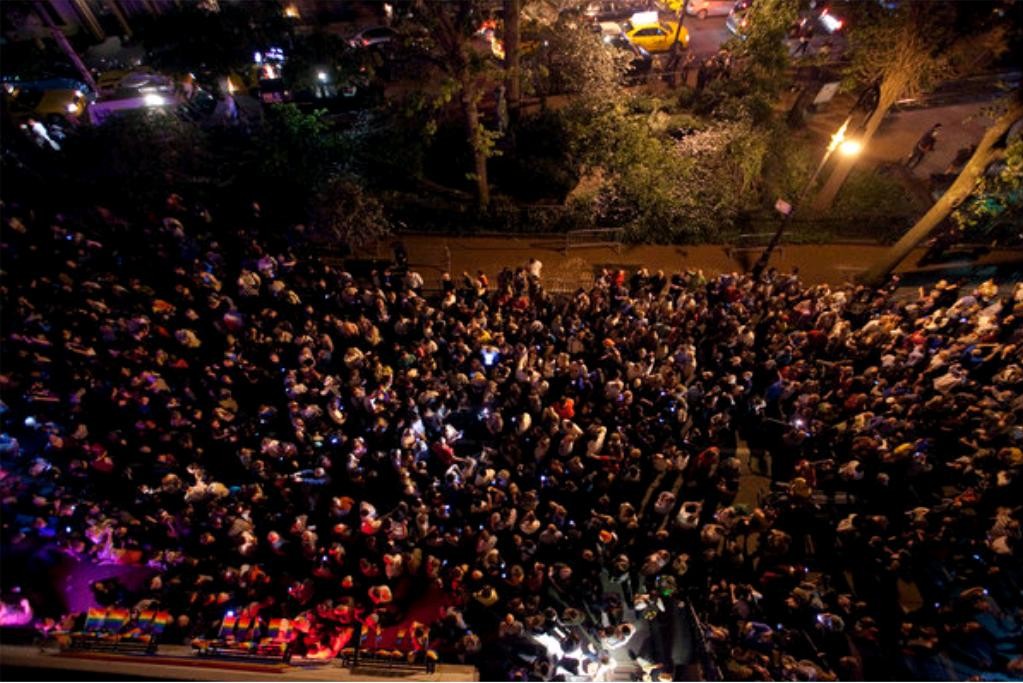
Outside the Stonewall Inn, June 23, 2011

Support for LGBT marriage rights seems to be going the way of racial equality and women’s rights – our kids are probably going to be baffled at the idea of the Defense of Marriage Act, like we were at some women’s rights and racial discrimination issues that we take for granted. One difference, though, is that same sex couples, unlike women and racial minorities, will definitely always be a minority, unless demographics change hugely (or there are way more of us in the closet than we thought). This is another thing that’s going to make the future interesting for same-sex politics – the discrimination might just cycle around again after all of the people who witnessed the fight for marriage equality are gone, unless the idea of LGBT rights settles itself into a comfortable position as the social norm. That seems to be the case so far.3

1 the best source I could find, figure 13; the second best source I could find
2 source
3But maybe this will be a short-lived trend, considering the growing muslim population in the EU and the US; juxtapose that with the fact that the 7-9ish countries in which homosexual activity is punishable by death (Iran, Sudan, Saudi Arabia, UAE, Mauritania, Yemen, Somalia [Somaliland], Afghanistan [capital punishment until 2009, which is still often unoficially enforced], Pakistan [sometimes, where Shar’ia law applies]) are all Muslim-majority states. If demographic trends continue and Muslim-majority states continue to tend to enforce Shar’ia law, it doesn’t seem that same sex marriage will be able to remain a social norm, at least in Europe, for more than a few decades.