The last time I wrote a post that was titled in a similar format was back in 2013, which followed another the year before. Both were written because at the time events had occurred in the comic book industry that touched on LGBT representation. Given the fact that Western comic books don’t necessarily have a dearth of Asian creators [Gene Luen Yang, Annie Wu, and Jerome Opeña being just a few examples] it’s actually sort of surprising that it wasn’t until this week that I felt justified in putting together a similar post.
What’s unfortunate is, as you can probably tell by the title, that it’s not all good news. With that in mind I’m going to go with the classic “sandwich” delivery, with the positives buttressing a negative. That said, and without further ado-
Greg Pak’s Totally Awesome Hulk #15 Brings a Tear to My Eye
I should probably clarify that I have not read the 15th issue of Totally Awesome Hulk. That won’t actually hit stands until this upcoming October. That said, the cover was released in the Marvel NOW’s Previews Magazine this past Wednesday [with leaks hitting the internet a little earlier]. You can see the cover below in all of its glory-

Cover art by Mukesh Singh.
Clockwise from the very top of the cover is: Kamala Khan/Ms. Marvel [Pakistani-American], Shang-Chi/Master of Kung Fu [Chinese], Amadeus Cho/Totally Awesome Hulk [Korean-American], presumably SHIELD Agent Jimmy Woo [Chinese-American], Cindy Moon/Silk [Korean-American], and lastly a character I can’t place who Bleeding Cool cites as being Winter Soldier [which I could not confirm through my own research].
What struck me was that this is a comic book cover from one of the the two major publishers [DC and Marvel] on which every one of the many characters depicted is Asian. It’s also not an established team of Asian heroes like Big Hero 6 [the film adaptation of which you know my exact feelings about]. This is especially notable in light of the fact that other comics like Sam Wilson: Captain America #10-

Sam Wilson: Captain America #10. Written by Nick Spencer, illustrated by Angel Unzueta.

Cover art by Marguerite Sauvage.
-and the cover to Black Panther #7 [as seen on the right] communicate the ideas that a) Black heroes exist within this universe and b) just like in many real life situations, Black people can and do congregate together.
Even before these respective examples came to light most of these heroes were fairly recognizable by the public [Storm and Black Panther, Nick Fury Jr.], but they also shine light on the lesser-knowns [Misty Knight, Doctor Voodoo, Spectrum].
The cover to Totally Awesome Hulk #15 is the first major step in my recent memory to bring a similar awareness to Asian representation in comic books, and it’s very clear that a conscious decision was made by Greg Pak [a Korean-American himself] to do this. It’s no exaggeration that just seeing the cover made me emotional, and I cannot wait until October to get my hands on the issue.
Frank Cho Stirs Continues to Stir Up Controversy Over Wonder Woman Variant Covers
There’s no such thing as the perfect week.
Frank Cho, a Korean-American artist and the initial collaborator with Greg Pak on Totally Awesome Hulk [their similarities to the titular character further discussed here], announced two days ago that he would be walking off Wonder Woman as variant cover artist with Issue #6. Deciding to go to Bleeding Cool, Cho explained that:
“All the problem lies with [author] Greg Rucka.
EVERYONE loves my Wonder Woman covers and wants me to stay. Greg Rucka is the ONLY one who has any problem with covers. Greg Rucka has been trying to alter and censor my artwork since day one.
Greg Rucka thought my Wonder Woman #3 cover was vulgar and showed too much skin, and has been spearheading censorship, which is baffling since my Wonder Woman image is on model and shows the same amount of skin as the interior art, and it’s a VARIANT COVER and he should have no editorial control over it. (But he does. WTF?!!!)
I tried to play nice, not rock the boat and do my best on the covers, but Greg’s weird political agenda against me and my art has made that job impossible. Wonder Woman was the ONLY reason I came over to DC Comics.
To DC’s credit, especially [Art Director] Mark Chiarello, they have been very accommodating. But they are caught between a rock and a hard place.
I just wanted to be left alone and do my Wonder Woman variant covers in peace. But Greg Rucka is in a hostile power trip and causing unnecessary friction over variant covers.”
For those who are not familiar with comic book journalism websites, Bleeding Cool excels in tracking a lot of what goes on behind the scenes in the industry. That said, they’re also known for rumour-mongering, a practice with a so-so success rate. They have also devoted many an article to the artist’s last controversy over covers, noting each time one of the illustrations made its way online.
While Rucka has made no official response to Cho or to anyone else asking for comment save for the following tweet:
https://twitter.com/ruckawriter/status/753668711211335680?lang=en
As far as an actual example of the “censorship” Cho is decrying, pictured below is the aforementioned cover to Wonder Woman #3, with the final cover on the left and the original art on the right:

Notably absent is the character’s panty line, shown on the right. Apart from the cropping, the art appears untouched.
It should be restated that Cho was not fired from the gig, but instead chose to leave of his own volition. As a creator doing work-for-hire the people at DC comics had every right to ask for edits to be made to whatever iss submitted to them. It was also his choice to approach the comic book journalism site most likened to a tabloid to announce the reasons behind this. The true irony is that the artist’s sensitivity over what occurred feels out of line with his approach to the outrage others have felt about his own work.
Gene Luen Yang’s New Super-Man #1: This Man of Steel is a Boy From Shanghai
Particularly worth spotlighting as the first-ever DC book I’ve decided to buy issue-to-issue, New Super-Man comes from the same writer of one of my favourite graphic novels, American Born Chinese. That book proved that Yang understands a lot of the innate conflict in being Asian-American, living your entire life in a country but never quite feeling like you fit in.

Cover art by Viktor Bogdanovic.
With that in mind, several months ago he wrote a blog post for the DC Comics site in which he admits almost immediately that “I’ve only visited China twice, so my understanding of Chinese culture is through echoes.” That said, he wants to do everything he can to make his portrayal of the character as authentic as possible, and the majority of the post spends time picking apart exactly how and why he landed on the name “Kenan Kong”.
It’s but one example of how committed he is to the authentic portrayals of Asians, and it can be strongly felt throughout that first issue, which was sold in comic stores everywhere this past Wednesday.
It’s my hope that this isn’t the last such blog post that I piece together, and that part of the reason for that will be even more Asian creators working in both mainstream and indie comics. While the news won’t always be positive, the dream is that with even more talent we’ll be able to see the best that they have to offer, especially in regards to pushing representation in my favourite medium.





 Culture War Reporters
“You Might as Well Have [insert character here] Be [insert 2-4 minority types here]!”
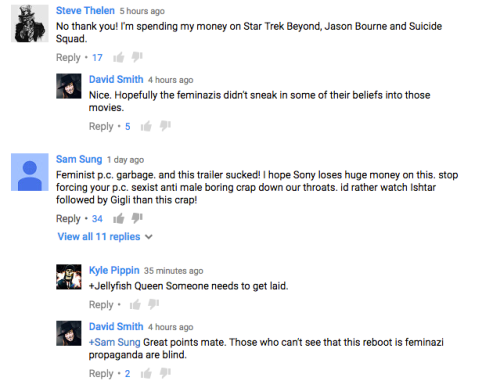
One of the most common adages on the internet is “don’t read the comments”. While this global network that we’re all currently using [unless you somehow managed to snag a printout of this post] has given us all the ability to share and discuss everything under the sun, the unfortunate truth is that a lot of that conversation amounts to hot garbage. You could scroll down past an article to see what people are saying about it, but chances are that it won’t be a particularly uplifting experience.
As someone who spends much of his time online reading about entertainment there’s a type of comment that I’ve seen crop up time and time again. It’s existence ties directly into a lot of the recent trends in comic books, television, and film, the push towards inclusivity and the people who are actively working to make that happen. A perfect example [of a handful I’ll be referencing throughout this article] is:
“disabled, multiracial trans women with disfiguring facial scars” – posted on “There are more (white) women starring in movies than ever before”
I’ve been compiling these for the past few months, originally with the intent of putting together another “For Your Consideration” and allowing readers to look them over and come to their own conclusions. A general [and accurate] takeaway would be to note them as being typical of inane online comments and move on, but I’d like to spend a little time breaking down the idiocy they represent.
They Perpetuate the Default
The default person, in case you needed to be informed of who generally holds the most power and screentime across the board, is a straight able-bodied cisgendered White man. I’m painfully aware that simply listing those words in successive order like that marks me as being one of the SJWs [my thoughts on that term here], but every one is important to take note of.
Take the following:
“black Asian gay lesbian transgender Spider-man” – posted on “Dear HOLLYWOOD REPORTER: May We Have a Word About ‘Cultural Appropriation’?”
To look at the list and mark it against the checklist of what makes a default human being, in the eyes of at least a few, we have:
Other comments I’ll be including later on will add examples that include disabled people, but the general gist of every one capitalizes on the absurdity of a person who doesn’t match the standard cutout. A straight able-bodied cisgendered White woman? Not a terrible strain of the imagination. Once you start to tick off more items that don’t coincide with the norm, however, things apparently get a lot shakier.
I don’t even think that many of these commenters are aware of the implicit message behind the words they type. By listing these adjectives and identifiers they end up with a person who most of them share absolutely nothing in common with, which exposes the very reason we need diversity at all. Everyone should be able to relate to entertainment, and for too long the industry has catered to an audience that gets smaller every day. Continue reading →
Rate this:
1 Comment
Posted in comics, film, gender, internet, lgbt, race, television
Tagged believable, black, character, comment, comments section, complaints, default, disabled, diversity, gay, internet comments, lesbian, lgbt, marginalized, minority, possibility, race, realistic, representation, straight, Transgender, transgendered, visibility, white, why not have