Category Archives: feminism

A Special Place In Hell For Madeleine Albright

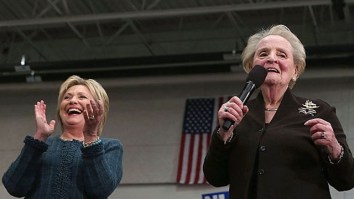
madeleine-albright-and-hillary-clinton“There’s a special place in hell for women who don’t help women…”

That declaration was by former Secretary of State and (depending on the shift in public perception) former feminist icon Madeleine Albright, speaking at a rally for presidential candidate Hillary Clinton.

This comment follows close on the heels of feminist Gloria Steinem’s snide remark that the some 82% of millennial women supporting Bernie Sanders were doing so just so they could meet boys, and not long after DNC chairperson Debbie Wasserman-Schultz accused the same demographic of “complacency.

And the timing is hardly coincidental. Staggered by a Pyrrhic victory in Iowa and a resounding defeat in New Hampshire, the Clinton campaign has been desperately attempting to find a swift end to what will otherwise become a protracted and altogether too-close-for-comfort campaign, and securing the female vote has been the first place to start.

Or at least, such was the intention. Continue reading

Angoulême, #OscarsSoWhite, and the Possibility of Change

I had initially planned on permanently shelving this blog post, for the most part due to the fact that I felt the two incidents I was comparing had come and gone, and I try to stay topical. Then recently Facebook notified me that Kate Winslet not boycotting the Oscars was trending, and just today that acclaimed director Steven Spielberg had some thoughts about the awards ceremony. It appears that a discussion that began with the continuing hashtag #OscarsSoWhite is far from over.

rock

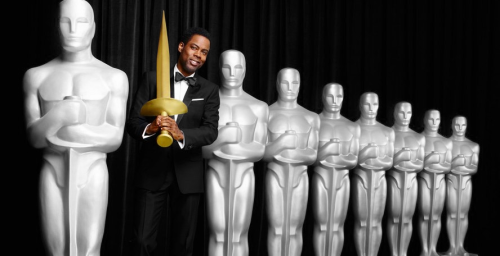
I wanted to call Chris Rock the one bright spot in this upcoming Academy Awards, but the irony was too much.

This may surprise you, but the focus of this particular blog post isn’t race. It is about social justice in general, though [just because this pony has more than one trick doesn’t mean that he has a lot of them]. Social justice is ultimately concerned with change, a positive transformation of our society, and is more often than not battling against the presumption that this is impossible. I’m going to be covering two somewhat recent events, both surrounding awards shows, that prove it’s not. Continue reading

Filmmaker Christine Welsh on Tracing Her Heritage in Women In the Shadows

My Canadian studies class recently watched Women in the Shadows, a documentary by feminist filmmaker and professor, Christine Welsh. Not long after we had watched her film Welsh agreed to visit our class for a question and answer period. Below I’ve included a little of what I learned from her film and her visit.

christine20qu27appelle20valley

1101331

Norbert Welsh’s oral history was recorded by Mary Weekes.

In an article detailing her documentary experience, Welsh explains that her interest had been sparked when her mother recovered a copy of The Last Buffalo Hunter, an oral history by her great grandfather, Norbert Welsh. In the film, however, Welsh attempts to recover more information about her great grandmothers, figures who were much harder to trace.

Along her search, Welsh discovers the name of her great grandmother, Margaret Taylor, and Margaret’s mother, Jane. Welsh surmises that Jane was most likely Cree. Jane’s union with George Taylor meant that Margaret was one of the first generations of Metis women. While documentation about women was lacking during early colonization, Welsh was able to uncover some details about her foremothers because of Margaret Taylor’s connection to Hudson’s Bay Company Governor George Simpson.

In the early period of Canadian colonization, Hudson’s Bay employees often took “country wives”. These women, of First Nations or Metis heritage, would create family ties between the explorers and the local community and were often the reason their husbands survived their first few Canadian winters. In Women in the Shadows, Welsh discovers that Taylor had been Simpson’s “country wife” for many years, only to be cast aside by Simpson when he returned from a trip to England with a new white wife.

Continue reading

Why Hillary Shouldn’t Be President

At the time of this writing, the results of the New Hampshire primaries have yet to be tallied. While it’s generally predicated that they’ll reflect a sweeping win for Vermont senator Bernie Sanders, following weeks will see the battle carried on to Nevada and South Carolina, where Sander’s rival Hillary Clinton is polling much stronger.

The war for the White House is far, far from over, but in the Democrat’s camp it’s still surprising that there’d be such a struggle to begin with.

After all, it was supposed to be a cakewalk.

Former first lady, former New York senator, former Secretary of State, former presidential contender Hillary Rodham Clinton was supposed to have this in the bag. With her extensive political career, her chosen-one status among the party establishment, her global reputation, her nomination was so certain many had dubbed it a “coronation“.

Months into the campaign, and barely scraping by after a virtual tie in Iowa, Clinton’s hopes for an easy win have been obliterated- and yours truly couldn’t be happier about it.

jsc

Am I a Sanders fan?

I’m not sure yet. Continue reading

“Hymn for the Weekend”: Appreciation, Appropriation, and the Exotic Black Woman

I don’t know about you, but I can’t stop listening to “Hymn for the Weekend” on repeat.

However, before I had even listened to Chris Martin and Queen Bey meld their voices in a divine mesh of harmonies, I was reading about it on Tumblr.

Cultural Appreciation vs. Appropriation

The first thing I heard about the video was that it had some pretty rampant cultural appropriation. Since there have been a number of music videos and performances accused of cultural appropriation over the last few years, I wasn’t too surprised to hear about “Hymn for the Weekend” being added to the list.

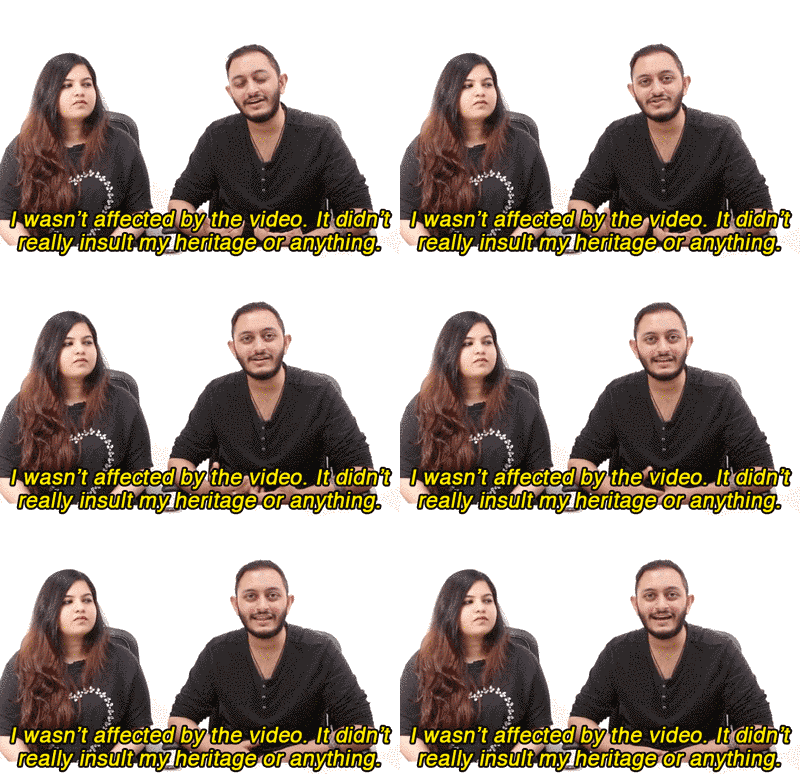
The video quickly split viewers into two groups, those who considered it cultural appropriation, and those who appreciated the video’s focus on Indian culture. The clip below highlights a few of the key elements that have been discussed and criticized.

This discussion is tricky for a variety of reasons. For example, there is a time and place when a white person can wear Indian clothing and accessories without coming off as disrespectful. In some cases, it’s actually much more respectful to embrace local dress customs than to ignore them.

There are even music videos where diverse customs and styles have been featured without any backlash about appropriation.

This debate can also seem confusing when Indian fans, or fans with Indian heritage, don’t seem to be bothered by the video’s representation of their culture.

anigif_optimized-20745-1454418987-1 Continue reading

In The Force Awakens White Women get Representation, but Black Women get CGI

I loved Star Wars: The Force Awakens. I loved it so much that the first thing I thought about doing when I walked out of the theatre was hash out everything that this Star Wars reboot had done right.

Like including legitimately humorous dialogue rather than slapstick CGI sidekicks.

Unfortunately, everyone on the blogosphere had already come to the same conclusion long before I was back from my Christmas break. Still, I couldn’t stop thinking about the film, or reading articles about it. So I’ve decided to write about one of the few things that bothered me about the film, rather than many aspects of the film that I loved.

If you’ve been reading this blog for some time, you probably already know that we at CWR were excited to hear about the diversity of casting in The Force Awakens.

I was especially excited when I heard that Lupita Nyong’o had been cast. Ever since she won best supporting actress for 12 Years a Slave and was declared the most beautiful person of 2014 by People magazine, I’ve been keeping my eyes peeled for Nyong’o. After witnessing her sudden rise to fame, I was curious to see if she would continue to find roles in major films, or if she would slowly be pushed out of Hollywood because of her dark skin. As Gregg Kilday explains in his article about Nyong’o, few black actresses have ever managed to secure a spot as a permanent Hollywood heavyweight:

While the stage would appear to be set for [Nyong’o] to ascend to the A-list — just as Jennifer Lawrence did after her best actress win for Silver Linings Playbook last year — it’s not that simple. For while there have been a handful of African-American actors, from Sidney Poitier to Eddie MurphyDenzel Washington and Will Smith, who have reached that status, there’s never been a black actress who has become the equivalent of a Julia Roberts or Angelina Jolie. Whoopi Goldberg came closest, following her best actress Oscar nomination for 1985’s The Color Purple and supporting actress win for 1990’s Ghost, but despite an occasional hit like 1992’s Sister Act, she didn’t maintain that momentum. Hollywood also flirted with Angela Bassett, Thandie Newton, Halle Berry and, most recently, Mandela‘s Naomie Harris, without ushering any of them into its very top tier.

It seems like a habit for major blockbuster films to tick off their diversity checklist by casting a white woman and/or a black man. Meanwhile, actors from other minority groups, especially women of colour, get overlooked because all the non-white, male roles have already been taken. As Evan pointed out in his post about the Martian and racebending, this seems to be the impulse, even when it means casting a white women to play a Korean- American character and a black man to play an Asian- Indian character. Continue reading