Category Archives: media

Fame Day: American Horror Story

americansdoghasdToday, I’d like to tip my hat to one of my favorite shows, a young series by the name of American Horror Story.

Now it’s no secret that the horror genre is universally despised, being seen by many as being lower on the totem pole than even toilet-humor comedies or the most saccharine romances out there. I could probably spend an entire post speculating on why exactly horror flicks are treated with such little respect (a lot of it is probably due to the genre’s inbred cousin, the “teen scream” flick), but that’s another topic for another time. I’m here to simply showcase the series and highlight a few of its key strengths and accomplishments that I think make it worthy of a Fame Day.

Each season of the show (the second has just concluded, and a third has been greenlit) is a separate story, made up of the horrific lives of the characters as they struggle with their pasts, their inner demons, and some ever-present terror always lurking just beyond the shadows. It essentially cashes in on the initial charm that LOST had before it jumped the polar bear.

Guilt and shame are themes that play heavily into the series as a whole (or at least, the past two “stories”), giving even the most heinous characters a degree of sympathy. Again, similar to LOST at its best, the constant shifting of the story from one perspective to the next prevents the series from ever being boring. Granted, the madcap pacing doesn’t always work (especially in the first story), but for the most part, the audience is always kept interested.

And that brings us to the first key accomplishment of the series:

Popularity

As I stated above, horror is simply not popular- at least, not in any mainstream way. Tim Burton’s lighter works are really the closest most people get to anything remotely macabre, and the fact that the series has continually drawn in high ratings (to say nothing of critical acclaim) is nothing short of amazing. And we’re not talking about a series that is eerie or has a handful of jump-scares, we’re talking about truly unsettling elements here. I’m certainly not alone in hoping that that AHS‘s continued success serves to begin building bridges between mainstream entertainment and horror subculture; heaven knows both could benefit from some fresh perspective.

And even in the subculture, AHS is playing a pretty major role. It’s…

Raising the Bar

As a result of the genre’s (comparative) isolation, quality in horror is typically pretty rare. When you can’t secure funding for special effects, good equipment, or even B-level actors, chances are your product isn’t going to be all that good. Of course, when you have a built in audience who would pay money to watch Dwayne Johnson protect an orphanage from chupacabras, why would you even bother trying?

I would actually probably watch that…

I’ve seen my fair share of (decent) horror movies, and I can count on one hand the films that had even passable cinematography. AHS, as a series that actually has some decent funding and actually puts effort into creating tense atmospheres and believable effects, is raising the bar for the entire industry. When AHS is the basis for most people’s experience with the genre, there’s going to be pressure on the rest of the industry to meet and excel the expectations the mainstream audience is going to have. Furthermore, AHS‘s star-studded cast (including Zachary Quinto, Ian McShane, James Cromwell, and, I kid you not, Adam Levine) is hopefully going to make the horror genre more inviting to high-caliber actors who can actually sell the audience on the direness of the situation and maintain interest without having to drag in a bunch of fornicating teenagers.

The series is actually one of the few I’ve ever seen that actually gives teens any credit or respect…

And perhaps most importantly, it comes down to this:

Depth

While the stories are good, as are the actors (Jessica Lange being easily more frightening than the goriest bits of the series), it’s some of the basic discussions held during the stories that really hit home. Oppression of women and the dark history of psychology are topics repeatedly brought up, and dealt with both in a historically accurate and totally visceral manner. Perhaps the most disturbing thing I’ve yet seen in the series hasn’t been any of the monsters or murders- it’s been a demonstration (scaled back for TV, even) of the psychological “treatment” given to people “suffering from homosexuality,” seen at the time as a mental disease. Those five minutes alone were more frightening than anything else in the story- and it was amazing. Amazing to see some serious and deep social commentary made, and to see the brutality and insanity some people had to undergo actually presented in a way that’s going to resonate with the audience. You will be a better human being for having watched that scene.

Though in the spirit of honesty, your view of nuns will probably diminish a bit…

When’s the last time you could say that about a rom-com?

American Horror Story, keep up the good work.
A final note. I would’ve included more gifs, but (1) I didn’t want to spoil anything and (2) easily 90% of all AHS images are of Evan Peters, who is apparently just the bee’s knee’, if the series’ female fans are to be believed.

Evan and Gordon Talk: Separating Art From Artist

GORDON: Ladies and Gentlemen, boys and girls of all ages, welcome you here to Evan’s Dignity Memorial Art Gallery to view these lovely pictures of houses and flowers and stuff. The artist? Adolf Hitler.

Why, you ask, do we have Hitler’s youthful paintings and sketches? Because tonight we’re going to be talking about separating art from the artist, and whether or not such a thing can be done.

EVAN: To throw out an example, let me refer to the science fiction author Orson Scott Card, a man famous for writing Ender’s Game and for being pretty staunchly opposed to homosexuality in any form.

DC has hired him to pen a new “Adventures of Superman” comic for them, and quite a few stores have decided to boycott this product and not stock them. This being done, of course, as an act of protest.

GORDON: We’re not talking about some latent disapproval of homosexuality people, we’re talking about full blown vitriol on OSC’s part. Here’s a quote from him on the subject:

The dark secret of homosexual society—the one that dares not speak its name—is how many homosexuals first entered into that world through a disturbing seduction or rape or molestation or abuse, and how many of them yearn to get out of the homosexual community and live normally…

OSC straight up declares  in one piece of his, that he will not simply advocate, but will actively engage in the overthrow of the government should it ever attempt to legalize gay marriage:

Regardless of law, marriage has only one definition, and any government that attempts to change it is my mortal enemy. I will act to destroy that government and bring it down, so it can be replaced with a government that will respect and support marriage

EVAN: Which is straight-up reprehensible, which I hope you’ll agree with regardless of your personal stance towards the very loaded topic of gay marriage, etc.

GORDON: Absolutely.

EVAN: On a similar note, we have Frank Miller, a legend in the comics industry.

 The guy penned Batman: The Dark Knight, 300, Sin City, and had a marvelous run on Daredevil that really defined the character. The man’s a legend.

He’s also on record for calling members of the Occupy Movement “nothing but a pack of louts, thieves, and rapists, an unruly mob, fed by Woodstock-era nostalgia and putrid false righteousness.”

The Occupy Movement doesn’t have the same hot button status gay marriage does, and it’s arguable that people are less certain about it, but that doesn’t make the things Miller said any less ignorant or wrong.

GORDON: Again, this is true. But we’re not here to list off the artists and creative minds who have maintained ignorant or bigoted positions over the years.We’re here to talk about separating them from their art, and I’m going to submit that one some fundamental level, it can’t be done.

EVAN: Alright, let’s hear why.

GORDON: I’m going to cite Miller’s iconic work The Dark Knight Returns, which has just recently been adapted as an animated film.

It’s not hard to see Miller’s borderline fascist views bleeding through in the book, as he takes pot shots at “reform not punishment” imprisonment, youth (portrayed as violent, stupid, barely comprehensible thugs that even Alex DeLarge would be creeped out by), and even the latest Robin’s parents being portrayed was whiny, drug-addled liberals.

While I doubt Miller was using much restraint, I’m going to submit that the artist is almost always too close to his or her art for her views not to bleed through.

EVAN: So members of Oprah’s book club who read The Education of Little Tree, by former member of the KKK Forrest Carter, should have been able to pick up on his racial sentiments?

GORDON: I said “almost.” Obviously there are exceptions to the rule.

And this isn’t to say that the work itself is to be shunned; I really and truly enjoy Miller’s work, even though he has a goose-stepping, paranoid Islamophobe.

Because of this, in particular.

EVAN: So we shouldn’t let the beliefs of creators affect our enjoyment of their work?

GORDON: I’d hope not. That would preclude me from liking anything done by Dali, any music written by Wagner, and so on and so forth. My issue isn’t with enjoying something a despicable person has made, my issue is with hiring someone you know is despicable.

Would I listen to “Flight of the Valkyries”? Yes. if Wagner was alive today, would I hire that anti-Semite? No way.

EVAN: That’s a really good point. For example, anyone who buys the new “Adventures of Superman” comic will actually be indirectly funding various anti-homosexual movements that Card himself supports. In this case paying money for his product actually results in an action you probably aren’t okay with.

That doesn’t mean that you couldn’t read his comic and think, “Huh, that is a great take on the Last Son of Krypton,” which is entirely likely since he really is a great writer. His art isn’t necessarily affected by his beliefs, but your buying his art supports them, in a roundabout way.

It’s a metaphor for rejection

GORDON: Despite the counter-arguments in DC’s favor, the simple truth of the matter is people aren’t going to be boycotting these books simply because they’re angry at Card- they were angry at him before- they’re also angry at DC for not having the basic decency to not go into business with a raging homophobe.

EVAN: No matter how good a writer, or any other kind of artist, is, there will always be another who approaches them in talent who doesn’t espouse the negative views that they do. The fact of the matter is that DC has other options.

But going back to the topic at large, we confirmed earlier, in a way, that knowing about an artist’s beliefs after you’ve already appreciated and enjoyed their work shouldn’t rob you of that. If I see a painting and think it’s quite lovely, then find out Hitler painted it, that doesn’t suddenly cause it to become hideous in my eyes. At least, it shouldn’t.

GORDON: And because of the pressure we the audience can put on companies to ensure that bigots and nutcases aren’t given a platform, we should try to keep the artist and their work tied together.

EVAN: Voting with our wallets, which should really be done in every area of our lives [buying ethically produced products, high quality entertainment, etc.].

GORDON: Kinda thrown off by the fact that some wallets are thicker than others. But such is Capitalism. Overthrow the bourgeois. Down with the system.

EVAN: But that is a topic for another day. One that I may or not be hopping on, simply due to a lack of knowledge on the matter.

And it’s also about time we wrapped things up.

GORDON: I submit that next week we discuss poverty, as more and more of the nation (and world) slips into it.

EVAN: And I think that we should talk about Gordon never seems to win these polls.

Ha! Just kidding. We could maybe talk about . . . eh . . . yeah, I got nothing. I’m gonna open up my spot to be viewer submitted, just to see what ideas you have in mind.

GORDON: How gracious of you. Perhaps you’ll even close us out here?

EVAN: Thanks, as usual, for tuning in. If you have anything you want to tell us in general, feel free to email us at culturewarreporters@gmail.com, we’re always happy to hear from you.

More Writing On Sexual Standards

The dearth of creativity that went into titling this post aside, I thought I’d tackle yet another double standard that appears to exist in our culture. To begin with, let me refer you all to my primary example, Season 4 Episode 5 of Top Chef: Masters, “Holly Madison’s Pool Party.”

In this case, the background behind the show itself is pretty inconsequential: 12 award-winnings chefs compete against each other to raise money for charity, et cetera. On this season the chefs spent the vast majority of their time in Sin City [Las Vegas, aka where Gordon resides] and rubbed shoulders with quite a few celebrities. The superstar for this episode was Holly Madison, of Playboy’s “The Girls Next Door” fame, and their task was to cater her pool party.

Enter James Oseland, editor of Saveur and one of the show’s judges. At the party musclebound hunks abound, and after one is encouraged to sit next to the critic he somehow manages to ask “how are you guys gonna like, keep the, this thing [abs], going with, wha- all this food.” As he refers to the man’s midsection he gives it a few pats, prompting responses like the following [which I found on The A.V. Club, of course]:


And Larrybaby’s points are all incredibly valid. Thankfully the guys and girls who peruse the TV Club reviews weren’t the only ones to notice this, and celebrity chef website [yes, it is a real thing] The Braiser did a short bit on the episode. Oseland’s antics are described there as follows:

So, naturally, the daytime cocktails start flowing, the croque madames sizzle on the griddle, and James Oseland starts giddily stripping pool boys. Wait, what?! Yes, Saveur editor-slash-very esteemed and shmancy Top Chef: Masters judge James Oseland gets a little on the trashed side of tipsy at brunch and takes matters into his own hands when a cluster of bikini-clad women fail to get a pool boy to take his shirt off.

James marches right on over to the ripped hunk of manflesh (née “Warren”) and strips his shirt right off. And then he grabs another equally buff guy and steals his shirt, too! James Oseland is shameless, you guys.

Of course, the article then goes on to describe how they’d love Oseland to be their celebrity BFF, but we won’t go into that. The point I’m trying to make is that this man, who, yes, is a homosexual, acted in a way that was inappropriate. More than that, he wasn’t stopped but was actually encouraged by those around him with cheers.

I’m not saying that I dislike watching homosexual characters on television, or that they make me uncomfortable; far from it. Max is easily my favourite part of the sitcom Happy Endings, and his adventures in romance  are both engaging and hilarious. I’m still waiting [and I know I’m not the only one] for Raj on The Big Bang Theory to come out of the closet, and more and more I’m realizing that it really is just art imitating life. Living in Toronto I’m very aware that there’s a gay population  out there, and it just so happens that TV has finally gotten around to representing them.

What I don’t want to see is gay people, men or women, being handsy when they shouldn’t be. I don’t really appreciate it in heterosexuals, and the same extends to all other orientations. If James Oseland thinks a pool boy is cute that is fine. If he wants to touch him, that is also fine. If he touches him in front of others and without the permission of said pool boy, to flirt openly in a physical way, that is not fine. It’s kind of gross.

There’s not much more I can add to what larrybaby said, because he [or she, I don’t know] sums it all up really well. I’m not a homophobe by any means, but I’d like the world as a whole to keep people to the same standards. Let’s not cheer someone on when they paw at another person they’re attracted to. If we’re going to acknowledge homosexual urges and relationships as on par with heterosexual ones let’s treat them the same way.

I end with another comment highlighting the actions of both Oseland and his fellow critics [context: the hunks were asked about sit-ups, and one actually did push-ups for the critics’ benefit a little later]:

jmann

Evan and Gordon Talk: Why Christian Media Is So Bad

EVAN: The particular topic of discussion that comes to us today is more one that finds itself passed back and forth within Christian circles, and that is: “Why is Christian media so bad?”

GORDON: I think the problem is self-imposed by the religion (I use the term loosely) itself. We’re not talking about a lack of funding (we’ve got plenty of good low-budget films), or a lack of good directors (there’s plenty of decent talent out there), we’re talking about an issue that runs right down the core of it all.

“Christian” media can’t just be media- they have to drag in everything that goes with it.

EVAN: So basically what you’re saying, and we talked about this a little earlier, is that Christian media more often than not has an agenda, correct?

GORDON: I’d say plenty of it has an agenda, but no, I don’t think that’s the core issue-  there’s plenty of other preachy movies out there.

EVAN: So what are you saying, exactly?

GORDON: I’m saying that “Christians” can’t make good media because they won’t allow themselves to. Every protagonist has to fit the moral code to a tee, so that they wind up as either Aslan 2.0 or the epitome of Christian morality: John Smith, the middle class suburban, patriotic family man. Which is why I keep putting “Christian” in quotation marks.

We’re not talking about Catholic peasants in El Salvador or the East Orthodox Church in Ethiopia.

EVAN: Okay, I like that a lot, this idea that those creators of Christian media [and primarily I think we’re talking about films] box themselves in. They’re telling the same sorts of stories to who they perceive to be their audience [and they’re not wrong]: white suburban middle class families.

To sort of break this up a little, I actually saw a Christian film that was reasonably passable at some point last summer.

GORDON: Was it related in any way to Steve Taylor?

EVAN: Is that any way related to “End of the Spear”? It was not, if that’s what you’re referring to.

GORDON: Steve Taylor is the only good Christian musician who ever has or ever will have existed.

But anyway, what was the movie you saw?

EVAN: It was called “To Save a Life,” and it stood out for a couple of reasons:

1) The cinematography was shockingly good for something produced and made by Christians. You can tell which movies they are within the first few seconds.

2) The “villain” of the piece was actually the pastor’s kid. Which was- refreshing, and kind of nice.

It kind of broke out of the whole stereotype you introduced earlier.

GORDON: Huh- interesting. I’ll have to check out the trailer. But let me ask you this:

Can a Christian make a James Bond movie?

EVAN: You mean a movie starring a suave, debonair British man who beds women and guns down henchmen as naturally as he dons his suit jacket every morning?

I’d say no, probably not.

GORDON: I think that’s the problem. It’s not just that you can’t have any explicit sex or graphic violence or excessive profanity (which are overused and abused as is), you can’t have anything even remotely sensual or rough or crude. It rips away reality and humanity in the name of not stepping on anyone’s toes.

Self-imposed legalism.

EVAN: Well, I’d say the difference is that you can’t have a protagonist who glorifies such things as wanton sexuality-

I say that Christian filmmakers will never produce anything like James Bond because of who the character is.

GORDON: Did you like the movie “Fight Club”?

EVAN: I liked it a fair amount.

GORDON: Did you like “Ocean’s 11” or “Snatch”?

EVAN: I haven’t seen the latter, but I very much enjoyed the former.

GORDON: Did you like “Superbad”? “Kick-Ass”? “Ironclad”?

EVAN: I enjoyed aspects of the first, thought the second was a shaky, though fairly decent adaptation of the source material, and thought the third was pretty unfair in its depiction of “strong female characters.”

But I think you’re going to have to get to your point-

GORDON: Could a Christian make any of these movies?

EVAN: I think a Christian could, yes. In relation to “Fight Club”, at least, Christian author Ted Dekker has penned novels [sold both in and out of Christian bookstores] which offer a fairly decent psychological thriller aspect to the reader.

GORDON: Ah, Dekker. The whole reason he stands out as an exception is- I believe- that he grew up among Indonesian headhunters, and not in Middle America. Again, it’s about having that different perspective on life.

EVAN: And I think what he’s realized, as a creator of the arts, as someone who has a hand in shaping Christian media, is that you can have these other sorts of exciting, thrilling stories told with a faith-built worldview. People of every religion want a little excitement.

GORDON: Of that there’s no question. The heavy use of the video library at our school stands in testament to that.

But again I think the issue is that “Christian” self-imposed isolation inevitably leads to the vast majority of their work winding up as “White People Problems” or “Chronicles-of-Narnia-minus-the-good-stuff”…

EVAN: Or “Lord-of-the-Rings-but-way-more-heavy-handed.”

GORDON: Exactly.

EVAN: I mean, we’ve talked a little bit about why Christian media can be bad [terrible production values, cookie-cutter story lines, sheer absurdity], but how could it be better [to harken back a little to our last talk]?

GORDON: They have to stop being terrified of the big bad world. They have to realize they can show characters with flaws- real flaws- not drunkard stereotypes and the occasional swear word.

Saying this will get you expelled from Liberty, Pensacola, and BJU

EVAN: I mean, a deeply flawed person who finds redemption is a much more compelling story than a white bread sort of guy with his middle class problems.

And they have to stop coddling their audience. Yes, Christians turn to Christian media for “better alternatives,” but the odd cuss word won’t negate an overall positive message; neither will a fight scene, or two guys sitting around enjoying a beer.

GORDON: There’s this one scene in a (Christian) movie Steve Taylor directed:

A character hurts his hand loading something into the back of van. He lets loose a cuss word and his buddy chides him for it, saying “God don’t like it when we cuss.”

Later on in the film, the buddy hangs his head and apologizes, saying “I’m sorry. I was upset that you cussed- I should’ve just been upset that you hurt your hand.”

EVAN: Wow. That is very, very good.

GORDON: That right there is the problem not just with Christian media, but with the whole religion.

EVAN: Misplaced priorities.

GORDON: More obsessed with present clean-cut paragons of middle class etiquette than anything really real.

That’s why we turn to “secular” movies for actual substance. The struggle for identity in “Fight Club”, the heroism in “Kick-Ass”, the friendship in “Superbad.”

EVAN: I think what’s really ironic is that Christian media-makers have a Christian-made work out there that’s immensely popular. “The Hobbit: An Unexpected Journey” came out just this past December.

GORDON: I again reference an (alleged) quote by Steve Taylor.

“I’m not a Christian artist- I’m an artist who is Christian- it affects what I do.”

EVAN: Really well-put. And something that a lot of us [I speak for many in our graduating class] as writers, musicians, artists, et cetera would benefit from keeping in mind.

And that puts us more than a little overtime.

GORDON: Well, people, you know what that means. Time to vote on our subject for next week.

EVAN: My contribution this time around is . . . wow, I never think ahead . . . masculinity. You’ve done a post about “Manly Culture” in the past, but I want to talk about what it is at present, and how we feel about the shifts and trends and things.

GORDON: Interesting subject. I submit we speculate on the upcoming Star Wars movies.

EVAN: If you think you’re up for it, then yeah, cool. I’ve read quite a few of the post-original-trilogy books, so I know a reasonable amount about the subject.

GORDON: Nerd.

And with that witty response, we’re out! Have a good night, everyone.

EVAN: Spend it with better friends than Gordon.

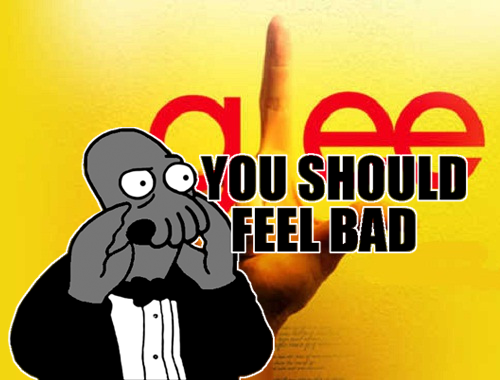
Shame Day: Glee

shame gleeTo begin with, I’m not a huge fan of Glee. I am a man who can say with confidence how much he loves musicals and acapella arrangements, but the show’s claim to be a melting pot of diversity [a place where Black people, Asians, homosexuals, and the disabled can belt it out to their hearts’ content] is not one I find myself agreeing with. But that’s the topic of another post.

Last week internet sweetheart Jonathan Coulton, known first and foremost for being the composer of “Still Alive”, the song that plays at the end of the game Portal, wrote a blog post in response to last Thursday’s episode of Glee. Specifically, the post was in response to their cover of “Baby Got Back” by Sir-Mix-A-Lot, which you can listen to here:


The issue being that Coulton released his own version of the song in 2006, which you can check out [and should, for comparison’s sake] here:


If you really want to scrutinize the two side by side, there’s a track on Soundcloud that simply places both tracks on top of one another [and an in-depth audio analysis, for those of you into that]. Coulton’s issue isn’t simply that Glee seems to have stolen his arrangement, but did so to the point where unique elements he added were copied as well. A duck quack is used to censor an expletive, and [this is practically impossible to ignore] the lyric “Mix-a-Lot’s in trouble” is replaced with “Johnny C’s in trouble” in both versions.

As he has kept the blog post constantly updated, four days ago he announced that having gotten in touch with the people at Glee, the following information was relayed to him:

They also got in touch with my peeps to basically say that they’re within their legal rights to do this, and that I should be happy for the exposure (even though they do not credit me, and have not even publicly acknowledged that it’s my version – so you know, it’s kind of SECRET exposure). While they appear not to be legally obligated to do any of these things, they did not apologize, offer to credit me, or offer to pay me, and indicated that this was their general policy in regards to covers of covers.

While Coulton is unsure of his exact copyright claim to the track, he had obtained a Harry Fox license to release it on an album alongside his own original music. His response is, refreshingly, a mature one in response to this whole ordeal.

He has re-released his track on iTunes under the new title “Baby Got Back (In the Style of Glee). “ Thanks to using the same license as before, Sir Mix-a-Lot will collect royalties, and all proceeds from the following month will go to charities The VH1 Save the Music Foundation and The It Gets Better Project.

This has, of course gotten its fair share of media attention. From a Facebook status by webcomic artist Rob DenBleyker to posts by Kotaku and The A.V. Club,  the internet appears to have rallied behind one of its own.

In his interview with Wired magazine Coulton shared a very simple solution for the show that spends millions per episode. He suggests that “they could offer to pay artists whose arrangements they use the same amount of money they would otherwise pay a musical arranger,” and that “if they opened with that, I’m sure a lot of artists would jump at the chance.”

Somehow, this isn’t the first time this has happened. Singer-songwriter Greg Laswell’s cover of a song made famous by Cyndi Lauper, “Girls Just Wanna Have Fun”, was also seemingly ripped off for an episode in November 2011. I’ve embedded the two songs for you to compare once again [and because I’ve gotta break up this wall of text somehow]:


Unfortunately, Laswell did not quite have the fan following that Jonathan Coulton does, and as a result this happened more or less without incident. The Hollywood Reporter did a short piece on it the month following, but from what I can tell it didn’t generate much controversy. Similarly, Petra Haden’s arrangement of “Don’t Stop Believin'” may have been appropriated without permission [i.e. stolen] by Glee as well.

It remains to be seen whether or not Coulton’s lawyers will be able to take legal recourse, but for the time being I’m happy that the show is finally being taken to task by those who believe that creativity should be rewarded and acknowledged, not plundered.

A Comic Lover’s Opinion on “The Bakersfield Expedition” [Last Night’s Episode of The Big Bang Theory]

I love comics. In no way should this be a surprise to anyone who’s given this blog more than a passing glance. I also love television a lot, and when the two happen to overlap you can be assured that you have my undivided attention.

Yesterday I wrote a little bit about Bleeding Cool’s response to The Big Bang Theory episode “The Bakersfield Expedition”, half of which revolved around the premise that the show’s female cast would be entering a place traditionally closed off to their gender. I was able to catch the show last night and have many thoughts, but my ultimate conclusion is this: It really wasn’t that bad.

The guys, Sheldon, Leonard, Raj, and Howard are all off to the Bakersfield Comic-Con, so the girls enjoy their weekend alone by having brunch [an idea celebrated by the character we all know is an alcoholic, Penny].  While sitting around and enjoying their croissants and mimosas, Amy states that she doesn’t get why the guys go to these conventions. To which Penny responds:

“The four of them work at a major university, they’re all super smart, how can they still be into something made for 12-year-olds?”

Which did not please me. Having given it a second viewing, however, I realize that it’s a believable response and the perspective many people still have on the medium today. Bernadette suggests that they try to become a part of their significant others’ lives by seeing what the big deal with comics is, and soon they’re all off to their LCS [local comic store].

As the promo advertised, the following does indeed happen:


But it’s a quick gag that thankfully doesn’t overstay its welcome. Owner of the store and new series-regular Stuart is quick to chastise his socially awkward clientele and is soon talking to the girls about comic book recommendations.

Amy’s direct approach of asking “Alright, well who’s the best super hero?” and Stuart’s haste to nip that line of questioning in the bud was fantastic. There isn’t really any media that’s cut and dry as far as what “the best” is, and his whispered “What do you want to do, start a riot?” communicated well that this is a pretty contentious topic in certain circles.

Stuart also does a great job in saying that there are many different kinds of comics, and a little later on that there are different types of super heroes as well. The character really shines when he recommends to the ladies the incredible Fables #1, about which he says:

“The artwork is sophisticated, it’s intelligently written and it doesn’t objectify or stereotype women.”

Unfortunately Penny ultimately chooses for the group when she looks over and sees an issue of Thor and notes that:

Back at the apartment Amy and Bernadette sit quietly as they wait for Penny to finish the twenty-or-so-page issue. The following exchange occurs:

Amy: “There was a lot of action, the story moved along at a brisk pace, it was overall, what’s the word I’m looking for?”

Penny: “Stupid”

Amy: “So stupid.”

This upset me when I first watched it, but upon finding out the title was Thor, God of Thunder #2, written by Jason Aaron and illustrated by Esad Ribic I was dumbfounded. The Big Bang Theory has always been really good about keeping their comics contemporary, and the stock in Stuart’s shop actively changes to keep up with what’s new on the stands, but this was something else entirely. Aaron’s new Marvel NOW! title follows the character as he grows from a young, brash god to the hero we all know today and then further on to his role as the future king of Asgard. It’s masterfully written, and features artwork like this jaw-dropping splash page [which also happens to be my current desktop wallpaper.

I’m willing to assume, probably correctly so, that the show was in no way actually referring to anything in the actual book [though it would not surprise me to have an entire page featuring the single word “Krakka-DOOM” in a Thor title].

Then, as the three gripe about the waste of time that is their boyfriends’ [and husband’s] pastime, Bernadette notes that “It’s crazy, they spend hours arguing about things that don’t even exist!” And then things get interesting. Penny mocks the idea of a “hammer so heavy that no one else can pick it up” and then before you know it the girls are deeply debating the fundamentals of who or what can wield Mjolnir.

A lot of good points are bandied back and forth, but the best is easily Penny’s observation that:

“If we were in outer space, anyone could pick up the hammer  because it would be floating around in a weightless environment that’s right the slow reader used science suck on that.”

Wonderful. I say that without a trace of sarcasm.

After a fairly unenjoyable pan back to whatever it is the guys are doing we return to see that the girls are in Sheldon and Leonard’s apartment, eating takeout with comics strewn all around them. They are still talking about Thor’s hammer. Then the following exchange happens [and this is my last quote, I promise]:

Bernadette: Red Hulk must be worthy.

Penny: How can Red Hulk be worthy?

Bernadette: You don’t know his life!

If there was any laugh-out-loud moment of this entire episode that was it.

Coming away from watching “The Bakersfield Expedition” for the second time [which I did to write this post] I have to say that I quite enjoyed exactly half of it. Absolutely no part of me was invested in the guys trekking [ah ha] around the desert as a Federation landing party. What I was interested in was watching three characters, formerly wholly unfamiliar with comic books, arguing intensely about a matter which, and I’ll be honest, is not important in most senses of the word.

While The Big Bang Theory has often taken the nerdier passions and portrayed them in a fairly mockable light, it was certainly not so in this episode. Yes, comic books were referred to as something for twelve-year-olds, but Stuart does a great job in telling both the girls and the audience that it’s a broad, diverse medium that has beautiful illustrations and excellent writing, as well as a little eye candy for the ladies.

Rich Johnston at Bleeding Cool thinks they did a passable job at addressing comics, but continues to assert that it’s still The Television Show That Hates [Comic Book Fans]. The episode review over at The A.V. Club’s TV Club actually referenced the Bleeding Cool movement [which you again read about in yesterday’s Fame Day post] and similar to what I did focused mainly on the girls’ plot for this episode. The comments section of that review go over the age old conversation of how the show treats its subject material and its potential audience, but that is another post for another day.

All I have to say is that I was pleasantly surprised by the episode, and enjoyed it much more than I thought I would. I also finally received the second volume of Mark Waid’s Daredevil, so this is not a day on which I can feel unhappy. Here’s another picture of Thor from Issue #4 of Aaron and Ribic’s title for all you lovely people.