In my attempt to err on the side of caution in regards to confidentiality, I rarely speak about my job, let alone write about it. Such is the nature of social work. Even so, the subject of today’s post has been preying on mind for a while now, and while I’m still going to not disclose the entirety of what I do, I am going to put it out there that I am (essentially) a vocational counselor for individuals who have criminal backgrounds. I just want to show that I do have some basic understand of some of the things I’ll be discussing, and I’m not speaking simply out of speculation. So what are we talking about today? Crime, criminals, and why you shouldn’t be afraid of either.
Except the Corleones, who are the Lannisters, but without the inbreeding… Oh wait- wasn’t there something up with the cousins in the 3rd movie? I try to suppress it…
What’s the first thing that comes to mind when I say the words “wife and homemaker”?
Exactly.
Now as you probably know by now I’m getting married this summer. I’m super stoked about spending the rest of my life with John because he is my best friend and we have awesome adventures, but I’ve been struggling with what it means to become a wife within our cultural context.
Look at us! We’re married! Now we can jump on the bed!
It’s occurred to me that I actually don’t know when high schools in the US finish for the summer. I’m still reducing my speed through school zones on the way to and from work, so I presume some of them are still in session- having been home-schooled overseas my whole life, I can only really guess.
One way or another, though, kids will be finishing up, or will have just finished up, so it’s high time we at Culture War Reporters dispense some unsolicited paternalistic wisdom to all the youngsters about college.
There are certain things in life that can be avoided.
For all our howling about vapid, synthetic pop-songs we do, at the end of the day, have the ability to simply turn the radio off. For all our wailing about trashy, stupid television, we have the ability to just point our remote and switch off the TV. Even people who annoy us we can at least avoid.
But that’s not so much true when it comes to advertising. Unless you’re living in an underground bunker somewhere in Colorado, it’s not something you can get away from.
Why you’d even be reading this blog, I don’t know.
Between telemarketers, logos, TV and radio, billboards (including mobile ones, which we have in Vegas), and the internet, there’s really no escaping. Even if you’re sitting alone in your house, it’s all around you. You’ve got company emblems stitched onto your shirts. Manufacturer’s names written on your underwear. Go to your kitchen, and you’ll find advertisements on the back of pasta and cereal boxes.
I’m only here to offer some food for thought; I won’t be taking up myself the war cry that advertisements and commercials always play to the lowest common denominator. Sexuality in the crassest, most objectified form, greed, gluttony, envy, passivity, sloth (not the kind shown above)- it’s all there, and thrown at us every waking minute of every day of our lives. What does that do to us?
Most people who work with this line of thought point to the movie Idiocracy as a dark prophecy of the world to come.
In this movie, a man is (accidentally) cryogenically frozen and awakens in a dystopian future where advertising and trashy TV has resulted in the average human IQ dropping well into the double digits. While it’s not a masterpiece in and of itself, and it’s suggestion that dumb people have inherently dumb kids is just plain wrong, the fact that more and more our society seems to be moving towards Idiocracy is downright eerie.
I will, nonetheless, offer an alternative for you to ponder.
What if advertising is actually raising our BS awareness? Information on the internet is usually either (at best) misrepresented or (at worst) outright falsehood. We don’t seem dumber as a species for it- on the contrary, we seem more skeptical and discerning. Perhaps we are, in fact, becoming tougher to fool. Naturally I can’t point to any cause-and-effect relationship, but it’s certainly something to think about.
Of course, there’s the dark alternative to that as well.
What happens to our psyches and society when we’re constantly on-guard against everything? Is that paranoid cynicism really healthy for us? What does it do to us to hold everything in contempt as just another scheme to take away your money? Even if we tone that down a bit, what does it do to us to walk through life constantly being sold things? Cradle to grave, confronted by sales pitch after sales pitch- how can that be anything but damaging?
Again, this isn’t to simply rail against advertising. There’s plenty that advertising, well, I don’t want to say “does right,” but certainly does “well.” Managing to communicate messages or ideas in the shortest amount of time using the smallest amount of words and images is, well, impressive. The ability to remotely encode associations, emotions, and reactions in the human mind through slogans, catch phrases, campaigns and the like is undeniably clever, even if more than a little Orwellian.
Imagine if all that money, research, and manpower was put towards something actually constructive. Imagine even just a quarter of all advertising dedicated to communicating positive messages. How much more of an intelligent, healthy, compassionate society would we be? If nothing else, it would mean some telemarketers could do something more fulfilling with their lives than shilling out cruises in the Caribbean.
EVAN: This week on E> we take a break from scrutinizing film to look back about seven or so months to a different time of our lives: college. Now that we’ve both graduated we find ourselves in a different stage of life, and it begs the question of what those four years did for us, and whether or not that’s what we wanted or expected.
GORDON: Throughout my college career, especially towards the end, I heard a recurring argument:
“College is a scam,” they said, “It’s a trap or, at very best, a waste of money. You don’t learn anything you can actually translate into a job, so either drop out while you can or don’t sweat the grades and party your buns off.”
EVAN: Wait, who is the “they” that was saying this?
GORDON: I’ve read it in various Cracked articles, I’ve seen it covered in webcomics and in comments, I’ve heard it on the radio. Not always the same tone, but it always boiled down to that essential idea. “College doesn’t teach you what you really need to know, it just puts you in debt and wastes your time.”
EVAN: Well, I guess that really begs the question of “What is it that we’re really supposed to know?” If college is the great institution to prepare us for our lives, what should it have taught us?
GORDON: Some would argue that technical and vocational skills are what we really need. Stuff that’s meant to train us for jobs. Wrenches, not Whitman.
EVAN: Which is the sort of thing you see advertised on television late at night or in the middle of the day; schools for electricians and dental assistants and plumbers and what have you.
GORDON: Which always come across as propaganda films from a dystopic alternate timeline. They can claim to be breaking the mold all they want- I’ll still always just see Orwellian Factory-Schools designed train the subservient masses for laboring in name of supreme leader and glorious fatherland.
EVAN: Heh heh.
The contrast to this idea you brought up when first introducing this topic, that the two sides could be seen as college prepping us for our careers or making us more well-rounded individuals.
There’s obviously more to it than that, but how would you boil the latter option down to its essence?
GORDON: I’d probably cite our own alma mater’s (for me more just “mater”) slogan of “global mindedness.” The idea is to create people who are, first and foremost, thinkers. Logical and critically minded thinkers with strong creative abilities and appreciation for art and wonder. A noble enough sentiment to be sure.
EVAN: To really engage with this topic I feel like we should have equal footing, and I’ll have to give our readers a little bit of context-
I’m currently unemployed, and chose to live the latter part of 2012 living with and taking care of my grandfather, whose wife [my grandmother] passed away in September. My job hunt has only very recently started up again.
I say that because as it stands one of us is currently working and knows how his education has aided him and the other is not.
GORDON: I, unlike my Canadian counter-part, am currently employed, having worked two jobs simultaneously for a while there. Having vainly searched for a job the entire summer and most of the fall, I am now working a job helping unemployed people find work, the irony of which is not lost on me.
EVAN: And did you, my Employed-American friend, find that a degree helped you in your search for work?
GORDON: In all honesty, I’m not sure.
On one hand, I can say that certain classes I brought definitely assisted me in securing a job, but those classes really more on the whole “applied” spectrum of education. I definitely didn’t need to go to a top 3% college. People, it turns out, don’t give a crap about where you went.
EVAN: Again, I can’t comment from experience, but I’d like to say that it depends on the job.
GORDON: This is probably true. However, if you were looking for a job, which is gonna look better on a resume? Four years of college, or four years of experience in that field? From everything that I’ve seen, I’d take experience every time.
EVAN: And I agree with that entirely. I can’t count the number of want ads I’ve seen [and this is for stuff like janitorial work, and dishwasher] that require “minimum 2 years work experience.”
It’s like, heck, what was I doing in school when I could’ve been out working this whole time?
GORDON: But of course, that brings up the first question: what’s the point of college? Are we expected to choose a career path and be trained like the mindless, dehumanized proles that we are?
EVAN: Well, for me personally my career goals were more tailored to an academic setting. My personal interest in writing and editing is definitely something that can and is fostered in that environment.
That being said, if I had skipped my four years of college to simply freelance as hard as I could out there in the real world, would I be a better writer today? I honestly couldn’t tell you.
GORDON: The problem is that both sides have really, really big flaws.
On the one hand, turning college into a simple vocational training course does truly rip the soul right out of academia. It makes it just the place you go to get a desk job instead of a manual one.
On the other hand, college as it is now, while fostering intellect and creativity, is as unhelpful as it is expensive. Why put yourself over a hundred thousand dollars in debt to not get employment?
EVAN: I guess in the bigger picture, what is it that we want to do with our lives?
There are plenty of jobs out there that don’t require a college education, and that certainly benefit from hard work at an early stage.
On the flip-side, there are jobs that you simply can’t get without a degree.
GORDON: We also can’t imagine that we can simply get any job we want to begin with. It’s all a gamble. I can get a degree in biology, but that doesn’t at all mean I’m gonna get a job in biology- heck, I’d probably be lucky if I got something even close!
EVAN: Like a janitor in a pharmaceutical company. Or the guy who delivers mail to a biology professor’s house.
GORDON: Exactly. So is that it, then? It’s the whole dang system?
EVAN: I mean, yeah. I feel like more often than not that’s all it really boils down to.
GORDON: So let’s talk about an ideal universe. Or at least one that ain’t quite so screwed up. What’s college look like? Give me your take.
This does not count as an ideal college…
EVAN: It’s tricky, man- Because I would like everyone to be well-read individuals who think about the media that they access and have a fuller understanding of what makes us who and what we are as a culture, I mean, that’s the dream-
But at the same time I acknowledge that there are people who don’t care a whit about any or all of that.
And with so many people who enjoy poetry and the arts, while those are debatably important parts of society, what happens when they need to find work? How many playwrights can any single country sustain?
GORDON: My response would be “how many playwrights are there actually out there?”
EVAN: I think there’s a difference between the actual number, and how many individuals would actually like to be a part of that number.
GORDON: Touché, but we can blame certain jobs being glorified and others suffering from unwarranted contempt.
But let’s move on. College. Your college- what’s it look like?
EVAN: A thorough exploration of the ideas that created Western civilization, the one most of us live in today, because it’s extremely important to observe our origins before we can look at our present and then ahead, after that.
A strong emphasis on writing with the reason that without the ability to properly communicate our thoughts how can we even really fully think them to begin with.
GORDON: Sounds to me that you’re still leaning more towards the side of academia.
EVAN: Well, like we’ve discussed, I have a slight bias. And I suppose we haven’t really defined the question as far as the purpose of college.
GORDON: My take would a combination of both sides, with the end goal being application. We’re talking about the study of English for the purposes of applying the principles in same, either in writing or screenplays or entertainment or communication of some kind.
I feel this would allow for all the creative and academic elements while keeping the whole process grounded. No ivory towers.
EVAN: I don’t think my take discounts the possibility of lining up with what you said, but that’s a really good description of how college could and maybe should be.
That being said, we are actually overtime.
GORDON: You wanna talk about drugs and culture next time?
EVAN: I think at some point we could hand this back to the viewers, actually. We’ve really gotten a handle on this whole E>. I’m just not sure when or how to do so.
GORDON: The readers are slack-jawed cattle who would eat their own shoes if we told them to.
EVAN: I should probably edit that out of the final post.
GORDON: Nah, we can let ’em vote. My subject would be Drugs and Culture.
EVAN: Mine would be . . . um . . . huh. About SNL. How to fix SNL.
GORDON: Nice. Let it be so.
EVAN: Tell the nice people to have a good Wednesday, Gordon.
GORDON: Have a good Wednesday, Gordon.
EVAN: And don’t forget to vote, readers! Thanks for putting up with my co-writer!
For the most part, I try to keep my politics toned down here at CWR, but every once in a while, something comes along that straddles the line between ideology and culture that’d be wrong not to talk about.
I’m guessing you may have heard of Malala Yousafazi.
Young Pakastani girl known for being a women’s education and peace activist, shot by a reported Taliban assassin just short of a week ago and just today being flown to England to continue her recovery.
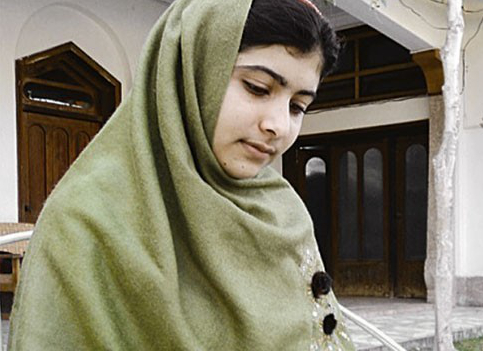
You may have seen this picture of her:
But the picture you may not have seen is this one here:
That’s young Malala wearing a hijab, a head-covering worn by many Muslim women as part of their understanding of modesty. Yep, Malala’s a Muslim– but that’s something you’re not gonna hear on the news or read in your paper.If Islam is mentioned at all, chances are, it’s in reference to Malala’s would be assassin- not her (or her friends who were with her). Why is that? How come the same frenzied media attention that is devoted to listing off every attack or offense on the part of “Radical Islam” utterly fails to note the Islamic element when it’s related to something positive. I can understand- maybe even overlook- the fact that the news doesn’t offer any attention to the millions of Muslims (the ones I grew up with) who just go about their day without doing anything to anyone. But the moment a Muslim man or woman stands up for what he or she believes, even going so far as be nearly murdered for those beliefs and actions, religion disappears from the picture.
And while we’re at it, there’s another thing that’s been bothering me.
You remember Pussy Riot? Feminist Punk Band who got into trouble for playing anti-Putin songs in a historic Russian cathedral?
Why is it that when they got convicted of “hooliganism” and were sentenced to two years in prison (a term waaay disproportionate to the crime) the world united in outrage, and when Leah-Lynne Plante was arrested-
Oh.
Who’s “Leah-Lynne Plante”?
She’s an activist up in Washington State whose apartment was raided by FBI and SWAT Teams. See, back on May 1st, there was some vandalism that occurred in Seattle and Leah-Lynne was a suspect.
How many people who have vandalized walls or billboards actually have the police investigate them, let alone the FBI and the Joint Terrorism Task Force? Of those people, how many have black clothes and books confiscated as “evidence”?
Obviously this has about as much to do with vandalism as Pussy Riot’s sentencing had to do with disturbing the peace. See, Leah-Lynne Plante is a self-proclaimed anarchist, and after refusing for a third time to answer questions before a grand jury. Considering the Grand Jury that’s investigating these and other alleged anarchist criminals was first created in March (two months prior to when she allegedly committed these crimes) doesn’t exactly reflect well on the whole “liberty and justice for all” element of the legal system.
But that’s all beside the point.
The point is, you probably don’t know about it. Your news has almost certainly never reported it, and considering the similarities between the two cases, doesn’t Leah-Lynne Plante’s case deserve your attention just as much as anti-government rockers off in Moscow?
Your media doesn’t think so.
And I think we’re being asked too much. I think we’ve had enough.
See, you can’t pick and choose- if the media want to take the violent or oppressive actions of Muslims as being representative of their faith, they have to apply the same logic to Muslim heroism as well. The same goes for equal air-time. The news can’t report on a bunch of women in brightly colored balaclavas for being broadsided by the state and then whistle Dixie while one in a black shirt has her home raided by men in kevlar.
Consistency- I’m not expecting that the news be factual (and considering it’s the news, that’s a pretty big thing to let slide) but they have got to be fair or stop calling themselves reporters. If they wanted to pick and choose their battles, they should’ve become bloggers instead.


 EVAN: This week on E> we take a break from scrutinizing film to look back about seven or so months to a different time of our lives: college. Now that we’ve both graduated we find ourselves in a different stage of life, and it begs the question of what those four years did for us, and whether or not that’s what we wanted or expected.






 Culture War Reporters