Tag Archives: film

Free State of Mind: Behind the Scenes with Producer Terwadkar Rajiv

Free-State-Updated-PosterLast month I was offered the amazing opportunity to watch a screener of Free State, and published my review at the beginning of this one. Set in mid-70s South Africa the film revolves around an interracial relationship that would have been illegal due to anti-miscegenation laws of that time.

In addition to that I was also able to interview members of the cast and crew via email, with consequent installments of “Free State of Mind” being released in the following days. Up first is a Q&A with Terwadkar Rajiv, who produced the film alongside Piet De Jager and Sallas De Jager.


When many people think of South Africa and racism their minds immediately go to Nelson Mandela and apartheid. What do you think their reaction will be to Free State, which focuses on relations between White people and South Asians, instead of Black people?

Apartheid was one of the dark patches of South Africa, no doubt about that! When South Africa got independence and Nelson Mandela became the President most of the people were thinking – what will be the future of South Africa? Will whites be kicked out of the country? The way things happened clearly shows that all ethnic groups started living towards one nation, South Africa!

Although there are stories during Apartheid where Indians and blacks were tortured, beaten up or even killed by the Police or Army; some whites used to treat Indians & Blacks respectfully! There are so many stories from Apartheid which prove that inter-racial relationships and friendships existed before 1994.

­Free State is a film which focuses on the relationship between Jeanette (Afrikaans White Girl) and Ravi (Handsome Indian man). This also beautifully shows the motherly relationship between Zulu maid Maria and Jeanette, who she raised as her own daughter, ­­making it truly cross cultural and crossing ethnic boundaries. Continue reading

What Would Make For A Good Christian Movie?

It seems like a lifetime ago that this blog’s editor and yours truly discussed the question “Why is Christian media so bad?”

Because it is.

So bad.

Like there are dirty limericks carved into the side of gas station bathrooms with more artistic and spiritual merit, and for anyone who doubts me I’d challenge you to watch God’s Not Dead 2, which premiered on the first of this month.

As much as you might pray otherwise- no, this is not some elaborate April Fool’s trick. This wretched, pandering slog of garbage is absolutely real, the hellspawn of 2014’s disturbingly popular (and obliviously sacrilegious) God’s Not Dead.

Look, as much as I’d like to pour out seven bowls of wrath upon this nasty, ugly product of a nasty, ugly franchise, I’m not going to. There are people who’ve already done so with more eloquence than I could muster, and I legitimately think I’d have a stroke if I tried to convey my repulsive and rage to this unholy dreck. If you’ve got a shred of artistic judgment or basic morality, you can see what makes this movie bad.

So let me ask this instead:

What would a good Christian movie look like?

Here’re some of my ideas-

That Dark Battle

The God’s Not Dead franchise has a habit of using death and disease to hamfistedly make its points. Is the prideful atheist looking down her Ivy-League nose at these simple, humble Christians? Smite her with cancer! Haha! She’s not so high-and-mighty now that she’s facing a slow and painful death! Thanks, God!

Think that’s a bit cruel?

It’s OK! She converted and has been miraculously cured! Because no God-fearing person has ever died of cancer and no atheist has died of anything else!

I **** you not- that happens in the first God’s Not Dead.

maxresdefault

Mr. David A.R. White- On behalf of everyone who’s ever lost a loved one to cancer, allow me to say a heartfelt “****. You.”

Continue reading

Free State: A Film Review

Free-State-Updated-PosterA film covering “a pair of star-cross’d lovers” is certainly nothing new, and for centuries creators have strived to honour the trope by putting their own distinct spin on it. As a film by South Africans set in their very own country Free State sets itself apart from the crowd at its outset, in particular because it neglects the assumed Black and White mixed couple [and all of the baggage that comes with it] in favour of an Afrikaans woman and an Indian man.

Jeanette, South African model Nicola Breytenbach’s first role, is a law student in the mid-70s returning home to Memel and her father. Ravi, played by Andrew Govender, another model, is a man whose family is currently working out the specifics of his upcoming arranged marriage.

The reason they can never be together is spelled out in the first few minutes of the film in which Jeanette, describing her childhood, relates the story of a man arrested for being Indian in the Free State province after dark. She also shares the details of South Africa’s Immorality Acts that she learned about while in school, which explicitly prohibit sexual intercourse between White and non-White people. It’s racism, plain and simple, and while not the freshest romantic deterrent it’s nonetheless framed in way most viewers won’t be familiar with. Continue reading

A Non-Female Writer’s Opinion About That Wonder Woman Promo Picture

As the title attests, and as you probably know by now, I’m a guy. A cisgendered male, to be more specific, which for those not in the know means that I was born male and identify as one. And as a guy I’ve been writing about feminism on this blog since day one. While it’s always been my goal for the site to be a platform for female voices speaking out on those same issues [made reality in having Kat hop on board as well as the majority of our guest writers] the truth is that there are an essentially infinite number of topics and only so many bloggers.

That’s all to say that ideally this probably should’ve been tackled by a woman. While a given female perspective may not necessarily be the correct one, the fact of the matter is that they would be able to write from a level of understanding that I cannot. Yet here I am, covering Wonder Woman, arguably one of the biggest feminist icons.

ewWW

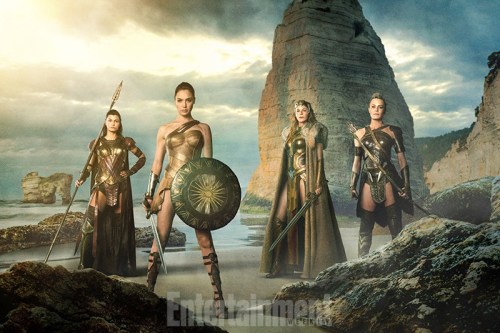
Yesterday Entertainment Weekly shared an exclusive promo image from Warner Bros.’ upcoming Wonder Woman movie. Diana Prince AKA Wonder Woman, the titular character, played by Gal Gadot, is second from the left. The other women, from left to right, are her mother Hippolyta [Connie Nielsen],
Menalippe [Lisa Loven Kongsli], and General Antiope [Robin Wright].

As it’s made its way across the internet it has generally been regarded with a lot of excitement and enthusiasm, which should be no surprise given the fact that Wonder Woman is literally the biggest draw for people lining up to see Batman v. Superman: Dawn of Justice. When it comes out in theatres next year it will have been Hollywood’s first return to female-led superhero movies since 2005’s Elektra, and arguably stands for so much more than the Jennifer-Garner-played red-clad assassin ever could.

wwMake no mistake, I am very excited for it. Seeing the Amazonian on the silver screen for the first time is also the primary reason I’m seeing BvS in the next few days, and a Wonder Woman t-shirt that I shamefully purchased at Hot Topic [shameful for the store, not the product] is the only merchandise I have bought and plan on buying [the poster on the right was free]. In spite of that, or maybe directly because of it, I ended up with a number of thoughts about the promo picture released. While the first point is the shortest and has nothing to do with my gender, the ones that follow may be defended by readers who can better relate. Which is to be expected, and that I hope people feel comfortable doing if they want to. Continue reading

In The Force Awakens White Women get Representation, but Black Women get CGI

I loved Star Wars: The Force Awakens. I loved it so much that the first thing I thought about doing when I walked out of the theatre was hash out everything that this Star Wars reboot had done right.

Like including legitimately humorous dialogue rather than slapstick CGI sidekicks.

Unfortunately, everyone on the blogosphere had already come to the same conclusion long before I was back from my Christmas break. Still, I couldn’t stop thinking about the film, or reading articles about it. So I’ve decided to write about one of the few things that bothered me about the film, rather than many aspects of the film that I loved.

If you’ve been reading this blog for some time, you probably already know that we at CWR were excited to hear about the diversity of casting in The Force Awakens.

I was especially excited when I heard that Lupita Nyong’o had been cast. Ever since she won best supporting actress for 12 Years a Slave and was declared the most beautiful person of 2014 by People magazine, I’ve been keeping my eyes peeled for Nyong’o. After witnessing her sudden rise to fame, I was curious to see if she would continue to find roles in major films, or if she would slowly be pushed out of Hollywood because of her dark skin. As Gregg Kilday explains in his article about Nyong’o, few black actresses have ever managed to secure a spot as a permanent Hollywood heavyweight:

While the stage would appear to be set for [Nyong’o] to ascend to the A-list — just as Jennifer Lawrence did after her best actress win for Silver Linings Playbook last year — it’s not that simple. For while there have been a handful of African-American actors, from Sidney Poitier to Eddie MurphyDenzel Washington and Will Smith, who have reached that status, there’s never been a black actress who has become the equivalent of a Julia Roberts or Angelina Jolie. Whoopi Goldberg came closest, following her best actress Oscar nomination for 1985’s The Color Purple and supporting actress win for 1990’s Ghost, but despite an occasional hit like 1992’s Sister Act, she didn’t maintain that momentum. Hollywood also flirted with Angela Bassett, Thandie Newton, Halle Berry and, most recently, Mandela‘s Naomie Harris, without ushering any of them into its very top tier.

It seems like a habit for major blockbuster films to tick off their diversity checklist by casting a white woman and/or a black man. Meanwhile, actors from other minority groups, especially women of colour, get overlooked because all the non-white, male roles have already been taken. As Evan pointed out in his post about the Martian and racebending, this seems to be the impulse, even when it means casting a white women to play a Korean- American character and a black man to play an Asian- Indian character. Continue reading

Putting The Martian On Blast – Racebending, Whitewashing, and the Last Straw

The Martian is Guilty of Whitewashing

Last Thursday the Media Action Network For Asian-Americans [MANAA] issued a statement criticizing director Ridley Scott for the whitewashing of Asian roles in his film The Martian. Their judgements are twofold, namely citing that:

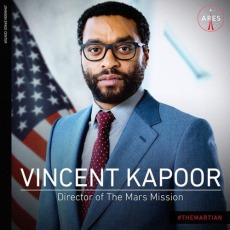
  • NASA’s director of Mars operations Dr. Venkat Kapoor as an Asian-Indian character who identifies religiously as being “a Hindu.” The group pointed out that in Scott’s film, his name is changed to Vincent Kapoor, and he’s played by British black actor Chiwetel Ejiofor, who says his father was “a Hindu” but that his mother was “Baptist.”
  • Mindy Park, described by Weir as Korean-American, is played in the movie by Mackenzie Davis, a white, blonde actress.

Now I wish I could proceed on to the rest of this blog post, but people have asked the question as to whether or not this is, technically, whitewashing. It’s going to take a few paragraphs, but let’s get that out of the way-

Okay, The Martian is Guilty of Racebending/Whitewashing

Let’s start from the very, very, very top. The Wikipedia entry for this can actually be found under “racebending”, with “whitewashing” cited as being [citation needed] a more archaic term. Their definition of this practice is:

“when the race or ethnicity of a character, in a story, is altered to an ostensibly more ‘palatable’ or ‘profitable’ ethnicity.”

The reason people have been asking the question as to whether or not this did in fact take place is that The Martian is a film adaptation of a novel by author Andy Weir. As such the source material is devoid of any visual aids in regards to the explicit ethnicities of its characters. Weir himself had a number of things to say about this with MTV News at the Toronto International Film Festival where the film debuted [the interview occurred before MANAA’s statement]:

In regards to writing and describing his characters’ ethnicities-

“So unless a physical description is somehow relevant to the plot, OK, you know he’s missing a leg — something like that, but unless it’s like really important to the plot then I don’t physically describe my characters at all.”

“You can imagine them however you like. Like, for instance, the ethnicity of Mark, I never told you.”

In response to criticisms of Chiwetel Ejiofor being cast as Vincent Kapoor-

“He’s an American. Americans come from lots of different sources! You can be Venkat Kapoor and black.”

In response to criticism of Mackenzie Davis being cast as Mindy Park-

“Whatever ethnicity she has, she’s an American and her family has been in America forever, which is why her first name is just Mindy, but her last name is Park. But Park is also a British surname so the casting people [could have] thought Mackenzie Davis looks like someone descended from Brits. And she did a great job! I’m certainly not complaining about anything related to casting.”

mindyparkWhile not a direct quote, MTV News also shares how Weir envisioned Park while writing the novel:

“He did admit that he’d always pictured Mindy Park as of Korean lineage, but emphasized again that he had never actually explicitly written her as Korean.”

This is all well and good, but problematic in that it doesn’t jive with an interview that took place in May of this year with the blog domesoph. When asked by blogger Sophie Milam about how he approached writing his extensive cast, Weir responded [emphasis added]:

“I didn’t set out to deliberately balance the crew. For the most part, I just wanted them each to be unique enough for the reader to tell them apart without prompting. It’s a real problem in written fiction. You don’t have the face on-screen or voice being heard to remind the audience who’s who. They need to know it immediately from the name.
So there are no two people on Hermes who are the same demographic. There’s one white American guy (Beck), one Hispanic guy (Martinez), and one German guy (Vogel). There are two women of undefined ethnicity (presumably white) but one of them is the Commander, so you won’t get them confused either. Especially since they all call her ‘Commander’.
So it wasn’t any deliberate attempt at diversity. It was really just a shortcut to making sure the reader knew who was who. You’ll find I pulled the same trick with the NASA characters: Teddy (white guy who is in charge), Mitch (white guy who isn’t in charge), Venkat (Indian), Annie (white woman), Mindy Park (Korean woman), Rich Purnell (African American).”

Now I want to be fair and admit that not every author is [or can be] Alan Moore, who has very publicly denounced all film adaptations of his own work. Weir is currently working on his sophomore novel, with The Martian making up the entirety of his current bibliography. As an author with his first-ever book being adapted by Hollwood, and with the film rumoured to be nabbing an Oscar, there are more reasons against than for when it comes to rocking the boat. So let’s discard what Weir has to say, separate from his novel, completely.

All art is open to interpretation regardless of the creator’s intent, so without Weir’s opinions here’s what we know about the characters:

That being said I’m willing to make the concession that free of Weir’s intentions Mindy Park certainly could have been either White or East Asian. When it comes to Venkat Kapoor, on the other hand, most signs point towards him being South Asian, more specifically East Indian. Let’s pull up the definition for “racebending” again:

“when the race or ethnicity of a character, in a story, is altered to an ostensibly more ‘palatable’ or ‘profitable’ ethnicity.”
vincentkapoor

Chiwetel Ejiofor is an Academy Award winning actor. He’s also a Nigerian English man, part of a demographic that has not struggled in Hollywood compared to many others. Comparatively speaking I would run out of American films headlining East Indian talent before I ran out of fingers. Are Black men more profitable than Indian men? Everything I know about North America answers a resounding yes. So this is what we’re left with:

Venkat Kapoor was racebent for The Martian.

Mindy Park [given the author’s intent] was whitewashed for The Martian.

To be fair [and I think I have been thus far], East Indian actor Irrfan Khan had been in talks to play Kapoor but had to decline due to another commitment. It’s worth noting that the role had been intended for Khan, and it’s also commendable that- Continue reading