
There are just so many reasons to love Sir Patrick Stewart.

He gets into the Halloween spirit, for one.
There are just so many reasons to love Sir Patrick Stewart.
He gets into the Halloween spirit, for one.
Posted in comics, Fame Day, film, games, internet, television, video games
Tagged Amnesty International, Combat Stress, Comic-Con, Comicpalooze, Doctor Who, domestic abuse, Fame Day, feminism, Hamlet, Harry Potter, Ian McKellan, Jean Luc Picard, Lord of the Rings, Men, Patrick Stewart, Professor Xavier, Refuge, respect, Ring the Bell campaign, sexism, Star Trek, Star Wars, Stargate, television, video games, Violence, women, X-Men, YouTube
The title of this post comes from the image below, which I see floating around the internet from time to time. It might’ve been from one of Cracked’s PhotoShop contests, I really have no idea.

The reason I’m bringing this to your attention is to underscore the fact that, by and large, “White” really does equal “normal,” at least in North America. You don’t really have to search hard to stumble across that fact, either. Think about how it works when you recount stories to other people-
Imagine you’re talking about this weird dude who sat down next to you on the subway. If he was White, would you bother mentioning that? How about if he was Black, or Asian, or Latino?

The terminology used in this gif aside, you probably never make reference to a White person’s ethnicity.
Posted in comics, film, media, race, writing
Tagged asian, black, Brian Lee O'Malley, casting, characters, fancasting, fandom, Fantastic Beasts and Where to Find Them, Harry Potter, Hunger Games, Newt Scamander, norm, normal, race, Rue, Scott Pilgrim, Toronto, white, writing
Today’s post is going to be a little shorter than most, primarily because I am, well, not writing this from home. Take from that what you will.
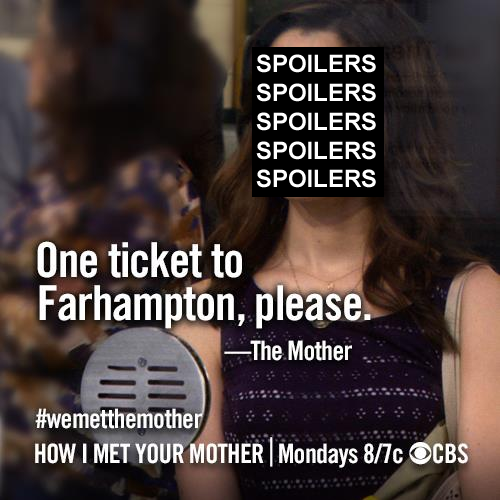
I write this because last night, while perusing Facebook, the page for CBS’s How I Met Your Mother posted an image of a certain someone [seen on the right]. The caption for the image was as follows:
A secret 8 years in the making! You just met… wait for it… the mother! Like this post if you were surprised!
http://bit.ly/10K4e18
But here’s the thing, I hadn’t seen the episode. I was busy talking about short stories with my writing group, which was swiftly followed up by reviewing the season finale of the other CBS sitcom. As the description of the image reads, this was a reveal “8 years in the making.” I may not have started the year the show came out, but I have seen every episode. That’s 183 episodes; that comes out to something like 3660 minutes, or 61 hours, or 2.5 full days of television. Continue reading
Posted in advertisement, advertising, comics, film, internet, media, Shame Day, television, writing
Tagged Barnes and Noble, Bleeding Cool, CBS, comics, considerate, Damian Wayne, DC Comics, drive-by, extended previews, Facebook, Game of Thrones, Harry Potter, How I Met Your Mother, internet, M. Night Shyamalan, Marvel, reveal, Saw, shame day, spoil, spoiler, spoilers, The Avengers, The Happening, the mother, The Sixth Sense, The Village, twist
Gordon and I only just talked about fan fiction two days ago, but in debating its merits managed to avoid much conversation about its place in our world today. To begin with, the topic was first brought up by Marilyn in her comment on our reactions to easy-money shows, and she specifically mentioned Anne Rice.
For those of you who don’t know, Anne Rice became famous for writing vampire novels decades before the Twilight books came out [and a few centuries after Bram Stoker’s most well-known work]. She also had a very particular stance on fan fiction, which I have pulled from an old archived version of her site:
“I do not allow fan fiction.
The characters are copyrighted. It upsets me terribly to even think about fan fiction with my characters. I advise my readers to write your own original stories with your own characters.
It is absolutely essential that you respect my wishes.” Continue reading
Posted in internet, literature, media, writing
Tagged 50 Shades of Grey, A Study in Emerald, Abigail Gibbs, Anne Rice, arthur conan doyle, Bruce Banner, craft, creative property, Cuthulhu, deviantART, Dracula, fan fiction, fan fiction writers, fanfiction.net, ficiton, H.P. Lovecraft, Harry Potter, literature, Mark Ruffalo, Marvel, Masters of the Universe, Neil Gaiman, Pride and Prejudice and Zombies, prose, public domain, publishing, Science Bros, Seth Grahame-Smith, Sherlock Holmes, ship, slash, smut, Spider-Man, story, style, Superman, technical, The Dark Heroine, Tony Stark, Tumblr, twilight, victorian, videogames, writing
GORDON: A long time ago, in a galaxy far away, it was suggested that Evan and I discuss fan fiction and its merits (or lack thereof).
Now I’m going to jump right into things by saying that not only do I not believe fan fiction is good, I do not feel it has the capacity to ever be so.
EVAN: Okay. Why? Continue reading
Posted in Evan and Gordon Talk, internet, literature, video games, writing, Youth
Tagged Alan Moore, arthur conan doyle, captain nemo, craft, deviantART, Dracula, fan fiction, fan fiction writers, fanfiction.net, ficiton, Halo, halo novels, Harry Potter, jane eyre, League of Extraordinary Gentlemen, literature, Marvel, mmo, nemo, Odd Bedfellows, porn, prose, Sherlock Holmes, sir arthur conan doyle, slash, smut, Star Wars, StarCraft, story, style, Sumiyoshi, superbad, Superman, supernatural, technical, Tumblr, victorian, video games, videogames, WarCraft III, world of warcraft, writing
Harry Potter and the Philosopher’s Stone [marketed that way everywhere but in the States and India] was released in 2001. Nine years later Percy Jackson & the Olympians: The Lightning Thief, the first film adaptation of Rick Riordan’s series of young adult novels, hit the big screen. One went on to spawn a sequel the following year, while the other is taking as long as three. One of the reasons for this, I think, lies in the studio’s portrayals of the characters in their respective works.
I’m not going to go into a great deal about the Harry Potter franchise. The first book was released in 1997, and since then the films have swept up Western culture [and others] up into a wonderful world of witchcraft and wizardry. This post is written under the assumption that you have at least some familiarity with the works.
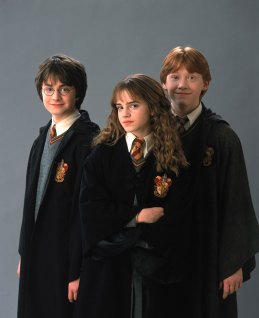
I opted for an image of them really young, since the majority appear to be just shots of good-looking young people staring somewhat broodily at the camera.
At their foundation, Rowling’s novels are built on a trio. Harry Potter is the chosen one, the courageous hero, the primary protagonist. Second is Ron Weasley, redhead, best friend, basically a wimp [for a lot of the series]. Last, but certainly not least, is Hermione Granger, the girl, the genius, the level-headed one. Clearly this is a team with some kind of equilibrium to it and a formula that works, and this is definitely evidenced in Riordan’s pentalogy.
The Lightning Thief, the book the film was based on, stars Percy Jackson, son of Poseidon, talented swordsman, fearless warrior, and new to being a halfblood. Second is his best friend, Grover Underwood, a satyr, kind of a cowardly kid [goat jokes, everyone]. Topping this all off is Annabeth Chase, Athena’s daughter, meaning that she’s definitely got the wisdom thing going on. Clearly if it ain’t broke, don’t fix it. Before you go to assuming that Riordan’s books are a cheap knock-off, don’t; the series is a well-written take on both Greek mythology and the young adult genre as a whole.
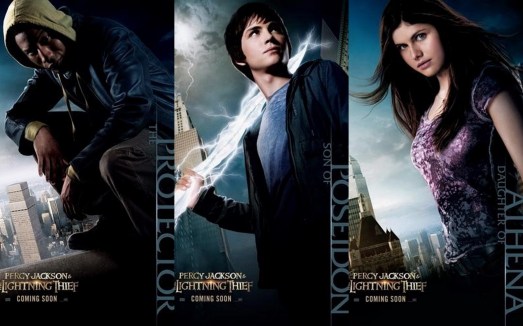
From left to right: Grover, Percy, and Annabeth.
The problem isn’t that the characters appear to mirror those in the Harry Potter books. If anything, this is a strength of sorts, as they’re both familiar and effective. The issue is that the film adaptation of the novel takes these archetypes and throws them out the window. The result is this: three badasses.
In Percy Jackson & the Olympians: The Lightning Thief, Percy, Grover, and Annabeth are all depicted as being a) brave, and b) proficient at fighting, making them essentially slightly different facets of the same archetype. Yes, Annabeth is the one knows more about mythology and magic, et cetera, but she still wields a sword along with the best of them, transforming her from a cold, sharp-tongued girl to an athletic tomboy.
The irony is that Chris Columbus directed both films [as well as Academy Award winning The Help], choosing to faithfully adapt one and tailor the other for a specific audience, going so far as to significantly age the characters. Percy Jackson & the Olympians: The Lightning Thief has all the signs of a movie meant to catch the world’s attention with action, special effects, and good-looking teenagers. Three traditionally heroic characters are three times as entertaining, or at least that’s what a certain type of logic would dictate.
The film did well regardless, pulling in $225 million and with the sequel supposedly [I reserve the right to express some doubts] dropping sometime next year. Fans of the book, however, are hoping that Sea of Monsters is a much better installment than the first. Full character rewrites are rare, so the best they can expect is a film that respects the narrative of the series, and strives to fit their characters into that.
Posted in film, literature, writing
Tagged Annabeth Chase, archetypes, books, Chris Columbus, Grover Underwood, Harry Potter, Harry Potter and the Philosopher's Stone, Hermione Granger, J. K. Rowling, Percy Jackson, Percy Jackson & the Olympians: The Lightning Thief, Rick Riordan, Ron Weasley, The Lightning Thief, writing, YA fiction

 | Evan on The “One Size Fits All… |
 | Phi on The “One Size Fits All… |
| ‘Nimble Fingers’ Rac… on Lisa Nakamura Part 2: Navajo C… | |
 | abdessamed gtumsila on Colonial Williamsburg: A Cultu… |
 | T on Is “Art of Manliness… |
 Culture War Reporters