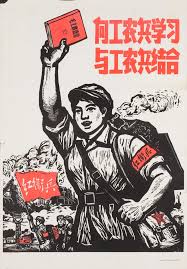
 Gangs of schoolchildren sporting red scarves chant slogans as they march through the streets. A shop owner tears down an old sign for containing counter-revolutionary terminology. A man is publicly shamed for wearing pants too tight for manual labor- a young woman with scissors cut from the hem to above the knee. The son of a landlord is dragged through the streets as insults are hurled at him.
These are scenes from the so-called “Cultural Revolution”. Begun by Mao and his followers in 1966, these rallies and mass actions were meant to purge China of the last vestiges of antiquated, foreign, and Capitalist thought, replacing it with a proletarian culture that would forever cement the victory of the Maoists in 1950.
The Cultural Revolution quickly degenerated into something that could only be likened to the Reign of Terror following the French Revolution, with anyone accused of counter-revolutionary sentiment facing political and physical attacks. The “revolution” became a hotbed for corruption and suppression of dissent of any kind, and one might even argue that this major attempt to push socialism upon its inhabitants is actually what eventually led to the unraveling of Chinese Communism and its replacement with the sweatshops and slave-labor we more commonly associate with that nation today.
Mao, you see, had it backwards- trying to seize power and then change the hearts and minds of the public. That’s not a revolution, comrades, that’s just a coup. Rosa Luxemburg, an early but seminal Marxist thinker, once asserted that even if each and every civil servant and elected official were to suddenly become Communists, the world would not be one iota closer to being a Socialist one. Luxemburg understood the true nature of revolution- not some bleak military conquest but a fundamental change in the thinking and values of the majority of society. My ability to make you memorize Lenin, work on communal farms, and wave red-and-black flags will not make you Communists, no matter how long you do it (and even if it did, you’d be some pretty lousy Communists at that). The entire disastrous venture of the cultural revolution may have been avoided had Mao heeded the words of American Socialist and presidential candidate Eugene Debs when he proclaimed:

In the simplest possible terms, leaders come and go, the great will of the masses does not. For our struggle is not against flesh and blood, but against the rulers, against the authorities, against the powers of this dark world and against the spiritual forces of evil in the heavenly realms. The fight to change the basic values and principals of the people must come first– but how is this done? Continue reading →
Posted in government, history, politics
Tagged advertising, Albert Einstein, America, August Willich, cheerios, China, Chinese Communism, commercial, communism, cultural revolution, democracy, Democratic, election, engels, eugene debs, Europe, four olds, George Orwell, history, Jack London, john steinbeck, KKK, Kshama Sawant, Latin America, marx, Marxism, middle class, propaganda, Protest, racism, Revolution, riot, robert oppenheimer, Rosa Luxemburg, Russia, strike, US, USA




 Culture War Reporters