Tag Archives: literature

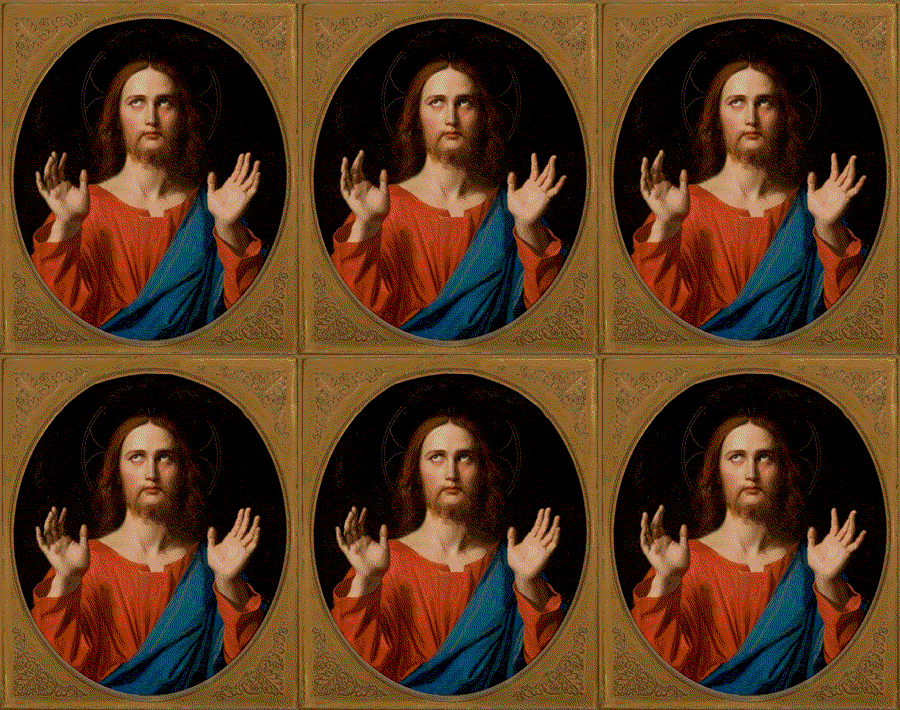
On The Image Problem of Christ

Back when this blog started up, Evan and I had a discussion about a lecture given by Socialist novelist China Miéville. During that lecture, Miéville commented that “if one person hears what you’re saying and does something horrible, the issue’s probably with them. If hundreds of people consistently start doing horrible things, it’s probably time to re-examine your message.”

Those words returned to me a few months ago as I watched Family Guy’s “The 2000-Year-Old Virgin”, which depicted Jesus as a cowardly shyster, lying about being a virgin in order to bed Lois Griffin (and more than a few other women).

Family Guy: Season 13, Episode 6

Grotesque? Repulsive? Offensive beyond all description?

For me, it wasn’t.

It was certainly far from being funny, but readers, yours truly simply was not offended.

As sacrilegious and bitingly edgy as I’m sure the writers thought the story was going to be, I was merely disappointed by it. While I’m not going to excuse the laziness or insensitivity of Seth MacFarlane or any of Family Guy’s writer’s, I actually don’t think the majority of blame should be placed on them.

I think it should be placed on Christians.

Continue reading

Is It Time To Stop Reading Shakespeare?

I never really liked Shakespeare.

Never hated the guy, mind you- downright enjoyed a few of his plays (The Tempest, Coriolanus, Hamlet). Still, I never really could bring myself to relish the bard’s works with the same zealous enthusiasm of the drama geeks and English majors.

With that in mind, you might spare me perhaps a little of the horrified gasping when I ask:

Is it time to stop reading Shakespeare?

And I ask that with all sincerity. I’ve made no secret about my general dislike of the theater and the culture surrounding it, but I’m not here to talk about those guys.

You know the type. Melodramatic airheads who’ll actually only refer to this as “the Scottish play”…

I’m talking about the actual works of William Shakespeare here.

Why still read ’em?

After all, with every passing year, we drift further and further away from those stories. In spite the film industry churning out one or two adaptations or modernizations of Shakespeare’s plays, there’s only so many ways to re-imagine Romeo and Juliet.

Continue reading

Re: #DontStayInSchool: In Defense of the System

A few weeks ago my brother sent me the following video and asked if I could write about it on the blog. He challenged me to defend academia and promised that he would respond by commenting on why this video resonated so deeply with him. So, although I agree with many of the comments Dave from Boyinaband makes in his video, I’m going to offer you several reasons why our education system can be, and has often been, a good thing.


1. Our education system was designed to promote equality

In his video on the history of education, Salman Kahn explains how our contemporary education system was shaped by ideologies that valued class equality. According to Kahn, the Prussian education system, despite its faults, insisted on providing public education for all citizens. Meanwhile, even the “Committee of Ten”,  the group of educators who originally introduced standardized curriculum, were motivated by their belief that economic status should not prevent students from having access to “higher order” skills. Standardization of curriculum meant that every student would (ideally) have access to the kind of information that was once restricted to the elite.

Continue reading

The Last 3 Books That Made Me Cry (And Why You Should Read Them)

I love getting lost into the world of a book. You know how it is when you can’t handle taking a bathroom break or stopping to eat lunch because it might mean tearing your eyes away from the page? Luckily, as an English major, reading is a big part of my learning experience. Not every book I’ve been assigned to read has been my style, but some of those books have been so good that they sucked me deep into the story until the next things I knew, tears were streaming down my cheeks.

For the sake of this article, I won’t be focusing on all the books I’ve read over the past year. If you want to read a fantastic overview of a wide span of books, I suggest you check out Evan’s 2014 Literary Awards. Instead, I want to share the last three books that made me cry, and, more importantly, I want to discuss the larger issues that make each of these three books valuable reads.

Each of these novels engages with what it means to live in a post-colonial world. In each story, it quickly becomes apparent that the horrors of colonization do not simply end the moment government policy changes.

While I will avoid any key plot points in these books, I will be alluding to general context around the books. If you prefer to go into your reading experience with a blank slate, I should warn you, Spoiler-ish content below.

Wide Sargasso Sea by Jean Rhys

Generally regarded as the post-colonial prequel to Jane Eyre, Wide Sargasso Sea opens in Jamaica, shortly after the abolition of slavery. Rhys’ protagonist, Antoinette, comes from a family of plantation owners who were brought to financial ruin by abolition. As a child, Antoinette struggles to understand what separates her family from the rising class of British capitalists.

By writing from the perspective of a child on the wrong side of history, Rhys prevents any oversimplification of her narrative. She also challenges the idea that colonial injustice somehow ended when slavery did.

Rhys’ strong narrative style creates a story that will immediately pull you in, but her imagery and carefully thought-through word choices create layers of meaning that make this novel much more complicated than it appears at first read. While it initially seems to be a Gothic Romance, Wide Sargasso Sea also explores a variety of important questions around race and gender. Continue reading

The 2014 Evan Yeong Literary Awards

My mom taught me how to read when I was 4-years-old, which WebMD, a reliable source if there ever was one, says is about two years younger than average. According to Iowa Tests [American standardized tests that I ended up taking at an American school] I was reading at a 12th Grade reading level when I was only ten. When I inevitably ended up majoring in both English and Writing at a Christian liberal arts college I was, to put it directly, horrifyingly average.

evanyeongliteraryawards2014I write all of that not to share that I was some sort of prodigy [I wasn’t], but that I was good at reading because I loved it. The written word continues to be my favourite artistic medium, and my appreciation for the literary has not faded. Today I start what I hope to be an annual tradition, a review of what was read in the past year to acknowledge the standouts [for better and for worse]. These are the 2014 Evan Yeong Literary Awards.

In 2014 I resolved to read 52 books, and while I only ended up stopping just four short of my goal, I do believe it was an overall success. You can check out a full list [with the exact dates of when I read each one] at this link. Continue reading

Not Strictly Literary: 6 Unexpected Subjects You Learn About in English

I’m currently in the last year of my English undergraduate degree. Well, kinda. I will probably have to do an extra semester to finish off my credits completely, but after next semester I will have finally finished all my English requirements.

Like many students, I kind of fell into my major. In my first year of full time studies I was seriously considering a degree in economics, or anthropology. Until I took a class in those subjects and quickly changed my mind. Once I started figuring out what kind of classes I actually liked, I started talking about doing my degree in Sociology, Political Science, or Environmental Ethics. Then, when I transferred to UVic, I decided I would take their writing program. Well I thought I was decided, until I was invited to join the English Honours program. That invitation totally went to my head and I dropped everything in order to pursue that (very structured) program.

Because of the number of required English classes (and because I blew many of my elective classes during first year), I’ve been taking pretty-well only English classes for the last two years. During that time, I began to ask myself if I had made the best choice. After all, English is really just reading books, isn’t it? Couldn’t I do that in my own time?

Ah, reading for fun/relaxation. Can’t wait until I get to do that again.

Now that I’m getting close to the end of my degree, I’m able to look back and be thankful for (almost) all of the English classes I needed to take. Yes, I still feel like there are a million others I wish I could have taken, but I think I would have felt that way regardless of my major. There are more fantastic courses out there than what you can possibly fit into one undergraduate degree.

Getting close to the end has also allowed me to reflect on the many English courses I have taken and realize just how broad a range of subjects they actually address. I’ve included a few examples below.

Linguistics
Screen Shot 2014-12-08 at 10.32.54 AM

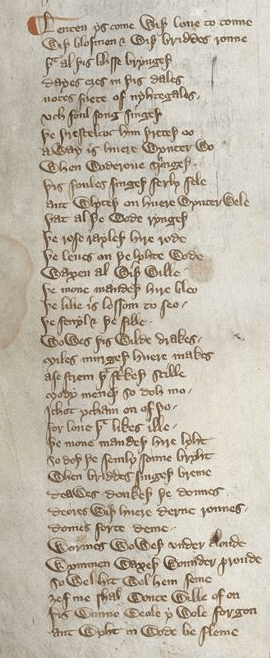
One of the texts we are translating for our final project.

I’m currently finishing off a class on Middle English that I did not want to take. Not at all. I’m required to take a class in early English literature, so I chose this class after a friend recommended the professor. I was then pleasantly surprised to find that it was a fantastic class. It was also not at all what I was expecting.

English has evolved considerably since the 12th century, so it’s hardly surprising that trying to read Middle English texts is like reading an entirely different language.

At the beginning of the class our professor touched on many of the other languages that have influenced the formation of the English language. Then, as the class progressed, a lot of the work we did in class involved translating various works. The translation process required a basic understanding of how to parse language, something I had almost no experience with. Like many English speakers, sentence structure is something I know intuitively, not something I’ve intentionally learned. However, if my experience in Quebec this summer taught me anything, it’s that knowing how to break down language is key to learning a new one. So I’m hopeful that the linguistic skills I’ve been struggling to learn in this class will help me with my future language learning goals. Continue reading