Tag Archives: music

Evan and Gordon Talk: Why Christian Media Is So Bad

EVAN: The particular topic of discussion that comes to us today is more one that finds itself passed back and forth within Christian circles, and that is: “Why is Christian media so bad?”

GORDON: I think the problem is self-imposed by the religion (I use the term loosely) itself. We’re not talking about a lack of funding (we’ve got plenty of good low-budget films), or a lack of good directors (there’s plenty of decent talent out there), we’re talking about an issue that runs right down the core of it all.

“Christian” media can’t just be media- they have to drag in everything that goes with it.

EVAN: So basically what you’re saying, and we talked about this a little earlier, is that Christian media more often than not has an agenda, correct?

GORDON: I’d say plenty of it has an agenda, but no, I don’t think that’s the core issue-  there’s plenty of other preachy movies out there.

EVAN: So what are you saying, exactly?

GORDON: I’m saying that “Christians” can’t make good media because they won’t allow themselves to. Every protagonist has to fit the moral code to a tee, so that they wind up as either Aslan 2.0 or the epitome of Christian morality: John Smith, the middle class suburban, patriotic family man. Which is why I keep putting “Christian” in quotation marks.

We’re not talking about Catholic peasants in El Salvador or the East Orthodox Church in Ethiopia.

EVAN: Okay, I like that a lot, this idea that those creators of Christian media [and primarily I think we’re talking about films] box themselves in. They’re telling the same sorts of stories to who they perceive to be their audience [and they’re not wrong]: white suburban middle class families.
To sort of break this up a little, I actually saw a Christian film that was reasonably passable at some point last summer.

GORDON: Was it related in any way to Steve Taylor?

EVAN: Is that any way related to “End of the Spear”? It was not, if that’s what you’re referring to.

GORDON: Steve Taylor is the only good Christian musician who ever has or ever will have existed.

But anyway, what was the movie you saw?

EVAN: It was called “To Save a Life,” and it stood out for a couple of reasons:

1) The cinematography was shockingly good for something produced and made by Christians. You can tell which movies they are within the first few seconds.

2) The “villain” of the piece was actually the pastor’s kid. Which was- refreshing, and kind of nice.

It kind of broke out of the whole stereotype you introduced earlier.

GORDON: Huh- interesting. I’ll have to check out the trailer. But let me ask you this:

Can a Christian make a James Bond movie?

EVAN: You mean a movie starring a suave, debonair British man who beds women and guns down henchmen as naturally as he dons his suit jacket every morning?

I’d say no, probably not.

GORDON: I think that’s the problem. It’s not just that you can’t have any explicit sex or graphic violence or excessive profanity (which are overused and abused as is), you can’t have anything even remotely sensual or rough or crude. It rips away reality and humanity in the name of not stepping on anyone’s toes.

Self-imposed legalism.

EVAN: Well, I’d say the difference is that you can’t have a protagonist who glorifies such things as wanton sexuality-

I say that Christian filmmakers will never produce anything like James Bond because of who the character is.

GORDON: Did you like the movie “Fight Club”?

EVAN: I liked it a fair amount.

GORDON: Did you like “Ocean’s 11” or “Snatch”?

EVAN: I haven’t seen the latter, but I very much enjoyed the former.

GORDON: Did you like “Superbad”? “Kick-Ass”? “Ironclad”?

EVAN: I enjoyed aspects of the first, thought the second was a shaky, though fairly decent adaptation of the source material, and thought the third was pretty unfair in its depiction of “strong female characters.”

But I think you’re going to have to get to your point-

GORDON: Could a Christian make any of these movies?

EVAN: I think a Christian could, yes. In relation to “Fight Club”, at least, Christian author Ted Dekker has penned novels [sold both in and out of Christian bookstores] which offer a fairly decent psychological thriller aspect to the reader.

GORDON: Ah, Dekker. The whole reason he stands out as an exception is- I believe- that he grew up among Indonesian headhunters, and not in Middle America. Again, it’s about having that different perspective on life.

EVAN: And I think what he’s realized, as a creator of the arts, as someone who has a hand in shaping Christian media, is that you can have these other sorts of exciting, thrilling stories told with a faith-built worldview. People of every religion want a little excitement.

GORDON: Of that there’s no question. The heavy use of the video library at our school stands in testament to that.

But again I think the issue is that “Christian” self-imposed isolation inevitably leads to the vast majority of their work winding up as “White People Problems” or “Chronicles-of-Narnia-minus-the-good-stuff”…

EVAN: Or “Lord-of-the-Rings-but-way-more-heavy-handed.”

GORDON: Exactly.

EVAN: I mean, we’ve talked a little bit about why Christian media can be bad [terrible production values, cookie-cutter story lines, sheer absurdity], but how could it be better [to harken back a little to our last talk]?

GORDON: They have to stop being terrified of the big bad world. They have to realize they can show characters with flaws- real flaws- not drunkard stereotypes and the occasional swear word.

Saying this will get you expelled from Liberty, Pensacola, and BJU

EVAN: I mean, a deeply flawed person who finds redemption is a much more compelling story than a white bread sort of guy with his middle class problems.

And they have to stop coddling their audience. Yes, Christians turn to Christian media for “better alternatives,” but the odd cuss word won’t negate an overall positive message; neither will a fight scene, or two guys sitting around enjoying a beer.

GORDON: There’s this one scene in a (Christian) movie Steve Taylor directed:

A character hurts his hand loading something into the back of van. He lets loose a cuss word and his buddy chides him for it, saying “God don’t like it when we cuss.”

Later on in the film, the buddy hangs his head and apologizes, saying “I’m sorry. I was upset that you cussed- I should’ve just been upset that you hurt your hand.”

EVAN: Wow. That is very, very good.

GORDON: That right there is the problem not just with Christian media, but with the whole religion.

EVAN: Misplaced priorities.

GORDON: More obsessed with present clean-cut paragons of middle class etiquette than anything really real.

That’s why we turn to “secular” movies for actual substance. The struggle for identity in “Fight Club”, the heroism in “Kick-Ass”, the friendship in “Superbad.”

EVAN: I think what’s really ironic is that Christian media-makers have a Christian-made work out there that’s immensely popular. “The Hobbit: An Unexpected Journey” came out just this past December.

GORDON: I again reference an (alleged) quote by Steve Taylor.

“I’m not a Christian artist- I’m an artist who is Christian- it affects what I do.”

EVAN: Really well-put. And something that a lot of us [I speak for many in our graduating class] as writers, musicians, artists, et cetera would benefit from keeping in mind.

And that puts us more than a little overtime.

GORDON: Well, people, you know what that means. Time to vote on our subject for next week.

EVAN: My contribution this time around is . . . wow, I never think ahead . . . masculinity. You’ve done a post about “Manly Culture” in the past, but I want to talk about what it is at present, and how we feel about the shifts and trends and things.

GORDON: Interesting subject. I submit we speculate on the upcoming Star Wars movies.

EVAN: If you think you’re up for it, then yeah, cool. I’ve read quite a few of the post-original-trilogy books, so I know a reasonable amount about the subject.

GORDON: Nerd.

And with that witty response, we’re out! Have a good night, everyone.

EVAN: Spend it with better friends than Gordon.
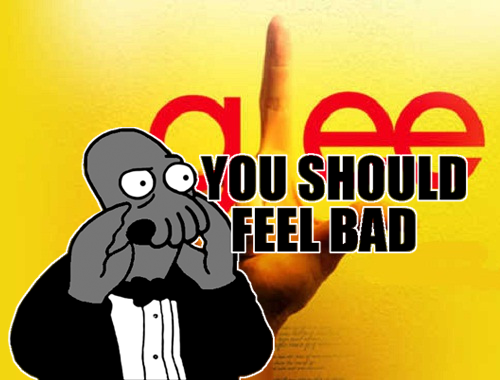
Shame Day: Glee

shame gleeTo begin with, I’m not a huge fan of Glee. I am a man who can say with confidence how much he loves musicals and acapella arrangements, but the show’s claim to be a melting pot of diversity [a place where Black people, Asians, homosexuals, and the disabled can belt it out to their hearts’ content] is not one I find myself agreeing with. But that’s the topic of another post.

Last week internet sweetheart Jonathan Coulton, known first and foremost for being the composer of “Still Alive”, the song that plays at the end of the game Portal, wrote a blog post in response to last Thursday’s episode of Glee. Specifically, the post was in response to their cover of “Baby Got Back” by Sir-Mix-A-Lot, which you can listen to here:


The issue being that Coulton released his own version of the song in 2006, which you can check out [and should, for comparison’s sake] here:


If you really want to scrutinize the two side by side, there’s a track on Soundcloud that simply places both tracks on top of one another [and an in-depth audio analysis, for those of you into that]. Coulton’s issue isn’t simply that Glee seems to have stolen his arrangement, but did so to the point where unique elements he added were copied as well. A duck quack is used to censor an expletive, and [this is practically impossible to ignore] the lyric “Mix-a-Lot’s in trouble” is replaced with “Johnny C’s in trouble” in both versions.

As he has kept the blog post constantly updated, four days ago he announced that having gotten in touch with the people at Glee, the following information was relayed to him:

They also got in touch with my peeps to basically say that they’re within their legal rights to do this, and that I should be happy for the exposure (even though they do not credit me, and have not even publicly acknowledged that it’s my version – so you know, it’s kind of SECRET exposure). While they appear not to be legally obligated to do any of these things, they did not apologize, offer to credit me, or offer to pay me, and indicated that this was their general policy in regards to covers of covers.

While Coulton is unsure of his exact copyright claim to the track, he had obtained a Harry Fox license to release it on an album alongside his own original music. His response is, refreshingly, a mature one in response to this whole ordeal.

He has re-released his track on iTunes under the new title “Baby Got Back (In the Style of Glee). “ Thanks to using the same license as before, Sir Mix-a-Lot will collect royalties, and all proceeds from the following month will go to charities The VH1 Save the Music Foundation and The It Gets Better Project.

This has, of course gotten its fair share of media attention. From a Facebook status by webcomic artist Rob DenBleyker to posts by Kotaku and The A.V. Club,  the internet appears to have rallied behind one of its own.

In his interview with Wired magazine Coulton shared a very simple solution for the show that spends millions per episode. He suggests that “they could offer to pay artists whose arrangements they use the same amount of money they would otherwise pay a musical arranger,” and that “if they opened with that, I’m sure a lot of artists would jump at the chance.”

Somehow, this isn’t the first time this has happened. Singer-songwriter Greg Laswell’s cover of a song made famous by Cyndi Lauper, “Girls Just Wanna Have Fun”, was also seemingly ripped off for an episode in November 2011. I’ve embedded the two songs for you to compare once again [and because I’ve gotta break up this wall of text somehow]:


Unfortunately, Laswell did not quite have the fan following that Jonathan Coulton does, and as a result this happened more or less without incident. The Hollywood Reporter did a short piece on it the month following, but from what I can tell it didn’t generate much controversy. Similarly, Petra Haden’s arrangement of “Don’t Stop Believin'” may have been appropriated without permission [i.e. stolen] by Glee as well.

It remains to be seen whether or not Coulton’s lawyers will be able to take legal recourse, but for the time being I’m happy that the show is finally being taken to task by those who believe that creativity should be rewarded and acknowledged, not plundered.

Evan and Gordon Talk: The Purpose of College

EVAN: This week on E&GT we take a break from scrutinizing film to look back about seven or so months to a different time of our lives: college. Now that we’ve both graduated we find ourselves in a different stage of life, and it begs the question of what those four years did for us, and whether or not that’s what we wanted or expected.

GORDON: Throughout my college career, especially towards the end, I heard a recurring argument:

“College is a scam,” they said, “It’s a trap or, at very best, a waste of money. You don’t learn anything you can actually translate into a job, so either drop out while you can or don’t sweat the grades and party your buns off.”

EVAN: Wait, who is the “they” that was saying this?

GORDON: I’ve read it in various Cracked articles, I’ve seen it covered in webcomics and in comments, I’ve heard it on the radio. Not always the same tone,  but it always boiled down to that essential idea. “College doesn’t teach you what you really need to know, it just puts you in debt and wastes your time.”

EVAN: Well, I guess that really begs the question of “What is it that we’re really supposed to know?” If college is the great institution to prepare us for our lives, what should it have taught us?

GORDON: Some would argue that technical and vocational skills are what we really need. Stuff that’s meant to train us for jobs. Wrenches, not Whitman.

EVAN: Which is the sort of thing you see advertised on television late at night or in the middle of the day; schools for electricians and dental assistants and plumbers and what have you.

GORDON: Which always come across as propaganda films from a dystopic alternate timeline. They can claim to be breaking the mold all they want- I’ll still always just see Orwellian Factory-Schools designed train the subservient masses for laboring in name of supreme leader and glorious fatherland.

EVAN: Heh heh.

The contrast to this idea you brought up when first introducing this topic, that the two sides could be seen as college prepping us for our careers or making us more well-rounded individuals.

There’s obviously more to it than that, but how would you boil the latter option down to its essence?

GORDON: I’d probably cite our own alma mater’s (for me more just “mater”) slogan of “global mindedness.” The idea is to create people who are, first and foremost, thinkers. Logical and critically minded thinkers with strong creative abilities and appreciation for art and wonder. A noble enough sentiment to be sure.

EVAN: To really engage with this topic I feel like we should have equal footing, and I’ll have to give our readers a little bit of context-

I’m currently unemployed, and chose to live the latter part of 2012 living with and taking care of my grandfather, whose wife [my grandmother] passed away in September. My job hunt has only very recently started up again.

I say that because as it stands one of us is currently working and knows how his education has aided him and the other is not.

GORDON: I, unlike my Canadian counter-part, am currently employed, having worked two jobs simultaneously for a while there. Having vainly searched for a job the entire summer and most of the fall, I am now working a job helping unemployed people find work, the irony of which is not lost on me.

EVAN: And did you, my Employed-American friend, find that a degree helped you in your search for work?

GORDON: In all honesty, I’m not sure.

On one hand, I can say that certain classes I brought definitely assisted me in securing a job, but those classes really more on the whole “applied” spectrum of education. I definitely didn’t need to go to a top 3% college. People, it turns out, don’t give a crap about where you went.

EVAN: Again, I can’t comment from experience, but I’d like to say that it depends on the job.

GORDON: This is probably true. However, if you were looking for a job, which is gonna look better on a resume? Four years of college, or four years of experience in that field? From everything that I’ve seen, I’d take experience every time.

EVAN: And I agree with that entirely. I can’t count the number of want ads I’ve seen [and this is for stuff like janitorial work, and dishwasher] that require “minimum 2 years work experience.”

It’s like, heck, what was I doing in school when I could’ve been out working this whole time?

GORDON: But of course, that brings up the first question: what’s the point of college? Are we expected to choose a career path and be trained like the mindless, dehumanized proles that we are?

EVAN: Well, for me personally my career goals were more tailored to an academic setting. My personal interest in writing and editing is definitely something that can and is fostered in that environment.

That being said, if I had skipped my four years of college to simply freelance as hard as I could out there in the real world, would I be a better writer today? I honestly couldn’t tell you.

GORDON: The problem is that both sides have really, really big flaws.

On the one hand, turning college into a simple vocational training course does truly rip the soul right out of academia. It makes it just the place you go to get a desk job instead of a manual one.

On the other hand, college as it is now, while fostering intellect and creativity, is as unhelpful as it is expensive. Why put yourself over a hundred thousand dollars in debt to not get employment?

EVAN: I guess in the bigger picture, what is it that we want to do with our lives?

There are plenty of jobs out there that don’t require a college education, and that certainly benefit from hard work at an early stage.

On the flip-side, there are jobs that you simply can’t get without a degree.

GORDON: We also can’t imagine that we can simply get any job we want to begin with. It’s all a gamble. I can get a degree in biology, but that doesn’t at all mean I’m gonna get a job in biology- heck, I’d probably be lucky if I got something even close!

EVAN: Like a janitor in a pharmaceutical company. Or the guy who delivers mail to a biology professor’s house.

GORDON: Exactly. So is that it, then? It’s the whole dang system?

EVAN: I mean, yeah. I feel like more often than not that’s all it really boils down to.

GORDON: So let’s talk about an ideal universe. Or at least one that ain’t quite so screwed up. What’s college look like? Give me your take.

This does not count as an ideal college…

EVAN: It’s tricky, man- Because I would like everyone to be well-read individuals who think about the media that they access and have a fuller understanding of what makes us who and what we are as a culture, I mean, that’s the dream-

But at the same time I acknowledge that there are people who don’t care a whit about any or all of that.

And with so many people who enjoy poetry and the arts, while those are debatably important parts of society, what happens when they need to find work? How many playwrights can any single country sustain?

GORDON: My response would be “how many playwrights are there actually out there?”

EVAN: I think there’s a difference between the actual number, and how many individuals would actually like to be a part of that number.

GORDON: Touché, but we can blame certain jobs being glorified and others suffering from unwarranted contempt.

But let’s move on. College. Your college- what’s it look like?

EVAN: A thorough exploration of the ideas that created Western civilization, the one most of us live in today, because it’s extremely important to observe our origins before we can look at our present and then ahead, after that.

A strong emphasis on writing with the reason that without the ability to properly communicate our thoughts how can we even really fully think them to begin with.

GORDON: Sounds to me that you’re still leaning more towards the side of academia.

EVAN: Well, like we’ve discussed, I have a slight bias. And I suppose we haven’t really defined the question as far as the purpose of college.

GORDON: My take would a combination of both sides, with the end goal being application. We’re talking about the study of English for the purposes of applying the principles in same, either in writing or screenplays or entertainment or communication of some kind.

I feel this would allow for all the creative and academic elements while keeping the whole process grounded. No ivory towers.

EVAN: I don’t think my take discounts the possibility of lining up with what you said, but that’s a really good description of how college could and maybe should be.

That being said, we are actually overtime.

GORDON: You wanna talk about drugs and culture next time?

EVAN: I think at some point we could hand this back to the viewers, actually. We’ve really gotten a handle on this whole E&GT. I’m just not sure when or how to do so.

GORDON: The readers are slack-jawed cattle who would eat their own shoes if we told them to.

EVAN: I should probably edit that out of the final post.

GORDON: Nah, we can let ’em vote. My subject would be Drugs and Culture.

EVAN: Mine would be . . . um . . . huh. About SNL. How to fix SNL.

GORDON: Nice. Let it be so.

EVAN: Tell the nice people to have a good Wednesday, Gordon.

GORDON: Have a good Wednesday, Gordon.

EVAN: And don’t forget to vote, readers! Thanks for putting up with my co-writer!

Taylor Swift and Artistic Intent

You can’t ignore Taylor Swift. Whether it’s having her mic snatched by Kanye, hosting Saturday Night Live three years ago, or having her hit “We Are Never Ever Getting Back Together” play as you flip through radio stations [yes, some people still listen to the radio] she’s become a public pop culture icon and she’s not going anywhere anytime soon.

Yes, she’s loved by millions, but also derided by a sizable number. While many of the judgements stem from her seeming inability to hold down a relationship, this more often than not seems like the public concentrating on an aspect of superstardom that they tend to turn a blind eye to when it comes to their  respective favourites. What Taylor Swift really receives a lot of flak for [and for better reason]  is the content of her music.

I first came across this idea on a blog post by Shelby Fero that has since been taken down. Recently I managed to dig it up again since it had been replied to on another tumblr, and you can check it out here[EDIT: That has since been taken down as well] There’s a four-minute video you can watch, but if not, Let me recap it:

It’s a follow-up to another post on tumblr where she says, in one line without profanity, “‘Mean’ by Taylor Swift pisses me off so much.” Which is fine. The video goes on to elaborate her point, and is largely about the music video. In essence Fero says that it’s fine to have a song about those bullied because of their sexuality or poverty [both seen in the music video], but you can’t marry or compare that to your own problems about being told you’re not a good singer; you can’t put yourself into this song and still have it be about these other bigger problems.

Continue reading

A Brief Argument Against Anti-Piracy

Over the past couple years, the issue of regulating the internet has repeatedly arisen, and while there have been many issues contributing to this, there is perhaps none more well known than the contention over copyright infringement and piracy.

Now for  a brief disclaimer.

I am a Marxist. I do not believe in “property” as the word would be recognized today. Every written work, every film, every piece of art belongs to every human being living. The Godfather series is just as much a part of our legacy and inheritance as the Mona Lisa, and as such, access to it should be enjoyed by all.

https://i0.wp.com/gifninja.com/animatedgifs/297918/it-belongs-in-a-museum.gif

This is all to say that I don’t view “copyright infringement” as constituting any true offense. On the contrary, it’s simply the people taking back what was rightfully meant for them to begin with- but I’m not here to talk about that.

No, I’m here to talk about how the music and film industries’ witchhunt for media pirates is doing them (and everyone else) far more harm than good. Let me break it down for you.

I. Some People Will Never Buy

It’s a strange statement, but a true one. There may be a slim minority of people who pirates actually are keeping from the major industries through their cheaper/free service, however it ought to be fairly safe to say that there are plenty of people out there who would not otherwise listen to certain artists or watch certain shows. We’re living in tough times, and with your average movie ticket running at about twenty bucks (to say nothing of the gas getting to the theater and back), for many of us piracy is the only way we’ll see new movies and shows. Assuming there’s a segment of the population who will never, ever pay to see The Godfather, stamping out free avenues- namely piracy- doesn’t save the industry any cash. On the contrary, it just means that those people who don’t get to see the movie because they won’t pay for it aren’t talking about it, and generating buzz that might well attract people who will pay to see the movie. And speaking of them…

II. Some People Will Always Buy

https://i0.wp.com/www.reactiongifs.com/wp-content/uploads/2012/11/take-my-money.gif

Just as some people simply can not or will not pay (such outrageous prices) for entertainment, you will find people who will spare no expense when it comes to it. There are plenty of people who want to see movies on the big screen. There are plenty of people who want to see their band live in concert.The Mona Lisa is a perfect example of this.

No ownership claimed...

You can see pictures of Mona Lisa anywhere; it’s one the most widely recognized images in human history. Because it’s available for free most anywhere, no one will actually go see it, right? After all, it’s been “pirated” to death. Yet that room in the Louvre is packed wall to wall with people who want to see the thing for themselves. Why? Because it’s the original. Doesn’t matter that it’s roped off, or behind glass, or barely visible, or that the guards usher you along after thirty seconds- it’s still wildly popular. The same is true of all media. Some people- plenty of people- will part with their cash to see Avatar in 3D, rather than watching some grainy, laggy version taken on a hand-held video camera in Thailand.

III. Anti-Piracy Hurts the Audience

You may not have experienced this in the states, but there was once a time when DVDs were listed by region codes, and could only be played on players that recognized that region. In other words, a DVD from America couldn’t be played on a DVD player from Europe and vice versa. You were granted a limited number of “switches,” but seeing as how you typically only got seven, it just put off the problem, rather than solving it. The goal (one of ’em, at least) was to prevent international piracy of DVDs through cracking down on how far away they came from, but all that just came down to it being a huge hassle for everyone, regardless whether or not their purchase was legitimate. Imagine all the time, money, and manpower that was invested in that venture that wound up solving nothing and quite possibly leading the industries involved to lose more money over that debacle than they would’ve lost to actual piracy. The same could be said for those hyperbolic ad campaigns comparing piracy to car theft

IV. Anti-Piracy Hurts the Industry

And while we’re talking about the industry shooting itself in the foot, let’s not forget the fact that preventing access to one film will very often lead to prevention of access to another. Quite simply, a person who doesn’t see The Godfather is not likely to go see the sequel, whereas someone who has seen The Godfather has a far better probability of winding up trying to see the sequel, either legitimately or through piracy. Is it a guarantee? No, but it’s still a better chance for the industry to make some cash than by preventing the person from seeing the first film at all.

V. Anti-Piracy Hurts the Environment

Lastly, I have to point out that we have free access to most films, music, and TV shows anyways- down at the local library. Only problem with that is when I drive to the library, I’m spending gas money, creating traffic, and spitting out exhaust fumes. Now I can get most anything down there for absolutely free, and no one complains. But imagine instead that I save on gas money, I keep the streets clear, and I reduce my carbon footprint by staying inside and watching the same movie I would’ve gotten free at the library. Suddenly, I’m a soulless criminal. Does that make sense to you?

https://i0.wp.com/www.reactiongifs.com/wp-content/uploads/2011/09/1239638148802.gif

What’s to be gained from all of this? Despite the doom-and-gloom prophecies of the industries, piracy continues on its merry path and yet we haven’t seen a decrease in the quality or production values of our movies.

Though "quality" is such a tricky word...We have more music artists now than we did a decade ago (at least, more access to them), in spite of piracy, and two of the most popular genres of our generation, techno and dub-step (I will never stop being ashamed of that) is heavily based on remixing and sampling other people’s work, i.e., piracy.

Look- I’m not asking the media giants to be happy about piracy, but at the same time, I have to question whether it’s really even worth it. All that cash being poured into anti-piracy gambits isn’t workingif it doesn’t already outweigh the revenue lost, wouldn’t all that time and effort be better spent elsewhere? Wouldn’t it be more profitable elsewhere?

https://i0.wp.com/media.tumblr.com/tumblr_manlx9hrn71r2sv68.gif

Just sayin’.

Blood, Honey, and Bicycles

It’s about two in the afternoon on a Friday, and I’ve clearly surpassed my self-imposed noon deadline. This is kind of an awkward place to be, because I’m clearly lacking the motivation to write, and all of the topics that I’ve been planning on tackling require a lot of research, so . . .

I’m going to talk about a topic that I know little to nothing about: music.

Holly Brook on the left, Skylar Grey on the right.

Last summer I wrote a post called “Holly Brook is Skylar Grey,” about singer/songwriter Holly Brook Hafferman, who took the stage name Holly Brook, released an album, and years after rebooted her persona as the current Skylar Grey.

If you really don’t have time to read the six short paragraphs that make up my first post, I hypothesized that her song “Dance Without You” was a clear indicator of her wanting to start anew without the baggage of her past self. With that being said, I was legitimately surprised when I discovered recently exactly where her new path has taken her.

I subscribed to Skylar Grey’s email newsletter a while ago for curiosity’s sake, and found a link in my inbox one day exclaiming that the lyric video for the song “C’mon Let Me Ride” had hit YouTube. Here it is:

It’s definitely catchy. It’s also a song that begins with the lyrics “If you got a sweet tooth / You can taste my watermelons.”

Skylar Grey began her career singing the bridges to rap songs such as Dr. Dre and Eminem’s “I Need A Doctor,” and Lupe Fiasco’s “Words I Never Said.” While not the best use of her songwriting abilities, at the very least they tackled common topics such as loneliness and regret. “C’mon Let Me Ride” is a song about sex.

The following is an acoustic session of Holly Brook performing the titular song from her album “Like Blood Like Honey”:

I don’t want to hammer this point, because I feel it’s obviously overstated after watching both videos. At the very least let me point out that both songs have their foundations in comparison, riding a bicycle, and blood and honey, and leave it at that.

Promo art for the single "C'mon Let Me Ride."

According to Wikipedia, what Holly Brook was to indie-pop-rock, Skylar Grey is now to pop and hip hop. I definitely get that artists of every medium are going to grow and evolve in their craft, but have difficulty getting behind her choices. According to Rolling Stone the song is supposed to be satirical, and “a jab at ‘overly sexified music, media and the girls who try and imitate it.'” I guess I’ll leave it up to you whether or not that’s communicated well.

That same article also reveals that her original project under the Skylar Grey moniker, “Invinsible” is being reworked as “Don’t Look Down,” on which the aforementioned single about bikes will be featured. It just seems like a lot of image refinement in a very short period of time, and if she’s accurate in saying that the song is “about as far as [she takes the playfulness of her album]” I’m not sure what fans are supposed to expect, or how it will ultimately turn out.