A few days ago, a client at the nonprofit where I work heard that I was from the Middle East.
The conversation went as it usually does, beginning with some surprise, followed by a few questions like “why on earth were over there?” and “How did you learn to speak English?”
You get used to questions like that.
Then came the inevitable comments on the ongoing violence in my adopted homeland of Syria. Those comments are always pretty vague- existing as a result of having to say something so as to not appear ignorant while being ambiguous enough to avoid proving that you are ignorant. In this case it was a theatrical, sad shake of the head, followed by the statement “Well that’s a shame. But y’know? There always has been fighting over there and there probably will be to the end of time.”
I’ve always hated that statement.
In all fairness, that’s true as well…
First and foremost, it’s a complete lie: “There’s always been war in the Middle East?”
No, there hasn’t. For centuries, the Arab world was the shinning pinnacle of human civilization. Even in its decline, the Middle East was still a relatively peaceful place- especially when compared with the rest of the world. Look at European History in the 19th and 20th centuries and compare its body count with that of the Middle East in the same time period.
Secondly, there’s a deeply racist implication in the statement that “there will always be war in the Middle East.”
Why?
Because of the way the borders are drawn? Because there’s oil in certain parts of the desert?
Or is it because the Arabs are simply and inherently angry, violent people?
That statement is on par with saying “Africa will always be poor.” Why?
Because, you know… Africans?
This is some ol’ bull. “Africans are capable of nothing but starving, as they always have done and always will do, and Arabs are capable of nothing but fighting- always have and always will”?
Starting with the self-immolation of 26-year-old street vendor in Tunisia, ripples of protest spread out across the Arab world, building in power and momentum until they evolved into revolutions against some of the most brutal and dictators and entrenched bureaucracies in modern history. Egypt, in particular, stands out as a shining example, with thousands of young, unarmed Egyptians doing in 18 days what the US and all her allies couldn’t do for Iraq in nearly 10 years.
And no, in case you’re wondering, that had nothing to do with either Facebook or Twitter. I recall during the weeks following the victory of the Egyptian revolutionaries, pundits in the West were desperately fishing for some way to co-opt the accomplishments of the young Arabs and paint them as somehow being ultimately rooted in the bounty and decency of America. Facebook and Twitter were cited as essential tools, without which there would surely be no free Egypt. Again, any sane person is going to call bull on this. Twitter never set itself on fire. Facebook didn’t dodge gas canisters or face-off with riot police and tanks. Again, as a result of the American media’s desire to scare you without actually showing you any blood or gore, grasping the full scope of what many of these young protesters were up against is difficult, if not impossible.
You’ve got to see the casualties of battle to really and truly understand the courage and sacrifice of those going into the maw. Perhaps its for that reason that westerners often look to social media to take a slice of a glory (though my bet is still on jealousy).
And what’s even more impressive isn’t simply that the Arab people have faced off with their governments in the past, it’s that they’re still doing it.
You might think “Hey- we came, we saw, we conquered. Insert-dictator-here is dead and/or gone, let’s all go home and take a much deserved and well earned break.”
Across the Arab world, in the face of vicious repression, the Arab people are fighting on. Through their perseverance and valor, this generation of Arabs is changing the image of the Middle East from a place that “always has been violent and always will be” to something soon to be synonymous with democratic revolution, collaboration, and freedom. There’s certainly still a long way to go, but time and time again the young Arabs have proven that they’re on the right path and they’re not taking one step backwards.
GORDON: Dearly beloved, we are gathered here today before these witnesses to discuss the role of religion in our comparatively secular world.
Not too long ago, Evan and I discussed the subject of separating art from its artist, which brought up controversial science fiction writer Orson Scott Card, selected by DC to author a series of Superman comics.
Public outcry ensued as a result of OSC’s viciously homophobic views- including a statement advocating the overthrow of the American government should gay marriage ever be legalized.
EVAN: I am going to be honest and admit that I am counting down the second until this is over, when I get to finally play my copy of StarCraft II: Heart of the Swarm.
That being said, this relates back to our talk because OSC’s views are deeply founded in his religion, Mormonism.
GORDON: Now back in that post, Evan asserted that OSC’s views were “reprehensible, regardless of where you stand.” Could you expound on that a bit for us?
EVAN: Well, the general consensus of the internet [from what I could tell] is that OSC is free to believe whatever he wants. If a man believed his cat created the universe he would, by anyone’s standards, certainly be wrong, but would not necessarily be chided for it.
People drew the line at Card’s support of organizations that were actively boycotting the legalization of gay marriage in America, as well as, like you said, advocating the overthrow of the government.
Homosexuality as a sin is something I think on almost every day, due to my belief that the Bible is without errancy and my observation that there is, from what I can see, absolutely nothing negative about a healthy homosexual relationship with another person. That being said, I am not about to cry that we burn down Parliament [or the White House, whatever] simply because the government allows two men to wed.
GORDON: So ultimately, your issue with OSC is that he shouldn’t let his personal views lead to him commit drastic acts?
EVAN: My personal issue, I suppose, is that he takes a stance that I’m already extremely uncomfortable with having and pushes it to its most extreme. That’s my honest answer.
On the surface, and certainly where I was last week or whenever it was, yes. Essentially that was where I was coming from, that his cry to overthrown the powers that be was an overreaction.
GORDON: And that’s certainly something that’s fair.
I often hear the argument that “You can’t force your religious views on others,” usually using a homophobic, sexist, or totalitarian agenda as an example. My issue with that has always been that you never hear the same people making that argument when something positive is on the table.
I’d probably reference John Brown, MLK Jr., Bonhoeffer, or Malcolm X as examples.
EVAN: I definitely agree with what you’re saying. Just regarding basic good behavior you never really hear people saying, “How dare you tell people to tell the truth and not murder and steal! Stop pushing your antiquated morals on the rest of us!”
GORDON: Exactly. That brings me to the core of the issue I wanted to hash out a bit: is militancy really a bad thing? Earlier today, I came across this image:
And I was kinda bugged by it. The implication seemed to be that Jimmy’s only two courses of action are silence or rage. I mean- if a friend posted something on Facebook I thought was incorrect, I don’t think I’d just ignore it.
EVAN: I rarely do when it comes to misspellings, grammatical issues, and anything regarding comic books.
GORDON: Exactly. If something is important to you, you should speak up about it, right? Heck, you shouldn’t you take direct action on it?
EVAN: I’m going to bring up an experience of mine that essentially no one knows about:
When I was much, much, much younger I thought it would be a good idea to evangelize to a classmate [this was in 8th Grade, I think]. It didn’t pan out the way I’d hoped, because they were quite satisfied with their own religious beliefs, and reasonably so.
The thing is, I was coming from a place where I thought I was doing the right thing. After all, if Christians really do believe that Jesus is “the way the truth and the life” and that no one gets to heaven except through him, isn’t there some sort of responsibility to tell others? And if there isn’t an onus, wouldn’t you want the people you care about to get in?
So yes, it was important to me, and no, I don’t think I went about it the right way. But I did take action, for better or for worse.
GORDON: Let me throw you an extreme scenario:
The government has decided to start indiscriminately throwing minorities into internment camps, dragging ’em out of their homes in the middle of the night because, I don’t know, if you don’t, the terrorists win. Do you take militant action?
EVAN: Would I directly oppose the government, you mean?
GORDON: Yes.
EVAN: Do I count as a minority?
GORDON: For the purposes of this example, yes.
EVAN: If I was not a minority I would probably act in the same capacity as those who hid Jews in Nazi-occupied Europe.
As a minority, I’m honestly not sure. I’m not particularly disposed to act violently, so I suppose I have to ask what you would deem as being “militant action.”
GORDON: But one way or another, your actions would be rooted in your understanding of your religious/moral code, right?
EVAN: Correct.
GORDON: So it’s not so much an issue of extremism, even in regards to religion- it’s just a question of the issue itself
In this case, OSC is a jerk not because he advocates the overthrow of the government, but because he makes that threat over something so benign as Adam and Steve getting a sheet of paper.
EVAN: I suppose it is contextual, yes. Though I’m sure there are people out there [myself not included] who would equate gay marriage with throwing babies into the Nile.
GORDON: This is indeed true. with that in mind, How do we address the question of the separation of church and state?
EVAN: That’s a really great question. I guess we have to ask how well of a job we’re doing with that at the moment.
GORDON: Not knowing the ins and outs of Canadian politics, I’m afraid I won’t be able to make so much of a universal statement. Speaking for myself, I prefer a pretty staunch elimination of the cosmetics of religion in my government.
Get “In God We Trust” off my money, take “Under God” out of the Pledge of Allegiance. Though in total honesty, that’s more from a distrust of government in my religion than vice versa.
EVAN: The whole issue that “money is the root of all evil,” so why do we have religious institutions that have a net worth that goes into the billions? Yeah, I can be pretty into that sentiment.
GORDON: A very interesting topic, considering the elections currently going on in the Vatican.
EVAN: Well, the question we were presented today is what role does religion have to play in our increasingly secular world. In terms of Christianity, my hope is that its role is a positive one.
That Christians [myself included] can be seen as loving and not hateful [see: The Westboro Baptist Church], as giving and not selfish [see: most people in general], as willing to consciously process what we believe to be the truth instead of sticking to them blindly because they’re what we were told.
Christianity has changed a lot over the centuries without straying from what it is at its core. We can keep changing, we should keep thinking.
GORDON: So at the end of the day, religion becomes a social movement, rather than a distinct community or culture?
EVAN: I think that as a culture Christianity is, ideally, a social movement.
GORDON: So how do you reconcile other religions with this?
EVAN: Honestly it depends on the religion. I think Buddhism, when done right, more or less works along the same lines.
Are we counting Scientology as a religion and not a cult?
GORDON: Oooh. Them’s fighting words. Let’s call it a religion, for now.
EVAN: I suppose I would like every religion, Scientology included, to stick to my format of what I would like Christianity to be. If you hash out logically that alien soul debris is the cause of every human’s problems, more power to you; I have done the same thing in believing that a man who was also God died on a cross and was resurrected.
What’s really important is that we act on the positive aspects of our religious beliefs [taking care of the poor, not being dicks to one another] and really thinking upon our beliefs. Like I said, homosexuality as a sin does not at this point in my life make a lick of sense to me, and I continue to struggle with reconciling that with the rest of my faith. Make sure what you believe makes sense to you.
So as a TL;DR, do good things and think.
GORDON: Fair enough- but what about when it doesn’t work? There are plenty of vile groups out there whose diseased, twisted “logic” has led them to some pretty nasty conclusions. They’re obligated to act on those beliefs, right? How do you deal with conflicting agendas?
EVAN: How are they acting on these beliefs?
GORDON: Let’s say they’re banning the Hijab for Muslim Women; passing legislation on it.
EVAN: I’d say that infringes on basic human rights, and that people should stick to the words of public awareness campaign “If You See Something, Say Something.” People should protest.
GORDON:Certainly something we don’t get enough of. And with that, dearly beloved, we are out of time.
EVAN: It’s creeping me out that you’re calling our readers that. Or me. That’s even more troubling.
GORDON: Imagine if I actually did have a cult following. How awesome would that be?
EVAN: Extremely troubling.
GORDON: I for one believe our readers have learned their lesson- I’d like to leave them the option of offering an “other” topic in the comment section.
EVAN: Guys and girls, this week we talked as much as we could upon the topic for the week, and were only able to get so far. So in addition to us possibly discussing what you want us to, next week you can possible look forward to us discussing:
GORDON: Violence in media: How much is not enough?
EVAN: Thank you for wading through our back and forths, and we sincerely hope you join us again next week [and every weekday, really]. I am now off to go play some Heart of the Swarm.
Only got four hours of sleep last night, so bear with me if this isn’t the epitome of proper grammar or decent, coherent writing. It took me almost half a minute to remember the word “coherent.”
The topic for today was brought to me by my good friend Stew, and forced me to look up the definition to the word “filibuster.” Since I’m going to assume that at least a few people have, like me, lived their lives without ever having to read, hear, or use it themselves, it is as follows:
fil·i·bus·ter (noun):
the use of irregular or obstructive tactics by a member of a legislative assembly to prevent the adoption of a measure generally favored or to force a decision against the will of the majority.
b. an exceptionally long speech, as one lasting for a day or days, or a series of such speeches to accomplish this purpose.
c. a member of a legislature who makes such a speech.
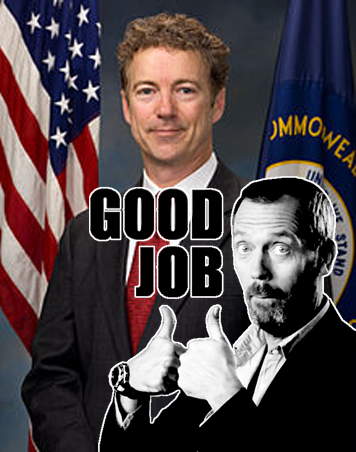
Basically, in layman’s terms, a filibuster is a whole lot of talking to make sure that some sort of law or policy doesn’t pass [or the person who does this]. Enter filibuster, and subject of today’s Fame Day, Rand Paul.
This man began his filibuster yesterday at roughly 12 pm EST, and he kept on going for almost 13 hours. Not only that, but in spite of coming prepared with binders of notes he barely looked at them. He ended his interminable talk with a touch of humour, saying “I would go for another 12 hours to try to break Strom Thurmond’s record, but I’ve discovered that there are some limits to filibustering and I’m going to have to go take care of one of those in a few minutes here.”
Let that sink in for a bit. Rand Paul stood and talked for almost 13 hours. As quoted from the article I linked to above, “As the person leading the filibuster, Paul was forbidden from ever leaving the floor, lest he lose control of the debate.”
Rand Paul went without food, water, or the means to relieve himself for over half a day. He did this to protest a very frightening reality, that of the American military using drones on American soil. During the speech he voiced his concern with that, saying “When I asked the president, can you kill an American on American soil, it should have been an easy answer. It’s an easy question. It should have been a resounding, an unequivocal, ‘No.’ The president’s response? He hasn’t killed anyone yet. We’re supposed to be comforted by that.”
I end this post with another quote from the speech highlighting the fervour that this man has for human rights in America, and his unwavering dedication to uphold them:
“I will speak until I can no longer speak. I will speak as long as it takes, until the alarm is sounded from coast to coast that our Constitution is important, that your rights to trial by jury are precious, that no American should be killed by a drone on American soil without first being charged with a crime, without first being found to be guilty by a court.”
EVAN: Ladies and gentlemen, children with surprisingly discerning taste, Gordon and I have managed to look past the weariness of a day of work to bring you a new installment of Evan and Gordon Talk.
EVAN: This topic arose organically, actually, due to a few posts by Gordon on piracy and my not being able to fully agree with them.
And no, it’s not that kind of piracy, though we did start a new pirate-themed D&D game just this past Sunday.
GORDON: And it shall be awesome- but back to the subject at hand. I’m going to start with some full disclosure:
I am not of the mind that piracy is, in and of itself, a great and noble thing. Any indication or implication of this on my part is usually just in reaction to the mainstream media’s portrayal of piracy as a crime on par with defacing priceless art, grand theft auto, and punching old ladies in the face.
EVAN: And in all fairness from my part, I will admit that I’m no saint when it comes to piracy. I stream a plethora of shows for my viewing pleasure, though I have [and this is likely the voice of Justification speaking] sworn off downloading full-length films, music, books, etc.
GORDON: And Evan, I will attest, is not some twisted chaos-worshiping miscreant devoid of honor or humanity, as the major media industries would have you believe. Well, not entirely, anyways.
Now, Evan, one of the justifications I’ve heard you use in the past is that you’re living in Canada. Many- if not all- US shows are simply unavailable outside of the States through any conventional means.
EVAN: This is true. And while I resided in the States for my post-secondary education I made frequent use of the free streaming service Hulu. I even watched, and somewhat enjoyed, the ads.
In Canada we cannot even watch the episodes on the channels’ respective websites [NBC.com, CBS.com, etc.]
GORDON: And you’re certainly not alone in that. The vast majority of the world is in the same boat, forced to choose between piracy or waiting a few years for the DVDs to come out and then pay an exorbitant fee plus crazy shipping costs. Better hope your purchase isn’t damaged en-route.
EVAN: Since we have been so good about being fair, I will point out that there are options- many television episodes are available to buy via Amazon, online. Before you ask why you should pay for something you would otherwise get for free I’d point out that you pay for these shows by watching ads, and that as someone not in the States you would not “otherwise get it for free” to begin with.
GORDON: And that’s something I can actually tolerate. In spite of my muting ads and/or talking back to them while giving the corporate pigs the finger, I’m perfectly willing to subject myself to ’em if it means cheap and convenient access.
EVAN: If I recall our time together in college correctly [which we both know I can, and do], I distinctly remember you blocking said ads with Adblock.
GORDON: Even though it meant the waiting time was ultimately longer.
EVAN: Which is besides the point. But let’s continue onwards: is piracy damaging?
GORDON: The continued existence of Hollywood, as well as the ever increasing budget of films, would seem to indicate otherwise.
There are people out there who might try to argue that piracy hurts new musicians, who can’t afford to lose profits like big businesses can, but that’s a flawed argument. Truth is, musicians only get a sliver of the profits they generate, and wind up losing the rights to their own songs in the process. Working independently with the consumer is generally a safer and more profitable move.
EVAN: I will not argue with what you have said about musicians for a second. The amount they make through selling single tracks on iTunes is deplorable.
What I will point to, however, are the other areas where piracy can [and does] occur. Television series live and die based on their ratings, and buying them does nothing to help what’s perfectly good [if not great] television. Similarly, if only 1,000 people decided to download a new issue of a comic book instead of simply paying the three or four dollars, that could mean the end of that series; titles that dip below 20,000 are typically cancelled soon afterwards.
GORDON: I agree wholeheartedly. But I think that speaks the whole reason piracy exists- not malice, but rather cost and convenience. These people- especially television producers- have got to understand that their old metrics for measuring the popularity of shows are dead.
It’s the equivalent of saying communication isn’t popular because house phones are dying out. No, we’re just turning to new, cheaper, and more convenient methods. Piracy could be dealt a deathblow if these major industries would just step up their game, rather than trying to use lobbies and buy off politicians to keep us dancing to their tunes.
EVAN: The thing is, I think in arguing for “cost and convenience” you run the risk of defending those who just a) want to get quality products for free b) whenever they want.
It’s not just that people want ease in accessing what they love, the truth is that when given the choice between paying and not paying people will always opt for the latter.
Not to bring it back to comic books [who am I kidding, it’s what I do], but you putting down a few dollars means that a talented writer or artist is able to keep on doing what they do: providing you with high-quality stuff. That’s an actual case where piracy can severely jeopardize both artists and their art.
GORDON: Again, I agree. I do believe in paying for what I love. My record collection stands as a testament to this, as does my choice to spend a few extra bucks buying beer produced by one of the few ethical companies on this blighted earth.
Tell me this- you like the show New Girl, right?
EVAN: Immensely.
GORDON: Would you pay fifty bucks American to watch the show at 4:12 (and ONLY at 4:12) in the afternoon?
EVAN: I would not.
GORDON: How ’bout ten cents to watch it whenever you so desire?
EVAN: Yes indeed.
GORDON: You and millions others, am I right? Ten cents for a crisp, working copy rather than some choppy, blurry pirated version where the sound and video are out sync?
EVAN: Oh, I stream at only the highest quality.
GORDON:That’s my point, I guess. Yeah, there will always be people out there who don’t want to pay the ten cents, but overwhelmingly, that kind of price and convenience will make such a minority negligible.
I assert again that piracy doesn’t exist because millions of people are art-hating maniacs, but because the business plans of these networks and companies are painfully obsolete and short-sighted, especially in regards to the international market. Heck, I’d say such changes could ultimately lead to these companies turning a healthy profit- especially if they just included some advertising à la early Hulu.
EVAN: Here’s the thing, the US already has a working model of what you just said. As I mentioned you can purchase episodes of stuff on Amazon, and I’m talking $2 an episode. That is reasonable. I don’t think your average American would look at that price and think, “There’s no way in Hades I am spending two dollars on a 45-minute episode of television that I can keep forever.”
Yet in spite of that, people in America still download TV shows all the time. If it doesn’t work for them, what makes you think they can extend something like that to the rest of the world?
GORDON: Firstly, I disagree that 2 bucks is reasonable for an episode. That’s the cost of an entire dinner right there. How much more so is that going to be true for the rest of the world, who have even less?
I mean, we’re not talking about a book or a record which goes through an intensive manufacturing process for each copy- we’re talking digital here. Every man, woman, and child on Earth could be given every book, movie, song, and piece of art on earth if the masters so chose…
EVAN: Gordon. It’s two dollars. The average American does not spend that much on a full meal, they spend that much on stuff they don’t need, like gum or coffee or inane tabloids. As a country America is more than able to pay that paltry amount and yet they do not. My point stands.
I’d further argue that since it’s digital that ease of access adds, not detracts, from its value. You can watch it whenever and wherever you want.
GORDON: What I mean about it being digital is that it doesn’t cost money (anything noticeable) to reproduce it, unlike hard copies of things such as books or art. With that mind, charging two bucks an episode seems to me to be unreasonable. I’d cite the fact that for 20 dollars you can get a season of a show with (at least) 20 episodes as proof of this. The cost can, and should, be lowered for great consumption.
EVAN: Like I said, we’re adding availability as a variable. Sure, you can pay 20$ for a full season of a show, but that’s waiting a year or however long it takes for it to come out. People are also paying for the availability of getting it when or soon after it airs.
GORDON: That’s gonna be different from company to company, but for the most part, that’s true. But I’d jump back to my complaint about how little the actual artists get in all this. If anyone- anyone– is gonna set a price, let it be the ones producing the work.
EVAN: Honestly, though, that’s an entirely different argument.
The fact of the matter is that if a writer/artist wanted to print their own comic book there’s no way they’d be able to do it on any significant scale on their own, the cost of printing alone would wreck them.
Different industries pay those who work in them different amounts, and it’s not the topic of our conversation this week.
GORDON: Again, my issue isn’t with the fact that we must pay; we can all get behind this. My issue is with the terms and conditions we’re subjected to- especially when big companies start throwing their weight around to slow progress.
If piracy is the rampant issue that they say it is- and I seriously contest that- then I submit that the fault is on their part for adopting inconvenient, pricey, and exclusionary policies. Let me put it this way: If you say apples can only be purchased by people who’ve climbed Mount Everest, you’re gonna create a lot of apple thieves.
EVAN: We’ve left you a lot to think about, even if you’re not someone who refreshes a website over and over waiting for a new episode of 2 Broke Girls to pop up [did you know I review that show?].
So with that ladies, gentlemen, and genius babies, we bid you a happy Wednesday. We came up with this week’s topic, but you can decide if next week we talk about . . . um . . . Dungeons & Dragons. How we’ve chosen to play it and why we think it works [better?].
GORDON: Alternatively, you may vote that we discuss the role of religion in our (relatively) secular society.
EVAN: Thank you, as always, for reading, and please vote!
Normally, Thursdays here at Culture War Reporters is dedicated to “Fame Day,” in which Evan and I call attention to people, events, or trends we think aren’t getting the attention they deserve.
But not today.
Partly due to my illness, partly due to some unforeseen time constraints, and mostly because of the severity of the issue in question, today there will be no Fame Day.
Instead, we’ll be performing an emergency Shame Day on the subject of yesterday’s terrible news that five major internet service providers (ISPs) will be implementing a “six-strike” system on people suspected of copyright infringement.
Let me break it down for you.
Normally, when you sign up with an internet provider, exactly what you do or don’t do with your connection is entirely and exclusively your business. Whether it’s something as impressive as you doing an electric guitar cover of the hallelujah chorus or as lousy as writing a thousand comments calling that same YouTube video gay is all up to you. What you read, what you write, what you post, what you view- the ISP is simply there (as the name states) to provide internet.
Now you’re probably thinking “Hey- just don’t pirate stuff and you’ll be fine!” and you know what?
You’re right. You don’t have to pirate.
I’m taking over from this point on for a number of reasons. For the most part because although Gordon had good things to say, he didn‘t necessarily say them well, and in some cases didn’t make very much sense; we’re going to chalk that up to his recent illness. I will be relating to you what points of his that I can, while adding my own.
-Evan.
Gordon’s next point is that for the most part, many people pirate because of time and money. Focusing on time, the truth is that we can’t always guarantee that we’ll be at home on a Thursday night to catch The Office. Maybe we’re working another job [many of us need to], or maybe we just forgot. What options does this leave us?
For those of us in America, Hulu is always an option. The on-demand streaming site once provided a very broad range of TV programming, and Gordon points out that it’s a fantastic resource, or at least used to be. Nowadays, however, it’s a lot more difficult to use than it used to be. Hulu Plus, which requires a subscription, is needed to watch a lot of older shows, sometimes even episodes that aired a month ago, if New Girl is any indication. With one of the most convenient resources made less so, is it any wonder that so many people simply turn to torrents?
Gordon’s next point, and a very valid one, is this issue of the Six Strike System and how it relates to piracy. There’s an issue of what exactly is at stake here. Gordon insists that the answer to that is everything, and while I’m not fully with him on that, there’s some sense to what he’s saying.
The thing is that almost anything can be considered copyright infringement. YouTube covers, memes [which often use screenshots of shows like Futurama {see: our Shame Day image}], Gordon’s beloved gifs, even many of the pictures of this blog, in spite of being Photoshopped, don’t technically belong to us. Would we have our internet cut because we run this blog? [Answer: I wouldn’t, because I am Canadian.]
To finish off what Gordon wrote earlier today, the issue is that the people in question aren’t being penalized by an international agency, or even the state or federal government. The fact of the matter is that these ISPs are “using their lobbies to persecute and prosecute suspected users without due process” [quoting Gordon]. What truly incensed him more than anything, though, was the way they’re going about it. That they’re holding themselves up as Knights of Good when in reality they’re just proud that they’re “selectively picking off anyone their bosses deem a threat to their unending stream of profit.”
Piracy is not a subject I agree with Gordon on, and in fact I had a very hard time letting his last piece on the subject be put up on the blog. If people really, truly love art, whether it take the form of television or movies or video games they need to vote with their wallets and know that what they love is worth spending money on.
That being said, I do believe that what these ISPs are doing is wrong, particularly in that they have no one to be accountable but themselves. No business or corporation should have that right. Shame on these ISPs, and shame on the Center for Copyright Information.
In an early Shame Day post I called a particularly reprehensible political lobby “what cancer would look like if it were a social movement.” While I continue to stand by that statement (this group was pulling the exact same ploy against Muslims that Middle Ages Christians used against Jews), a commenter did assert that I had gone too far, stating “as wicked or wrong as you think these people are, they remain human beings.”
It’s got me back to thinking on a subject that’s long held my interest- namely the issue of evil. You’d think it’d be pretty straight forward- right is right and wrong is wrong- but let me get right into an example.
Was this guy evil?
No question. Hitler and his followers aren’t simply evil- they’re the go-to example of evil. They’re our baseline for evil. Everything vile and nefarious is measured against either Hitler or the Nazis.
So what about this guy?
Columbus’s long-list of achievements (discovering America not being one of them) read more or less as a chronicle of genocide, slavery, and theft. It’s well known, certainly at this point, that Columbus was a greedy, narcissistic, tyrannical, and corrupt man. Even with streets, cities, a holiday, and even an asteroid commemorating him, surely we can all agree that this guy was evil. Not on the level of Nazi Germany, but still indisputably evil.
But what about him?
Yep, that’s Thomas Jefferson. President. Founding Father. Author of the Declaration of Independence.
Slave owner.
Not just a slave owner, but an abusive one- carrying on an affair with one of his slaves (that slave also being his wife’s half-sister), getting her pregnant multiple times, and then promptly allowing his own children to spend the rest of their lives as slaves.
Pretty depraved, eh? If I did any one of these things, I’d be called out as a first-rate ******* (and rightly so). I’d be called evil, and that would be telling it like it is.
But let’s move on.
Is this guy evil?
That’s J. Edgar Hoover, founder of the FBI, which he oversaw with about the same leadership you’d expect from some Stone Age self-proclaimed god-king. Hoover was an egoistical, jealous, paranoid man who used the FBI to advance his own political agenda. In addition to all of this, Hoover was a rabid racist, and struggled long and hard against the Civil Rights movement, targeting MLK Jr. in particular, as well as spearheading a campaign to undermine the Black Power movement of the 1960s. Would you call this guy evil?
Ok, what about them?
Yes, the average American family (not pictured above), or heck, even just the average American? Our money goes to supporting companies that use sweatshop labor. Our money goes to supporting companies that recklessly destroy the environment. Our money goes to supporting corporations that push objectifying ads (especially, but not exclusively, in regards to women).
Our taxes go to supporting dictatorial regimes (such as former Egyptian president Mubarak), racist and apartheid states (such as Israel), and even states that utilize child soldiers.
Where does that put us?
Now all of that is simply to illustrate the apparent complexity of the issue. Evil is evil, yes, but pinning down exactly who is and isn’t evil becomes a little more complex once we look at someone other than the Nazis. Jefferson was instrumental not only to the founding of this nation, but to the establishment and perpetuation of the core concepts of democracy and human rights- even to the point where Martin Luther King Jr., a man whose ancestors Jefferson owned– wound up quoting him in his iconic I Have a Dream speech.
Likewise, there’s the issue with the average American. Almost none of us would actually be able to manage a sweatshop, or put an assault rifle in a twelve-year old’s hands, at least, not in person. Despite this, our economy is built on the backs of Bangladeshi kids working for twenty-five cents an our. Our security (we are told) is predicated on us coordinated with nations whose human rights records are drenched in blood (*Cough*China*Cough*Saudi Arabia*Cough*Columbia*Cough*). The vast majority of us either don’t know or don’t care; not enough to raise a voice in protest, anyhow. Again, what does that make us? We might not be ourselves actively implementing imperialism and violence and despotism, but we still do rake in the rewards and howl for more.
We could try arguing innocence by virtue of not being the ones pulling the trigger on any of this, but the truth that history has taught us over and over is that simple knowledge of an injustice creates moral culpability. To ignore injustice equates with committing injustice. We simply can’t escape it.
Not without risk of being hunted down by zealously religious Irishmen…
And maybe that’s the answer. Maybe we can’t be so picky about where we draw the line between right and wrong. Maybe the answer is sweeping judgment. That’s not meant to be some fire and brimstone-esque statement, that’s simply a fact of the matter. You’re not good and evil only when you embark on a mission of genocide- you’re a participant in a viciously evil system until such a time as you act otherwise. You’re part of the problem until you’re part of the solution.
That’s not to say that you have to be flawless. You’re not going to be able to do that (neither am I, for that matter)- in part because we’re human, and in part because the world we live in simply isn’t going to cooperate. But people, we can at least try. I don’t think making an effort to not totally **** up the planet and all that’s in it is really all that much to ask, do you?








 Culture War Reporters