Category Archives: Asia

Fame Day: Cambodian Orphans and the Calgary Flood

These are some of the kids at the Place of Rescue orphanage in Cambodia.

The reason I want to talk about these kids is because on June 20th one of my best friends was evacuated from her home in Calgary, B.C. due to extensive flooding.
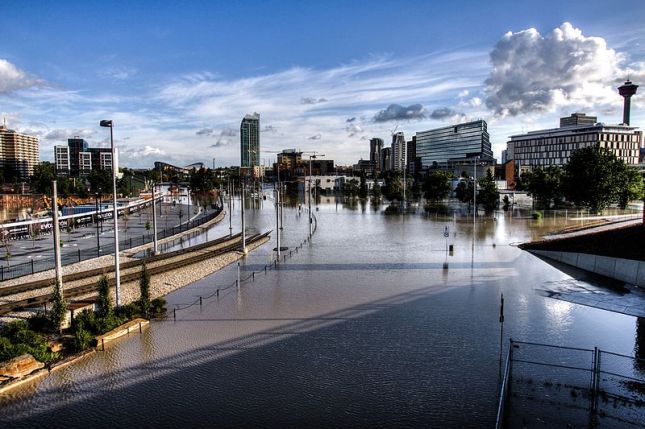
There was actually a lot of cool stories I began hearing after the flood. Like the time the city asked for a few hundred volunteers to come out and help clean out flooded homes and a few thousand showed up instead.

But the coolest story I heard was actually about those kids at the orphanage in Cambodia.  About six days after my friend was evacuated kids and staff at the place of rescue pulled together and sent a total of $900 to help with flood relief in Calgary. Apparently they had each been given the equivalent of about $12 Canadian money by the Cambodian prime minister’s wife not long before the flooding here in Canada. When they heard about the damages they decided to send some of the money they had been given to help with flood repairs. The reason I find this so exciting is because here in North America we tend to think we don’t actually have any real problems.

And we are constantly told about the horrible things happening overseas and why we should send money to help stop these horrible things from happening.

I’m not saying these horrible things aren’t happening. I’m not saying there isn’t a real need, or even that we shouldn’t send money overseas. All I’m saying is that we need them just as much as they need us. When the discussion of poverty is constantly framed in a way that leads us to believe we have the power to save lives it tends to lead to a bit of a god complex.
Not to mention that it also allows us to forget that often we are part of the problem. According to Blaine Sylvester, director of the Calgary-based Canadian

Foundation Place of Rescue, the kids at the orphanage don’t feel like they are so  poverty stricken that they can’t share with their Canadian friends: “The children may live in spartan conditions and sleep 10 to a house with a house mother, but they’re safe, they’re secure and they’re loved.” While Canada and the States are ranked well below countries like Fiji, Nigeria and Ghana on the Global Happiness Index we still assume North Americans need to teach countries we perceive to be “3rd world” how they ought to live.

But while more and more North Americans begin to suffer from donor fatigue, the kids at Place of Rescue seem more than happy to teach us how to give.

World War Z Doesn’t Take Place In A World I Live In

Newer readers may not know this, but this is actually the third post about World War Z on this blog. I first wrote about the way the film was to deviate from the book back in 2011, while former CWR writer [who I dearly miss] Elisa briefly explored their prevalence in pop culture the year after.

So two days ago I saw the movie, and I’m not going to write the logical continuation of my first post, complaining about how the movie could have been “so much better if only. . .”

What I’m going to write about how I wasn’t in the movie.

I drew this over two years ago for an all-comics weekly publication I used to run.

And no, I don’t mean why wasn’t there a zombified version of me in the movie, because seriously if you guys didn’t know I am deathly terrified of any sort of biting reanimated corpse. What I mean is why, when I watched this movie, weren’t there any dang Asians.

Spoilers follow. Kind mild, kinda not. Continue reading

“Asian-Americans,” Admission, and Assimilation

As some of you know, I review the CBS sitcom 2 Broke Girls every Monday night. I do so mostly because The A.V. Club has dropped it from its reviewed shows, and partly because it brings in the hits. This past episode featured the following exchange between Korean diner owner [he’s Korean, the diner is not] Han Lee, played by Matthew Moy, and casting director Tom, played by Eddie Shin:

Before you ask, yes, I put the video together myself.

The reason this struck me is that it highlights a humorous turn of events that I’ve observed more than once. As I mentioned in my review, Shin’s character’s response echoes, almost word for word, that of Howling Commando Jim Morita, played by Kenneth Choi in Captain America: The First Avenger:

Yes, I put that clip together as well. Sorry for the out-of-sync sound. Continue reading

The Avengers Go To Hong Kong, Japan

Early this week I was perusing Marvel’s solicitations for May 2013, and came across the following cover for Avengers #11:

avengers11

Art by Dustin Weaver.

The first part of the issue’s description [and the one I thought was most relevant] was the following:

As Shang-Chi battles an ancient enemy, the Avengers hang out in Hong Kong’s swankiest casino. Continue reading

Re: Where I Try To Explain Red Dawn

I don’t normally get that angry about things. Disappointed, sure. Upset, often enough. But really, truly angry? That emotion is normally reserved for pure, undistilled racism.

Yesterday I wrote about the production history of Red Dawn, and mostly talked about how the plot was immensely improbable and how the film industry is all about money, et cetera. What I did not at all dwell on was the potential of the film to bring out racism in people, similar [but not at all comparable] to the abuse of Middle Eastern Americans after what happened on 9/11.

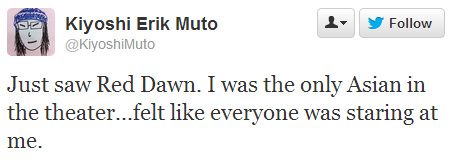
On Facebook Racebending.com directed me to Tumblr user manilaryce, who compiled a number or racist tweets by people who had just watched Red Dawn. I have embedded the image below and on the right.

The following are a few of the tweets that particularly stood out to me:

Kinda wanna kill some Asians right now and defend the homeland, thank you Red Dawn for sparking some patriotism in me

The only reason Im going to see red dawn is cause there’s sexy ass guys running around with guns killing Asians my type of movie;)!

I now hate all Chinese, Japanese, Asian, Korean people. Thanks. #reddawn #amazingmoviedoe

Red dawn was sickkk..just another reason why to hate asians.

This is like when racist Hunger Games fans tweeted about how the casting of a character as Black ruined the movie for them. The difference between that situation and this one is that I feel directly targeted.

One of the tweets, by @elysse223, reads “I usually love Asians, but in Red Dawn I found them terrifying.” After reading that I almost immediately felt worse, like both me and everyone else like me had been transformed into inhuman movie monsters.

The only consolation I can take in all this is that the film is being almost universally panned. Liam Lacey, reviewing the film for The Globe and Mail, says “Red Dawn panders to the worst kind of racist and jingoist impulses, though the movie is so preposterously insincere, it feels like those adjectives should be in air quotes.” Over at Indiewire Gabe Toro describes the film as “stitched together with scotch tape and falling apart at the seams, letting casual racism and misanthropy to spill out the sides.”

I honestly don’t have a lot to say except that I’m angry, hurt, and somewhat unsurprised that this is what audience members all over America are choosing to take away from this movie. I am Asian and I am not evil. I do not want to take over America. I do not want to ever feel like this:

Where I Try to Explain Red Dawn

I’ve begun seeing trailers on TV, and apparently it hit theatres two days ago, so I figure now’s as good a time to talk about Red Dawn as any.

For those of you who don’t know, Red Dawn is a remake of the 1984 film of the same name. In the original the United States is invaded by both the Soviet Union and its Cuban allies. A group of plucky high schoolers bands together to form a guerrilla fighting force, named the Wolverines after their high school mascot.

In remaking the film the studio, Metro-Goldwyn-Mayer (MGM), realized that they needed to modernize the invaders in light of the current political climate, and chose China. Keep in mind that in the original film that country was apparently America’s only ally, with the following exchange taking place:

“…Well, who is on our side?”
“Six hundred million screaming Chinamen.”
“Last I heard, there were a billion screaming Chinamen.”
There were.”

Production was going smoothly until the summer of 2010 when the Global Times, a Chinese state-run newspaper, got a hold of leaked excerpts of the script. This prompted such headlines as “U.S. reshoots Cold War movie to demonize China” and “American movie plants hostile seeds against China.” In early 2011 the LA Times reported that the film’s villains were changed from Chinese to North Korean to “[maintain] access to the Asian superpower’s lucrative box office.Continue reading