Category Archives: Canada

Fighting the Good Fights

Earlier today there was a fight outside my apartment.

I say “fight” in the loosest sense of the word. From what I could gather, a woman had given the wrong address to a pizza delivery man, and the gentleman who the pizza had been accidentally delivered to had been sleeping at the time and was more than a little annoyed at being woken up and compelled to give the delivery man directions to the right place. It essentially boiled down to this man and this lady shouting at each other while the poor delivery guy stood awkwardly in between them with no clue as to how to proceed. Apparently the whole ordeal of having to deal with a mix-up between apartment block 2 and apartment block 20 is on par with genocide. Needless to say, seeing two people break down into three-year olds over something so trivial didn’t exactly reinforce any hope for the future of humanity.

But that sad incident isn’t what I’d like to talk about today- at least, not entirely. What first caught my attention when the whole hissy-fit was going down was the shrill screech of the lady that “‘He’ had better not lay a finger on her or he’d be going to jail”.

Now naturally, I don’t know the whole story, but from where I was standing, the gentleman in question hadn’t given any indication of violence- from all I could see, he was just annoyed at being woken up and having to help this delivery guy find the right apartment. It did grab my attention, though- and that’s what I want to address today.

Violence- we have a long standing love affair with it in this country.

We view it as the be-all-end-all solution to our problems. When all else fails, there’s no problem that can’t be solved with a good, old-fashioned butt-kicking. From the cowboys to the noir detectives to comic book superheroes, violence is the answer. For all our advocacy of non-violence, tolerance, empathy, and understanding, we do get a rush out of seeing “justice” dispensed by means of a vicious haymaker.

Just take a look at this video that’s exploded on the internet over the past 48 hours.

Now chances are, your only complaint after watching that is that the video doesn’t go long enough for you to hear the derisive laughter of all the onlookers as this jerk slinks off with his tail between his legs. Certainly that’ my only issue with it.

Take a look at this video from a few years back.

Now this one isn’t quite so clear cut. Yes, the smaller kid is clearly harassing the chubbier one- even getting violent, but nevertheless the beat-down that ensues is so visceral that I defy you not to feel a little twinge of guilt with your (probable) satisfaction in seeing the bullied kid defend himself.

There are, of course, more clear-cut fights. The video below offers a prime example.

For anyone who might be unclear- the guy with the tray is simply standing there, minding his own business when the other guy walks past and for no apparent reason simply decides to flip the first guy’s tray. No (knowable) provocation, no reason- just sheer, unadulterated spite.I don’t know about you, but I thought the guy falling flat was (1) hilarious and (2) a pretty strong argument for the existence of karma.

When is it ok to hit someone?

“When it’s in self-defense!”, I can hear most of you shouting, and do you know what? They’re right. All but the most hardcore pacifist would probably assert that when someone’s shoving you around, there’s really nothing you can be expected to do other than swing back. Of course, it’s never that’ clear cut.

Did the man in the first video deserve to be hit? He wasn’t presenting a clear and present threat to anyone around, unless you count wet willies as a instrument of destruction.  That being understood, did you cry out in indignation when the street performer knocked him down?

Again, probably not.

The street performer was very clearly being harassed by a guy who wrongly thought the street performer would just sit there and take it. But what if it wasn’t the street performer who had punched the guy? In the video, you can pretty clearly hear other people shouting “Leave him alone!”- what if one of them laid some smackdown? Would we be ok with that?Probably.

I’m going to go out on a limb here and say we’d all still applaud this guy getting punched, though the fact that justice is dispensed by some outsider rather than by the victim may potentially diminish the poeticism of it.

So what do we have so far?

Violence is acceptable in self-defense, acceptable (in some degree) when being harassed, acceptable when someone else is being harassed- where does it end?

I don’t say that in a disparaging tone- I am simply curious as to where that line of logic takes us. Is it ok for the average man to walk around and step in to defend people from being bullied? Do we accept full-on vigilantism?

It’s not as far-fetched an idea as it might sound. If it’s alright (if not straight-up admirable) to go around attempting to defend others, how do we address the laws that (supposedly) govern our society?

Again, we do have an absolute love of violence in this country, but for all our depictions of this:

And this:

Or this:

And even this:

We rarely ever show the dark side with something like this:

The reason we can all get together and applaud the punching of the guy harassing the street performer is because it appeals to our (almost) universal sense of what is and isn’t acceptable in society, and what is and isn’t a measured response. The moment you drift away from clear cut right and wrong, the waters get very murky very quickly.

And I’m not saying that’s a bad thing.

Yeah, the idea of every man, woman, and child declaring “I am the law!” is more than a little unsettling…

…but is it really any worse than what we have now? America and her allies (including Canada, which has only just recently withdrawn from Afghanistan) are engaged in the longest war in recent history with- despite repeated reassurances from the president- no clear end in sight. Do I agree with these wars? Absolutely not.  I think the bad guys who actually should be deposed (and we’re talking about everyone from the Burmese junta to the executive boards of BP and Coca-Cola) are getting off clean. You could argue that the role of ensuring justice and security belong exclusively to the police, but what has their track record been?

All that’s to simply point out that you can argue that such an anarchic system means little or no accountability, but how exactly does that differ from what we have now?

I know it sounds surreal, but if right and wrong as so arbitrarily dispensed from on high, is it really that psychotic to suggest that the front line for security and human decency is in fact you?

It’s just a thought- I’m hoping we can actually start of something of a debate in the comment section (something I’d like to see brought up is a discussion of whether or not our society might benefit from the distinct possibility of getting stomped for being a jerk- anyone and everyone who’s ever waited tables knows what I’m talking about).

Now seeing as how this post pretty much escalated to a declaration of “blood in the streets!”, here’s a picture of a baby hippo.

Be sure to check in tomorrow for Evan’s Shame-Day (yes, we’re switching up the order again- just roll with it), and understand that not leaving a comment will be taken as silent agreement on your part of everything I’ve written!

Evan and Gordon Talk: Piracy

EVAN: Ladies and gentlemen, children with surprisingly discerning taste, Gordon and I have managed to look past the weariness of a day of work to bring you a new installment of Evan and Gordon Talk.

Today’s topic: Piracy.

GORDON: That’s right- having not actually received any suggestions on time last E&G Talk, we’ve resorted once again to choosing for ourselves. Let this be a warning to you.

EVAN: This topic arose organically, actually, due to a few posts by Gordon on piracy and my not being able to fully agree with them.

And no, it’s not that kind of piracy, though we did start a new pirate-themed D&D game just this past Sunday.

GORDON: And it shall be awesome- but back to the subject at hand. I’m going to start with some full disclosure:

I am not of the mind that piracy is, in and of itself, a great and noble thing. Any indication or implication of this on my part is usually just in reaction to the mainstream media’s portrayal of piracy as a crime on par with defacing priceless art, grand theft auto, and punching old ladies in the face.


EVAN:
 And in all fairness from my part, I will admit that I’m no saint when it comes to piracy. I stream a plethora of shows for my viewing pleasure, though I have [and this is likely the voice of Justification speaking] sworn off downloading full-length films, music, books, etc.

GORDON: And Evan, I will attest, is not some twisted chaos-worshiping miscreant devoid of honor or humanity, as the major media industries would have you believe. Well, not entirely, anyways.

Now, Evan, one of the justifications I’ve heard you use in the past is that you’re living in Canada. Many- if not all- US shows are simply unavailable outside of the States through any conventional means.

EVAN: This is true. And while I resided in the States for my post-secondary education I made frequent use of the free streaming service Hulu. I even watched, and somewhat enjoyed, the ads.

In Canada we cannot even watch the episodes on the channels’ respective websites [NBC.com, CBS.com, etc.]

GORDON: And you’re certainly not alone in that. The vast majority of the world is in the same boat, forced to choose between piracy or waiting a few years for the DVDs to come out and then pay an exorbitant fee plus crazy shipping costs. Better hope your purchase isn’t damaged en-route.

EVAN: Since we have been so good about being fair, I will point out that there are options- many television episodes are available to buy via Amazon, online. Before you ask why you should pay for something you would otherwise get for free I’d point out that you pay for these shows by watching ads, and that as someone not in the States you would not “otherwise get it for free” to begin with.

GORDON: And that’s something I can actually tolerate. In spite of my muting ads and/or talking back to them while giving the corporate pigs the finger, I’m perfectly willing to subject myself to ’em if it means cheap and convenient access.

EVAN: If I recall our time together in college correctly [which we both know I can, and do], I distinctly remember you blocking said ads with Adblock.

GORDON: Even though it meant the waiting time was ultimately longer.

EVAN: Which is besides the point. But let’s continue onwards: is piracy damaging?

GORDON: The continued existence of Hollywood, as well as the ever increasing budget of films, would seem to indicate otherwise.

There are people out there who might try to argue that piracy hurts new musicians, who can’t afford to lose profits like big businesses can, but that’s a flawed argument. Truth is, musicians only get a sliver of the profits they generate, and wind up losing the rights to their own songs in the process. Working independently with the consumer is generally a safer and more profitable move.

EVAN: I will not argue with what you have said about musicians for a second. The amount they make through selling single tracks on iTunes is deplorable.

What I will point to, however, are the other areas where piracy can [and does] occur. Television series live and die based on their ratings, and buying them does nothing to help what’s perfectly good [if not great] television. Similarly, if only 1,000 people decided to download a new issue of a comic book instead of simply paying the three or four dollars, that could mean the end of that series; titles that dip below 20,000 are typically cancelled soon afterwards.

GORDON: I agree wholeheartedly. But I think that speaks the whole reason piracy exists- not malice, but rather cost and convenience. These people- especially television producers- have got to understand that their old metrics for measuring the popularity of shows are dead.

It’s the equivalent of saying communication isn’t popular because house phones are dying out. No, we’re just turning to new, cheaper, and more convenient methods. Piracy could be dealt a deathblow if these major industries would just step up their game, rather than trying to use lobbies and buy off politicians to keep us dancing to their tunes.

EVAN: The thing is, I think in arguing for “cost and convenience” you run the risk of defending those who just a) want to get quality products for free b) whenever they want.

It’s not just that people want ease in accessing what they love, the truth is that when given the choice between paying and not paying people will always opt for the latter.

GORDON: I agree such people exist.

EVAN: As I stated in your Shame Day post about the internet providers and their lobbying group, if people really love something they should be willing to sacrifice both time and money. Maybe that means working around an 8 pm show if it truly means that much to them, or paying for a copy of Captain Marvel.

Not to bring it back to comic books [who am I kidding, it’s what I do], but you putting down a few dollars means that a talented writer or artist is able to keep on doing what they do: providing you with high-quality stuff. That’s an actual case where piracy can severely jeopardize both artists and their art.

GORDON: Again, I agree. I do believe in paying for what I love. My record collection stands as a testament to this, as does my choice to spend a few extra bucks buying beer produced by one of the few ethical companies on this blighted earth.

Tell me this- you like the show New Girl, right?

EVAN: Immensely.

GORDON: Would you pay fifty bucks American to watch the show at 4:12 (and ONLY at 4:12) in the afternoon?

EVAN: I would not.

GORDON: How ’bout ten cents to watch it whenever you so desire?

EVAN: Yes indeed.

GORDON: You and millions others, am I right? Ten cents for a crisp, working copy rather than some choppy, blurry pirated version where the sound and video are out sync?

EVAN: Oh, I stream at only the highest quality.

GORDON: That’s my point, I guess. Yeah, there will always be people out there who don’t want to pay the ten cents, but overwhelmingly, that kind of price and convenience will make such a minority negligible.

I assert again that piracy doesn’t exist because millions of people are art-hating maniacs, but because the business plans of these networks and companies are painfully obsolete and short-sighted, especially in regards to the international market. Heck, I’d say such changes could ultimately lead to these companies turning a healthy profit- especially if they just included some advertising à la early Hulu.

EVAN: Here’s the thing, the US already has a working model of what you just said. As I mentioned you can purchase episodes of stuff on Amazon, and I’m talking $2 an episode. That is reasonable. I don’t think your average American would look at that price and think, “There’s no way in Hades I am spending two dollars on a 45-minute episode of television that I can keep forever.”

Yet in spite of that, people in America still download TV shows all the time. If it doesn’t work for them, what makes you think they can extend something like that to the rest of the world?

GORDON: Firstly, I disagree that 2 bucks is reasonable for an episode. That’s the cost of an entire dinner right there. How much more so is that going to be true for the rest of the world, who have even less?

I mean, we’re not talking about a book or a record which goes through an intensive manufacturing process for each copy- we’re talking digital here. Every man, woman, and child on Earth could be given every book, movie, song, and piece of art on earth if the masters so chose…

EVAN: Gordon. It’s two dollars. The average American does not spend that much on a full meal, they spend that much on stuff they don’t need, like gum or coffee or inane tabloids. As a country America is more than able to pay that paltry amount and yet they do not. My point stands.

I’d further argue that since it’s digital that ease of access adds, not detracts, from its value. You can watch it whenever and wherever you want.

GORDON: What I mean about it being digital is that it doesn’t cost money (anything noticeable) to reproduce it, unlike hard copies of things such as books or art. With that mind, charging two bucks an episode seems to me to be unreasonable. I’d cite the fact that for 20 dollars you can get a season of a show with (at least) 20 episodes as proof of this. The cost can, and should, be lowered for great consumption.

EVAN: Like I said, we’re adding availability as a variable. Sure, you can pay 20$ for a full season of a show, but that’s waiting a year or however long it takes for it to come out. People are also paying for the availability of getting it when or soon after it airs.

GORDON: That’s gonna be different from company to company, but for the most part, that’s true. But I’d jump back to my complaint about how little the actual artists get in all this. If anyone- anyone– is gonna set a price, let it be the ones producing the work.

EVAN: Honestly, though, that’s an entirely different argument.

The fact of the matter is that if a writer/artist wanted to print their own comic book there’s no way they’d be able to do it on any significant scale on their own, the cost of printing alone would wreck them.

Different industries pay those who work in them different amounts, and it’s not the topic of our conversation this week.

GORDON: Again, my issue isn’t with the fact that we must pay; we can all get behind this. My issue is with the terms and conditions we’re subjected to- especially when big companies start throwing their weight around to slow progress.

If piracy is the rampant issue that they say it is- and I seriously contest that- then I submit that the fault is on their part for adopting inconvenient, pricey, and exclusionary policies. Let me put it this way:  If you say apples can only be purchased by people who’ve climbed Mount Everest, you’re gonna create a lot of apple thieves.

EVAN: We’ve left you a lot to think about, even if you’re not someone who refreshes a website over and over waiting for a new episode of 2 Broke Girls to pop up [did you know I review that show?].

So with that ladies, gentlemen, and genius babies, we bid you a happy Wednesday. We came up with this week’s topic, but you can decide if next week we talk about . . . um . . . Dungeons & Dragons. How we’ve chosen to play it and why we think it works [better?].

GORDON: Alternatively, you may vote that we discuss the role of religion in our (relatively) secular society.

EVAN: Thank you, as always, for reading, and please vote!


Evan and Gordon Talk: The Purpose of College

EVAN: This week on E&GT we take a break from scrutinizing film to look back about seven or so months to a different time of our lives: college. Now that we’ve both graduated we find ourselves in a different stage of life, and it begs the question of what those four years did for us, and whether or not that’s what we wanted or expected.

GORDON: Throughout my college career, especially towards the end, I heard a recurring argument:

“College is a scam,” they said, “It’s a trap or, at very best, a waste of money. You don’t learn anything you can actually translate into a job, so either drop out while you can or don’t sweat the grades and party your buns off.”

EVAN: Wait, who is the “they” that was saying this?

GORDON: I’ve read it in various Cracked articles, I’ve seen it covered in webcomics and in comments, I’ve heard it on the radio. Not always the same tone,  but it always boiled down to that essential idea. “College doesn’t teach you what you really need to know, it just puts you in debt and wastes your time.”

EVAN: Well, I guess that really begs the question of “What is it that we’re really supposed to know?” If college is the great institution to prepare us for our lives, what should it have taught us?

GORDON: Some would argue that technical and vocational skills are what we really need. Stuff that’s meant to train us for jobs. Wrenches, not Whitman.

EVAN: Which is the sort of thing you see advertised on television late at night or in the middle of the day; schools for electricians and dental assistants and plumbers and what have you.

GORDON: Which always come across as propaganda films from a dystopic alternate timeline. They can claim to be breaking the mold all they want- I’ll still always just see Orwellian Factory-Schools designed train the subservient masses for laboring in name of supreme leader and glorious fatherland.

EVAN: Heh heh.

The contrast to this idea you brought up when first introducing this topic, that the two sides could be seen as college prepping us for our careers or making us more well-rounded individuals.

There’s obviously more to it than that, but how would you boil the latter option down to its essence?

GORDON: I’d probably cite our own alma mater’s (for me more just “mater”) slogan of “global mindedness.” The idea is to create people who are, first and foremost, thinkers. Logical and critically minded thinkers with strong creative abilities and appreciation for art and wonder. A noble enough sentiment to be sure.

EVAN: To really engage with this topic I feel like we should have equal footing, and I’ll have to give our readers a little bit of context-

I’m currently unemployed, and chose to live the latter part of 2012 living with and taking care of my grandfather, whose wife [my grandmother] passed away in September. My job hunt has only very recently started up again.

I say that because as it stands one of us is currently working and knows how his education has aided him and the other is not.

GORDON: I, unlike my Canadian counter-part, am currently employed, having worked two jobs simultaneously for a while there. Having vainly searched for a job the entire summer and most of the fall, I am now working a job helping unemployed people find work, the irony of which is not lost on me.

EVAN: And did you, my Employed-American friend, find that a degree helped you in your search for work?

GORDON: In all honesty, I’m not sure.

On one hand, I can say that certain classes I brought definitely assisted me in securing a job, but those classes really more on the whole “applied” spectrum of education. I definitely didn’t need to go to a top 3% college. People, it turns out, don’t give a crap about where you went.

EVAN: Again, I can’t comment from experience, but I’d like to say that it depends on the job.

GORDON: This is probably true. However, if you were looking for a job, which is gonna look better on a resume? Four years of college, or four years of experience in that field? From everything that I’ve seen, I’d take experience every time.

EVAN: And I agree with that entirely. I can’t count the number of want ads I’ve seen [and this is for stuff like janitorial work, and dishwasher] that require “minimum 2 years work experience.”

It’s like, heck, what was I doing in school when I could’ve been out working this whole time?

GORDON: But of course, that brings up the first question: what’s the point of college? Are we expected to choose a career path and be trained like the mindless, dehumanized proles that we are?

EVAN: Well, for me personally my career goals were more tailored to an academic setting. My personal interest in writing and editing is definitely something that can and is fostered in that environment.

That being said, if I had skipped my four years of college to simply freelance as hard as I could out there in the real world, would I be a better writer today? I honestly couldn’t tell you.

GORDON: The problem is that both sides have really, really big flaws.

On the one hand, turning college into a simple vocational training course does truly rip the soul right out of academia. It makes it just the place you go to get a desk job instead of a manual one.

On the other hand, college as it is now, while fostering intellect and creativity, is as unhelpful as it is expensive. Why put yourself over a hundred thousand dollars in debt to not get employment?

EVAN: I guess in the bigger picture, what is it that we want to do with our lives?

There are plenty of jobs out there that don’t require a college education, and that certainly benefit from hard work at an early stage.

On the flip-side, there are jobs that you simply can’t get without a degree.

GORDON: We also can’t imagine that we can simply get any job we want to begin with. It’s all a gamble. I can get a degree in biology, but that doesn’t at all mean I’m gonna get a job in biology- heck, I’d probably be lucky if I got something even close!

EVAN: Like a janitor in a pharmaceutical company. Or the guy who delivers mail to a biology professor’s house.

GORDON: Exactly. So is that it, then? It’s the whole dang system?

EVAN: I mean, yeah. I feel like more often than not that’s all it really boils down to.

GORDON: So let’s talk about an ideal universe. Or at least one that ain’t quite so screwed up. What’s college look like? Give me your take.

This does not count as an ideal college…

EVAN: It’s tricky, man- Because I would like everyone to be well-read individuals who think about the media that they access and have a fuller understanding of what makes us who and what we are as a culture, I mean, that’s the dream-

But at the same time I acknowledge that there are people who don’t care a whit about any or all of that.

And with so many people who enjoy poetry and the arts, while those are debatably important parts of society, what happens when they need to find work? How many playwrights can any single country sustain?

GORDON: My response would be “how many playwrights are there actually out there?”

EVAN: I think there’s a difference between the actual number, and how many individuals would actually like to be a part of that number.

GORDON: Touché, but we can blame certain jobs being glorified and others suffering from unwarranted contempt.

But let’s move on. College. Your college- what’s it look like?

EVAN: A thorough exploration of the ideas that created Western civilization, the one most of us live in today, because it’s extremely important to observe our origins before we can look at our present and then ahead, after that.

A strong emphasis on writing with the reason that without the ability to properly communicate our thoughts how can we even really fully think them to begin with.

GORDON: Sounds to me that you’re still leaning more towards the side of academia.

EVAN: Well, like we’ve discussed, I have a slight bias. And I suppose we haven’t really defined the question as far as the purpose of college.

GORDON: My take would a combination of both sides, with the end goal being application. We’re talking about the study of English for the purposes of applying the principles in same, either in writing or screenplays or entertainment or communication of some kind.

I feel this would allow for all the creative and academic elements while keeping the whole process grounded. No ivory towers.

EVAN: I don’t think my take discounts the possibility of lining up with what you said, but that’s a really good description of how college could and maybe should be.

That being said, we are actually overtime.

GORDON: You wanna talk about drugs and culture next time?

EVAN: I think at some point we could hand this back to the viewers, actually. We’ve really gotten a handle on this whole E&GT. I’m just not sure when or how to do so.

GORDON: The readers are slack-jawed cattle who would eat their own shoes if we told them to.

EVAN: I should probably edit that out of the final post.

GORDON: Nah, we can let ’em vote. My subject would be Drugs and Culture.

EVAN: Mine would be . . . um . . . huh. About SNL. How to fix SNL.

GORDON: Nice. Let it be so.

EVAN: Tell the nice people to have a good Wednesday, Gordon.

GORDON: Have a good Wednesday, Gordon.

EVAN: And don’t forget to vote, readers! Thanks for putting up with my co-writer!

Shame Day: Nationalism

Imagine for a moment, the existence of two mythical lands: Acirema and Adanac. Imagine that you are a citizen of Acirema, living in a little town bordering Adanac. Despite your isolation, you’re just as patriotic as any another Acireman. You wave the Acireman flag, salute it, pledge your undying allegiance to the homeland, and swear to defend her against all attacks. You cheer on your Acireman compatriots competing in the Olympics. You stand up and applaud when they win, and howl with despair when they lose. As far as you are concerned, you are a proud Acireman, a citizen of the greatest nation on earth; you love your country just as every red-blooded Acireman is expected to.

And then it is discovered in an old, forgotten document that a century earlier your far-off neck of the woods was actually purchased by Adanac from some forgettable Acireman president. All this time the Acireman-Adanacian border was actually twenty miles further south, making your town and everyone in it Adanacian. What do you do? You were born in another country, making you a citizen from a country that has until now been foreign to you. Do you still salute the Acireman flag? Do you still cheer for the Acireman athletes? Do you still decry the metric system as a tool of the devil?

You probably get the point by now.

Nationalism, boiled down to its most basic components, is the idea that borders matter. That being born on one side of an imaginary line fabricated by affluent racists a few centuries ago should make you a different person than if you were born a few miles north/south/east/west of it.

Now we’re not exactly caught up in some series of Napoleonic conflicts, so why bring up nationalism as the topic for this week’s shame day?

It’s because of this quote by President Obama:

“America remains the one indispensable nation, and the world needs a strong America, and it is stronger now than when I came into office…”

Now let’s take a few minutes to reflect on the sheer arrogance of that statement.

Done?

Good, now let’s break it down.

According to the president, America, and only America, is the one necessity in the world. Brazil, we’re ok if that goes away. The UK can sink into the ocean. China, Russia, Nigeria, Japan,  Italy, Laos- these places are “dispensable.” They don’t serve an important function like America does. America is “indispensable”- the one indispensable nation.

Now if this quote came from some goose-stepping splinter cell in Nowhere, Arkansas, we could probably ignore this. However, as it came from the single most powerful man on the planet, we’re probably not crazy for raising some concerns.

I mean, let’s assume the guy is right- America’s existence is the cornerstone of all stability and decency in the universe, and it is simply more important and valuable than all the other nations of the earth. Shouldn’t we then be concerned about damaging this sole stitch in the fabric of civilization? Puerto Rico, a US territory, is currently petitioning to become a state. If it does, will the America that Obama calls indispensable change in such a way as to unravel all of that? What about selling an acre of land in the south to Mexico, would that shift in the border constitute a change to this indispensable nation?

Or maybe it has nothing to do with borders- maybe America’s indispensable nature has to do with its people. Obviously to protect this, we must maintain things the way they are, and keep any immigrants from entering into the nation, or any Americans from immigrating out, lest we screw up the quota that makes us us. Or maybe it’s not about borders or people- maybe America’s unique nature as “indispensable” comes from its values- that’s why we need to never add or abolish any laws or rules or alter our culture or worldview in any way.

Let’s be realistic here. I’m an American, and I am not exceptional. God Almighty does not smile more upon me for have been born in square A than in square B. My blood is not somehow more precious than that of someone who lives a few feet across an imaginary line in the dirt. If a Mexican, a Canadian, and I were drowning in the ocean, you would not be more obligated to rescue me for either of them. I am not any less dispensable than any other human being on the planet by virtue of my passport or my heritage. This idea that we are somehow inherently divided as human beings on the basis of where we were born is unspeakably stupid. There’s nothing wrong with liking the unique things about the place where you live, or the good and courageous things that are being done, or have been done, or the noble values that your countrymen hold. But ranking these things- the unique things, the good and courageous actions, the noble values- as being less or more important on the basis of their proximity to you is just a flipping shame.

Looking Back at a History of Booze and Bacon

It’s been pretty evident for a while now that a lot of you have gotten here due to a post I wrote almost exactly a year ago, “Epic Meal Time: Leaving Grease Stains on Pop Culture.” In it I extol the internet show and its evolution into something that ultimately rewards long-time viewers, as well as its impact on pop culture.

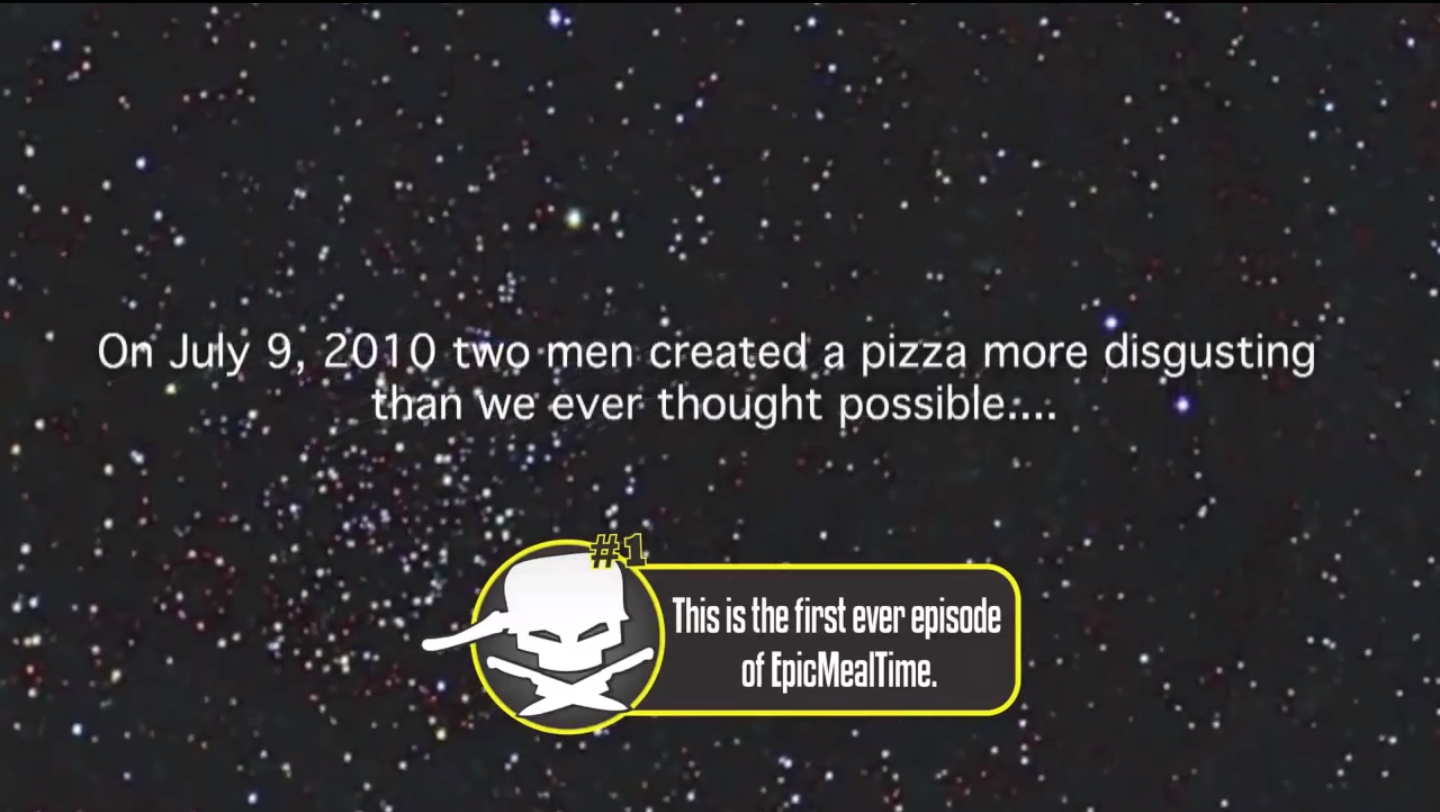
Coinciding with the anniversary of my original EMT post is the show’s second birthday, and a loving tribute to their first episode ever, the Fast Food Pizza. Video below:

While two whole years of epic meals is impressive enough, what got me even more excited is what the crew uploaded yesterday.

The new feature, going by the name “Flashback Friday” is a director’s commentary of sorts, presumably all done by creator and star of EMT, Harley Morenstein. Essentially the entirety of their Fast Food Pizza episode, the main difference takes the form of pop-ups that are very reminiscent of Xbox Live Achievements, or [probably more accurately] VH1’s Pop-Up Video

Additional changes include a bacon strip censor bar for Muscles Glasses’ eyes, as well as vocal distortion. From this point on they moved forward with turning him into a silent, powerful destroyer of fast food and liquor.

What I probably appreciate more than the fact that they made this video is that they haven’t removed the first. There’s a trend on the internet to simply remove or take down earlier work, or whatever you’re not proud of. Both Harley and Epic Meal Time are sticking to their roots in remembering the first video that got them where they are today. And that means not removing this video with Alex Perrault [as you’d call him sans aviators, I suppose], or another where they, believe it or not, actually use vegetables.

EMT announced on its twitter account that if fans liked the video then they’d continue to do more. While not all of the feedback was positive, I for one hope that the likes, and views, continue to multiply. Watching the behind the scenes of almost anything is interesting, even more so learning about the history behind two years of booze and bacon.

EDIT: After their fourth episode on YouTube the EMT guys have decided to move the show over to their own site. You can watch every one of the episodes here, where they continue to be put up every Thursday.

The Cloaca: A Book Review

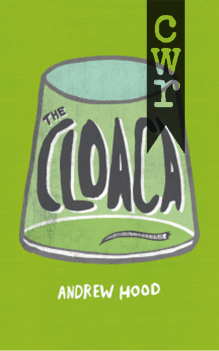
The sophomore collection of short stories from Halifax-based author Andrew Hood, The Cloaca is 138 pages of people who don’t know what they’re doing.

Described on the back cover as “your high school gym coach, drunk and dishing dirt on all the other teachers on the crosstown bus,” the stories in this book capture your attention like a man on a bicycle wiping out in the rain, or a bunch of Italians yelling at each other on the sidewalk [both of which I saw two days ago]. Continue reading