Category Archives: film

Filmmaker Christine Welsh on Tracing Her Heritage in Women In the Shadows

My Canadian studies class recently watched Women in the Shadows, a documentary by feminist filmmaker and professor, Christine Welsh. Not long after we had watched her film Welsh agreed to visit our class for a question and answer period. Below I’ve included a little of what I learned from her film and her visit.

christine20qu27appelle20valley

1101331

Norbert Welsh’s oral history was recorded by Mary Weekes.

In an article detailing her documentary experience, Welsh explains that her interest had been sparked when her mother recovered a copy of The Last Buffalo Hunter, an oral history by her great grandfather, Norbert Welsh. In the film, however, Welsh attempts to recover more information about her great grandmothers, figures who were much harder to trace.

Along her search, Welsh discovers the name of her great grandmother, Margaret Taylor, and Margaret’s mother, Jane. Welsh surmises that Jane was most likely Cree. Jane’s union with George Taylor meant that Margaret was one of the first generations of Metis women. While documentation about women was lacking during early colonization, Welsh was able to uncover some details about her foremothers because of Margaret Taylor’s connection to Hudson’s Bay Company Governor George Simpson.

In the early period of Canadian colonization, Hudson’s Bay employees often took “country wives”. These women, of First Nations or Metis heritage, would create family ties between the explorers and the local community and were often the reason their husbands survived their first few Canadian winters. In Women in the Shadows, Welsh discovers that Taylor had been Simpson’s “country wife” for many years, only to be cast aside by Simpson when he returned from a trip to England with a new white wife.

Continue reading

Rowling’s Wizarding World: Just As Small As Ours, Unfortunately

I like the Harry Potter books. I just can’t say I love them [my favourite YA series of novels is Percy Jackson & the Olympians], and after having finished all seven and catching the last few movies in theatres haven’t thought about them much. Certainly not enough to give the Pottermore website, created by Rowling to give HP fans what they continue to jones for, even a cursory visit.

On that same note I haven’t really been following Fantastic Beasts and Where to Find Them, a prequel and spin-off to the film franchise, aside from perking up at the idea that protagonist Newt Scamander might be something other than White. I briefly mentioned it back in 2013 when covering the inherent problem with assuming that White is the norm, but ultimately stopped paying attention after it was officially announced last June that Eddie Redmayne had been cast in the role.

That said, fantasy worlds and the worldbuilding involved in their creation have always interested me, and I didn’t hesitate to click on a link a friend had shared on Facebook stating that Rowling had “[revealed] four wizarding schools, including one in the United States“, with the latter being one of the settings in the upcoming film. After all, if one of the aforementioned magical places of learning was to be in North America chances were that the other three were located elsewhere. Harry Potter and the Goblet of Fire had always been my favourite of the series, with one of the many reasons being that it featured the two other wizarding schools and characters from them, expanding the universe beyond the borders of Great Britain. Continue reading

Black to the Oscars

Well readers, it was exactly one week ago that actress Jada Pinkett Smith announced her decision not to attend this year’s Academy Awards, citing a distinct lack of diversity in the nominees. In a brief video [embedded below], Pinkett Smith expressed her frustration at the apparent exclusion of people of color in the “mainstream”, and declared that “…begging for acknowledgement, or even asking, diminishes dignity.”


Upon hearing this, the nation has since had a moment of quiet reflection over the issues Miss Pinkett Smith has brought up, calmly and honestly discussing the root issues facing the representation of-

Nah, I’m just kidding. People went ape****.

tumblr_nqofbeqloy1twltp9o1_250

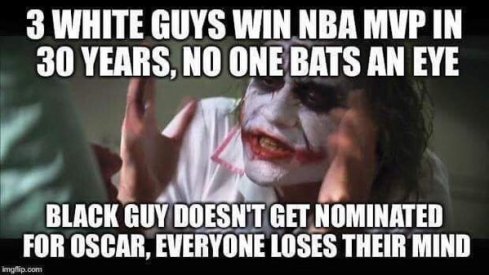
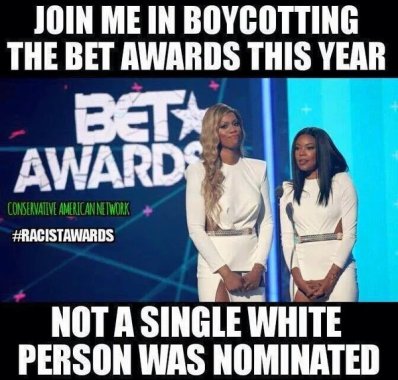
Cue the torrent of self-righteous indignation as folks started positively shrieking about reverse-racism, hypocrisy, and entitlement. And as more and more figures have come out in support of (or at least, sympathy with) Pinkett Smith’s cause, the outrage has only grown with it. It seems that you can’t go anywhere online without running into something like this:

czu22daumaapgu3

Or this:

czdq2uxwwaay9z7

Or this:

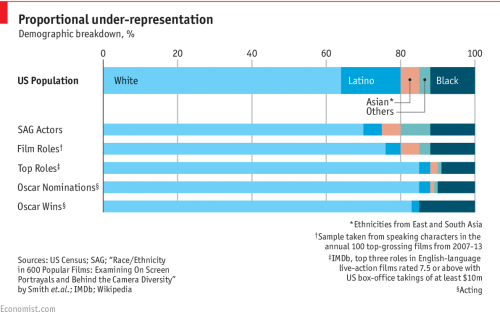
20160123_woc197

For the record, the stats on this lead to incorrect conclusions- but we can talk about that later.

Continue reading

Celebrity Mortality and Actual Emotion

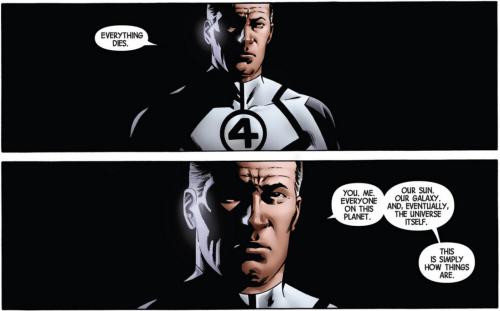
everythingdies

New Avengers #1 (Vol. 5). Written by Jonathan Hickman, illustrated by Steve Epting.

Yesterday morning it was announced that British actor Alan Rickman had passed away from cancer. At the very beginning of this week it was revealed that musician David Bowie has suffered the same fate. As social media was filled with mournful statuses and 140 character eulogies I couldn’t help but be drawn back to a post I wrote almost three and a half years ago called “Celebrity Mortality and Actual Loss”.

In it I drew a comparison between Michael Clarke Duncan, and other such famous people who had died within the past month or so, and my grandmother, who breathed her last in the ICU of a Toronto hospital just the day before. When rereading it in preparation for this post it was impossible to ignore the bitterness that lay right beneath the surface, the pain still so fresh from the loss I had just experienced.

It’s been a while since then, long enough for the years to dull the hurt and extinguish any anger I might have once felt towards a world that appeared to haphazardly allocate its sorrow. Now, years later, my Facebook feed filled with dozens of Ground Controls hailing Major Tom, I find myself on the opposite side of the spectrum, feet terrifyingly close to being planted firmly in indifference.

Which, understandably, makes it look like I’m not doing so hot on the scale of emotional maturity. Continue reading

In The Force Awakens White Women get Representation, but Black Women get CGI

I loved Star Wars: The Force Awakens. I loved it so much that the first thing I thought about doing when I walked out of the theatre was hash out everything that this Star Wars reboot had done right.

Like including legitimately humorous dialogue rather than slapstick CGI sidekicks.

Unfortunately, everyone on the blogosphere had already come to the same conclusion long before I was back from my Christmas break. Still, I couldn’t stop thinking about the film, or reading articles about it. So I’ve decided to write about one of the few things that bothered me about the film, rather than many aspects of the film that I loved.

If you’ve been reading this blog for some time, you probably already know that we at CWR were excited to hear about the diversity of casting in The Force Awakens.

I was especially excited when I heard that Lupita Nyong’o had been cast. Ever since she won best supporting actress for 12 Years a Slave and was declared the most beautiful person of 2014 by People magazine, I’ve been keeping my eyes peeled for Nyong’o. After witnessing her sudden rise to fame, I was curious to see if she would continue to find roles in major films, or if she would slowly be pushed out of Hollywood because of her dark skin. As Gregg Kilday explains in his article about Nyong’o, few black actresses have ever managed to secure a spot as a permanent Hollywood heavyweight:

While the stage would appear to be set for [Nyong’o] to ascend to the A-list — just as Jennifer Lawrence did after her best actress win for Silver Linings Playbook last year — it’s not that simple. For while there have been a handful of African-American actors, from Sidney Poitier to Eddie MurphyDenzel Washington and Will Smith, who have reached that status, there’s never been a black actress who has become the equivalent of a Julia Roberts or Angelina Jolie. Whoopi Goldberg came closest, following her best actress Oscar nomination for 1985’s The Color Purple and supporting actress win for 1990’s Ghost, but despite an occasional hit like 1992’s Sister Act, she didn’t maintain that momentum. Hollywood also flirted with Angela Bassett, Thandie Newton, Halle Berry and, most recently, Mandela‘s Naomie Harris, without ushering any of them into its very top tier.

It seems like a habit for major blockbuster films to tick off their diversity checklist by casting a white woman and/or a black man. Meanwhile, actors from other minority groups, especially women of colour, get overlooked because all the non-white, male roles have already been taken. As Evan pointed out in his post about the Martian and racebending, this seems to be the impulse, even when it means casting a white women to play a Korean- American character and a black man to play an Asian- Indian character. Continue reading

2015’s Cultural Battleground – Kat’s Account

EDITOR’S NOTE: We end this year by each taking a look back and picking our five best posts, explaining both their importance to us and to the world we currently live in.  Clicking the banner images will link you to each post, so as 2014 comes to a close join us in remembering how far we’ve come, but also how far we still have to go.

RachelBrown

After the recent acts of Daesh terrorism in Paris I returned to this interview with PhD Candidate Rachel Brown to get some perspective. While Brown’s work was focused on food and religious identity in French and Quebecois Muslim immigrant communities, it also highlights how isolation and religious persecution can push young people towards accepting religious extremism. In the interview, Brown explains,

“I’m not really an expert in ISIS or Jihadist fighters or any of the topics that relate to this. I can say that when people, especially youth, feel alienated, when they don’t feel at home anywhere, this can lead to finding identity in extreme forms of religion. If the religious identity is the only identity that one feels they can claim, he/she is going to place a huge amount of importance on that identity.”

nestle

This year, a petition began circulating that condemned Nestlé’s operations here in British Columbia. While Nestlé has been operating here in B.C. for 15 years, residents became particularly concerned during the drought this past summer.  As Gordon has pointed out in his previous Shame Day post, Nestlé doesn’t have the greatest track record when it comes to respecting other countries and their water needs. In this post we take a closer look at the relationship between Canadian water and the American corporations that would like to bottle it up. Continue reading