Category Archives: film

Apocalypse Wow

There is, if sources are to be believed, going to be a rebooted Left Behind movie coming out sometime next year.

Your reaction should be as follows:

If it isn’t, then you probably aren’t familiar with the series (and should count yourself truly fortunate), so for you blissfully innocent, here’s the basic run-down.

The Left Behind series is based on the book of Revelation in the Bible, as well as certain (delectably) apocalyptic verses in Old Testament books. I say “based on”, but that’s more to demonstrate the authors’ intentions. Left Behind is “based on” the book of Revelation in the same way that Teenage Mutant Ninja Turtles is based on Vasari’s biographies of Italian Renaissance artists.

In the sixteen-novel series, all true (cough, Protestant, cough) Christians have been “raptured” (removed from the world and taken directly to the after life), leaving behind the unsaved protagonists of the story who find themselves contending with the oncoming “tribulations” (the host of hardships and catastrophes marking the end times) and the rise of the antichrist, who walks the earth in the form of a Romanian politician who takes control of the UN (because, you know, there’s no one more powerful than the UN).

Things more powerful than the UN:
The Student Government of MLK Jr. Middle School,
A Junior Sales Rep from Prescott Pharmaceuticals,
Paris Hilton’s Chihuahua

Needless to say, I don’t think very highly of the series. But hey, if we’re looking for badly written fan-fiction, why not haul Twilight to the guillotine?

It’s because of the fan part. That’s what really gets me. We’re not talking about someone fawning over the idea of stalker-veggie-sparkle-vampires, we’re talking about someone fawning over the idea of millions- billions– of human beings undergoing agonizing deaths. Think I’m reading into things? Take a look at this passage from the series:

The riders not thrown leaped from their horses and tried to control them with the reins, but even as they struggled, their own flesh dissolved, their eyes melted, and their tongues disintegrated. As Rayford watched, the soldiers stood briefly as skeletons in now-baggy uniforms, then dropped in heaps of bones as the blinded horses continued to fume and rant and rave.

Seconds later the same plague afflicted the horses, their flesh and eyes and tongues melting away, leaving grotesque skeletons standing, before they too rattled to the pavement.

You might say “Sure, that’s violent, but that isn’t exactly glorifying it, is it?”. Let me continue on.

…Jesus nudged His magnificent white charger and descended to the top of the Mount of Olives.

As He dismounted, Carpathia shrieked out his final command, “Attack!” The hundred thousand troops followed orders, horsemen at full gallop firing, foot soldiers running and firing, rolling stock rolling and firing.

And Jesus said, in that voice like a trumpet and the sound of rushing waters, “I AM WHO I AM.”

At that instant the Mount of Olives split in two from east to west, the place Jesus stood moving to the north and the place where the Unity Army stood moving to the south, leaving a large valley.

All the firing and the running and the galloping and the rolling stopped. The soldiers screamed and fell, their bodies bursting open from head to toe…

So much for turning the other cheek, eh?

And here’s what gets me about the series. It’s not the generally bad writing or the twisted theology- it’s just how freakishly popular the series is. Popular enough not to spawn just one movie attempt, but two. It’s hard enough for good stories to get a second chance at something like that, let alone this junk. And it’s the implication of that popularity which gnaws at me. There are people out there- a lot of people- who genuinely look forward to this supposed apocalyptic scenario, or an apocalyptic scenario, anyhow. People who fully expect the end of the world to be a plague and hellfire ridden Armageddon, complete with WWIII and genocide of unheard of proportions. People who look forward to this- and not in a “in the sweet by and by” way, I’m talking about a “I love the smell of napalm in the morning” kind of way.

You can’t deny that this blood-thirsty anticipation does exist. If you’re even only vaguely familiar with the Christian (American-Christian, more on that in a second) subculture, you’ll almost have certainly run into this. There’s plenty of other lousy Armageddon fantasies out there.

And what makes it all the worse is just how utterly undeserved all this hidden vitriol is. This vengeful glee isn’t coming from people who have been mercilessly persecuted for their faith. This isn’t coming from the families of martyrs or the congregations of assassinated priests and pastors in the third world. The churches of Africa, Asia, and South America have enough problems combating war, poverty, and disease to be drooling over prophesied war, poverty, and disease. No, this is the bitter vindictiveness that only comfort and safety can breed. All this body-bursting leering isn’t a result of imprisonment (not that it would be justified there either), it’s a result of being snubbed by Bill Maher or portrayed as yokels on some sitcom.

That’s just messed up.

Now this isn’t Shame Day, but that doesn’t mean we can’t all gather ’round and ruthlessly mock something that so richly deserves it, and if this drivel doesn’t deserve it, I don’t know what does.

Evan and Gordon Talk: Django Unchained

GORDON: You know what they call a quarter pounder with cheese in France?

EVAN: What?

GORDON: A poor attempt at distracting our readers from the fact that we ain’t gonna be talking about drugs like we said we would.

EVAN: I have seen very few Tarantino films, and only barely recognize the references.

GORDON: You make me sad.

EVAN: I know.

That aside, what we’re going to be talking about today is Django Unchained, a movie I finished watching less than an hour ago and the subject of this Monday’s post [written by Gordon].

GORDON: So what did you think?

EVAN: Initial thoughts are: Very long. Not what I expected. Apparently in Django’s world everyone is a skinbag filled to bursting with blood.

GORDON: Speaking as someone who’s fired black-powder guns, I can actually kinda see something like that happening.

EVAN: That is ridiculous, but interesting to know.

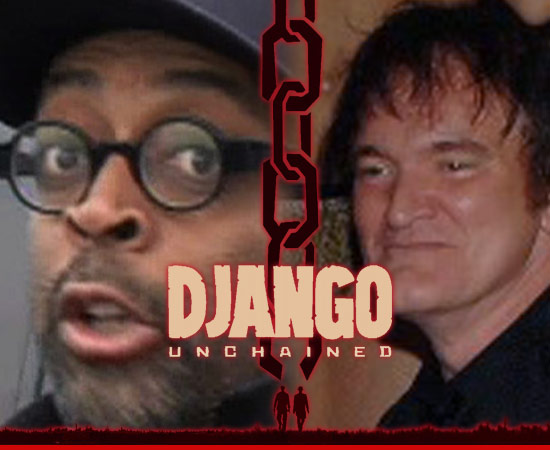
Now if you don’t have anything in particular you wanted to talk about, did you want to maybe address Spike Lee’s reaction to this film really quick?

GORDON: The Lee-Tarantino feud has been going on for a long time now, so I really wasn’t surprised that Lee reacted the way he did. I naturally wish he had at least seen the movie, but I don’t think it would’ve made a difference in his mind.

EVAN: To give readers a little context, director Spike Lee tweeted:

American Slavery Was Not A Sergio Leone Spaghetti Western. It Was A Holocaust. My Ancestors Are Slaves. Stolen From Africa. I Will Honor Them.

He also straight-up said “I cant speak on it ’cause I’m not gonna see it. All I’m going to say is that it’s disrespectful to my ancestors. That’s just me…I’m not speaking on behalf of anybody else.”

GORDON: I get where he’s coming from, but (1) I don’t think the movie dishonors the slaves and (2) I don’t think that there should be any time period off-limits for telling stories.

EVAN: I definitely agree with both points. Tarantino does not disrespect the plight of slaves during the time period, and there are really no eras of history that we shouldn’t be allowed to explore through various media. How it’s done is what matters.

GORDON: It’s Tarantino; you either love him or you hate him. He does a spastic, scatterbrained style of movie which is two parts tense dialogue and three parts references to obscure exploitation flicks. It is what it is.

EVAN: So did you like it?

GORDON: I did, but not as much as his other movies. And not for the subject matter, simply for the storytelling. I felt it was anticlimatic. Especially compared to his second latest, Inglourious Basterds.

EVAN: Very much agreed. You expect [SPOILER ALERT YOU’VE BEEN WARNED] Monsieur Candy to be killed by Django, or at least in a big way, but instead he’s just shot by Dr. Schultz with his sleeve-Deringer.

GORDON: And there’s still plenty left in the film, we just kinda trudge through it. I simply wasn’t impressed. I mean- I ain’t asking for a John Wu fightscene, but something more than [SERIOUSLY YOU GUYS, SPOILERS] Django shooting unarmed people from the top of the plantation stairs.

But as far as the whole thing goes, relatively amusing and a major stepping stone in addressing the subject of slavery.

EVAN: I mean, sort of going back to where Lee was coming from, it’s not a very realistic depiction by any means, a revenge story of this fashion can’t be. That being said, isn’t it the same sort of concept as Inglourious Basterds? Revenge enacted by the persecuted?

GORDON: That’s exactly what it is. A revenge fantasy. Bad guys being killed by the people who they oppressed. It gives us a feeling of divine judgment upon the wicked. Which is a theme a lot of westerns have.

REVENGE.

EVAN: I have seen at least one, and you are not wrong.

GORDON: I think what Lee needs to get is this:

This was not a movie about slavery, this was a movie about revenge set in the world of slavery. This wasn’t- and shouldn’t be- taken as a commentary of any kind about African-Americans anymore than Kill Bill should be taken as a commentary on women.

You wanna pick a fight with Tarantino, do it over something that’s actually there. (And just so everyone knows, I really like Spike Lee’s work and admire the guy as an individual)

EVAN: So you’re saying that slavery must be viewed as a backdrop, and not the subject matter? I know that you wrote your Monday post on this, but we can go over it just a little.

GORDON: That’s exactly it. It’s not a history film, it’s a Tarantino film. Don’t look for realism there, and don’t look for buoyancy in a nightstand; it’s not what either of them are for.

EVAN: I agree with you to a point, in that the exploration of slavery was in no means Tarantino’s intent. It’s just difficult to look past that as subject matter when it permeates the film [what with it opening up on a slave’s scarred back, etc].

GORDON: That is true, and you can question whether or not it’s right for Tarantino to use the subject matter to shock and horrify people and draw in crowds, but from what I saw and understood of the film the scenes of horror inflicted upon the slaves were, what’s the word for this, “respectful?” enough to indicate that even blood-and-guts Quentin wasn’t unaware of what he was dealing with.

EVAN: I can accept that. Two more thoughts as we wrap up this talk: the soundtrack and Samuel L. Jackson as a real life Uncle Ruckus.

GORDON: The soundtrack sucked. We can all agree on this. Usually he can make it work- this time he didn’t.

EVAN: My cousin and I actually really liked it.

GORDON: Really? I couldn’t disagree more. I felt it lacked cohesion, which the soundtracks in his other works normally have. Heck, more often than not it’s the commonalities in the soundtracks trying the whole thing together.

EVAN: I felt like the more contemporary hip-hop rap tracks were a little bit jarring, but thought the other songs overall were good picks.

GORDON: We’ll have to agree to disagree on that one. Let’s move on.

EVAN: Samuel L. Jackson’s character.

If you don’t know who that is on the right you need to start watching The Boondocks right now. Finish this post first, then immediately go find an episode online or something.

GORDON: I thought he knocked it out of the park. Didn’t have any problem with him whatsoever.

EVAN: 1) Did not know Samuel L. Jackson could play such a convincing old man. 2) Sycophants in films are normally played up for comedic value, and that is no less the case here.

GORDON: Let’s not forget that Jackson was not only an active member of the civil rights movement, but even associated with some of its more radical leaders.

EVAN: That is something that I, and presumably our readers, did not know.

To end this off, did you have a favourite moment in the film? [I SHOULDN’T HAVE TO WARN ABOUT SPOILERS, BUT I AM ANYWAY]

GORDON: For me, it would have to be the scene where Christoph Waltz (who really stole the show) was explaining bounty-hunting the Django in the bar. The dude is awesome to watch.

EVAN: Christoph Waltz’s accent was amazing. I could listen to him talk all day.

My personal favourite was the posse getting ready to go kill Django and Schultz and arguing about the masks. The dialogue was hilarious, and Jonah Hill was a nice surprise, too.

GORDON: That was awesome. And speaking of awesome stuff, our discussion topic for next week:

EVAN: Ah man, I kind of just want to talk about movies. Could we somehow generally address the trend towards big budget sci-fi flicks that’s coming about in Hollywood?

GORDON: No. No more movies. We do ’em too much already.

EVAN: Fine, fine. Suggestions?

GORDON: College: what should its purpose be? Careers or Well-Rounded Individuals?

EVAN: Or just in general, I’m not sure it has to go one of two ways. But that’s a good one. I’m on board.

Thanks everyone for reading, and for continuing to unwittingly stumble upon our blog in 2013! Evan and Gordon out.

Django and the N-Word

Let me begin by explaining that this is not a review of the simultaneously acclaimed and decried 2012 Tarantino blood-fest. You want to hear one of those, I’d recommend clicking over to Spill or The Escapist’s “Escape to the Movies.” No, what I want to talk about are some specific elements and segments of the film which have become points of contention, controversy, and debate in the past weeks.

Let’s start with the most obvious:

I. Saying “Nigger” Every Other Word

I won’t claim to know your stance on the word “Nigger”- heck, I’m not even sure of my own stance. Perhaps you view the term as so degrading and reprehensible as to merit burning it from spoken language. Perhaps you believe that appropriating and using the word strips it of its power to even be used as an insult. Maybe you see it as being purely contextual- a term of address with audience and a terrible insult with another.

It’s all Elmo ever thinks about

There are probably strong points to be made on all sides, but perhaps the stance you cannot take is that the use of the word “nigger” was inappropriate for the movie.

Now before you take up the battle-cry of “Tarantino is just trying to shock us!” or “Tarantino uses the word excessively in his other movies!” I have to say this.

You’re right.

It’s Tarantino; that’s not an excuse, that’s a fact. You wanna take up his use of the word in other films, then that’s part of the whole debate mentioned above. Simple truth of the matter is that this use of the word “nigger” would still be controversial if the film had been made by anyone else. So let’s talk about it.

Let’s assume that this movie, with selfish or noble intent, is trying to demonstrate a glimpse of the world in question; the use of that word is almost bound to come up. I might throw out the example of Mark Twain’s classic novel Huckleberry Finn, and while by sheer volume Django probably has Huck beat for use of the word, by percentage I’d posit the two are pretty evenly matched. The escaped slave Jim is repeatedly and almost exclusively referred to as “Nigger Jim,” as are the other black characters in the book. Now Twain was anti-slavery and used that word to demonstrate the dehumanization of African Americans (which is why taking the word out of versions of the book is so dumb), as well as reflect the general use of the word. Now I’m admittedly no historian, but if the writings of Twain and other authors are any indication of the times, I wouldn’t say the film is quite so far off as some critics might suggest.

And speaking of historical accuracy…

II. The KKK, or Lack Thereof

There is a scene in the film during which a group of men wearing white sacks over their heads attempt to stage an attack on Django and Schultz. New Yorker contributor Jelani Cobb writes “Tarantino depicts the K.K.K. a decade prior to its actual formation in order to thoroughly ridicule its members’ (literally) veiled racism.” While that scene was (in my own opinion) side-splittingly hilarious, Jelani, and many others, are dead wrong in assuming that this scene depicted historical inaccuracy.

Take this section from Huckleberry Finn:

Why don’t your juries hang murderers? Because they’re afraid the man’s friends will shoot them in the back, in the dark — and it’s just what they WOULD do.

“So they always acquit; and then a MAN goes in the night, with a hundred masked cowards at his back and lynches the rascal. Your mistake is, that you didn’t bring a man with you; that’s one mistake, and the other is that you didn’t come in the dark and fetch your masks.

Again, this is a Tarantino movie set in a Tarantino universe. That’s not a defense, simply, as I’ve already stated, a fact. If you’re looking for a historical account of the pre-war South, a spaghetti-western revenge flick probably ain’t the best place to look for it. There are going to be certain inaccuracies, and there are going to be things the filmmaker has to get right- but all of that is beside the point (which we’ll get to in a minute). All of that’s to say if you’re gonna try to criticize (or praise) the movie’s deviation from historical truth, make sure you’re (1) doing it for the right reason and (2) that you’re critique is actually right.

III. Samuel L. Jackson as Uncle Tom

In Django, Samuel L. Jackson plays the role of the villain’s head-slave Stephen, who isn’t so much a character as a caricature of the most groveling, snivelling Uncle Tom you will ever see or even imagine. This guy makes Uncle Ruckus look like Eldridge Cleaver.

You are guaranteed one genuine Gordon hug if you know who Eldridge Cleaver is.

I’ve heard people call this portrayal offensive, bordering on “black-face” in its depiction of stereotypical “black” mannerisms. It’s exactly for that reason that I didn’t have a problem with the character.

I really have no reason for putting this gif in here…

See, the entire point is to make fun of the guy- and not just him, but the quisling slaves that did indeed exist. I don’t think that this portrayal robbed the film of the gravity of slavery anymore than Bugs Bunny foiling a cartoonized Hitler robbed WWII of it’s gravity.

Now let’s get right to it-

IV. The Horror, The Horror

LA Times journalist Erin Aubry Kaplan said this of Django’s depiction of slavery: “It is an institution whose horrors need no exaggerating, yet Django does exactly that…”

This is a flat-out falsehood.

If Django Unchained exaggerated the horrors of the slavery, if the film depicted one one-hundredth of the horrors of slavery, I will never write again. Despite the allegations of this critic, the truth of the matter is that we could depict the institution of slavery for a century and be no closer to depicting an ounce the inhumanity of it all than when we first started. Does the film exaggerate slavery? Absolutely not. Does it make light of it? Certainly this was a concern of mine going into the movie, but having seen it, I really don’t think it can be faulted there either. The film does, I believe, make a distinct effort to show slavery as brutish and ugly as possible. Or, at the very least, the slavery scenes; this is, after all, a revenge movie first and foremost.

V. The Point

That’s the thing I feel most people are missing here. This ins’t a movie about slavery, this is a movie with slavery in it. It’s a revenge film in which one sorely persecuted character dispenses well-deserved justice upon his persecutors and we all nod our heads in approval and feel a sense of pride and joy well up as we look into this fantasy where the bad guy does get what’s coming to him. Slavery is the backdrop, not the subject, of the movie, but it’s just such a major issue that most of us are getting hung up on it. The equivalent might be bashing a western on the basis that the actual “wild west” was pretty peaceful- factually true, but still missing the goal of the story.

No, this is not a historically accurate film. No, it doesn’t capture the horror of slavery. No, it doesn’t even try to wrestle with it. No, it’s not a discussion of our checkered heritage. No, it’s not the film to drag that dark, bloody history out into the light of day.

But damn it, it’s a start.

A Brief Argument Against Anti-Piracy

Over the past couple years, the issue of regulating the internet has repeatedly arisen, and while there have been many issues contributing to this, there is perhaps none more well known than the contention over copyright infringement and piracy.

Now for  a brief disclaimer.

I am a Marxist. I do not believe in “property” as the word would be recognized today. Every written work, every film, every piece of art belongs to every human being living. The Godfather series is just as much a part of our legacy and inheritance as the Mona Lisa, and as such, access to it should be enjoyed by all.

https://i0.wp.com/gifninja.com/animatedgifs/297918/it-belongs-in-a-museum.gif

This is all to say that I don’t view “copyright infringement” as constituting any true offense. On the contrary, it’s simply the people taking back what was rightfully meant for them to begin with- but I’m not here to talk about that.

No, I’m here to talk about how the music and film industries’ witchhunt for media pirates is doing them (and everyone else) far more harm than good. Let me break it down for you.

I. Some People Will Never Buy

It’s a strange statement, but a true one. There may be a slim minority of people who pirates actually are keeping from the major industries through their cheaper/free service, however it ought to be fairly safe to say that there are plenty of people out there who would not otherwise listen to certain artists or watch certain shows. We’re living in tough times, and with your average movie ticket running at about twenty bucks (to say nothing of the gas getting to the theater and back), for many of us piracy is the only way we’ll see new movies and shows. Assuming there’s a segment of the population who will never, ever pay to see The Godfather, stamping out free avenues- namely piracy- doesn’t save the industry any cash. On the contrary, it just means that those people who don’t get to see the movie because they won’t pay for it aren’t talking about it, and generating buzz that might well attract people who will pay to see the movie. And speaking of them…

II. Some People Will Always Buy

https://i0.wp.com/www.reactiongifs.com/wp-content/uploads/2012/11/take-my-money.gif

Just as some people simply can not or will not pay (such outrageous prices) for entertainment, you will find people who will spare no expense when it comes to it. There are plenty of people who want to see movies on the big screen. There are plenty of people who want to see their band live in concert.The Mona Lisa is a perfect example of this.

No ownership claimed...

You can see pictures of Mona Lisa anywhere; it’s one the most widely recognized images in human history. Because it’s available for free most anywhere, no one will actually go see it, right? After all, it’s been “pirated” to death. Yet that room in the Louvre is packed wall to wall with people who want to see the thing for themselves. Why? Because it’s the original. Doesn’t matter that it’s roped off, or behind glass, or barely visible, or that the guards usher you along after thirty seconds- it’s still wildly popular. The same is true of all media. Some people- plenty of people- will part with their cash to see Avatar in 3D, rather than watching some grainy, laggy version taken on a hand-held video camera in Thailand.

III. Anti-Piracy Hurts the Audience

You may not have experienced this in the states, but there was once a time when DVDs were listed by region codes, and could only be played on players that recognized that region. In other words, a DVD from America couldn’t be played on a DVD player from Europe and vice versa. You were granted a limited number of “switches,” but seeing as how you typically only got seven, it just put off the problem, rather than solving it. The goal (one of ’em, at least) was to prevent international piracy of DVDs through cracking down on how far away they came from, but all that just came down to it being a huge hassle for everyone, regardless whether or not their purchase was legitimate. Imagine all the time, money, and manpower that was invested in that venture that wound up solving nothing and quite possibly leading the industries involved to lose more money over that debacle than they would’ve lost to actual piracy. The same could be said for those hyperbolic ad campaigns comparing piracy to car theft

IV. Anti-Piracy Hurts the Industry

And while we’re talking about the industry shooting itself in the foot, let’s not forget the fact that preventing access to one film will very often lead to prevention of access to another. Quite simply, a person who doesn’t see The Godfather is not likely to go see the sequel, whereas someone who has seen The Godfather has a far better probability of winding up trying to see the sequel, either legitimately or through piracy. Is it a guarantee? No, but it’s still a better chance for the industry to make some cash than by preventing the person from seeing the first film at all.

V. Anti-Piracy Hurts the Environment

Lastly, I have to point out that we have free access to most films, music, and TV shows anyways- down at the local library. Only problem with that is when I drive to the library, I’m spending gas money, creating traffic, and spitting out exhaust fumes. Now I can get most anything down there for absolutely free, and no one complains. But imagine instead that I save on gas money, I keep the streets clear, and I reduce my carbon footprint by staying inside and watching the same movie I would’ve gotten free at the library. Suddenly, I’m a soulless criminal. Does that make sense to you?

https://i0.wp.com/www.reactiongifs.com/wp-content/uploads/2011/09/1239638148802.gif

What’s to be gained from all of this? Despite the doom-and-gloom prophecies of the industries, piracy continues on its merry path and yet we haven’t seen a decrease in the quality or production values of our movies.

Though "quality" is such a tricky word...We have more music artists now than we did a decade ago (at least, more access to them), in spite of piracy, and two of the most popular genres of our generation, techno and dub-step (I will never stop being ashamed of that) is heavily based on remixing and sampling other people’s work, i.e., piracy.

Look- I’m not asking the media giants to be happy about piracy, but at the same time, I have to question whether it’s really even worth it. All that cash being poured into anti-piracy gambits isn’t workingif it doesn’t already outweigh the revenue lost, wouldn’t all that time and effort be better spent elsewhere? Wouldn’t it be more profitable elsewhere?

https://i0.wp.com/media.tumblr.com/tumblr_manlx9hrn71r2sv68.gif

Just sayin’.

Why Superman’s Briefs Matter

The Hobbit is due to touch down in theatres next month [yes, I watched the Grey Cup last night], and with it will come a new, full trailer for Zack Snyder’s Man of Steel With all of that happening, I’m going to touch on . . . hm, maybe not the best choice of words. . . I’m going to write a little about the new suit we’ll be seeing in the 2013 summer flick.

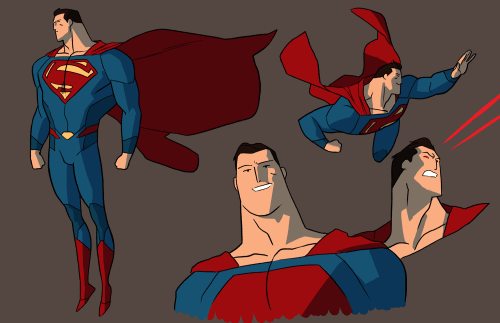
On the right is what Henry Cavill is expected to look like as the Last Son of Krypton. Many fans have [as usual] expressed great displeasure in the loss of Supes’ signature undies, as can be read in the aptly titled “‘Man of Steel’: Is Superman’s new suit made of fanboy Kryptonite?

What’s probably unknown to most of them, however, is that director Zack Snyder fought to keep the supehero’s look traditional. In an interview with the New York Post he said:

“The costume was a big deal for me, and we played around for a long time. I tried like crazy to keep the red briefs on him. Everyone else said, ‘You can’t have the briefs on him.’ I looked at probably 1,500 versions of the costumes with the briefs on.”

Ultimately the studio [as usual] had their way, and the iconic red briefs were done away with. There are a few reasons why I think they should’ve stayed, though, and they have nothing to do with the iconic depictions of the character.

The first reason, if you look up, is staring you right in the face. It’s- well, it’s distracting to say the least, and was actually a problem when suiting up Brandon Routh for the 2006 Superman Returns. From what I can tell, costume designer Louise Mingenbach had her hands fu- sorry . . . had a lot to deal with when it came to the suit. The film’s IMDB page tells us:

According to an article in the 12 September 2005 issue of Newsweek, the biggest question concerning Superman’s costume involved the size and shape of the bulge in the front of his tights. Costume designer Louise Mingenbach finally decided on a bulge that wasn’t too big. “Ten-year-olds will be seeing this movie,” she explained.

A less reputable source [The Sun], told second-hand via KillerMovies reports that a source had this to say about the film:

“It’s a major issue for the studio. Brandon is extremely well endowed and they don’t want it up on the big screen. We may be forced to erase his package with digital effects.”

The current costume design is definitely not doing them any favours in that department, and if anything calls even more attention to Superman’s unmentionables.

My second point has to do directly with design. As archaic and old-fashioned as the red shorts over tights are, they were great in breaking up the blue of the rest of the costume. Although the golden belt buckle attempts to do that in Cavill’s costume, it ultimately fails, and in fact draws added attention to my first point.

To bring up something I mentioned in passing in my post about the immensely talented Kris Anka, there are ways of omitting the briefs while still maintaining a good balance:


In the above design Superman’s midsection is broken up by  the two red lines and the golden buckle, which form an incomplete belt. This, along with the darker blue of the costume’s sides does wonders in not making it feel like the character is simply wearing a full set of blue tights and a cape.

I suppose we’ll have to wait until next summer to really determine whether or not the new suit works. Until then, these are my thoughts

If you want to keep reading about this particular topic, io9 wrote a great article called “The War on Superman’s Underpants.”

The Horror, The Horror

Today, I’m going to talk about horror.

Not “frightening stuff,” mind you- horror. There’s a distinction, you see.

Fright is the simple biological jolt you get when something startles or surprises you- a door being slammed, a discordant note blaring out of nowhere, and so on. Tragically, the title of “horror” gets slapped on things (typically movies) that merely have “jump-scares.” Horror on the other hand, is anticipation and dread at the perception of something threatening on a fundamental level.

So why talk about this? Because despite the outcry of some, horror- especially horror movies- holds a special place in our culture. Indeed, horror holds a special place in all cultures, and has since the first Cro-Magnons huddled around some arctic fire and whispered about strange and terrible things lurking just outside the circle of light. What we’re afraid of tells just as much about us as what we admire; a perfect example being Evan’s post on the remake Red Dawn. Evan cites that one of the reasons the new version doesn’t work is because the concept of the US being invaded is today laughable (especially by North Korea, whose entire population could fit into LA county with room to spare), whereas in the 1980s, the fear was far more realistic, or at least, believable.

Now I’m not here to analyze the past decade’s better horror movies and tell you what it is that we seem to be afraid of (not right now, anyways). In this post I’ll just be breaking down the three basic kinds of horror we seem to be responding to.

Fear For Self

First, we have the fear that attacks our egos- not “egos” as in pride, but “egos” as in the psychological term for you. This fits into the greater psychological element of “external anxiety,” meaning the stress we feel as a result of outside factors, such as school, our jobs, hunger, pain, and so on. When we’re afraid for our safety, or empathizing with characters in a movie or TV series who are fearing for their physical safety, we’re looking at this “fear for self” kind of horror. A good example would be any serial killer or monster movie- Psycho or Jaws being the best examples. Now usually we tend to botch this kind of horror, because the protagonists in movies or stories do things we would never do (blonde female college camper running through the woods at night, I’m talking about you). However, when it’s pulled off well, it leaves a noticeable mark on us. It has been said that Jaws created a significant drop in beach-goers after it was released, and you are a dirty liar if you say you’ve never once looked behind the curtain when you go into the bathroom.

Fear Of Self

Just as we have anxieties that stem from external factors, we have stresses and fears that come from within us: “Internal anxiety.” It was theorized by early psychologists, Freud in particular, that our mental issues were a result of us denying or repressing elements within us, most notably the “id”- that part of our mind with all the bloody, vicious, sexual animalistic drives that typically didn’t mesh well with Victorian (or any) society. As with the ego, horror works on this pathway as well- our fear of ourselves. All that madness and evil that we, for the most part, pretend isn’t there. The most obvious examples of this would be werewolf movies and vampire movies (obligatory “**** you, Twilight“) and most any film depicting a change or evolution the protagonist- see Dr. Jekyll and Mr. Hyde, The Wolfman, Dorian Grey, etc.

Fear Of No Self

Lastly we have stress and anxiety attacking (or coming from, depending on how you look at it) the “superego”- that element of our mind consisting of our real or imagined nobility, propriety, decency, etc. Here we encounter “existential horror,” more often called “cosmic horror.” This particular form of horror can be found in movies where the protagonists are fighting a losing battle against some massive, all powerful being- typically otherworldly in nature. Alien invasions and zombie uprisings are both good examples. Here we’re confronted with the fear that we are, in spite of all of our strength, morality, charity; in spite of our humanity, we are actually inconceivably small and insignificant. Ants who have just become aware that there are beings in the universe of incomprehensible magnitude whose simple existence negates everything about them. That unique feeling of powerlessness is separated from “ego fear” in that this form has a distinct hopelessness, rather than helplessness, attached to it.

Of course, every horror story has all three of these elements in it, but what kind of horror story it winds up being depends entirely on what is emphasized. Take AMC’s The Walking Dead– you’ve got your physical fear of the zombies, your id-based fear at what this new world is bringing out in you, and the general horrific despair at the absolute hopelessness of your situation, both in the face of zombies and the truth of human nature. What you wind up being afraid of depends on which element really gets pushed (survival, rationality, hope) and of course, what you individually, and we as a society, find most terrifying.

So what do we fear as a society right now?

Well, with the rampant popularity of zombie stories, and “disaster” films such as Cloverfield, Skyline, and even the whole “Slenderman” craze; it seems to me that we’re torn between physical and existential horror. And perhaps in an economic depression, that’s understandable- after all, we’re confronted with the physical job of keeping afloat in a rough time, and as the crisis drags on and on, the general feeling of hopelessness with regards to our general situation. We respond to characters whose immediate needs are threatened and characters who are struggling to maintain themselves in the face of cosmic nothingness.

At least, that’s my take on it. Feel free to debate me in the comments, and stop by tomorrow for another Shame Day installment.