Category Archives: religion

Marvel’s New Black Panther and the Ghettoization of Comic Books

Black_Panther_Cover_StelfreezeThis week Marvel announced that their new Black Panther title, dropping next spring, would be drawn by Brian Stelfreeze and, more importantly to many, penned by Ta-Nehisi Coates. For those of you unfamiliar with the latter Coates was at one point most well-known for his contributions to The Atlantic, in particular the contentious “The Case for Reparations”. More recently, however, a significant amount of attention has been given to his second published book, Between the World and Me, which was released just this past July.

The various news outlets that have covered this story, those dedicated to comic book journalism and otherwise, have taken note of the fact that both Coates and Stelfreeze are African-American. While the character himself hails from the fictional African nation of Wakanda he is nonetheless Black, and many have praised the publisher for allowing top-of-their-game, Black creators to take the reins of the person soon to be their most famous Black hero [due to his appearance in the upcoming film Captain America: Civil War].

Totally_Awesome_Hulk_1_CoverThis announcement comes, while not necessarily hot on the heels of, soon after Marvel breaking the news that the latest character to hold their own Hulk title will be Amadeus Cho. A Korean-American character and one of the smartest people on the planet despite his years, his adventures were also given to another match made in comic book A-list heaven. Writer Greg Pak and artist Frank Cho are both Korean-Americans themselves, with the former being of mixed descent. In the very same vein as next year’s Black Panther this December’s Totally Awesome Hulk bears a creative team that has a lot racially, as well as culturally, in this case, in common with their book’s titular character. Continue reading

“Hail Satan Gaiman” Or “Sympathy for the Devil”

Neil ****ing Gaiman.

Whimsical genius behind countless best-selling novels and comic books. Creative cadre to such literary giants as Terry Pratchett and Alan Moore. Champion of the plight of Syrian refugees. Perhaps one of the great authors of this time, with tales and yarns extending from the worlds of realism to science fiction to fantasy.

In many respects, a modern-day C.S. Lewis, with his ability to make the magical and divine seem every much as real and accessible as anything in the waking world.

Shame some folks don’t see it that way.

Specifically “One Million Moms”, which has created a petition for FOX to cancel Gaiman’s upcoming Lucifer TV series.

Now for the unaware, Lucifer is a comic book series spin-off of Gaiman’s fantastical masterpiece Sandman. Dealing largely with themes of free will and fate, the series sees its titular character abdicate his infernal throne and become a beach-bum in Australia.

The series has been loosely (but still earnestly) adapted by FOX, with the show’s premier airing at this year’s ComicCon and a three minute trailer released for the public at large. Continue reading

Houghton Students and Early Marriage [An Observation, Not a Defence] – Redux and Reflection

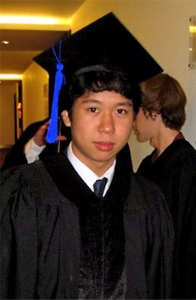
evan20122Three years ago I graduated from Houghton College, a Christian liberal arts college in the hamlet of Houghton, New York. A few months before I left, however, I wrote my first and only op-ed for the Houghton Star, the student newspaper, the title of which is pretty self-explanatory.

Due to recent events [three engagements within a few days of each other] marriage has very understandably been on my mind, and I thought it would be worth digging up the article and comparing where I was then to where I am now. Due to extensive revamping it’s no longer hosted on the paper’s website, so I’ve included it in its entirety below. There are also pictures from my high school and college graduations, respectively, for your enjoyment.


Houghton Students and Early Marriage
An Observation, Not a Defence


evan20082Four years ago I graduated from Grace International School, a Christian school in Chiang Mai, Thailand. With the internet and, of course, Facebook I was never really far away from my former classmates in spite of us scattering to the far corners of the globe. Since that final year of wearing matching polo shirts and eating lunch by the pool 
seven members of the class of ’08 have gotten married, two of them to each other; three others are currently engaged. Out of a class of 45 or so students that’s almost a quarter of us tying the knot before the age of 23.

A few years later I was musing about the flood of marriages [four happened at least a year after graduation] out loud to my cousin one day, and he asked why all of my classmates were getting married at such a young age. He then quickly answered his own question with a question, asking “Oh, it’s because you can’t have sex until you’re married, right?” This wasn’t a factor for him, and I vaguely recall half-heartedly muttering something to the affirmative. I knew that couldn’t be all there was to it, but it made enough sense at the time.

Now here I am, a senior with less than two months left before I hit the real world. At least four of my college friends have gotten married since my freshman year and “Save the Date” cards continue to materialize in PO boxes left and right. Proposals have lost any kind of surprise they once had for me. Not too long ago two people in one of my classes were engaged over the weekend and I [not that I wasn’t happy for them] didn’t give it a second thought. My first semester here I had never heard of “ring by spring” or the more clever “getting my MRS.” I didn’t understand at the time how quickly dating relationships could metamorphose into marriage or how prevalent engagements would be in my college life. Continue reading

(Gay) Mawige Is Wat Bwings Us Togever Today

As you already know, June 26th saw the US Supreme Court’s ruling in Obergefell v. Hodges- an agonizingly boring name for what was one of the most momentous decisions in American legal history.

Effectively legalizing same-sex marriage in all 50 states, the ruling was met by many Americans with resounding applause and celebration that often seemed to border on being downright aggressive.

But we’re not here to talk about that. Nor are we here to talk about the outcries and horror and disgust from the ever-dwindling minority of marriage equality opponents. At least- not the nutjobs.

The pastor who promised to set himself on fire if the ruling was made (though he swiftly retracted that oath), the folks claiming that gays cause hurricanes, the ones who hold up picket signs reading “God hates Fags!”-

-these are not the people I want to talk about.

I’m referring to the non-crazy (but by no means less angry) rank and file of the opposition here. Your conservative uncle. Your Wesleyan Aunt. Folks who’d never shriek obscenities, or claim the impending wrath of God, but who’d still shake their heads sadly and call this ruling a “tragedy” or “evidence of our culture’s moral free-fall”.

These folks:

FB capture 1FB Capture 2FB Capture 3 Continue reading

Rachel Brown on Food, Religious Identity, and the Appeal of Muslim Extremists

A few months ago, I had the opportunity to hear PhD candidate Rachel Brown speak about her research on food and religious identity in French and Quebecois Muslim immigrant communities. I found Brown’s talk fascinating and contacted her soon afterwards; I wanted to find out if her work was publicly available so I could write about it here on the blog. While Brown has written a chapter on her work for an academic publication it hasn’t been published quite yet. Lucky for me, Brown was willing to share a draft with me. Throughout this interview I will be referring to, and occasionally quoting, that draft in order to give you context for the questions I ask Brown.

According to Brown, her “primary research interest lies in the study of immigrant religious experience and how members of immigrant communities negotiate their religious identities through food and food practices in their host countries.” In order to write on this topic, Brown conducted fieldwork and semi-structured interviews in both Paris, France and Montreal, Quebec.

This was the most French gif I could find.

Kat: Hi Rachel, thanks again for being willing to share your research with me and our readers. Before I dive into the questions I have from reading your draft, can I ask, what drew you to this area of study?

Brown: I came to the project out of a love of all things food and all things France. On one of my many visits, I noticed that how and what the Muslim community in France ate was a point of interest for media, politics, and everyday conversation on the street between friends and neighbours. There was clearly a subject to be addressed. I figured if I was going to be in the field for a year I might as well be somewhere I love and studying something I am passionate about, and so I set out to study the topic of food and religion. As I got further and further into the topic I realized just how essential food practice is to identity, especially religious identity and my research has grown exponentially ever since. The importance of food in religious identity negotiation for immigrants can be seen across a variety of locations and traditions.

Kat: I’m also curious about the technical side of things. Did you intentionally limit your case studies to individuals from the Maghreb? If yes, then why? Also, how did you go about arranging these interviews, or even making these connections in the first place?

Brown: I definitely limited my study to individuals from the Maghreb. I did this because the largest Muslim community in both France and Quebec comes from the countries of the Maghreb. This is not only because of proximity, of the Maghreb to France, but also because of a colonial history between France and the countries of the Maghreb. When one thinks of Muslims in France, this is most often the community that comes to mind.

In terms of arranging the interviews, this was a tough process. I started by going to the Grand Mosque of Paris and just getting to know people there. I had to build up trust, and spent many hours just helping out at the mosque in order to show that I was not a journalist (a profession folks are very hesitant of in France) and that I meant well with my research. After people got to know me, some started to agree to do personal interviews with me. Once I conducted the first interviews the people I interviewed then put me in contact with friends or family members to interview. So I followed a snowball methodology. It was not easy to get people to talk to me, but because my topic is such an approachable one (who doesn’t want to talk about food?), it made it a little bit easier to get people to agree to interviews. Having the personal connection, and a validation from friends or family members that had already done the interview was also key. Continue reading

Two Things Forgiveness Should Never Mean (i.e. Learning from the Duggars)

On May 19th In Touch Weekly published an article alleging that when Josh Duggar was a teenager, he molested five underage girls, including several of his sisters.

I didn’t want to write about the Duggars, but I felt compelled to. I wanted to write about this case because I am a Christian, so I understand a lot of the rhetoric of forgiveness that the Duggars and their supporters have used to explain their stance towards the eldest son. However, I am also a feminist, and I have seen the effects of sexual violence on the lives of people I love. So for this post, I want to explain why the Duggar’s act of forgiveness doesn’t make me angry, instead, it is the decisions they made along with that gift of forgiveness that have left me in disbelief.

We Need Forgiveness More Than We Realize

Those of you who know me in person have probably chatted with me about Christianity. I’ve struggled with it a lot over the last few years, and considered throwing the label out the window altogether. However, there are a few things that keep pulling me back to the faith I grew up in. One of these things is the tenant of forgiveness.

You have probably all heard some kind of variation of the quote I included above. While most of these sayings have essentially become cliches, I honestly believe the act of forgiveness can help wounded individuals in their journey of healing. In my own life, I’ve had experiences that could have easily led me to foster an intense bitterness towards certain individuals. The theology I grew up with helped me to understand those individuals as damaged people, which made it much easier to move on from those events.

The tenant of forgiveness extends far beyond the Christian faith. Forgiveness is a valued aspect of most world religions, and is even recognized by doctors and psychologists as a key part of healing. However, there are certain aspects about the Duggar case that undermine their appeal to forgiveness. Continue reading