I and TV often find ourselves at odds. More often than not, what you get on television is hours upon hours of sensationalist news, vile game shows, and talk shows that swing between glorified bum-fights and thinly veiled infomercials. Sure, every once in a while you can find quality along the lines of Arrested Development or Ugly Americans or Scrubs or whatever wildly popular and inventive new show that NBC will cancel because **** you, but for the most part there are plenty more weeds out there than roses.
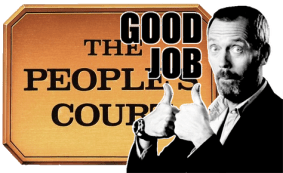
However, one such exception to the norm is- believe it or not- Court TV.
That’s right, Court TV. Judge Judy, Judge Mathis, Judge Milian, and so on.
Now you might be trying to wrap your heads around why on earth these shows are any good, but that’s probably because of the general skepticism you have about daytime TV (and not without just cause). Think about it. Really think about it. What do we see on this show? Glamorization? Perhaps, but for all the strange cases that show up, the majority of them seem nevertheless perfectly plausible. And that brings us to the second point: sympathy. Who among us can say we haven’t had a situation, or haven’t known someone who had a situation, which would constitute a conflict without going so far as to be criminal? Who hasn’t had some petty yet long-running dispute with a neighbor? Who hasn’t had some tiff about splitting up a dead relative’s possessions? Again, Court TV has it all, and what’s more, shows the real-life consequences of all this (usual) pettiness and greed. We actually get to see some positive arbitration, and get educated on not only our explicit laws, but our social contract, our culture, and our state as human beings in general. However hyped up it might be played, the “hollywoodization” of the shows still can’t rob them of their core essence, which is genuinely interesting and relatable conflicts and the ways we resolve ’em.
I’m not saying you don’t have better things you could be doing with your time, but if you’re gonna be watching TV, there’s plenty worse to watch than this.
And just one last note. I understand that “Court TV” also used to be the title of the TV channel now called “TruTV”. Obviously what I’m talking about and that are two unrelated things. Just a heads up.
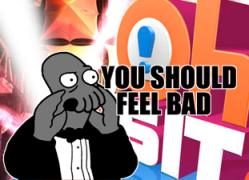
For those of you who don’t watch a lot of American TV, The CW is a television network that hosts a lot of show featuring attractive young people, like The Vampire Diaries, Gossip Girl, America’s Next Top Model, et cetera. Last fall they decided that what they didn’t have enough of was game shows, and thus the idea of Oh Sit! was born. Watch this:
Oh Sit! is essentially a combination of two things that I quite enjoy: musical chairs and the gameshow Wipeout. Knowing that, it should have been nothing but pure, unadulterated entertainment. Unfortunately, much like shrimp and pumpkin pie, not everything you love should be mixed together.
“…a fun, high-stakes, high-octane musical chairs competition, in which 20 thrill-seeking daredevils race head to head through five physically demanding, obstacle course-style eliminations as they each compete to claim a chair, to the sounds of a live band.”
I am not going to pretend I have watched even a full episode of the show. Thoroughly reading the above review has convinced me that it is not worth my time, and that I would probably not enjoy it. Gordon also said, in coming up with the Shame Day/Fame Day feature, that these would be short posts, so I strongly recommend just reading what they wrote.
The main reason I write this is because a little bit of browsing on Wikipedia has revealed that Oh Sit! was actually renewed for a second season. That’s at least ten more episodes of a show Variety‘s Brian Lowry described as feeling “like more of an ordeal than fun.” A second season of what the A.V. Club calls “yet another reality show that’s so depressingly static, so devoid of imagination, interest, or anything redeeming beyond a slightly promotable logline and a punny title.”
Not “frightening stuff,” mind you- horror. There’s a distinction, you see.
Fright is the simple biological jolt you get when something startles or surprises you- a door being slammed, a discordant note blaring out of nowhere, and so on. Tragically, the title of “horror” gets slapped on things (typically movies) that merely have “jump-scares.” Horror on the other hand, is anticipation and dread at the perception of something threatening on a fundamental level.
So why talk about this? Because despite the outcry of some, horror- especially horror movies- holds a special place in our culture. Indeed, horror holds a special place in all cultures, and has since the first Cro-Magnons huddled around some arctic fire and whispered about strange and terrible things lurking just outside the circle of light. What we’re afraid of tells just as much about us as what we admire; a perfect example being Evan’s post on the remake Red Dawn. Evan cites that one of the reasons the new version doesn’t work is because the concept of the US being invaded is today laughable (especially by North Korea, whose entire population could fit into LA county with room to spare), whereas in the 1980s, the fear was far more realistic, or at least, believable.
Now I’m not here to analyze the past decade’s better horror movies and tell you what it is that we seem to be afraid of (not right now, anyways). In this post I’ll just be breaking down the three basic kinds of horror we seem to be responding to.
Fear For Self
First, we have the fear that attacks our egos- not “egos” as in pride, but “egos” as in the psychological term for you. This fits into the greater psychological element of “external anxiety,” meaning the stress we feel as a result of outside factors, such as school, our jobs, hunger, pain, and so on. When we’re afraid for our safety, or empathizing with characters in a movie or TV series who are fearing for their physical safety, we’re looking at this “fear for self” kind of horror. A good example would be any serial killer or monster movie- Psycho or Jaws being the best examples. Now usually we tend to botch this kind of horror, because the protagonists in movies or stories do things we would never do (blonde female college camper running through the woods at night, I’m talking about you). However, when it’s pulled off well, it leaves a noticeable mark on us. It has been said that Jaws created a significant drop in beach-goers after it was released, and you are a dirty liar if you say you’ve never once looked behind the curtain when you go into the bathroom.
Fear Of Self
Just as we have anxieties that stem from external factors, we have stresses and fears that come from within us: “Internal anxiety.” It was theorized by early psychologists, Freud in particular, that our mental issues were a result of us denying or repressing elements within us, most notably the “id”- that part of our mind with all the bloody, vicious, sexual animalistic drives that typically didn’t mesh well with Victorian (or any) society. As with the ego, horror works on this pathway as well- our fear of ourselves. All that madness and evil that we, for the most part, pretend isn’t there. The most obvious examples of this would be werewolf movies and vampire movies (obligatory “**** you, Twilight“) and most any film depicting a change or evolution the protagonist- see Dr. Jekyll and Mr. Hyde, The Wolfman, Dorian Grey, etc.
Fear Of No Self
Lastly we have stress and anxiety attacking (or coming from, depending on how you look at it) the “superego”- that element of our mind consisting of our real or imagined nobility, propriety, decency, etc. Here we encounter “existential horror,” more often called “cosmic horror.” This particular form of horror can be found in movies where the protagonists are fighting a losing battle against some massive, all powerful being- typically otherworldly in nature. Alien invasions and zombie uprisings are both good examples. Here we’re confronted with the fear that we are, in spite of all of our strength, morality, charity; in spite of our humanity, we are actually inconceivably small and insignificant. Ants who have just become aware that there are beings in the universe of incomprehensible magnitude whose simple existence negates everything about them. That unique feeling of powerlessness is separated from “ego fear” in that this form has a distinct hopelessness, rather than helplessness, attached to it.
Of course, every horror story has all three of these elements in it, but what kind of horror story it winds up being depends entirely on what is emphasized. Take AMC’s The Walking Dead– you’ve got your physical fear of the zombies, your id-based fear at what this new world is bringing out in you, and the general horrific despair at the absolute hopelessness of your situation, both in the face of zombies and the truth of human nature. What you wind up being afraid of depends on which element really gets pushed (survival, rationality, hope) and of course, what you individually, and we as a society, find most terrifying.
So what do we fear as a society right now?
Well, with the rampant popularity of zombie stories, and “disaster” films such as Cloverfield, Skyline, and even the whole “Slenderman” craze; it seems to me that we’re torn between physical and existential horror. And perhaps in an economic depression, that’s understandable- after all, we’re confronted with the physical job of keeping afloat in a rough time, and as the crisis drags on and on, the general feeling of hopelessness with regards to our general situation. We respond to characters whose immediate needs are threatened and characters who are struggling to maintain themselves in the face of cosmic nothingness.
At least, that’s my take on it. Feel free to debate me in the comments, and stop by tomorrow for another Shame Day installment.
GORDON: Ladies and gentlemen devoted readers and people who found our blog by googling “dokata fanning playboy.” We’re were to have a frank and open discussion about “The Walking Dead,” both the critically acclaimed television series and Robert Kirkman comic books of the same name.
EVAN: I’d like to issue a fair warning to those who haven’t read the comic series or caught up on the show that there will be SPOILERS. You have been duly warned.
GORDON: Indeed. I’d like to kick things off by talking a bit about how the books and the television series differ, and whether or not that’s a good thing.
EVAN: I think there’s a firm answer there. The show differs a lot from the books, and that’s definitely a good thing.
GORDON: How so?
EVAN: Sticking to the book means that there aren’t any surprises for loyal fans of the series, and keeps them guessing. Furthermore, it allows AMC and others involved to play a little bit more loosely with the way the show is going, without feeling too tied down.
GORDON: I thought about that.
EVAN: And?
GORDON: At the same time, I feel there’s definitely a lot lacking from the series as a result of their pretty strong (and ever increasing) departure from the source material. Take some of the deaths, like Dale’s and Shane’s, for example. It’s like knowing you’re gonna go get Chinese food versus being surprised that you get some potato chips with your nasty sandwich.
EVAN: I agree. Both deaths were undeniably very well-written and powerful moments. I just think there’s something to be said for not being slavishly dedicated to one vision of the show.
And as far as Dale’s death is concerned, I can easily see his key line being spoken by some other character some ways down the road.
GORDON: I guess my point is that while the show does keep you on your toes, the changes it makes are typically just less impressive than the story itself. I think loyal fans of the series would be just as cool seeing a faithful show as one that goes its own way.
I mean, look at it this way: The books are dark. Really dark. I’m talking Laurie’s comic-book ending dark. It pushed the envelope in ways I just have yet to see the show do. That was a lot of the charm of the books- how unflinching it was. I’m just not getting that same power with the show’s spin.
EVAN: It’s obvious that fans are going to want a show that is as close to what they originally experienced in the comics as possible. I also agree that the comics are undeniably better than the show.
My point is that I think the deviation is good and realistic. Having the Governor both physically and sexually assault Michonne is probably not something we’re going to see. Neither did I think we were going to be witness to a woman and her baby being brutally gunned down.
The writing is weaker, but I don’t think that faults the direction to not stick to the book, it faults the current writers.
GORDON: Interesting, but it seems that the logical solution to that is to try to get closer to the hard-hitting story the books gave us. Here’s what I’m hearing from you:
“The books are objectively better, but the fault is with the show’s poor writing.”
Seems like you either just start trying to write a better zombie story while trying to stay within sight of the original material and characters (which kind of kills the point), or just stick to the material to begin with.
EVAN: I don’t think they’re not trying to write better stories. I’m saying they’re not succeeding. I don’t think they set out to do a bad job.
GORDON: Fair enough. So what needs to be done then?
EVAN: As with most forms of media taking into account constant feedback from fans and acknowledging their mistakes. Season 2 at the farm really dragged on, and was low on the zombie killing. At the very least, this season has given us plenty of “walker”-eviscerating action.
GORDON: No argument there . . . no complaint either. But I don’t think it’s a solution; just something to help ease the need for something more.
EVAN: You do get that not everything in the comics can make it on TV, though, right?
GORDON: Of course. And I wasn’t going to say that. I mean, ever since the season began, I’ve been like: “How the **** are they going to show a baby being shot on national television?”
The rest I could imagine, but not that.
EVAN: Okay, how about we move on to something most fans of the AMC show can relate to: How horrible Andrea is all the time always.
GORDON: That bugs me. I like Andrea. Andrea gets it.
EVAN: Andrea is horrible. Andrea almost shot Daryl in the face. Because she couldn’t listen to people telling her to hold the **** up.
GORDON: That was messed up. But otherwise, I think the criticism of her is all just BS.
I mean, everyone’s like, “Gah- I hate Andrea! Why can’t she see that the Governor is evil?”
And I’m like: “Please. If you had survived as long as she had, which you wouldn’t, you would be groveling at the man’s feet for a bowl of warm soup, let alone a flippin’ suburban paradise free from living corpses.”
Relatively, anyways.
EVAN: She only survived because of Michonne, who I don’t like all that much at the moment. And for the most part, I agree with you about the Governor not being a bad dude.
GORDON: Let’s not turn this into my twisted/completely reasonable sense of morality. What I think the show is really lacking is the eeriness. You got that in the first season, when Rick was on his own, that feeling of isolation. Upping the action doesn’t solve that problem, especially as more an more characters come in.
EVAN: What I really want to see is the whole idea, which has been communicated but could be better, that it’s not the zombies you’re afraid of, it’s the people. Two kids die, and everyone things it’s the huge black dude who did it. Turns out it’s the mild-mannered white guy who decapitated these two little girls.
GORDON: Very unexpected. Dang, there was so much good stuff there that we’ll never get to see. . .
EVAN: The theme of the books, if I could sum it up in three words, is “People Are Monsters.” I think that’s really what needs to come out of AMC’s Sunday evenings.
GORDON: I agree completely.
EVAN: We’ve got a little bit of time, do you want to share with the nice people why, barring slaughtering a few US Army men, the Governor’s not such a mustachio-twirling villain?
GORDON: In their defense, that version was pretty over-the-top; like a living Snidely Whiplash.
EVAN: In the books, you mean?
GORDON: Yeah.
EVAN: What I meant, though, is that as you said people are yelling at their screens, crying “Andrea you dumb blonde, can’t you see you’re making out with the devil?”
GORDON: They are, and without cause (barring knowledge from the book). I mean, people suspect because they’re the audience and can see the big picture. But if we’re talking realistically, they would be more eager than Andrea. I’m just saying the criticism of Andrea as being blind is utter nonsense.
EVAN: And furthermore, what has he done to have anyone assume he’s a bad dude? Taken away their weapons in a peaceful town. Shown them tons of hospitality. If anything, we’d all be telling Michonne to chill the eff out and stop glaring at everyone/thing.
GORDON: Exactly. People need to chill out.
EVAN: And, even though I’m sure we could’ve gone on for another hour, that just about concludes our time. Any topics you have in mind for next week? Probably not something television-related, to avoid the hat trick.
GORDON: True. Let’s talk about food. Let’s hypothesize the greatest food show of all time.
EVAN: Ladies and gentlemen, boys and girls, welcome to the first installment of E> where Gordon and I try to uncover the magic that was lost. The last post we did fell a little flat, so we’re here to casually discuss a subject we both know is awesome: DEADLIEST WARRIOR.
GORDON: That’s right- Deadliest Warrior, a show 90% about mutilating ballistic gel dummies, and it was STILL too intellectual for Spike. At least, that’s my version of why they cancelled it. You can probably tell we’re a little bit bitter about the whole thing.
EVAN: Ugh, Spike. Have you seen the little bits of footage they slot in between shows to fill up the space?
GORDON: I have not.
EVAN: It’s like . . . Here, let me find one.
Readers, the following is kinda PG-13. I kind of apologize for embedding this, but it’s just too ridiculous not to:
DISCLAIMER: This week we kind of dropped the ball, so our discussion on the topic is short and then turns to how WE can write this feature a little better. Our apologies.
And now back to the subject of the night: Is there artistic merit in Adventure Time?
EVAN: Whoa. You’re gonna shameless-plug your friend and then let me discuss the topic? Say something about it, haha.
GORDON: Is there artistic merit in beloved Cartoon Network show Adventure Time? Well, let’s break down what we mean by “artistic merit.” Evan?
EVAN: Is it worthy or deserving of being called art? Alternatively, does the show have the admirable qualities or attribute that art has? I guess a question to answer your question is: What is art?
GORDON: Well, let’s not try defining “art”. We’ve been trying to do that ever since we first started scratching pictures of fat ponies onto cave walls, and I doubt we’re gonna solve it in the next half hour or so. Let’s instead focus on the “merit”- what is it that makes ANY show good?
EVAN: Here’s a factor that relates directly to Adventure Time: Accessibility. How accessible does a show have to be to be good? Does it have to be accessible to be good?
GORDON: Are we talking about mass appeal here?
EVAN: Eh, sure, why not.
GORDON: Well, we gotta address that then. I mean, Twilight and the work of Michael Bay are popular, but they aren’t good. At the same time, you can’t just have a show that only you find funny, and then still call it good, right?
EVAN: You’re right. So is there a magic number of people we have to reach when it comes to a show being good? I shudder to remember Tim and Eric Awesome Show, Great Job! and how much our one friend used to love it.
GORDON: What’s worse is that my dad is into that show for some unfathomable reason. But the point is, a good thing ought to be popular to some degree, but popularity can’t be the sole element.
EVAN: Okay, so how about execution? How well the show pulls off whatever it’s supposed to be doing. Adventure Time is a show about a boy and his magical dog that is also his brother adventuring in a colourful post-apocalyptic fantasy world, but it works. They pull it off. I personally think this has a little something to do with its easy-to-digest ten minute segments.
GORDON: And there’s really no way of arguing with that- the story-telling is spot-on, but there’s gotta be more than that. The same can be said (and this is gonna give Evan an aneurysm), to some degree, of the copy-paste work of Seth McFarlane.
GORDON: What I’m saying is that McFarlane’s shows are both popular and (for what they are) well-executed, and yet we can both agree that his shows aren’t really “good,” at least, not anymore than a bag of chips is “good” food.
Therefore, there’s got to be another element at play, right?
EVAN: Ugh. I can’t even look at the chat window I’m so offended you would say something like that. I wish he would be “well-executed.” Share your other element if you must.
GORDON: Uniqueness. The show has to be unique. It’s not enough to go through the motions (as McFarlane’s shows do), you have to actually be able to make your show something that can’t be seen anywhere else.
EVAN: Something to make your stuff stand out of the crowd, okay, that’s fair. So I guess we can see how Adventure Time stands up to the criteria we’ve come up with.
Accessible? Eh, I’d say so, for its demographic and older.
Popular? Yeah, again for who I’ve stated.
You want to let these nice people know if it’s unique?
GORDON: Soooo Unique. If you can find anything remotely similar to it made in the past decade, I will slap Evan on the ears and vote for taxing the homeless.
EVAN: I mean, like I said: Boy. Magical Dog. Colourful fantasy world that is also post-apocalyptic.
EVAN: What more could you want?
GORDON: Vampire rocker girls?
EVAN: I would not mind.
GORDON: Oh wait, we’ve got that too.
You want D&D references spliced in with Science Fiction and elements of Gothic Horror?
EVAN: I think we could go for some.
GORDON: WELL WE’VE GOT IT!
EVAN: I think it’s clear that we think Adventure Time is a good show, but one thing that’s been painfully clear with this entry of E> is how much trouble it’s been doing this. Might I suggest a little something?
GORDON: Go for it.
EVAN: Let’s just choose our own topics for a little while, just to really get back into the swing of things. Keep things casual, going back and forth, avoid the heavy questions. And then we can ease our way back into all this.
GORDON: I am inclined to agree with you on this one.
EVAN: Yeah? Awesome. Anything in particular you wanted to casually discourse about next time?
GORDON: Well, I don’t think my suggestion about the Disney takeover of the Star Wars franchise was all that bad, even if Adventure Time did win by a landslide…
EVAN: I kinda wanted to talk about Deadliest Warrior.
GORDON: That would be likewise awesome. Let’s do that.
EVAN: Yes. Awesome. I’m going to post this because we are men true to our word and we promise an E> every Wednesday. We shall discuss Deadliest Warrior in a week. Or this weekend, maybe, just to get ahead. I mean, whatever.
GORDON: Good night, everyone.
EVAN: Yep, sorry this wasn’t as awesome or decent as usual. But we will be back! With a vengeance. And remember:

 I and TV often find ourselves at odds. More often than not, what you get on television is hours upon hours of sensationalist news, vile game shows, and talk shows that swing between glorified bum-fights and thinly veiled infomercials. Sure, every once in a while you can find quality along the lines of Arrested Development or Ugly Americans or Scrubs or whatever wildly popular and inventive new show that NBC will cancel because **** you, but for the most part there are plenty more weeds out there than roses.


 Today, I’m going to talk about horror.


 DISCLAIMER: This week we kind of dropped the ball, so our discussion on the topic is short and then turns to how WE can write this feature a little better. Our apologies.


