Tag Archives: religion

Eight Things I Learned in Indonesia

A little over a year ago I spent four months in Indonesia. I didn’t really travel across the country, at least not in the way you would expect during that much time abroad. Instead I had the great privilege to live in Indonesia, and see it from the inside. It’s hard to put to words all that I learned, and impossible to do justice to the people I met and the experiences I had. Here is my attempt to share are a few things I learned while I was travelling.

DSCI0220

1) Hospitality

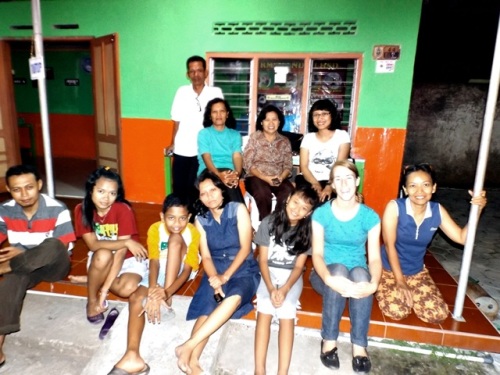
The first notable quality of almost every Indonesian I encountered, and especially of my host family, was their hospitality. Within 12 hours of arriving my concept of generosity and hospitality had been put to shame. My hosts not only shared their home, they shared their family, lives, and friends with me. I was adopted into their social circle, taken for day- or week-long trips by their friends while I was there. I was honoured to be one of the first people to greet the family’s first grandson alongside the immediate family.

DSCF0815

2) Hijabs aren’t scary

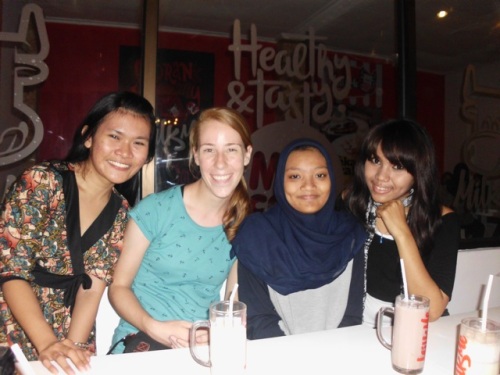
This is a fairly potent topic these days so I won’t comment too much. Over half the women on Java wear hijabs, a head covering worn by Muslim women. When I asked why they wore them, all the women I asked answered with “I wear it because I choose to.” I began to recognize beauty and comfort in these headdresses, as well as freedom of expression. These women were neither ashamed nor pious in their religion, it was simply a part of their life.

DSCI0470 Continue reading

2015’s Cultural Battleground – Kat’s Account

EDITOR’S NOTE: We end this year by each taking a look back and picking our five best posts, explaining both their importance to us and to the world we currently live in.  Clicking the banner images will link you to each post, so as 2014 comes to a close join us in remembering how far we’ve come, but also how far we still have to go.

RachelBrown

After the recent acts of Daesh terrorism in Paris I returned to this interview with PhD Candidate Rachel Brown to get some perspective. While Brown’s work was focused on food and religious identity in French and Quebecois Muslim immigrant communities, it also highlights how isolation and religious persecution can push young people towards accepting religious extremism. In the interview, Brown explains,

“I’m not really an expert in ISIS or Jihadist fighters or any of the topics that relate to this. I can say that when people, especially youth, feel alienated, when they don’t feel at home anywhere, this can lead to finding identity in extreme forms of religion. If the religious identity is the only identity that one feels they can claim, he/she is going to place a huge amount of importance on that identity.”

nestle

This year, a petition began circulating that condemned Nestlé’s operations here in British Columbia. While Nestlé has been operating here in B.C. for 15 years, residents became particularly concerned during the drought this past summer.  As Gordon has pointed out in his previous Shame Day post, Nestlé doesn’t have the greatest track record when it comes to respecting other countries and their water needs. In this post we take a closer look at the relationship between Canadian water and the American corporations that would like to bottle it up. Continue reading

Rachel Brown on Food, Religious Identity, and the Appeal of Muslim Extremists

A few months ago, I had the opportunity to hear PhD candidate Rachel Brown speak about her research on food and religious identity in French and Quebecois Muslim immigrant communities. I found Brown’s talk fascinating and contacted her soon afterwards; I wanted to find out if her work was publicly available so I could write about it here on the blog. While Brown has written a chapter on her work for an academic publication it hasn’t been published quite yet. Lucky for me, Brown was willing to share a draft with me. Throughout this interview I will be referring to, and occasionally quoting, that draft in order to give you context for the questions I ask Brown.

According to Brown, her “primary research interest lies in the study of immigrant religious experience and how members of immigrant communities negotiate their religious identities through food and food practices in their host countries.” In order to write on this topic, Brown conducted fieldwork and semi-structured interviews in both Paris, France and Montreal, Quebec.

This was the most French gif I could find.

Kat: Hi Rachel, thanks again for being willing to share your research with me and our readers. Before I dive into the questions I have from reading your draft, can I ask, what drew you to this area of study?

Brown: I came to the project out of a love of all things food and all things France. On one of my many visits, I noticed that how and what the Muslim community in France ate was a point of interest for media, politics, and everyday conversation on the street between friends and neighbours. There was clearly a subject to be addressed. I figured if I was going to be in the field for a year I might as well be somewhere I love and studying something I am passionate about, and so I set out to study the topic of food and religion. As I got further and further into the topic I realized just how essential food practice is to identity, especially religious identity and my research has grown exponentially ever since. The importance of food in religious identity negotiation for immigrants can be seen across a variety of locations and traditions.

Kat: I’m also curious about the technical side of things. Did you intentionally limit your case studies to individuals from the Maghreb? If yes, then why? Also, how did you go about arranging these interviews, or even making these connections in the first place?

Brown: I definitely limited my study to individuals from the Maghreb. I did this because the largest Muslim community in both France and Quebec comes from the countries of the Maghreb. This is not only because of proximity, of the Maghreb to France, but also because of a colonial history between France and the countries of the Maghreb. When one thinks of Muslims in France, this is most often the community that comes to mind.

In terms of arranging the interviews, this was a tough process. I started by going to the Grand Mosque of Paris and just getting to know people there. I had to build up trust, and spent many hours just helping out at the mosque in order to show that I was not a journalist (a profession folks are very hesitant of in France) and that I meant well with my research. After people got to know me, some started to agree to do personal interviews with me. Once I conducted the first interviews the people I interviewed then put me in contact with friends or family members to interview. So I followed a snowball methodology. It was not easy to get people to talk to me, but because my topic is such an approachable one (who doesn’t want to talk about food?), it made it a little bit easier to get people to agree to interviews. Having the personal connection, and a validation from friends or family members that had already done the interview was also key. Continue reading

Remembering Christopher Hitchens

Today marks the what would have been Christopher Hitchens’ 66th birthday. While the controversial writer lost his long battle with cancer in 2011, nearly half a decade later his legacy continues to remain a puzzle to most. To some, Hitchens was a brilliant iconoclast, fearlessly proclaiming truth and reason in a world crippled by political correctness and blind sentimentality. To others, Hitchens was a traitor who abandoned his radical roots in favor of jack-booted imperialism and  militarism. After all this time, the question remains: Who was Hitchens?

Born in Porstmouth, England, Hitchens first began his prolific career as a writer for a number of leftist magazines, eventually joining New Statesman in the early 70s, where he quickly made a name for himself as a fiery critic of the the Vietnam War. Hitchens would go on to become an acclaimed foreign correspondent, frequent contributor to The Nation and Vanity Fair, and unapologetic critic of most of the political establishment. No one- from Ronald Reagan to Bill Clinton, from Jerry Falwell to the royal family- escaped Hitchens’ unique blend of unimpeachable logic and acidic invectives. Hitchens made a name for himself in particular by viciously decrying Henry Kissinger, who he argued (not without cause) was a power-worshiping war criminal…

Continue reading

Explaining American Politics to Non-Americans – Part II: The Republican Party

Welcome again readers, to Culture War Reporter’s second installment of “Explaining American Politics to Non-Americans” [Part 1 here], in which yours truly attempts to explain the chaotic carnival that is our great democracy.

This week, we’ll be looking at the Republican party. Or parties, if things keep progressing as they do.

But let’s dive right in.

I won’t pretend I don’t have my own bias but I will try to be as fair as possible.

To say that the “Grand Old Party” has made itself unpopular abroad would be an understatement. The Bush-era wars, sanctions, and seemingly indiscriminate use of military force has created an international image of Republicans as blood-thirsty imperialists. While Obama has been far more liberal (pardon the pun) use of drone strikes, others point to the Republicans shaky relationship with environmentalism, science, and women’s issues to cast the GOP as backwards and puritanical.

But how fair are these assertions? If they’re true, where do they come from?

The History

The “Grand Old Party”, as it was once called was established in 1854, just prior to the American Civil War. Evolving from a number of groups, the Republican party came to stand largely for federal power and industrialization, contrasting with the emphasis on state’s rights and agriculture that the Democrats had (who we’ll get to next week). Indeed, while now struggling now to rid themselves of the accusation of being an “old, white guys’ party”, the Republicans of old were actually the more progressive, liberal and inclusive of the two parties. Although racism would remain an issue across the political spectrum, it was Republicans who could often count on the African-American voter demographic throughout much of the late 1800s.

Exactly when and why that stopped being the case is still a matter of heated debate.

Some would cite that the “Red Scares” (anti-communist witch hunts) of the 1950s pushed the party increasingly towards aggression, militarism, and social conservatism. Others might argue that as issues of civil rights, poverty, and the war in Vietnam caused many African-Americans to shift towards the Democrats, leaving the party almost exclusively in the hands of the white tycoons.

In spite of this shift, Republicans nevertheless have consistently managed to gain and often dominate American politics, the Reagan-era in the 1980s seeing massive cuts to government spending while increasing intervention in Latin America, the Middle East, and Afghanistan. The short-lived presidency of H.W. Bush, however, would see the abrupt end to the Republican Golden Age, with economic downturn and issues from within the party leading to Democrat victories in the 90s.

And then came “W”.

Continue reading

BURAAQ: Two Brothers, A Superhero, And the Truth About Islam

adilkamil

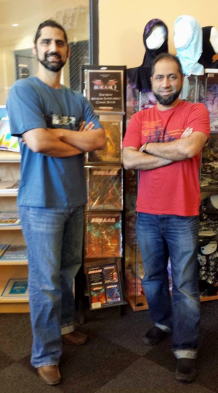
Kamil and Adil Imtiaz.

This past Saturday I had the opportunity to connect with Adil Imtiaz, one half of the two sibling team responsible for the comic book BURAAQ, which stars a Muslim superhero. While he was the illustrator starting out he shared, and continues to share, creative responsibilities with his brother Kamil, and was more than happy to talk to me a little bit more about how this project came to be and why.

Ms. Marvel, as you may have guessed, came up in conversation, and I ended up learning a few things about Islam that I didn’t originally know.
Throughout our talk it was clear that this character and all he presents is a passion for Adil, and that he believes it can, and has done, good things for Muslim youth.

After thanking him for finding the time to speak with me about his work we got right down to questions and answers, the latter of which he was very ready to provide.

Evan: Now I can’t wait to get into talking about BURAAQ, but before we get there would you like to say a few words about yourself?

Adil: Adil Imtiaz is my name. I’m an IT professional, just so you know. And I came here from Pakistan back in 1990; me and my  brother and my family. So we’re here with our families and that’s pretty much it as far as my background is concerned.

Evan: Would you say that your interest in comic books began at a very young age?

Adil: Absolutely. Even in Pakistan as kids, my brother and I used to have a stack of comic books by our bedside. Every night we used to read Marvel, DC, superhero stories. We were, and still are, fascinated with sci-fi and superhero stories and characters.

And movies, of course. Hollywood as you can see is all about superhero films. And we used to draw comics and superhero characters as kids. I got sidetracked when I had to focus on higher education, pursuing a career. I had to put it on the back burner so to speak.
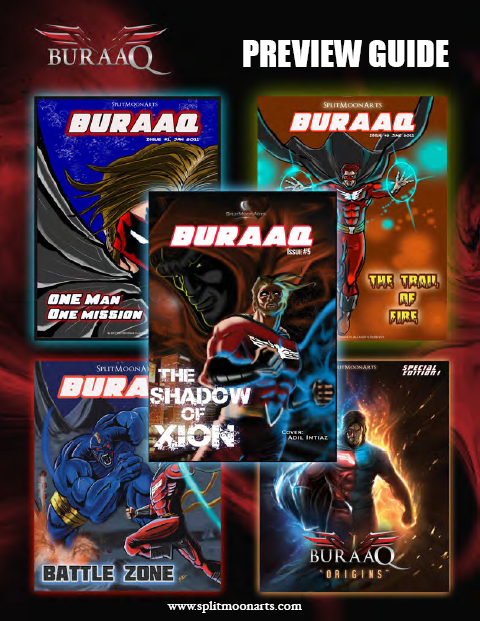
buraaqpreview

Evan: In the PDF I was given to review you and your brother’s mission was very clearly stated, and I’m just going to reiterate it for all my readers:

  • To provide a clean, fun (halal) and positive entertainment media alternative for our Muslim youth.
  • Reconnect our Muslim youth to Islam and make them feel proud to be a Muslim.
  • Enable interfaith dialogue and increase positive Islamic awareness.
  • Our principles are based on the Quran, Islamic values, and the teaching of the Prophet Muhammad (PBUH).

How long this been in the works? It seems particularly relevant now given recent events in North Carolina [with what I’m going to call a hate crime]-

Adil: Well, no, actually. This is something, the idea was born back in 2009 actually. Especially after 9/11 things changed in the US. And in the media, traditionally, Arabs and Muslims have been portrayed in a negative light in Hollywood, but after 9/11 things really picked up steam; a bunch of crazy people around the world who claim to be Muslims and other agencies at play, not to get into politics…

Sammy Sheik as Mustafa in American Sniper.

Continue reading