Tag Archives: white

In The Force Awakens White Women get Representation, but Black Women get CGI

I loved Star Wars: The Force Awakens. I loved it so much that the first thing I thought about doing when I walked out of the theatre was hash out everything that this Star Wars reboot had done right.

Like including legitimately humorous dialogue rather than slapstick CGI sidekicks.

Unfortunately, everyone on the blogosphere had already come to the same conclusion long before I was back from my Christmas break. Still, I couldn’t stop thinking about the film, or reading articles about it. So I’ve decided to write about one of the few things that bothered me about the film, rather than many aspects of the film that I loved.

If you’ve been reading this blog for some time, you probably already know that we at CWR were excited to hear about the diversity of casting in The Force Awakens.

I was especially excited when I heard that Lupita Nyong’o had been cast. Ever since she won best supporting actress for 12 Years a Slave and was declared the most beautiful person of 2014 by People magazine, I’ve been keeping my eyes peeled for Nyong’o. After witnessing her sudden rise to fame, I was curious to see if she would continue to find roles in major films, or if she would slowly be pushed out of Hollywood because of her dark skin. As Gregg Kilday explains in his article about Nyong’o, few black actresses have ever managed to secure a spot as a permanent Hollywood heavyweight:

While the stage would appear to be set for [Nyong’o] to ascend to the A-list — just as Jennifer Lawrence did after her best actress win for Silver Linings Playbook last year — it’s not that simple. For while there have been a handful of African-American actors, from Sidney Poitier to Eddie MurphyDenzel Washington and Will Smith, who have reached that status, there’s never been a black actress who has become the equivalent of a Julia Roberts or Angelina Jolie. Whoopi Goldberg came closest, following her best actress Oscar nomination for 1985’s The Color Purple and supporting actress win for 1990’s Ghost, but despite an occasional hit like 1992’s Sister Act, she didn’t maintain that momentum. Hollywood also flirted with Angela Bassett, Thandie Newton, Halle Berry and, most recently, Mandela‘s Naomie Harris, without ushering any of them into its very top tier.

It seems like a habit for major blockbuster films to tick off their diversity checklist by casting a white woman and/or a black man. Meanwhile, actors from other minority groups, especially women of colour, get overlooked because all the non-white, male roles have already been taken. As Evan pointed out in his post about the Martian and racebending, this seems to be the impulse, even when it means casting a white women to play a Korean- American character and a black man to play an Asian- Indian character. Continue reading

Coming Out, Moving Forward

When I was last dating a man, I talked long and loud about my queerness. I objectified female celebrities with the gusto of a barely post-pubescent male; I loudly debated the finer plot points of such luminous queer media as MTV’s Faking It; I was here and I was queer and I was proud, and god forbid anyone think I was straight, just because I was dating a man. I was all too familiar with that sort of misconception, but in reverse: when I had dated a woman for the first time, in my last year of high school, we had done that most high school of things and changed our relationship status on Facebook. This led a group of people – people who had known me over the course of multiple years and witnessed many ridiculously dramatic and public instances of romantic interest in men – asking me over and over again if I was a “lesbian, now”.

Being tacitly bisexual is a constant parade of those sorts of questions (as is being openly bisexual, unfortunately, but to a lesser extent). My unwillingness to announce my sexuality to everyone I met meant that when I was dating a woman, people assumed I was a lesbian, and when I was dating a man, people assumed I was straight.

And I was tired of it. I was tired of desperately trying to flip my self-presentation every time I was in a relationship, tired of worrying if I was queer enough, not to mention whether I seemed queer enough. Those worries became even more present when I became the co-editor in chief of my college’s only LGBTQ+ campus publication. How could I position myself as a leader in the queer community when I was in an ostensibly heterosexual relationship? Would anyone take me seriously as a queer advocate and writer if I happened to be dating a man come publishing time? Continue reading

On The Image Problem of Christ

Back when this blog started up, Evan and I had a discussion about a lecture given by Socialist novelist China Miéville. During that lecture, Miéville commented that “if one person hears what you’re saying and does something horrible, the issue’s probably with them. If hundreds of people consistently start doing horrible things, it’s probably time to re-examine your message.”

Those words returned to me a few months ago as I watched Family Guy’s “The 2000-Year-Old Virgin”, which depicted Jesus as a cowardly shyster, lying about being a virgin in order to bed Lois Griffin (and more than a few other women).

Family Guy: Season 13, Episode 6

Grotesque? Repulsive? Offensive beyond all description?

For me, it wasn’t.

It was certainly far from being funny, but readers, yours truly simply was not offended.

As sacrilegious and bitingly edgy as I’m sure the writers thought the story was going to be, I was merely disappointed by it. While I’m not going to excuse the laziness or insensitivity of Seth MacFarlane or any of Family Guy’s writer’s, I actually don’t think the majority of blame should be placed on them.

I think it should be placed on Christians.

Continue reading

Socially Conscious Comedy Part II: Key and Peele on Being Black in America

Seeing how I love to pretend that binge-watching comedy sketches counts as research, I decided to follow up on last week’s post about Amy Schumer with a post about Key and Peele.

I find a lot of Schumer’s work funny because I can relate to it. It’s not quite the same with Key and Peele, since I am neither black, nor male, nor American.

Although sometimes their characters aren’t male either.

Even though I have little in common with Jordan Peele and Keegan-Michael Key, I do find their work hilarious. They do a variety of flawless impressions and have a much wider range than Schumer, who generally sticks to one (albeit very funny) schtick.

Like Schumer, they also take on some very serious social issues in their comedy. Since they are both half-black, Key and Peele often touch on the way racism affects the lives of black or biracial individuals. Below, I’ve included three racial inequalities that Key and Peele do a great job revealing via their sketches.

1) Racial Profiling and Police Violence

As a Canadian, the prevalence of police violence towards black Americans blows my mind.  Don’t get me wrong, Canada certainly has our own problems when it comes to police violence. That said, our more recent incidents of violence are due to taser-overuse, rather than unnecessary use of a firearm. It’s uncomfortable to watch cases of police violence when they are discussed on American news, since the focus tends to be on whether or not the victim of police violence “deserved it.” Black victims, even twelve-year-olds with pellet guns, are framed as threatening, in order to excuse why a cop discharged their firearm.

Key and Peele often subvert this “threatening black man” trope in their sketches. In “Flash Mob” and “White Zombies” Key and Peele play non-threatening black men who are mistaken as dangerous by the white people (or white zombies) around them.

Similarly, “Solution to Racial Profiling” mocks the racial double-standard that fames black youth in hoodies as “thugs” while their white peers are described as “misunderstood”.

https://youtu.be/Ouxp8vtZN3E

One of their more serious sketches, “Negrotown,” addresses police violence directly, by imagining a world where police violence and racial profiling no longer existed.

Continue reading

Compulsory Comic-Con Blog Post About Race [And Archie Comics!]

The amount that’s going on today, let alone just this week, has been overwhelming. From the Pan Am Games starting tonight here in Toronto [which we only care about more than you do because it directly affects inconveniences our lives] to, as mentioned in the title, the second day of Comic-Con International in San Diego to the Confederate Flag being taken down from the South Carolina Capitol grounds.

I need to take a short paragraph just to state how immensely important this is for America, and the only reason I’m not covering it today is because I don’t want add what few drops I have to offer to an already overflowing new cycle. That being said, for any who are further interested in the topic of the Confederate flag and all it stands for I have a few articles that are over 150 years old for you to look over. Enjoy.

To get to the actual content of this post allow me to inform everyone that I am all about Archie Comics. I dug them before middle school, when my dad bought me sixty or so assorted digests and double digests at a garage sale, and I love them now years after having misplaced every single one. To put that more simply I have been into tales about a group of all-American teenagers before and after my actual teen years. Considering the fact that they’ve been around for almost three quarters of a century the titular Archie and the other residents of Riverdale have managed to perform the not unimpressive feat of telling timeless stories that appeal to generation after generation.

The thing is, a rolling stone gathers no moss and all that.

Roberto Aguirre-Sacasa, the publisher’s Chief Creative Officer, has been making strides to ensure that the world doesn’t forget about Archie Andrews. Non-comics-obsessives may not be aware of Afterlife With Archie, a series that he is writing himself which features the dead rising and the gang doing what they have to not to get eaten. Art by the immensely talented Franco Francavilla [who also illustrated the cover on the right] aside it’s good, with conventional tropes being carried out by characters we know like the backs of our hands. Crossovers with other franchises include GleePredator, and, somehow, Sharknado. Anywhere teens could potentially be found has the potential to host Betty, Jughead, Dilton, and the rest of them- Continue reading
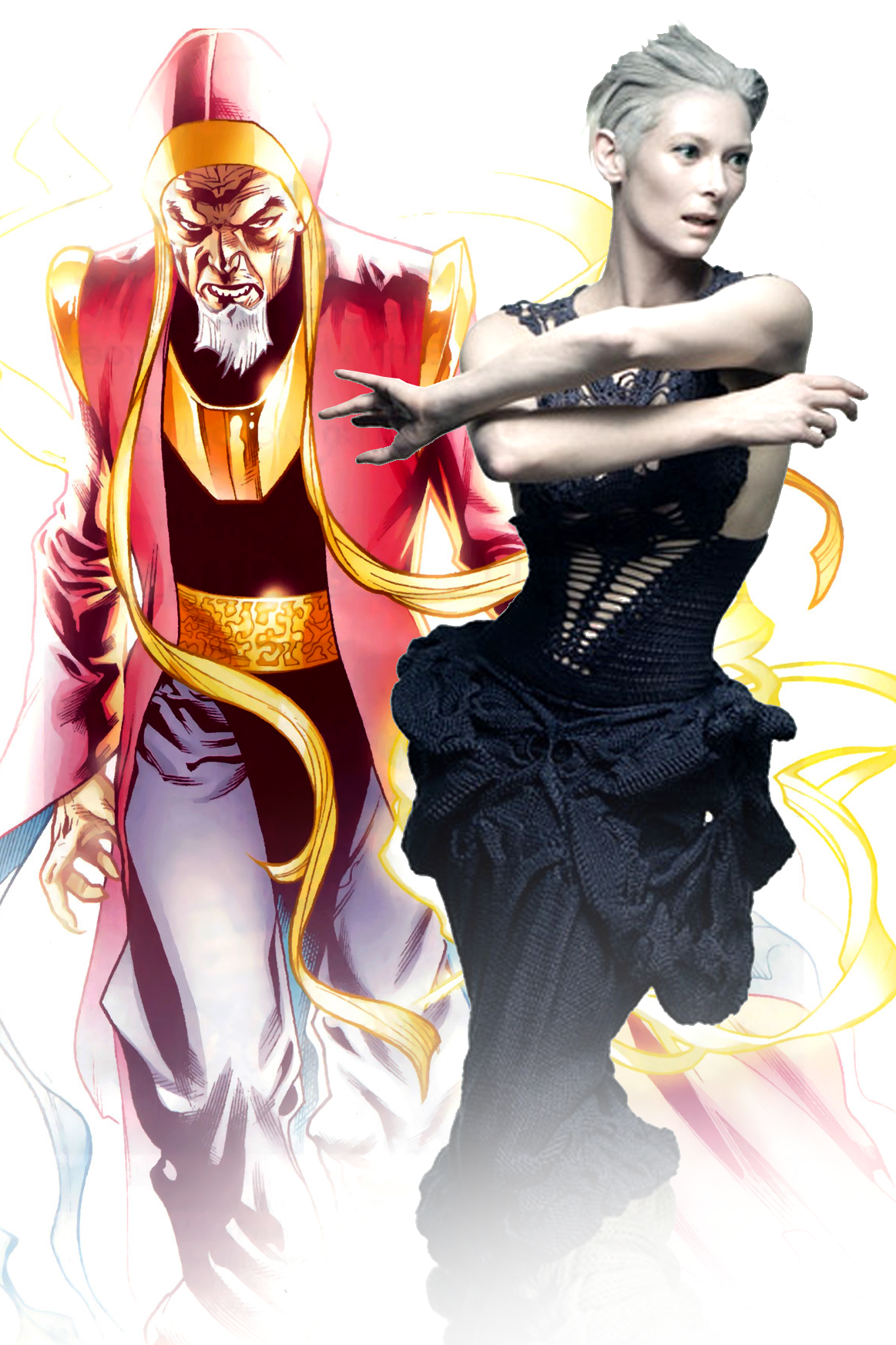
Celebrity Blind Spots and Fixing Racist Narratives [By Making Everyone White]

ANCIENTONETILDALast week it was announced that Tilda Swinton was in talks to join Marvel Studios’ Doctor Strange, specifically in the role of the Ancient One. For those of you who don’t read a lot of comic books [and even those who do] the character in question is Doctor Strange’s teacher, a Tibetan mystic named Yao. If it wasn’t plainly apparent to you, Swinton is about as Tibetan as Emma Stone is Chinese or Native Hawaiian. The numerous comic book news outlets that I frequent have covered this in as much depth as they possibly can seeing as nothing is set in stone at this point, but I’ve noticed a trend in responses to the presumed casting choice. That perspective is what I’ll be covering first, following that up with how “progressive” Swinton playing this role would actually be-

“Meryl Streep could play Batman and be the right choice.”

Look, we’ve all seen at least one episode of Modern Family, and most of us can remember Cam reciting those exact words when lauding the actor’s ability to be perfect in any role. Like most effective jokes it’s funny because it’s a slight exaggeration of how people actually think and feel, in this case about their favourite talent.

Gordon lambasted the blog “Your Fave Is Problematic” last year, and for reasons that I generally agree with given their penchant of going overboard when finding areas in which celebrities and media have screwed up. That being said, at bare minimum the title of the site is effective in that it forces us to realize that nobody is above reproach. No one is so incredible that they should be given carte blanche to do [or be] whatever they want, yet that’s the attitude I’ve seen so many people give this news.

opinions

That’s not to say that people aren’t entitled to their own opinions of who can play what character, but that we’ll so quickly make exceptions when they involve people we love to watch perform. After it was announced that Martin Freeman would be appearing in the Marvel Cinematic Universe the number of people who wanted to see Martin Freeman as Wong opposite Benedict Cumberbatch’s Doctor Strange was staggering. That’s right, Martin Freeman. As a person named “Wong”.

martinwong Continue reading