For those of you who don’t know, Anne Rice became famous for writing vampire novels decades before the Twilight books came out [and a few centuries after Bram Stoker’s most well-known work]. She also had a very particular stance on fan fiction, which I have pulled from an old archived version of her site:
“I do not allow fan fiction.
The characters are copyrighted. It upsets me terribly to even think about fan fiction with my characters. I advise my readers to write your own original stories with your own characters.
It is absolutely essential that you respect my wishes.” Continue reading →
Way back in February I dedicated a Fame Day post to Marvel Editor in Chief Alex Alonso. In the very first paragraph of that post I observed that every one of these features thus far had been dedicated to a man or an organization, and that “[a post on a woman [was] in the near future].” Almost two months late is better than never, right?
Art by Jamie McKelvie.
Kelly Sue DeConnick is a writer for Marvel Comics, and a person who is doing all sorts of things for women in comics. For one, she’s part of the creative team that took Carol Danvers, formerly Miss Marvel, and promoted her to Captain Marvel. She even went out of her way to bring in artist extraordinaire Jamie McKelvie to help redesign her new look.
In writing the Danvers’ new title, DeConnick made sure to include a particular moment in history in her first arc. Talking about those first few issues of Captain Marvel, she recounts that:
“…I think it started with me talking about something I’d read about the Women Air Service Pilots of World War II over family dinner at our friends’ house one night. I was so angry about this thing that happened 60 years ago that I was shaking. I felt like I needed to do something with that anger, and then I realized that I had an angle on a story I cared about.”
While never shying away from the fact that she was writing a superhero comic, DeConnick used her 20-or-so pages per issue to shine light on the injustices that women pilots faced in years past, and that is worthy of praise, to put it lightly. Continue reading →
EVAN: Ladies, gentlemen, those who fall into neither category [I’ve been taking a course on gender], tonight Gordon and I will be talking about what most everyone in the world has to do to get by, and that is work.
As a topic it spun out organically from our conversation on naps and time, and it’s hard to discuss the hours in the day when such a large chunk of it is spent at one’s job.
GORDON: More specifically, it was through a general observation that too often, our work simply isn’t fulfilling.
This is certainly something we can all relate to; Evan and I in particular, having scrubbed down dorm toilets for minimum wage.
EVAN: Oh yes, the very high New York state minimum wage of $7.25.
GORDON: And yes, we were paid by the hour, meaning the better we were at our job, the less we made.
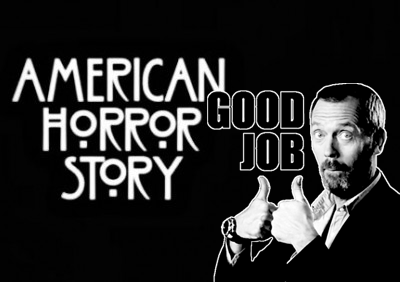
Today, I’d like to tip my hat to one of my favorite shows, a young series by the name of American Horror Story.
Now it’s no secret that the horror genre is universally despised, being seen by many as being lower on the totem pole than even toilet-humor comedies or the most saccharine romances out there. I could probably spend an entire post speculating on why exactly horror flicks are treated with such little respect (a lot of it is probably due to the genre’s inbred cousin, the “teen scream” flick), but that’s another topic for another time. I’m here to simply showcase the series and highlight a few of its key strengths and accomplishments that I think make it worthy of a Fame Day.
Each season of the show (the second has just concluded, and a third has been greenlit) is a separate story, made up of the horrific lives of the characters as they struggle with their pasts, their inner demons, and some ever-present terror always lurking just beyond the shadows. It essentially cashes in on the initial charm that LOST had before it jumped the polar bear.
Guilt and shame are themes that play heavily into the series as a whole (or at least, the past two “stories”), giving even the most heinous characters a degree of sympathy. Again, similar to LOST at its best, the constant shifting of the story from one perspective to the next prevents the series from ever being boring. Granted, the madcap pacing doesn’t always work (especially in the first story), but for the most part, the audience is always kept interested.
And that brings us to the first key accomplishment of the series:
Popularity
As I stated above, horror is simply not popular- at least, not in any mainstream way. Tim Burton’s lighter works are really the closest most people get to anything remotely macabre, and the fact that the series has continually drawn in high ratings (to say nothing of critical acclaim) is nothing short of amazing. And we’re not talking about a series that is eerie or has a handful of jump-scares, we’re talking about truly unsettling elements here. I’m certainly not alone in hoping that that AHS‘s continued success serves to begin building bridges between mainstream entertainment and horror subculture; heaven knows both could benefit from some fresh perspective.
And even in the subculture, AHS is playing a pretty major role. It’s…
Raising the Bar
As a result of the genre’s (comparative) isolation, quality in horror is typically pretty rare. When you can’t secure funding for special effects, good equipment, or even B-level actors, chances are your product isn’t going to be all that good. Of course, when you have a built in audience who would pay money to watch Dwayne Johnson protect an orphanage from chupacabras, why would you even bother trying?
I would actually probably watch that…
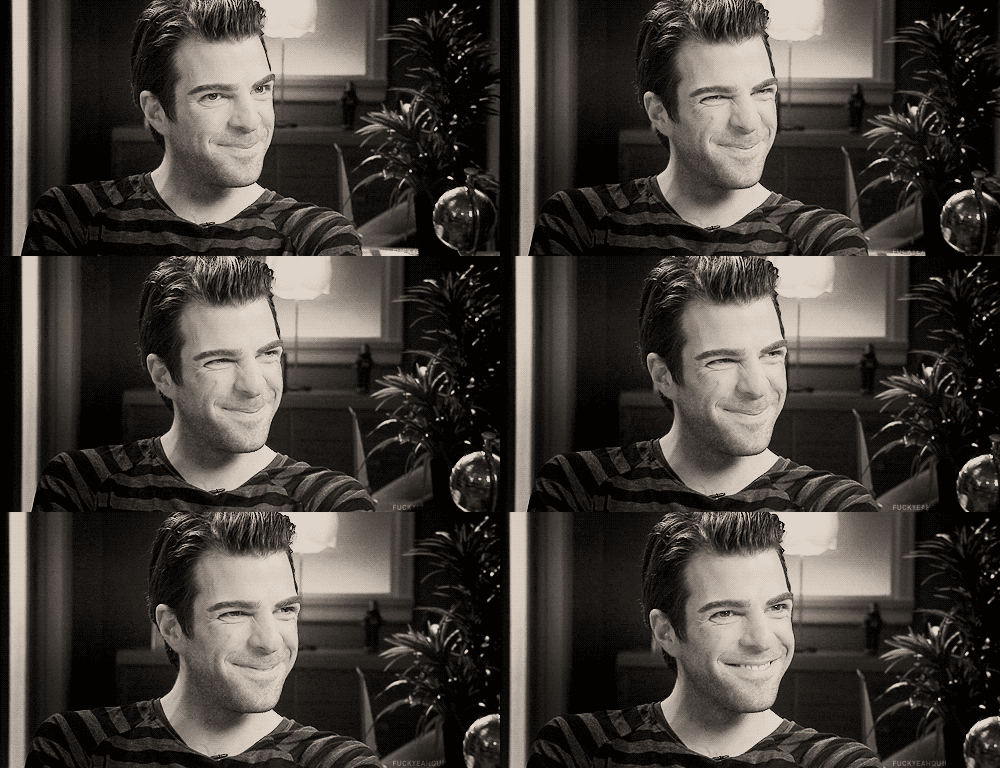
I’ve seen my fair share of (decent) horror movies, and I can count on one hand the films that had even passable cinematography. AHS, as a series that actually has some decent funding and actually puts effort into creating tense atmospheres and believable effects, is raising the bar for the entire industry. When AHS is the basis for most people’s experience with the genre, there’s going to be pressure on the rest of the industry to meet and excel the expectations the mainstream audience is going to have. Furthermore, AHS‘s star-studded cast (including Zachary Quinto, Ian McShane, James Cromwell, and, I kid you not, Adam Levine) is hopefully going to make the horror genre more inviting to high-caliber actors who can actually sell the audience on the direness of the situation and maintain interest without having to drag in a bunch of fornicating teenagers.
The series is actually one of the few I’ve ever seen that actually gives teens any credit or respect…
And perhaps most importantly, it comes down to this:
Depth
While the stories are good, as are the actors (Jessica Lange being easily more frightening than the goriest bits of the series), it’s some of the basic discussions held during the stories that really hit home. Oppression of women and the dark history of psychology are topics repeatedly brought up, and dealt with both in a historically accurate and totally visceral manner. Perhaps the most disturbing thing I’ve yet seen in the series hasn’t been any of the monsters or murders- it’s been a demonstration (scaled back for TV, even) of the psychological “treatment” given to people “suffering from homosexuality,” seen at the time as a mental disease. Those five minutes alone were more frightening than anything else in the story- and it was amazing. Amazing to see some serious and deep social commentary made, and to see the brutality and insanity some people had to undergo actually presented in a way that’s going to resonate with the audience. You will be a better human being for having watched that scene.
Though in the spirit of honesty, your view of nuns will probably diminish a bit…
When’s the last time you could say that about a rom-com?
American Horror Story, keep up the good work.
A final note. I would’ve included more gifs, but (1) I didn’t want to spoil anything and (2) easily 90% of all AHS images are of Evan Peters, who is apparently just the bee’s knee’, if the series’ female fans are to be believed.
EVAN: This week on E> we take a break from scrutinizing film to look back about seven or so months to a different time of our lives: college. Now that we’ve both graduated we find ourselves in a different stage of life, and it begs the question of what those four years did for us, and whether or not that’s what we wanted or expected.
GORDON: Throughout my college career, especially towards the end, I heard a recurring argument:
“College is a scam,” they said, “It’s a trap or, at very best, a waste of money. You don’t learn anything you can actually translate into a job, so either drop out while you can or don’t sweat the grades and party your buns off.”
EVAN: Wait, who is the “they” that was saying this?
GORDON: I’ve read it in various Cracked articles, I’ve seen it covered in webcomics and in comments, I’ve heard it on the radio. Not always the same tone, but it always boiled down to that essential idea. “College doesn’t teach you what you really need to know, it just puts you in debt and wastes your time.”
EVAN: Well, I guess that really begs the question of “What is it that we’re really supposed to know?” If college is the great institution to prepare us for our lives, what should it have taught us?
GORDON: Some would argue that technical and vocational skills are what we really need. Stuff that’s meant to train us for jobs. Wrenches, not Whitman.
EVAN: Which is the sort of thing you see advertised on television late at night or in the middle of the day; schools for electricians and dental assistants and plumbers and what have you.
GORDON: Which always come across as propaganda films from a dystopic alternate timeline. They can claim to be breaking the mold all they want- I’ll still always just see Orwellian Factory-Schools designed train the subservient masses for laboring in name of supreme leader and glorious fatherland.
EVAN: Heh heh.
The contrast to this idea you brought up when first introducing this topic, that the two sides could be seen as college prepping us for our careers or making us more well-rounded individuals.
There’s obviously more to it than that, but how would you boil the latter option down to its essence?
GORDON: I’d probably cite our own alma mater’s (for me more just “mater”) slogan of “global mindedness.” The idea is to create people who are, first and foremost, thinkers. Logical and critically minded thinkers with strong creative abilities and appreciation for art and wonder. A noble enough sentiment to be sure.
EVAN: To really engage with this topic I feel like we should have equal footing, and I’ll have to give our readers a little bit of context-
I’m currently unemployed, and chose to live the latter part of 2012 living with and taking care of my grandfather, whose wife [my grandmother] passed away in September. My job hunt has only very recently started up again.
I say that because as it stands one of us is currently working and knows how his education has aided him and the other is not.
GORDON: I, unlike my Canadian counter-part, am currently employed, having worked two jobs simultaneously for a while there. Having vainly searched for a job the entire summer and most of the fall, I am now working a job helping unemployed people find work, the irony of which is not lost on me.
EVAN: And did you, my Employed-American friend, find that a degree helped you in your search for work?
GORDON: In all honesty, I’m not sure.
On one hand, I can say that certain classes I brought definitely assisted me in securing a job, but those classes really more on the whole “applied” spectrum of education. I definitely didn’t need to go to a top 3% college. People, it turns out, don’t give a crap about where you went.
EVAN: Again, I can’t comment from experience, but I’d like to say that it depends on the job.
GORDON: This is probably true. However, if you were looking for a job, which is gonna look better on a resume? Four years of college, or four years of experience in that field? From everything that I’ve seen, I’d take experience every time.
EVAN: And I agree with that entirely. I can’t count the number of want ads I’ve seen [and this is for stuff like janitorial work, and dishwasher] that require “minimum 2 years work experience.”
It’s like, heck, what was I doing in school when I could’ve been out working this whole time?
GORDON: But of course, that brings up the first question: what’s the point of college? Are we expected to choose a career path and be trained like the mindless, dehumanized proles that we are?
EVAN: Well, for me personally my career goals were more tailored to an academic setting. My personal interest in writing and editing is definitely something that can and is fostered in that environment.
That being said, if I had skipped my four years of college to simply freelance as hard as I could out there in the real world, would I be a better writer today? I honestly couldn’t tell you.
GORDON: The problem is that both sides have really, really big flaws.
On the one hand, turning college into a simple vocational training course does truly rip the soul right out of academia. It makes it just the place you go to get a desk job instead of a manual one.
On the other hand, college as it is now, while fostering intellect and creativity, is as unhelpful as it is expensive. Why put yourself over a hundred thousand dollars in debt to not get employment?
EVAN: I guess in the bigger picture, what is it that we want to do with our lives?
There are plenty of jobs out there that don’t require a college education, and that certainly benefit from hard work at an early stage.
On the flip-side, there are jobs that you simply can’t get without a degree.
GORDON: We also can’t imagine that we can simply get any job we want to begin with. It’s all a gamble. I can get a degree in biology, but that doesn’t at all mean I’m gonna get a job in biology- heck, I’d probably be lucky if I got something even close!
EVAN: Like a janitor in a pharmaceutical company. Or the guy who delivers mail to a biology professor’s house.
GORDON: Exactly. So is that it, then? It’s the whole dang system?
EVAN: I mean, yeah. I feel like more often than not that’s all it really boils down to.
GORDON: So let’s talk about an ideal universe. Or at least one that ain’t quite so screwed up. What’s college look like? Give me your take.
This does not count as an ideal college…
EVAN: It’s tricky, man- Because I would like everyone to be well-read individuals who think about the media that they access and have a fuller understanding of what makes us who and what we are as a culture, I mean, that’s the dream-
But at the same time I acknowledge that there are people who don’t care a whit about any or all of that.
And with so many people who enjoy poetry and the arts, while those are debatably important parts of society, what happens when they need to find work? How many playwrights can any single country sustain?
GORDON: My response would be “how many playwrights are there actually out there?”
EVAN: I think there’s a difference between the actual number, and how many individuals would actually like to be a part of that number.
GORDON: Touché, but we can blame certain jobs being glorified and others suffering from unwarranted contempt.
But let’s move on. College. Your college- what’s it look like?
EVAN: A thorough exploration of the ideas that created Western civilization, the one most of us live in today, because it’s extremely important to observe our origins before we can look at our present and then ahead, after that.
A strong emphasis on writing with the reason that without the ability to properly communicate our thoughts how can we even really fully think them to begin with.
GORDON: Sounds to me that you’re still leaning more towards the side of academia.
EVAN: Well, like we’ve discussed, I have a slight bias. And I suppose we haven’t really defined the question as far as the purpose of college.
GORDON: My take would a combination of both sides, with the end goal being application. We’re talking about the study of English for the purposes of applying the principles in same, either in writing or screenplays or entertainment or communication of some kind.
I feel this would allow for all the creative and academic elements while keeping the whole process grounded. No ivory towers.
EVAN: I don’t think my take discounts the possibility of lining up with what you said, but that’s a really good description of how college could and maybe should be.
That being said, we are actually overtime.
GORDON: You wanna talk about drugs and culture next time?
EVAN: I think at some point we could hand this back to the viewers, actually. We’ve really gotten a handle on this whole E>. I’m just not sure when or how to do so.
GORDON: The readers are slack-jawed cattle who would eat their own shoes if we told them to.
EVAN: I should probably edit that out of the final post.
GORDON: Nah, we can let ’em vote. My subject would be Drugs and Culture.
EVAN: Mine would be . . . um . . . huh. About SNL. How to fix SNL.
GORDON: Nice. Let it be so.
EVAN: Tell the nice people to have a good Wednesday, Gordon.
GORDON: Have a good Wednesday, Gordon.
EVAN: And don’t forget to vote, readers! Thanks for putting up with my co-writer!





 EVAN: This week on E> we take a break from scrutinizing film to look back about seven or so months to a different time of our lives: college. Now that we’ve both graduated we find ourselves in a different stage of life, and it begs the question of what those four years did for us, and whether or not that’s what we wanted or expected.


 Culture War Reporters