A few weeks ago I stumbled onto a website called The Microaggressions Project and then promptly forgot about it. Returning to it tonight I looked over the “About” page, which had the following paragraph at the top:
This project is a response to “it’s not a big deal” – “it” is a big deal. ”It” is in the everyday. ”It” is shoved in your face when you are least expecting it. ”It” happens when you expect it the most. ”It” is a reminder of your difference. ”It” enforces difference. ”It” can be painful. ”It” can be laughed off. ”It” can slide unnoticed by either the speaker, listener or both. ”It” can silence people. ”It” reminds us of the ways in which we and people like us continue to be excluded and oppressed. ”It” matters because these relate to a bigger “it”: a society where social difference has systematic consequences for the “others.”
A little later on they define what “microaggressions” are, a term that was originally coined to speak about racial experiences. From the essay “Racial microaggressions in everyday life: implications for clinical practice,” which appeared in American Psychologist, Vol. 62, No.4:
“Racial microaggressions are brief and commonplace daily verbal, behavioral, or environmental indignities, whether intentional or unintentional, that communicate hostile, derogatory, or negative racial slights and insults toward people of color.”
One example of this could be a White couple walking down the street and having a Black man pass by them on the sidewalk. The woman clutches her purse tighter against her body, the subconscious idea being, of course, that Black men are prone to crime and should not be trusted.
As an Asian-Canadian I’ve experienced microaggressions plenty of times. I’ve had someone ask me if I was half-White [I am clearly not] with their rationale being that my “English was very good.” It can be an everyday occurrence for non-White people [I deign to use the word minorities, since I do believe that balance is turning the other way], and begs the question: “Why is this such a big deal?”
Writer of the aforementioned article and author of Microaggressions in Everyday Life: Race, Gender, and Sexual Orientation, Derald Wing Sue, PhD, has observed that microaggressions have actually been found to: “(a) assail the mental health of recipients, (b) create a hostile and invalidating work or campus climate, (c) perpetuate stereotype threat, (d) create physical health problems, (e) saturate the broader society with cues that signal devaluation of social group identities, (f) lower work productivity and problem solving abilities, and (g) be partially responsible for creating inequities in education, employment and health care.”
In other words, a Black or Latino man being stopped for a “random vehicle check” by police could be upset, and may even be accused of overreacting. Maybe they should simply be used to this and not let it bother them. The truth is that it makes them feel, even if only subconsciously, like second-class citizens. It’s true in a case as blatant as this one, and in an as subtle an action as hanging a Confederate flag or having a Native American stereotype as a high school mascot.
Microaggressions work in every direction. It’s like going to a Vietnamese restaurant and being given a fork and spoon instead of chopsticks because you’re White and not Asian. Microaggressions are built on assumptions and can make people painfully aware of who they are. They are rarely meant to offend, but often do.
It truly is a shame that so much of the time we send out microaggressions without so much as a second thought, and then defend ourselves by deeming the offended to be “too sensitive.” While we won’t always be aware of how our words or actions can harm others, we can at the very least listen to the people being hurt, and in doing so try to lessen the presence of microaggressions in our society.
Act 2, Scene 2 of William Shakespeare’s Hamlet has the titular character declare that “there is no good or evil, but thinking makes it so.” Years later, this same sentiment would be echoed by Milton’s Lucifer in Paradise Lost, vowing “The mind is its own place, and itself, can make a heaven of hell, a hell of heaven.”
Moral ambiguity, in case you haven’t caught the drift, is the subject of today’s post. Our culture is becoming increasingly saturated with concepts and figures embodying this general rejection of our traditional measures of what right and wrong is. Jump back twenty years, and the definition of a bad guy would be fairly straightforward. A bad guy breaks the law. A bad guy hurts people. A bad guy lies. A bad guy uses people.
Today, all those things would describe five minutes of screen time with Breaking Bad’s Walter White…
Or Sin City’sJohn Hartigan…
Or The Walking Dead‘s Rick Grimes…
Or even any of these guys…
And lest anyone think that women are excluded from this mentality…
Now this isn’t the first time we’ve had a run of morally questionable heroes/antiheroes dominating popular culture. If I were to describe tough, unflappable, characters struggling against each other for their own ends and agendas, often in contradiction of the law- you’d probably assume I was talking about characters from some film noir piece.
And it makes sense, doesn’t it? Throw a mass of people in an economic depression with no end in sight, mix in distrust of the powers that be, add cynicism in regards to any progress or change, and when else can you expect but a tacit respect for the handful of people who do manage to carve themselves out a living. When you’re living paycheck to paycheck, “right and wrong” doesn’t quite seem so relevant as “effective or not.” When you feel helpless and voiceless, chances are anyone whose managed to be independent and powerful is going to be attractive- be he/she a suave criminal, a cunning businessman, a shrewd politician (à la Game of Thrones), or even just an all-around tough guy (see Sons of Anarchy).
And we’re not just talking about TV shows here.
Who are the good guys and bad guys in Inception?
Think about it- exactly which characters were representing the side of justice, truth, and freedom? Or Killing Them Softly? The Godfather Series? The Big Lebowski?
Our heroes today aren’t crusaders, they’re survivors. They’re those who manage to carve out a slice for themselves in spite of law, society, and conventional morality. “Good and evil” simply aren’t relevant.
And y’know what? I’m not hear to pass judgement on any of that.
There’s strong arguments to be made on all sides for whether or not this is a good or a bad thing or, to put it into morally ambiguous terms, a productive or a destructive thing. There’s even a strong case to be made for the “morally ambiguous” characters on TV and in the movies still never straying too far from anything truly socially unacceptable. Alternatively, you could (and I would) potentially argue that the moral system we had before all this wasn’t actually all that moral to begin with.
And what about the issue of cultural plurality in our ever-shrinking world? When what is right according to my moral code wrong according to yours, how do we proceed? Do we try to find some sort of umbrella system to keep us from fighting each other? Maybe we should declare moral anarchy and simply duke it all out based on the strength of our convictions. Certainly Nietzsche would approve of that.
All that’s to say that the issue’s complicated.
I don’t know, Michael Cera gif, I don’t know…
Speaking for myself, it is nice to see some kind of conviction, even if I don’t agree with the cause at hand. There’s a case to be made for apathy being the pinnacle of all evil. In a world where the greatest battles the average person (or rather, Westerner) faces are over such petty, empty things as getting a dinner order right or having to wait in line, seeing any kind of drive makes for a nice change. As with so much in this past year, it might not be great, but it’s a start.
Having just finished an episode of The Big Bang Theory is as good a time as any to write this post, which elaborates on an article I found on Macleans.ca titled “How obnoxious is too obnoxious for a TV character?” In it TV writer Jaime Weinman primarily writes about TBBT and its most popular character, Sheldon Cooper.
Weinman points out that the 12th episode of this season, “The Egg Salad Equivalency,” was actually the highest rated in the show’s history, an astonishing fact when you realize that a large chunk of it features Sheldon being extremely [albeit unknowingly] sexist and racist. I’ve embedded the primary scene in question below:
It’s pretty awful, but the fact of the matter is that Sheldon Cooper is far from being the only popular sitcom character you would actually hate to be around in real life. Two years before TBBT even aired the US version of The Office was around, and the original British version came out four years before that. Michael Scott was a huge draw for people who tuned in weekly to see how a particular Scranton paper company was doing [as well as being solely responsible for repopularizing the phrase “that’s what she said”], but was also one of the most blindly insensitive people on the planet.
Very old television spoilers ahead.
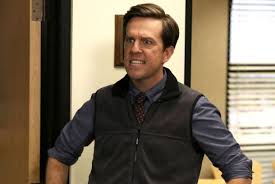
Steve Carrell’s departure at the end of Season 7 meant that someone else had to be the new boss, and in spite of my suggesting that Matthew Perry would fit the bill that role was given to Ed Helms’ Andy Bernard. While his character managed to be a fairly likeable manager earlier on, the current [9th] season has had him transform into what is essentially a terrible human being.
He’s this close to being a moustache-twirling symbol of outright villainy.
He leaves the office to sail a boat out to some island, comes back expecting everyone to have covered for his month-long absence, and then, upon having his girlfriend [understandably] break up with him for another coworker proceeds to make both their lives a living hell. Crazy-talented webcomic artist Anthony Clark tweeted it best when he said:
I hope the next episode of The Office starts w/someone reading a newspaper that says "Andy Died." Then he's never mentioned again
And speaking of Ed Helms, take as another example his companion in the Hangover films, Alan Garner. Essentially just Zack Galifianakis playing the role he always plays [see: Due Date, Dinner For Schmucks, etc.], he is, as we’ve been talking about, a person who is so obnoxious that you wonder how they continue to be alive; there are times when you want to reach through the screen and slap them in the face.
Most TV shows [that’s the end of the movie portion of this post for now] have them, too. Adventure Time has the Ice King, Community has Pierce Hawthorne, Modern Family has Manny Delgado [which you might debate, but I stand by this], and 30 Rock had the one-two punch of Tracy Jordan and Jenna Mulroney. Not only are the prevalent in television, but they also manage to become a huge draw for viewers.
Weinman ends his article by stating that “the show knows Sheldon is a jerk, but it doesn’t seem to know just how big a jerk he is.” I think it’s a fair assessment to say that all of the shows I’ve mentioned are aware that they’ve added obnoxious jerks to their casts, but the exact purpose for this is lost on someone who only had four hours of sleep last night. Sure, they can act as semi-antagonistic friends for our hero, usually the straight man, but eventually as the audience we’re forced to ask ourselves how people can bear having them around.
You could even justify it as being some sort of catharsis, rooted in schadenfreude, for whenever these character get their comeuppance, but it never happens. Sheldon will continue to be unaware of how his actions affect others, Pierce will continue to be extremely racist but get away with it due to his age, and we will continue watching them, amused, annoyed, or somewhere in between.
Only got four hours of sleep last night, so bear with me if this isn’t the epitome of proper grammar or decent, coherent writing. It took me almost half a minute to remember the word “coherent.”
The topic for today was brought to me by my good friend Stew, and forced me to look up the definition to the word “filibuster.” Since I’m going to assume that at least a few people have, like me, lived their lives without ever having to read, hear, or use it themselves, it is as follows:
fil·i·bus·ter (noun):
the use of irregular or obstructive tactics by a member of a legislative assembly to prevent the adoption of a measure generally favored or to force a decision against the will of the majority.
b. an exceptionally long speech, as one lasting for a day or days, or a series of such speeches to accomplish this purpose.
c. a member of a legislature who makes such a speech.
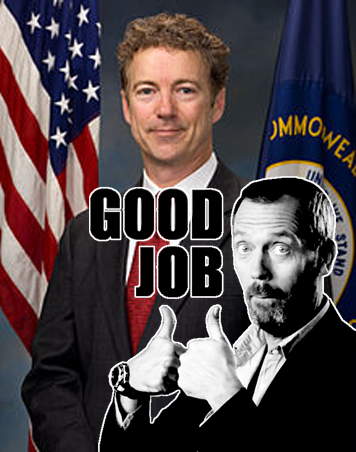
Basically, in layman’s terms, a filibuster is a whole lot of talking to make sure that some sort of law or policy doesn’t pass [or the person who does this]. Enter filibuster, and subject of today’s Fame Day, Rand Paul.
This man began his filibuster yesterday at roughly 12 pm EST, and he kept on going for almost 13 hours. Not only that, but in spite of coming prepared with binders of notes he barely looked at them. He ended his interminable talk with a touch of humour, saying “I would go for another 12 hours to try to break Strom Thurmond’s record, but I’ve discovered that there are some limits to filibustering and I’m going to have to go take care of one of those in a few minutes here.”
Let that sink in for a bit. Rand Paul stood and talked for almost 13 hours. As quoted from the article I linked to above, “As the person leading the filibuster, Paul was forbidden from ever leaving the floor, lest he lose control of the debate.”
Rand Paul went without food, water, or the means to relieve himself for over half a day. He did this to protest a very frightening reality, that of the American military using drones on American soil. During the speech he voiced his concern with that, saying “When I asked the president, can you kill an American on American soil, it should have been an easy answer. It’s an easy question. It should have been a resounding, an unequivocal, ‘No.’ The president’s response? He hasn’t killed anyone yet. We’re supposed to be comforted by that.”
I end this post with another quote from the speech highlighting the fervour that this man has for human rights in America, and his unwavering dedication to uphold them:
“I will speak until I can no longer speak. I will speak as long as it takes, until the alarm is sounded from coast to coast that our Constitution is important, that your rights to trial by jury are precious, that no American should be killed by a drone on American soil without first being charged with a crime, without first being found to be guilty by a court.”
EVAN: Ladies and gentlemen, children with surprisingly discerning taste, Gordon and I have managed to look past the weariness of a day of work to bring you a new installment of Evan and Gordon Talk.
EVAN: This topic arose organically, actually, due to a few posts by Gordon on piracy and my not being able to fully agree with them.
And no, it’s not that kind of piracy, though we did start a new pirate-themed D&D game just this past Sunday.
GORDON: And it shall be awesome- but back to the subject at hand. I’m going to start with some full disclosure:
I am not of the mind that piracy is, in and of itself, a great and noble thing. Any indication or implication of this on my part is usually just in reaction to the mainstream media’s portrayal of piracy as a crime on par with defacing priceless art, grand theft auto, and punching old ladies in the face.
EVAN: And in all fairness from my part, I will admit that I’m no saint when it comes to piracy. I stream a plethora of shows for my viewing pleasure, though I have [and this is likely the voice of Justification speaking] sworn off downloading full-length films, music, books, etc.
GORDON: And Evan, I will attest, is not some twisted chaos-worshiping miscreant devoid of honor or humanity, as the major media industries would have you believe. Well, not entirely, anyways.
Now, Evan, one of the justifications I’ve heard you use in the past is that you’re living in Canada. Many- if not all- US shows are simply unavailable outside of the States through any conventional means.
EVAN: This is true. And while I resided in the States for my post-secondary education I made frequent use of the free streaming service Hulu. I even watched, and somewhat enjoyed, the ads.
In Canada we cannot even watch the episodes on the channels’ respective websites [NBC.com, CBS.com, etc.]
GORDON: And you’re certainly not alone in that. The vast majority of the world is in the same boat, forced to choose between piracy or waiting a few years for the DVDs to come out and then pay an exorbitant fee plus crazy shipping costs. Better hope your purchase isn’t damaged en-route.
EVAN: Since we have been so good about being fair, I will point out that there are options- many television episodes are available to buy via Amazon, online. Before you ask why you should pay for something you would otherwise get for free I’d point out that you pay for these shows by watching ads, and that as someone not in the States you would not “otherwise get it for free” to begin with.
GORDON: And that’s something I can actually tolerate. In spite of my muting ads and/or talking back to them while giving the corporate pigs the finger, I’m perfectly willing to subject myself to ’em if it means cheap and convenient access.
EVAN: If I recall our time together in college correctly [which we both know I can, and do], I distinctly remember you blocking said ads with Adblock.
GORDON: Even though it meant the waiting time was ultimately longer.
EVAN: Which is besides the point. But let’s continue onwards: is piracy damaging?
GORDON: The continued existence of Hollywood, as well as the ever increasing budget of films, would seem to indicate otherwise.
There are people out there who might try to argue that piracy hurts new musicians, who can’t afford to lose profits like big businesses can, but that’s a flawed argument. Truth is, musicians only get a sliver of the profits they generate, and wind up losing the rights to their own songs in the process. Working independently with the consumer is generally a safer and more profitable move.
EVAN: I will not argue with what you have said about musicians for a second. The amount they make through selling single tracks on iTunes is deplorable.
What I will point to, however, are the other areas where piracy can [and does] occur. Television series live and die based on their ratings, and buying them does nothing to help what’s perfectly good [if not great] television. Similarly, if only 1,000 people decided to download a new issue of a comic book instead of simply paying the three or four dollars, that could mean the end of that series; titles that dip below 20,000 are typically cancelled soon afterwards.
GORDON: I agree wholeheartedly. But I think that speaks the whole reason piracy exists- not malice, but rather cost and convenience. These people- especially television producers- have got to understand that their old metrics for measuring the popularity of shows are dead.
It’s the equivalent of saying communication isn’t popular because house phones are dying out. No, we’re just turning to new, cheaper, and more convenient methods. Piracy could be dealt a deathblow if these major industries would just step up their game, rather than trying to use lobbies and buy off politicians to keep us dancing to their tunes.
EVAN: The thing is, I think in arguing for “cost and convenience” you run the risk of defending those who just a) want to get quality products for free b) whenever they want.
It’s not just that people want ease in accessing what they love, the truth is that when given the choice between paying and not paying people will always opt for the latter.
Not to bring it back to comic books [who am I kidding, it’s what I do], but you putting down a few dollars means that a talented writer or artist is able to keep on doing what they do: providing you with high-quality stuff. That’s an actual case where piracy can severely jeopardize both artists and their art.
GORDON: Again, I agree. I do believe in paying for what I love. My record collection stands as a testament to this, as does my choice to spend a few extra bucks buying beer produced by one of the few ethical companies on this blighted earth.
Tell me this- you like the show New Girl, right?
EVAN: Immensely.
GORDON: Would you pay fifty bucks American to watch the show at 4:12 (and ONLY at 4:12) in the afternoon?
EVAN: I would not.
GORDON: How ’bout ten cents to watch it whenever you so desire?
EVAN: Yes indeed.
GORDON: You and millions others, am I right? Ten cents for a crisp, working copy rather than some choppy, blurry pirated version where the sound and video are out sync?
EVAN: Oh, I stream at only the highest quality.
GORDON:That’s my point, I guess. Yeah, there will always be people out there who don’t want to pay the ten cents, but overwhelmingly, that kind of price and convenience will make such a minority negligible.
I assert again that piracy doesn’t exist because millions of people are art-hating maniacs, but because the business plans of these networks and companies are painfully obsolete and short-sighted, especially in regards to the international market. Heck, I’d say such changes could ultimately lead to these companies turning a healthy profit- especially if they just included some advertising à la early Hulu.
EVAN: Here’s the thing, the US already has a working model of what you just said. As I mentioned you can purchase episodes of stuff on Amazon, and I’m talking $2 an episode. That is reasonable. I don’t think your average American would look at that price and think, “There’s no way in Hades I am spending two dollars on a 45-minute episode of television that I can keep forever.”
Yet in spite of that, people in America still download TV shows all the time. If it doesn’t work for them, what makes you think they can extend something like that to the rest of the world?
GORDON: Firstly, I disagree that 2 bucks is reasonable for an episode. That’s the cost of an entire dinner right there. How much more so is that going to be true for the rest of the world, who have even less?
I mean, we’re not talking about a book or a record which goes through an intensive manufacturing process for each copy- we’re talking digital here. Every man, woman, and child on Earth could be given every book, movie, song, and piece of art on earth if the masters so chose…
EVAN: Gordon. It’s two dollars. The average American does not spend that much on a full meal, they spend that much on stuff they don’t need, like gum or coffee or inane tabloids. As a country America is more than able to pay that paltry amount and yet they do not. My point stands.
I’d further argue that since it’s digital that ease of access adds, not detracts, from its value. You can watch it whenever and wherever you want.
GORDON: What I mean about it being digital is that it doesn’t cost money (anything noticeable) to reproduce it, unlike hard copies of things such as books or art. With that mind, charging two bucks an episode seems to me to be unreasonable. I’d cite the fact that for 20 dollars you can get a season of a show with (at least) 20 episodes as proof of this. The cost can, and should, be lowered for great consumption.
EVAN: Like I said, we’re adding availability as a variable. Sure, you can pay 20$ for a full season of a show, but that’s waiting a year or however long it takes for it to come out. People are also paying for the availability of getting it when or soon after it airs.
GORDON: That’s gonna be different from company to company, but for the most part, that’s true. But I’d jump back to my complaint about how little the actual artists get in all this. If anyone- anyone– is gonna set a price, let it be the ones producing the work.
EVAN: Honestly, though, that’s an entirely different argument.
The fact of the matter is that if a writer/artist wanted to print their own comic book there’s no way they’d be able to do it on any significant scale on their own, the cost of printing alone would wreck them.
Different industries pay those who work in them different amounts, and it’s not the topic of our conversation this week.
GORDON: Again, my issue isn’t with the fact that we must pay; we can all get behind this. My issue is with the terms and conditions we’re subjected to- especially when big companies start throwing their weight around to slow progress.
If piracy is the rampant issue that they say it is- and I seriously contest that- then I submit that the fault is on their part for adopting inconvenient, pricey, and exclusionary policies. Let me put it this way: If you say apples can only be purchased by people who’ve climbed Mount Everest, you’re gonna create a lot of apple thieves.
EVAN: We’ve left you a lot to think about, even if you’re not someone who refreshes a website over and over waiting for a new episode of 2 Broke Girls to pop up [did you know I review that show?].
So with that ladies, gentlemen, and genius babies, we bid you a happy Wednesday. We came up with this week’s topic, but you can decide if next week we talk about . . . um . . . Dungeons & Dragons. How we’ve chosen to play it and why we think it works [better?].
GORDON: Alternatively, you may vote that we discuss the role of religion in our (relatively) secular society.
EVAN: Thank you, as always, for reading, and please vote!
I’ve always had a rough time with Fame Day posts. I’m a generally dispassionate guy, and the things that I do like either aren’t around anymore (good rock, for example) or don’t have much to be said about them (beer is good, that is all).
Bitter cynic that I am, it’s a lot easier (and more fun) to rail on things I despise (which is a lot of things) than make a case for what I enjoy. That issue is only compounded by the simple fact that at the end of the day, it’s really just all the little things which get ya.
With that in mind, today’s Fame Day [in lieu of the usual Shame Day] will not be spent dedicated to a single person or group or trend, but rather to a number of things which deserve some recognition, even if it’s just a little.
Middle-Eastern Jesus:
Even with a better understanding of history and geography, portrayals of Jesus are still pretty much limited to the fair-skinned, flowing-haired images of the Middle Ages. Even if we are, at the very least, keeping away from the blonde hair and blue eyes, we still have a long way to go. That’s the reason it’s always so refreshing to see Jesus portrayed with a stocky build, dark skin, dark hair, and a beard one would sooner associate with an Al-Qaeda commander.
He is not gonna tan well…
For everyone portraying Jesus as something more like that below, and less like this above- thank you.
PFC Bradley Manning:
In retrospect, I could’ve simply dedicated this Fame Day to saluting Bradley Manning, the young American soldier who leaked a massive number of documents to Wikileaks. Inevitably however, such an attempt would have simply devolved from a round of applause for Manning into a vitriolic diatribe against the increasingly Orwellian US government. Heck, even here I’m gonna be tempted to do so. Better just keep it short and to the point.
Included in the footage Manning leaked was video of a strike by American forces on targets they mistook for combatants, but who were in reality journalists and civilians. This footage would have doubtlessly been suppressed, as would similar information PFC Manning leaked, and kept from the public eye, perhaps forever. Rather than being given a medal, Manning has been arrested, imprisoned, intimidated, and presented with a host of charges, including “aiding the enemy,” which carries the death sentence. Again, I’m tempted to run off into a wild condemnation of this entire farce, so let’s throw PFC Manning a round of applause and our wishes for his speedy release.
Chill Parents:
In our paranoid world, we have a tendency to attempt to control and protect our loved ones- kids in particular- from any possible harm or danger, no matter how minor. You’ve probably seen it in some form or another. Loading the kids down with every imagine medication, drilling the idea of “stranger-danger” into their disproportionately large heads, heck, even tracking phones or school IDs is viewed as just a logical move in this chaotic and evil world.
I guess that’s why it’s always good to see parents who are okay with their kids getting a little dirty and scraped-up, or even view such things as a healthy part of development. I’m not talking about neglect, mind you, but rather an understanding that keeping kids penned up inside a house or wasting away in front of a TV is just as bad- if not worse- than having to liberally apply the iodine after Jack and Jill fall down some hill.
And there you have it folks- a grab bag of things worth nodding your heads at. Be sure to check in tomorrow for a new installment of “Evan and Gordon Talk,” and Free Bradley Manning!










 Culture War Reporters