Ms. Marvel, #11: A Comic Book Review

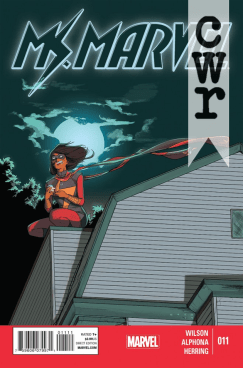
msmarvel11As predicted in my last review, this issue does in fact feature the downfall of the villainous Inventor. What I did not foresee, however, is how Alphona would be bringing his A-game when it came to illustrating our shapeshifting heroine’s triumph over evil. Seriously, there are some jaw-droppingly beautiful splash pages featured here.

For the most part my recaps of Ms. Marvel are exactly that, short summaries of what went down in addition to some exploration of any themes therein, so I feel it only fair to take a few paragraphs to focus on the art itself. To begin with, a “splash page” is:

“a page in the comic book where there are no other panels and the character or scene fills the entire page of the comic book.”

Issue #11 features three such pages, which would be more than overdoing it according to J. Caleb Mozzocco, one of my favourite comic book journalists. The reason for that being when you only have twenty-ish pages of comic [21 in this case, including the recap page] having one of them taken up by a single panel can make it feel like you’re not getting enough bang for your buck. Rest assured that that could not be further from the truth in this case-

tightsqueeze

While the entire page is indeed taken up by a single illustration there’s a strong sense of movement, with readers being able to trace Kamala’s journey through the innards of the deathbot with ease. The word boxes help to anchor a start and end point, and the intricacy of the gears as well as her cartoonish contortions keep you from turning the page even after you’ve finished reading the words. I could go on praising Alphona’s work, though, so as to the actual narrative- Continue reading

Why I Decided to Stop Being a “Tough Girl” and Just Be Me

I used to cry a lot as a kid. A lot. I had all the feels and I didn’t know what to do with them. 

I was also a pretty uncoordinated kid. I mean, nothing spectacular (I only broke a couple bones), but enough to make me suck at the only thing that mattered in elementary school: winning stuff. Being stuck as “it” for hours at a time in grounders or tag really gets the spirit low, so, as you might expect, I spent a lot of recesses crying.

My mom loves to tell this one story from back when she worked at my school. She had been helping a friend of mine with her homework one day and when this friend became frustrated she had reminded her that “Some people are good at spelling, some people are good at sports, etc. Everyone has something that they are good at, and everybody has something we need to work on.”

Later that day, I came dead last in a race (my mom likes to emphasize this part when she tells the story, often repeating herself with “and I mean dead last“). Anyways, after coming dead last in this race I retreated to a distance to cry my eyes out. This same friend of mine came over and put her arm around me. Then she started to tell me “You know Katherine, some people are good at spelling, some people are good at sports…”

You get the gist of it. I used to cry a lot. Then, one day on the playground, a kid called me a “cry-baby”. I don’t remember who it was, but I remember clenching my fists and swearing to myself “I will never cry again!” Continue reading

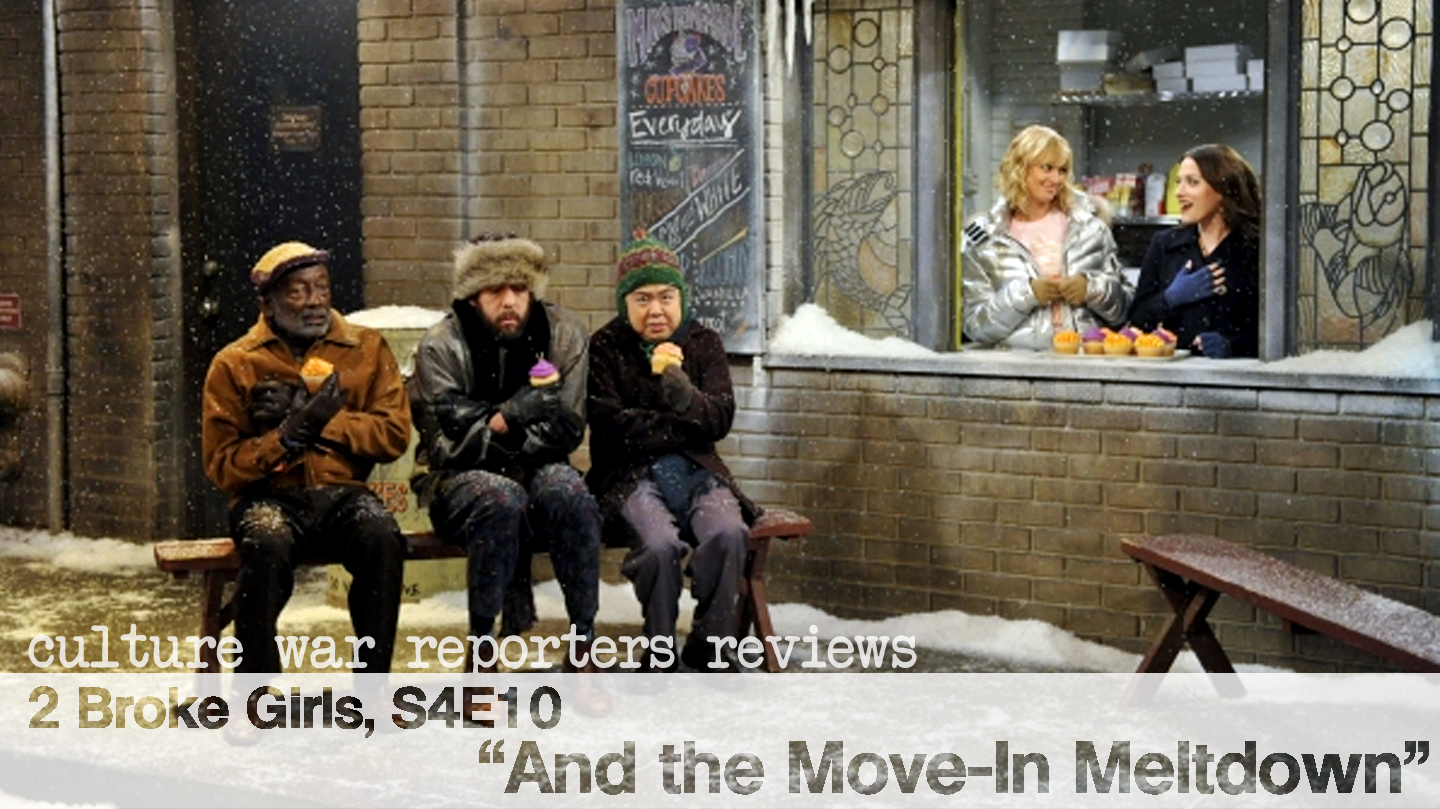
2 Broke Girls, S4E10 “And the Move-In Meltdown”: A TV Review

moveinmeltdown

Speaking of “meltdowns” I totally had the best melt for dinner [not a grilled cheese, as some may incorrectly call them]. It had cheese, obviously, as well as homemade guacamole and spinach. The second also had kimchi [I should mention I actually ate two of them]. Now that my prose-version of Instagram is over, I suppose we should move along to the episode itself-

Now last week’s review was pretty short and sweet, but I mentioned, as I have many times before, that this is a show that focuses a little too closely on its titular characters. Max and Caroline are the headlining act for sure, but every other member of the cast appears to be relegated to bit players at best. This episode appears to be the writers’ room forcing me to eat my words. Continue reading

Why We Need/Don’t Need Black History

I ran a Shame Day post a while back about “Black History” (or the whitewashed version that gets fed to us), and in it, I referenced this clip with Morgan Freeman:

I promised to shortly address Mr. Freeman’s comments-

-and promptly forgot about it for two years.

Well overdue, here’s why we desperately need Black History, and why we simply don’t.

Bear with me here.

Because We Don’t Have Real History

Again, we’re fed an overwhelmingly whitewashed and simplistic version of history. Lincoln benevolently freed the slaves and then, roughly 100 years later, MLK Jr. led a series of peaceful protests which ended segregation, and everybody lived happily ever after.

In reality, folks largely lost faith in peaceful protest as the 60s wore on, turning instead to self-defense, nationalism, revolution, and other techniques.

Continue reading

Michelle Obama, Cultural Norms, and Making A Statement

You should all know by now that I’m one of the last people to be up to speed on current events in the political sphere. Having said that, I do pay attention to the news in my Facebook sidebar, which is how I found out that three days ago Michelle Obama joined her significant other on his trip to Saudi Arabia to pay respects to the recently deceased King Abdullah.

Oh yeah, and she also didn’t wear a head covering of any kind.

Now look, before we really dive into this I should probably remind everyone that being the spouse of a world leader is no cakewalk. To pick just one example out of many, Michelle Obama [referred to by full name to avoid confusion] announced the Best Picture winner at the 2013 Oscars. This prompted Conservative columnist Jennifer Rubin to share that:

“There is a sense of going too far and too much and becoming so ubiquitous that people don’t consider you something special. She is the first lady for goodness sakes. She’s not just a Hollywood celebrity.”

It’s a statement which . . . okay, it’s ridiculous. I would explore that further, especially the comment about the inherent celebrity within the status of POTUS and all related to the person in that role, but I just wanted to illustrate the fact that Michelle Obama is under a lot of scrutiny all of the time about everything. Continue reading

The Last 3 Books That Made Me Cry (And Why You Should Read Them)

I love getting lost into the world of a book. You know how it is when you can’t handle taking a bathroom break or stopping to eat lunch because it might mean tearing your eyes away from the page? Luckily, as an English major, reading is a big part of my learning experience. Not every book I’ve been assigned to read has been my style, but some of those books have been so good that they sucked me deep into the story until the next things I knew, tears were streaming down my cheeks.

For the sake of this article, I won’t be focusing on all the books I’ve read over the past year. If you want to read a fantastic overview of a wide span of books, I suggest you check out Evan’s 2014 Literary Awards. Instead, I want to share the last three books that made me cry, and, more importantly, I want to discuss the larger issues that make each of these three books valuable reads.

Each of these novels engages with what it means to live in a post-colonial world. In each story, it quickly becomes apparent that the horrors of colonization do not simply end the moment government policy changes.

While I will avoid any key plot points in these books, I will be alluding to general context around the books. If you prefer to go into your reading experience with a blank slate, I should warn you, Spoiler-ish content below.

Wide Sargasso Sea by Jean Rhys

Generally regarded as the post-colonial prequel to Jane Eyre, Wide Sargasso Sea opens in Jamaica, shortly after the abolition of slavery. Rhys’ protagonist, Antoinette, comes from a family of plantation owners who were brought to financial ruin by abolition. As a child, Antoinette struggles to understand what separates her family from the rising class of British capitalists.

By writing from the perspective of a child on the wrong side of history, Rhys prevents any oversimplification of her narrative. She also challenges the idea that colonial injustice somehow ended when slavery did.

Rhys’ strong narrative style creates a story that will immediately pull you in, but her imagery and carefully thought-through word choices create layers of meaning that make this novel much more complicated than it appears at first read. While it initially seems to be a Gothic Romance, Wide Sargasso Sea also explores a variety of important questions around race and gender. Continue reading