Why The Fast and the Furious Franchise Has the Superior “Comic Book” Movie Shared Universe

This isn’t going to be the longest post for two reasons: 1) I made a bet with a friend and am only eating leaves for the entirety of today [this was my breakfast] and am therefore weak in mind, body, and spirit, and 2) this is a very straightforward assessment that two other other writers have already broken ground on already. Let me take a single step back, though, and remind you of what happens in a week’s time and why I’m writing this.

Furious 7 comes out.

I know I used my love of comic books to springboard my post on Flash Boys, the novel Aaron Sorkin refuses to write a screenplay for because “there aren’t any Asian movie stars”, but here we are again. Well, sort of. See, comic books only reach so large an audience. Comic book movies, on the other hand? They find themselves as two out of the top five highest grossing movies of last year [four of the top ten]. Everyone wants to get in on that business, to the point where a shared universe of larger-than-life characters was one of the goals of the truly awful Dracula Untold. Here’s the thing Universal, you already own The Fast and Furious [referred to as FF from this point on] franchise which has been going hard since the early aughts.

Remember at the end of Iron Man when Tony Stark meets Nick Fury for the first time and your nerdy friend gripped your arm so hard you thought they would snap it and whispered directly into your ear that “it’s happening“? The FF movies have been pulling that same move for years without the help of a narrative that’s been ongoing since the 60s. Every one of their reveals is builds on the preceding films,and the fact that they’ve managed to make this viewer drop his jaw is worth mentioning in and of itself.

Continue reading

Stew’s on Academic Leave

Hello all,

To the handful of you that actually visit the site on Thursdays, I offer my apologies.  I’m a bit swamped between preparing for my MS defense and getting my ducks in a row for the upcoming field season, so I won’t be contributing much to the blog over the next week or two.  But rest assured, Evan, Kat, and Gordon will continue generating fantastic stuff on the other days of the week.

I leave you with this turtle.

northernmapturtle

-Stew

Can Video Games Make Thoughtful Social Critiques?

Just to be clear, I am not a gamer. The only video game I ever successfully completed was Jill of the Jungle, which we owned on floppy disk when I was a kid.

I’m pretty sure I only liked this game because Jane was a super cool tough girl,

In fact, up until this past year I would have argued that video games don’t really have any redeeming qualities. At worst, they are a hotbed of misogyny and xenophobia, as chronicled by female gamers on websites like Not in the Kitchen Anymore and Fat, Ugly or Slutty. At best, they are like a bottomless pit where the lives of children and adults disappear, never to resurface.

Although I suppose the same could be said about pretty well anything.

This year a good friend convinced me to try a Digital Humanities class at my University. For those of you who haven’t heard of the field before (I hadn’t either), Wikipedia defines it as the “intersection of computing and the disciplines of the humanities”.  If you want to see some examples of the kind of research being done in the field, you could check out two of my past posts describing DH scholar Lisa Nakamura’s guest lectures at my university.

While this class has challenged the way I see technology in general, it has particularly challenged my very negative perception of video games. In fact, Ian Bogost, one of the DH scholars we studied in the course, argues that games can form powerful arguments and unique social critiques. In his book, Persuasive GamesBogost describes arguments made by a game as “procedural rhetoric“, or, more simply as “the art of persuasion through rule-based representations and interactions, rather than the spoken word, writing, images, or moving pictures”.

Below, I’ve included four examples of persuasive games my DH professor shared with the class. Each of these games make relevant and thoughtful arguments that wouldn’t have been as effective if they didn’t appear in their procedural form.

The Parable of the Polygons

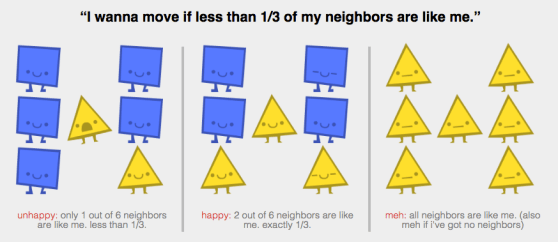
Vi Hart and Nicky Case preface their simple browser game by stating that “This is a story of how harmless choices can make a harmful world.” Hart and Case explain that the triangles and squares are “slightly shapist”. This means that the shapes prefer some level of diversity around them, but will become unhappy if they feel isolated in their community. Players are then asked to drag and drop the shapes until all of the squares and triangles are happy with the community of shapes around them.

Screen Shot 2015-03-25 at 1.28.02 PM

Click on the image to play the game

Once the player begins moving the shapes, it becomes apparent that even a slight bias will lead to large scale segregation. Continue reading

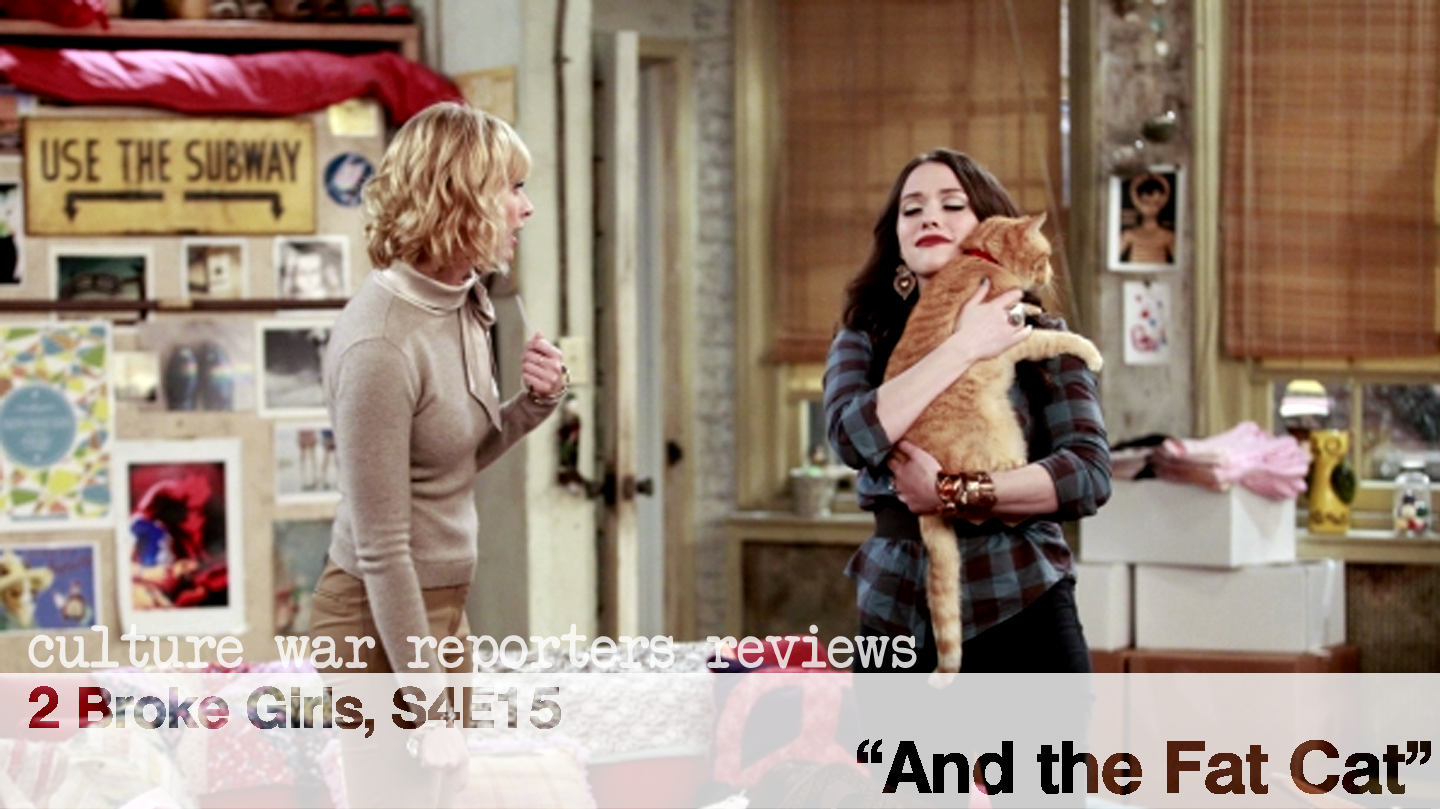
2 Broke Girls, S4E15 “And the Fat Cat”: A TV Review

fatcatwhatever

There were a lot of great things in this episode. First and foremost, the A-plot, which involved Max and Caroline trying to blackmail venture capitalist Owen Charles Boyd after his cat impregnates theirs. The fact that I could wrap it up in a single sentence underscores its simplicity. Once you’ve established the premise you’re free to concentrate on jokes and the absurdity that spins out of it, and the former has some wins [the latter I’ll get to].

While we’re staying positive, it was nice to see them back up the fact that the two girls live in a bad neighbourhood. They’re always going on about how horrible their life is in their enormous apartment, so having honest to goodness evidence that what lies outside of it is women screaming [which, let’s face it, is pretty uncomfortable] and men running away [presumably from some recently committed crime] and garbage literally everywhere is nice. It’s the closest the 2 Broke Girls has come to “showing vs. telling” in a long time, even if it is undercut by the fact that they still reference stuff off-screen. I guess that’s my cue to get into a little bit of criticism.

chestnut

Those legs. Yikes.

Remember Chestnut? He’s been around since the first season but didn’t make an appearance until he absolutely needed to, for the Victoria’s Secret models to fawn over when they visited [S4E6]. On a similar note, we haven’t seen Nancy, their cat, since early last season, in “And the It Hole” [S3E8]. I totally understand that it’s hard to have live animals on set, but if it’s that difficult why bother “casting” them at all? To have a pet not appear for 30 episodes, or more than an entire season of the show, feels especially strange when one of the minor conflicts between Max and Caroline is how the latter is not a fan of said pet, while the former is.

To restate the first paragraph, I really do like the premise of the episode. I do. My problem is that someone in the writers’ room came up with it and they then had to sort of create a status quo out of thin air to support the narrative. Up to this point most of us had honestly forgotten that Nancy even existed. Except for me, of course, because- Continue reading

Explaining American Politics To Non-Americans – Part I: Why We’re ****ed

It’s been my ambition for some time now to dedicate a series to explaining American politics to our substantial audience of non-Americans. While this blog is comprised 50% of Canadians (our frosty neighbors north of the wall), the simple fact of the matter is that the land-the-free has long been the front line of culture war. What happens here affects the rest of the globe.

With the already hotly contested primaries underway and prospects for the 2016 election being widely debated, what better time could there be than now to explain just why it is that we the people are fundamentally screwed.

Let me break it down here.

I. The Person Who Wins Isn’t Always The Person Who Gets Elected

In spite of our praise for democracy, the American republic does not have a one-man-one-vote policy. Every four years, there’s a decent chance that the candidate with the most votes will still lose to his opponent.

See, we have something called the “electoral college”- a staggeringly complex system that not even this succinct TED video can completely cover. At its simplest, the system boils down to states having “points” assigned to them on the basis of their populations and number of congressmen and senators.

This system means that a political candidate doesn’t necessarily have to get a massive number of people to vote for him- just a majority. So long as he or she gets that majority, no matter how slim, they still takes away as many “points” as if they had won a landslide.

What that means is that a person can get elected president in spite of his or her opponent getting more actual votes. Just look at this image below:

While the majority of votes cast in this example are blue, red still wins by virtue of this system. While supposedly protecting states with smaller populations (preventing them from being drowned out by heavily populated states), the result is that a person’s vote can very well be rendered utterly pointless. Plenty of folks simply don’t even bother voting, especially in states dominated by one party. Alternatively, states with greater electoral power (more points, that is) and a habit of swinging between parties (Ohio and Florida, most famously) get disproportionate amounts of attention.

In spite of being viciously despised by folks on both sides of the political spectrum, there’s really very little hope for any reform on this point. While part of that can be blamed on tradition, plenty of it also boils down to a little thing called- Continue reading

Aaron Sorkin and Flash Boys: The Difficulty with Bringing Asian Heroes to the Big Screen

Asian Superheroes. The perfect intersection of two of my passions: racial diversity, in particular the representation of those who look like me, and the stars of my favourite medium, ie. comic books. It was just earlier today that I picked up the second issue of Silk, which [as briefly mentioned in another post] features Marvel’s newest hero, a Korean-American who received her powers from the same spider that bit Peter Parker.

okay

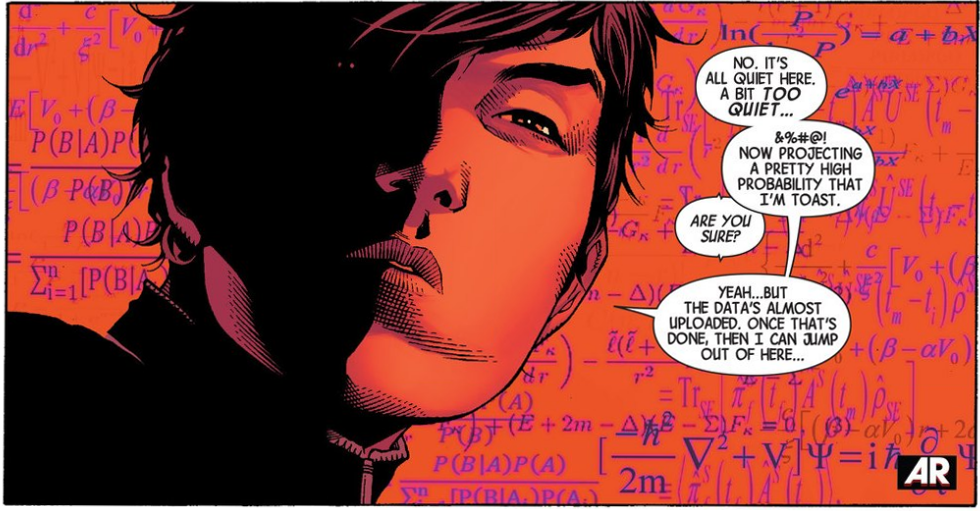
Similar to Spider-Man she has enhanced speed, strength, reflexes, and a danger detection system [aka. her self-coined “Silk-Sense”] as well as her very own ability to shangchicreate biological webs from her fingertips. Other favourites from the same publisher include Shang-Chi, the Master of Kung-Fu, an Avenger at the time of this writing. He primarily relies on his master of martial arts, an ability which didn’t keep him from participating in an intergalatic war to save the universe. Another is Amadeus Cho, a teenager who attained the title of “7th Smartest Man in the World” and frequently took down superhuman assailants with only his intelligence and whatever else was available. Yes, at one point one of those superhuman assailants was the Hulk. The Hulk.
amadeus

Each of these heroes is wildly different from the next, but share a few key similarities [besides their belonging to Marvel and being of East Asian descent]. The first is the quality that makes them heroes, the self-sacrificial desire to protect the innocent and defeat those who would do them harm. The second is that I would love to see any and all of them make it to the big screen one day, to fight alongside the White, square-jawed Chrises of the Marvel Cinematic Universe. The third is that every one of them is a work of fiction.

Bradley Katsuyama is a real-life currently existing person. He is an Asian-Canadian and has been a doer of objectively heroic actions surrounding the investigation and consequent combating of algorithms that preyed on unwitting investors. While not the intellectual property of a company creating and producing recent years’ largest blockbusters he is the focus of the novel Flash Boys: A Wall Street Revolt, a film adaptation of which Aaron Sorkin is set to write the screenplay for. Yet at this point Katsuyama is no closer to having his story told than Shang-Chi or any of the rest of them.

Continue reading