Tag Archives: family

3 Reasons You Should Watch Home (According to Kat and Her Nieces)

Last weekend, I was lucky enough to steal a couple of my nieces and bring them home with me. For the last few days, they’ve been busy helping me out with the kids program I run at work, and in the evenings we’ve all been busy showing them around the bustling metropolis of Williams Lake. While I thought about skipping out on this week’s post altogether, I decided instead to write a quick post about the movie we watched last night.

Below, I’ve included 3 reasons why we think you should watch it.

1) The aliens are super cute

This was why my nieces loved this movie so much. The main group of aliens, called the Boov, change colour according to their mood and seem to be made up of a jelly-like consistency.

The main character, Oh, is considerably cuter than I thought he would be. When I first saw the commercial for Home, I assumed that Jim Parsons would play a cartoon version of his well-known character from the Big Bang Theory. It was a pleasant surprise to see him change things up a bit while playing an equally quirky character in Home. Oh, the alien played by Parsons seems considerably more fun to be around than Sheldon.

Continue reading

Ms. Marvel, #17: A Comic Book Review

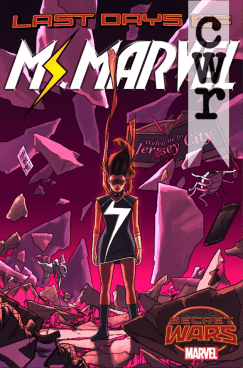
msmarvel17I’ve been waiting for this issue to come around since Ms. Marvel first hit local comic book stores roughly two years ago. Kamala Khan fights crime under the moniker that once belongs to Carol Danvers, and idolizes her to the point that the first ever usage of her powers was actually to transform into the blonde, blue-eyed superwoman. While she’s since realized a lot about her own identity as a hero [and as a person] the fateful meeting between the two is nonetheless a momentous event.

If only it wasn’t being overshadowed by, well, the end of the world.

That’s not to say that it’s being poorly handled, only that this isn’t the way many imagined the two would see each other face to face for the first time. Kamala sees Carol at what is hands-down the lowest point of her short career in vigilanteism. The world is, as mentioned, ending, but more importantly to her Jersey City is in danger. That’s only compounded by the fact that her brother has been kidnapped by her “ex-crush” AKA Kamran. And you thought your teen years were overwhelming. Continue reading

Ms. Marvel, #16: A Comic Book Review

msmarvel16So . . . Secret Wars. I’m sure there are a number of articles out there that could explain what exactly this event is to those new to the medium, but I’m going to try to do it in as few sentences as possible. Basically multiple earths have been colliding with and destroying one another. The last two earths to play interstellar chicken are Earth 616 [the primary Marvel universe] and Earth 1610 [the Ultimate Marvel universe].

That’s pretty much all the context you need, honestly, because what you should really be focusing on is that the world is ending. The tagline to the event as it started out was “Everything Dies” and the Last Days issues for a number of Marvel titles concern how the characters we know and love will spend what time they have left. Throughout the past fifteen issues we’ve seen Kamala Khan own her identity as a superhero; it goes without saying how she plans on facing the apocalypse.

For the Illuminati, a shadowy group of Marvel’s brightest and most powerful, absolutely everything has been counting down to this final incursion. For Ms. Marvel recent events are also coming to a head as her falling for and subsequent falling out with Kamran has left her in a pretty dark place. Heartbreak plays an enormous role in the life of the average teen and she even admits that it’s “affecting [her] work” to a listening bartender hot dog stand vendor.

With another planet looming above Manhattan all that is soon washed away as Kamala is reminded that she has another city entirely to protect. She directs Bruno and others to Cole Academic High School and then tends to her number one priority: her parents. Continue reading

Rachel Brown on Food, Religious Identity, and the Appeal of Muslim Extremists

A few months ago, I had the opportunity to hear PhD candidate Rachel Brown speak about her research on food and religious identity in French and Quebecois Muslim immigrant communities. I found Brown’s talk fascinating and contacted her soon afterwards; I wanted to find out if her work was publicly available so I could write about it here on the blog. While Brown has written a chapter on her work for an academic publication it hasn’t been published quite yet. Lucky for me, Brown was willing to share a draft with me. Throughout this interview I will be referring to, and occasionally quoting, that draft in order to give you context for the questions I ask Brown.

According to Brown, her “primary research interest lies in the study of immigrant religious experience and how members of immigrant communities negotiate their religious identities through food and food practices in their host countries.” In order to write on this topic, Brown conducted fieldwork and semi-structured interviews in both Paris, France and Montreal, Quebec.

This was the most French gif I could find.

Kat: Hi Rachel, thanks again for being willing to share your research with me and our readers. Before I dive into the questions I have from reading your draft, can I ask, what drew you to this area of study?

Brown: I came to the project out of a love of all things food and all things France. On one of my many visits, I noticed that how and what the Muslim community in France ate was a point of interest for media, politics, and everyday conversation on the street between friends and neighbours. There was clearly a subject to be addressed. I figured if I was going to be in the field for a year I might as well be somewhere I love and studying something I am passionate about, and so I set out to study the topic of food and religion. As I got further and further into the topic I realized just how essential food practice is to identity, especially religious identity and my research has grown exponentially ever since. The importance of food in religious identity negotiation for immigrants can be seen across a variety of locations and traditions.

Kat: I’m also curious about the technical side of things. Did you intentionally limit your case studies to individuals from the Maghreb? If yes, then why? Also, how did you go about arranging these interviews, or even making these connections in the first place?

Brown: I definitely limited my study to individuals from the Maghreb. I did this because the largest Muslim community in both France and Quebec comes from the countries of the Maghreb. This is not only because of proximity, of the Maghreb to France, but also because of a colonial history between France and the countries of the Maghreb. When one thinks of Muslims in France, this is most often the community that comes to mind.

In terms of arranging the interviews, this was a tough process. I started by going to the Grand Mosque of Paris and just getting to know people there. I had to build up trust, and spent many hours just helping out at the mosque in order to show that I was not a journalist (a profession folks are very hesitant of in France) and that I meant well with my research. After people got to know me, some started to agree to do personal interviews with me. Once I conducted the first interviews the people I interviewed then put me in contact with friends or family members to interview. So I followed a snowball methodology. It was not easy to get people to talk to me, but because my topic is such an approachable one (who doesn’t want to talk about food?), it made it a little bit easier to get people to agree to interviews. Having the personal connection, and a validation from friends or family members that had already done the interview was also key. Continue reading

Mad Max has a Feminist Hero for (Almost) Everyone

I know. Pretty well every woman with a computer has written about how great Mad Max: Fury Road was. I actually meant to write about it last week, but then I decided that I needed to address the news about the Duggars instead.

Not only am I late to the Mad Max conversation, but when I went to write about this post I came across the video I’ve included below, which succinctly summarizes many of the points I was hoping to make.

Even though Rowan Ellis beat me to the punch with several of her points, I loved this movie too much not to add my two cents. I also wanted to dig deeper into some of the feminist identities offered in the film and how they impacted me as a female viewer. Spoilers, obviously.

Furiosa: The Tough, Capable Woman

Furiosa is, of course, the first person anyone is going to think of when I say “strong female character”. She is a brave, intelligent, and capable character. I also love that she isn’t sexualized by the camera angles, and that we aren’t forced to view her through the male gaze.

As much as I absolutely love Furiosa, she doesn’t really bring anything new to the table. We’ve already had hardcore, confident female leaders like Sarah Connor and Ellen Ripley since the 80’s. And as much as I want to be like Furiosa, I don’t always feel myself reflected in these kind of figures. Sometimes that’s okay, sometimes all I want is to escape into the kind of fantasy where I can imagine myself kicking ass and taking names. However, it can be discouraging when movies only have one type of “strong female character”  to offer. While I absolutely love female heroes like Furiosa, I really loved having less capable heroines in Mad Max as well. Heroines who were well-rounded and brave in spite of their weaknesses and fears. Continue reading

Can’t Hang ‘Em Thrice: Dzhokhar and the Death Penalty

Friday saw a federal jury sentence Dzhokhar Tsarnaev, one of the culprits behind the horrific bombing of the 2013 Boston marathon, to death by lethal injection. When I saw the headline pop up on my news feed, all I could think to myself was-

What’s the point?

Readers, no one- even the defendant- disputes Tsarnaev’s guilt. Tsarnaev’s cowardly attack murdered three innocent people and wounded over a quarter thousand others. That Dzhokhar and his brother, Tamerlan (killed in a standoff with police shortly after the bombing) are monsters is likewise not in question.

But with all of that in mind- the guilt, the heinous nature of the act- what’s a lethal injection going to solve?

Now this isn’t the first time I’ve talked about the death penalty on this blog, but I think there’s hardly a better example of how fundamentally useless the thing is. And don’t for a minute think this is some bleeding-heart outcry against killing- I’ve got no problem with that, and I actually think we don’t resort to violence nearly as fast or often as we should.

I. Just. Don’t. Get. It.

What are we trying to acomplish here?

It’s Not Justice

It’s not.

Tsarnaev murdered three people and mutilated hundreds of others. If we take a balance-the-scales approach to justice (which I don’t- but that’s another discussion), then we’d have to find some way of killing and reviving him three times and subject him to years of physical and emotional torture.

We can’t do that.

Morally or practically.

You can pick whichever you want, but it’s just not going to happen. If you want to you make justice your sticking point, then fantastic. And I don’t say that with an iota of sarcasm, I really and truly to laud that. But again, this isn’t justice. Continue reading