Tag Archives: television

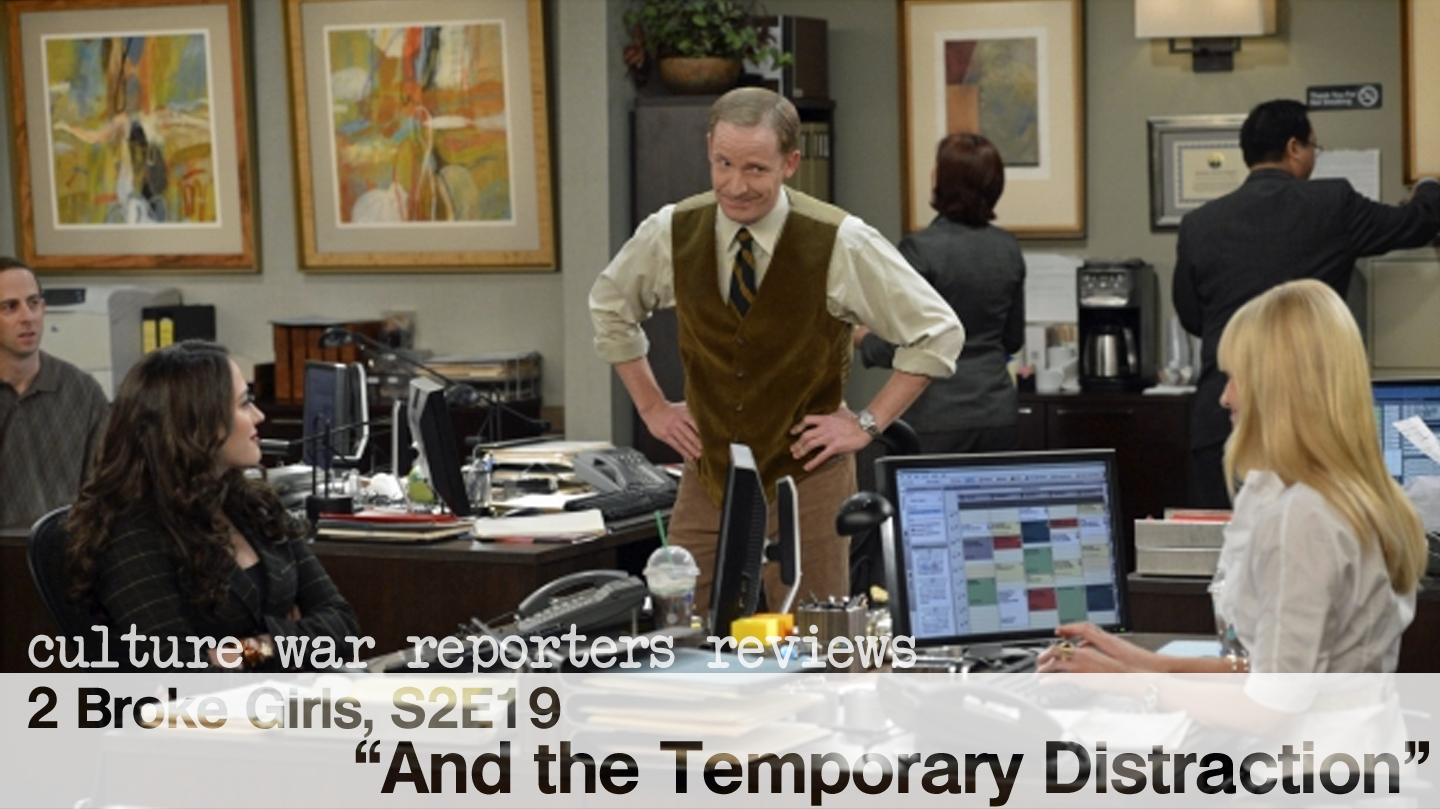
2 Broke Girls, S2E19 “And the Temporary Distraction”: A TV Review

necessarydistraction

I’m not going to lie, I’ve been infinitely grateful for the two week break CBS decided to give the show; working had made it hard to write these on Monday nights. It couldn’t have come at a better time, either, since last episode worked great as a sort of midseason finale, the opportunity for the show to head in vastly different and mysterious directions.

Open up on the diner, Max cracking wise about Han’s sexuality. Enter the character who is making the diner’s manager feel strange things in the downstairs department, the androgynous-looking lesbian Max has dubbed “Tina the Turner” due to her penchant for converting straight girls. Caroline scoffs at her co-waitress’ warnings and teenage boys the world over hold their breath.

Then they let out a sigh of disappointment, because all Caroline does is unconsciously give up her number before we cut to opening credits.

The next morning both girls wake up and Max lets her roommate know that her old temp agency calls. This elicits Caroline lamenting their fall from being small business owners,  but we all know where this is headed. Some inconsequential Sophie-and-Oleg-burst-into-their-apartment shenanigans later and the two are in an office talking to a delightfully deadpan office drudge. The way she answers questions with “Lemme give you a f’instance” is pretty darn funny.

They watch a sexual harassment video which will be a key plot point later.

As you may have guessed, the conflict of the episode presents itself when Caroline turns out to be a person who actually does her work instead of watching funny cat videos, and is legitimately interested in advancing at the company, filling out an application for a Junior Executive Position. This worries Max, who has been baking cupcakes to make a little extra cash at the diner, and clearly hasn’t completely given up on their dream.

Caroline nabs the position in a really quick back and forth of “YES’s” and “NO’s” between Max, Caroline, Office Manager Eli Green, and some dude named Ryan [I mean Leon]. For some reason her promotion is reason for champagne, which leads me to believe that this is a company with money to spare. Caroline talks to the boss and gets Max the position of Junior Executive’s Executive Assistant.

Max ultimately declines, pretty upset that Caroline quite the cupcake biz. After hearing her excuse that their dream blew up in their face, she asserts that “Lots of things blow up in your face, that’s part of being a woman.” I felt like this was somehow weirdly sexist, until Max continued on and I realized it was an ejaculation joke. Then I knew it was weirdly sexist. End on emotional note with them talking about whether or not cupcakes were the actual temp job, and that maybe it’s good not to have a dream.

Then Max gets Caroline fired by claiming that she sexually harassed her, which puts her on my list of horrible television characters. The scene leads to some laughs, such as Caroline’s explanation that “[they] were drinking and [she] was pretending to be a man,” but ultimately left me wondering why Max was being awful. Her excuse ends up being that Caroline forgot her dream, and that even if she’s not down with starting up the business again she should at least wait before jumping at the first opportunity that comes along.

We end with Caroline declaring [to cupcake-withdrawal sufferer Sophie] that they are back in business. Max declares that they’re doing things differently this time, but doesn’t explain how.

I guess it’s time for a plot hole paragraph. To begin with, how has Caroline not gotten a job in an office prior to this? Yes, her father was convicted of embezzling, but she still went to Wharton, “the most comprehensive source of business knowledge in the world.” She’s got the qualifications to land far better than a temp job, and we have to wonder why, before chasing the dream of Max’s Homemade Cupcakes became a thing, she wasn’t scouring offices all over NYC for a business position. It’s something that she clearly has a passion for, and it made me really think about how what Max did was a pretty big dick-move.

To end with, the final tally lies at $5.00, which I suppose we’re supposed to assume is from the cupcakes they’re selling at the diner. It’s also a 500% increase in funds, the largest financial jump the show has ever had, considering the last episode left them with a single dollar. The fact that the show has decided to have the two girls continue pursuing their cupcake shop dream was a pretty big letdown for me; the last episode set them up to do anything and this episode informed us we’re be back to more of the same. I understand that they don’t want to be waiting tables forever, but how about trying something new?

I was genuinely excited for 2 Broke Girls to come back, even if I wasn’t relishing writing these reviews [my Monday nights have been so free!]. Max and Caroline have returned to pursuing a dream I though they’d shelved when a car crashed into their storefront, and I guess the last five episodes of the season will reveal whether or not this new-old direction was the right one.

Stray Observations:

  • Max keeps her Temping Blazer in a big red bucket.
  • Caroline’s really embracing the “Broke Girl” lifestyle, talking about turning her underwear inside out instead of washing it and drinking way-too-old iced coffee.
  • Audience continues to mistake Sophie for Kramer.
  • Han is rapidly becoming one of my favourite characters on the show, with a fairly long speech addressing Caroline’s comment about wanting a workplace where her skills are valued and supported:

“Oh, are you not feeling supported here? I’m sorry, I’m a boss, not a bra. Should I praise you more? ‘Really killing it with the leaning on the counter doing nothing.’ Kudos, Caroline! Huzzah!”

  • Office Manager Eli Green displays some fairly obvious gay mannerisms, but is apparently straight judging by his admission to being accused of sexual harassment coupled with his desire to obtain one of Max’s butt photocopies.
  • 2 Broke Girls Cheesecake Menu: Got some skimpy morning wear on the nubile Ms. Channing; Caroline rubs at Max’s breasts after she spills some champagne on her good bucket blazer.
TV Characters We Hate To Love To Hate, Or Something

Having just finished an episode of The Big Bang Theory is as good a time as any to write this post, which elaborates on an article I found on Macleans.ca titled “How obnoxious is too obnoxious for a TV character?” In it TV writer Jaime Weinman primarily writes about TBBT and its most popular character, Sheldon Cooper.

Weinman points out that the 12th episode of this season, “The Egg Salad Equivalency,” was actually the highest rated in the show’s history, an astonishing fact when you realize that a large chunk of it features Sheldon being extremely [albeit unknowingly] sexist and racist. I’ve embedded the primary scene in question below:


It’s pretty awful, but the fact of the matter is that Sheldon Cooper is far from being the only popular sitcom character you would actually hate to be around in real life. Two years before TBBT even aired the US version of The Office was around, and the original British version came out four years before that. Michael Scott was a huge draw for people who tuned in weekly to see how a particular Scranton paper company was doing [as well as being solely responsible for repopularizing the phrase “that’s what she said”], but was also one of the most blindly insensitive people on the planet.

Very old television spoilers ahead.

Steve Carrell’s departure at the end of Season 7 meant that someone else had to be the new boss, and in spite of my suggesting that Matthew Perry would fit the bill that role was given to Ed Helms’ Andy Bernard. While his character managed to be a fairly likeable manager earlier on, the current [9th] season has had him transform into what is essentially a terrible human being.

download

He’s this close to being a moustache-twirling symbol of outright villainy.

He leaves the office to sail a boat out to some island, comes back expecting everyone to have covered for his month-long absence, and then, upon having his girlfriend [understandably] break up with him for another coworker proceeds to make both their lives a living hell. Crazy-talented webcomic artist Anthony Clark tweeted it best when he said:

And speaking of Ed Helms, take as another example his companion in the Hangover films, Alan Garner. Essentially just Zack Galifianakis playing the role he always plays [see: Due DateDinner For Schmucks, etc.], he is, as we’ve been talking about, a person who is so obnoxious that you wonder how they continue to be alive; there are times when you want to reach through the screen and slap them in the face.

Most TV shows [that’s the end of the movie portion of this post for now] have them, too. Adventure Time has the Ice King, Community has Pierce Hawthorne,  Modern Family has Manny Delgado [which you might debate, but I stand by this], and 30 Rock had the one-two punch of Tracy Jordan and Jenna Mulroney. Not only are the prevalent in television, but they also manage to become a huge draw for viewers.

Weinman ends his article by stating that “the show knows Sheldon is a jerk, but it doesn’t seem to know just how big a jerk he is.” I think it’s a fair assessment to say that all of the shows I’ve mentioned are aware that they’ve added obnoxious jerks to their casts, but the exact purpose for this is lost on someone who only had four hours of sleep last night. Sure, they can act as semi-antagonistic friends for our hero, usually the straight man, but eventually as the audience we’re forced to ask ourselves how people can bear having them around.

You could even justify it as being some sort of catharsis, rooted in schadenfreude, for whenever these character get their comeuppance, but it never happens. Sheldon will continue to be unaware of how his actions affect others, Pierce will continue to be extremely racist but get away with it due to his age, and we will continue watching them, amused, annoyed, or somewhere in between.

Evan and Gordon Talk: Piracy

EVAN: Ladies and gentlemen, children with surprisingly discerning taste, Gordon and I have managed to look past the weariness of a day of work to bring you a new installment of Evan and Gordon Talk.

Today’s topic: Piracy.

GORDON: That’s right- having not actually received any suggestions on time last E&G Talk, we’ve resorted once again to choosing for ourselves. Let this be a warning to you.

EVAN: This topic arose organically, actually, due to a few posts by Gordon on piracy and my not being able to fully agree with them.

And no, it’s not that kind of piracy, though we did start a new pirate-themed D&D game just this past Sunday.

GORDON: And it shall be awesome- but back to the subject at hand. I’m going to start with some full disclosure:

I am not of the mind that piracy is, in and of itself, a great and noble thing. Any indication or implication of this on my part is usually just in reaction to the mainstream media’s portrayal of piracy as a crime on par with defacing priceless art, grand theft auto, and punching old ladies in the face.


EVAN:
 And in all fairness from my part, I will admit that I’m no saint when it comes to piracy. I stream a plethora of shows for my viewing pleasure, though I have [and this is likely the voice of Justification speaking] sworn off downloading full-length films, music, books, etc.

GORDON: And Evan, I will attest, is not some twisted chaos-worshiping miscreant devoid of honor or humanity, as the major media industries would have you believe. Well, not entirely, anyways.

Now, Evan, one of the justifications I’ve heard you use in the past is that you’re living in Canada. Many- if not all- US shows are simply unavailable outside of the States through any conventional means.

EVAN: This is true. And while I resided in the States for my post-secondary education I made frequent use of the free streaming service Hulu. I even watched, and somewhat enjoyed, the ads.

In Canada we cannot even watch the episodes on the channels’ respective websites [NBC.com, CBS.com, etc.]

GORDON: And you’re certainly not alone in that. The vast majority of the world is in the same boat, forced to choose between piracy or waiting a few years for the DVDs to come out and then pay an exorbitant fee plus crazy shipping costs. Better hope your purchase isn’t damaged en-route.

EVAN: Since we have been so good about being fair, I will point out that there are options- many television episodes are available to buy via Amazon, online. Before you ask why you should pay for something you would otherwise get for free I’d point out that you pay for these shows by watching ads, and that as someone not in the States you would not “otherwise get it for free” to begin with.

GORDON: And that’s something I can actually tolerate. In spite of my muting ads and/or talking back to them while giving the corporate pigs the finger, I’m perfectly willing to subject myself to ’em if it means cheap and convenient access.

EVAN: If I recall our time together in college correctly [which we both know I can, and do], I distinctly remember you blocking said ads with Adblock.

GORDON: Even though it meant the waiting time was ultimately longer.

EVAN: Which is besides the point. But let’s continue onwards: is piracy damaging?

GORDON: The continued existence of Hollywood, as well as the ever increasing budget of films, would seem to indicate otherwise.

There are people out there who might try to argue that piracy hurts new musicians, who can’t afford to lose profits like big businesses can, but that’s a flawed argument. Truth is, musicians only get a sliver of the profits they generate, and wind up losing the rights to their own songs in the process. Working independently with the consumer is generally a safer and more profitable move.

EVAN: I will not argue with what you have said about musicians for a second. The amount they make through selling single tracks on iTunes is deplorable.

What I will point to, however, are the other areas where piracy can [and does] occur. Television series live and die based on their ratings, and buying them does nothing to help what’s perfectly good [if not great] television. Similarly, if only 1,000 people decided to download a new issue of a comic book instead of simply paying the three or four dollars, that could mean the end of that series; titles that dip below 20,000 are typically cancelled soon afterwards.

GORDON: I agree wholeheartedly. But I think that speaks the whole reason piracy exists- not malice, but rather cost and convenience. These people- especially television producers- have got to understand that their old metrics for measuring the popularity of shows are dead.

It’s the equivalent of saying communication isn’t popular because house phones are dying out. No, we’re just turning to new, cheaper, and more convenient methods. Piracy could be dealt a deathblow if these major industries would just step up their game, rather than trying to use lobbies and buy off politicians to keep us dancing to their tunes.

EVAN: The thing is, I think in arguing for “cost and convenience” you run the risk of defending those who just a) want to get quality products for free b) whenever they want.

It’s not just that people want ease in accessing what they love, the truth is that when given the choice between paying and not paying people will always opt for the latter.

GORDON: I agree such people exist.

EVAN: As I stated in your Shame Day post about the internet providers and their lobbying group, if people really love something they should be willing to sacrifice both time and money. Maybe that means working around an 8 pm show if it truly means that much to them, or paying for a copy of Captain Marvel.

Not to bring it back to comic books [who am I kidding, it’s what I do], but you putting down a few dollars means that a talented writer or artist is able to keep on doing what they do: providing you with high-quality stuff. That’s an actual case where piracy can severely jeopardize both artists and their art.

GORDON: Again, I agree. I do believe in paying for what I love. My record collection stands as a testament to this, as does my choice to spend a few extra bucks buying beer produced by one of the few ethical companies on this blighted earth.

Tell me this- you like the show New Girl, right?

EVAN: Immensely.

GORDON: Would you pay fifty bucks American to watch the show at 4:12 (and ONLY at 4:12) in the afternoon?

EVAN: I would not.

GORDON: How ’bout ten cents to watch it whenever you so desire?

EVAN: Yes indeed.

GORDON: You and millions others, am I right? Ten cents for a crisp, working copy rather than some choppy, blurry pirated version where the sound and video are out sync?

EVAN: Oh, I stream at only the highest quality.

GORDON: That’s my point, I guess. Yeah, there will always be people out there who don’t want to pay the ten cents, but overwhelmingly, that kind of price and convenience will make such a minority negligible.

I assert again that piracy doesn’t exist because millions of people are art-hating maniacs, but because the business plans of these networks and companies are painfully obsolete and short-sighted, especially in regards to the international market. Heck, I’d say such changes could ultimately lead to these companies turning a healthy profit- especially if they just included some advertising à la early Hulu.

EVAN: Here’s the thing, the US already has a working model of what you just said. As I mentioned you can purchase episodes of stuff on Amazon, and I’m talking $2 an episode. That is reasonable. I don’t think your average American would look at that price and think, “There’s no way in Hades I am spending two dollars on a 45-minute episode of television that I can keep forever.”

Yet in spite of that, people in America still download TV shows all the time. If it doesn’t work for them, what makes you think they can extend something like that to the rest of the world?

GORDON: Firstly, I disagree that 2 bucks is reasonable for an episode. That’s the cost of an entire dinner right there. How much more so is that going to be true for the rest of the world, who have even less?

I mean, we’re not talking about a book or a record which goes through an intensive manufacturing process for each copy- we’re talking digital here. Every man, woman, and child on Earth could be given every book, movie, song, and piece of art on earth if the masters so chose…

EVAN: Gordon. It’s two dollars. The average American does not spend that much on a full meal, they spend that much on stuff they don’t need, like gum or coffee or inane tabloids. As a country America is more than able to pay that paltry amount and yet they do not. My point stands.

I’d further argue that since it’s digital that ease of access adds, not detracts, from its value. You can watch it whenever and wherever you want.

GORDON: What I mean about it being digital is that it doesn’t cost money (anything noticeable) to reproduce it, unlike hard copies of things such as books or art. With that mind, charging two bucks an episode seems to me to be unreasonable. I’d cite the fact that for 20 dollars you can get a season of a show with (at least) 20 episodes as proof of this. The cost can, and should, be lowered for great consumption.

EVAN: Like I said, we’re adding availability as a variable. Sure, you can pay 20$ for a full season of a show, but that’s waiting a year or however long it takes for it to come out. People are also paying for the availability of getting it when or soon after it airs.

GORDON: That’s gonna be different from company to company, but for the most part, that’s true. But I’d jump back to my complaint about how little the actual artists get in all this. If anyone- anyone– is gonna set a price, let it be the ones producing the work.

EVAN: Honestly, though, that’s an entirely different argument.

The fact of the matter is that if a writer/artist wanted to print their own comic book there’s no way they’d be able to do it on any significant scale on their own, the cost of printing alone would wreck them.

Different industries pay those who work in them different amounts, and it’s not the topic of our conversation this week.

GORDON: Again, my issue isn’t with the fact that we must pay; we can all get behind this. My issue is with the terms and conditions we’re subjected to- especially when big companies start throwing their weight around to slow progress.

If piracy is the rampant issue that they say it is- and I seriously contest that- then I submit that the fault is on their part for adopting inconvenient, pricey, and exclusionary policies. Let me put it this way:  If you say apples can only be purchased by people who’ve climbed Mount Everest, you’re gonna create a lot of apple thieves.

EVAN: We’ve left you a lot to think about, even if you’re not someone who refreshes a website over and over waiting for a new episode of 2 Broke Girls to pop up [did you know I review that show?].

So with that ladies, gentlemen, and genius babies, we bid you a happy Wednesday. We came up with this week’s topic, but you can decide if next week we talk about . . . um . . . Dungeons & Dragons. How we’ve chosen to play it and why we think it works [better?].

GORDON: Alternatively, you may vote that we discuss the role of religion in our (relatively) secular society.

EVAN: Thank you, as always, for reading, and please vote!


Some Thoughts On Advertising

There are certain things in life that can be avoided.

For all our howling about vapid, synthetic pop-songs we do, at the end of the day, have the ability to simply turn the radio off. For all our wailing about trashy, stupid television, we have the ability to just point our remote and switch off the TV. Even people who annoy us we can at least avoid.

But that’s not so much true when it comes to advertising. Unless you’re living in an underground bunker somewhere in Colorado, it’s not something you can get away from.

Why you’d even be reading this blog, I don’t know.

Between telemarketers, logos, TV and radio, billboards (including mobile ones, which we have in Vegas), and the internet, there’s really no escaping. Even if you’re sitting alone in your house, it’s all around you. You’ve got company emblems stitched onto your shirts. Manufacturer’s names written on your underwear. Go to your kitchen, and you’ll find advertisements on the back of pasta and cereal boxes.

I’m only here to offer some food for thought; I won’t be taking up myself the war cry that advertisements and commercials always play to the lowest common denominator. Sexuality in the crassest, most objectified form, greed, gluttony, envy, passivity, sloth (not the kind shown above)- it’s all there, and thrown at us every waking minute of every day of our lives. What does that do to us?

Most people who work with this line of thought point to the movie Idiocracy as a dark prophecy of the world to come.

In this movie, a man is (accidentally) cryogenically frozen and awakens in a dystopian future where advertising and trashy TV has resulted in the average human IQ dropping well into the double digits. While it’s not a masterpiece in and of itself, and it’s suggestion that dumb people have inherently dumb kids is just plain wrong, the fact that more and more our society seems to be moving towards Idiocracy is downright eerie.

I will, nonetheless, offer an alternative for you to ponder.

What if advertising is actually raising our BS awareness? Information on the internet is usually either (at best) misrepresented or (at worst) outright falsehood. We don’t seem dumber as a species for it- on the contrary, we seem more skeptical and discerning. Perhaps we are, in fact, becoming tougher to fool. Naturally I can’t point to any cause-and-effect relationship, but it’s certainly something to think about.

Of course, there’s the dark alternative to that as well.

What happens to our psyches and society when we’re constantly on-guard against everything? Is that paranoid cynicism really healthy for us? What does it do to us to hold everything in contempt as just another scheme to take away your money? Even if we tone that down a bit, what does it do to us to walk through life constantly being sold things? Cradle to grave, confronted by sales pitch after sales pitch- how can that be anything but damaging?

Again, this isn’t to simply rail against advertising. There’s plenty that advertising, well, I don’t want to say “does right,” but certainly does “well.” Managing to communicate messages or ideas in the shortest amount of time using the smallest amount of words and images is, well, impressive. The ability to remotely encode associations, emotions, and reactions in the human mind through slogans, catch phrases, campaigns and the like is undeniably clever, even if more than a little Orwellian.

Imagine if all that money, research, and manpower was put towards something actually constructive. Imagine even just a quarter of all advertising dedicated to communicating positive messages. How much more of an intelligent, healthy, compassionate society would we be? If nothing else, it would mean some telemarketers could do something more fulfilling with their lives than shilling out cruises in the Caribbean.

It’s just something to think about.

Shame Day II: ISPs and the Six Strike System

Normally, Thursdays here at Culture War Reporters is dedicated to “Fame Day,” in which Evan and I call attention to people, events, or trends we think aren’t getting the attention they deserve.

But not today.

Partly due to my illness, partly due to some unforeseen time constraints, and mostly because of the severity of the issue in question, today there will be no Fame Day.

Instead, we’ll be performing an emergency Shame Day on the subject of yesterday’s terrible news that five major internet service providers (ISPs) will be implementing a “six-strike” system on people suspected of copyright infringement.

Let me break it down for you.

Normally, when you sign up with an internet provider, exactly what you do or don’t do with your connection is entirely and exclusively your business. Whether it’s something as impressive as you doing an electric guitar cover of the hallelujah chorus or as lousy as writing a thousand comments calling that same YouTube video gay is all up to you. What you read, what you write, what you post, what you view- the ISP is simply there (as the name states) to provide internet.

But no longer.

Yesterday, five major ISPs (Verizon, Time Warner, Cablevision, Comcast, and AT&T) announced that they would be participating in this anti-piracy initiative spearheaded by the “Center for Copyright Information” or “CCI”- a lobbyist group for a number of media groups. Quite simply, individual users suspected of “copyright infringement” will be given five warnings, the sixth “strike” resulting in their internet speed being slashed to dial-up quality for an unspecified amount of time.

Now you’re probably thinking “Hey- just don’t pirate stuff and you’ll be fine!” and you know what?

You’re right. You don’t have to pirate.

I’m taking over from this point on for a number of reasons. For the most part because although Gordon had good things to say, he didn‘t necessarily say them well, and in some cases didn’t make very much sense; we’re going to chalk that up to his recent illness. I will be relating to you what points of his that I can, while adding my own.

-Evan.

Gordon’s next point is that for the most part, many people pirate because of time and money. Focusing on time, the truth is that we can’t always guarantee that we’ll be at home on a Thursday night to catch The Office. Maybe we’re working another job [many of us need to], or maybe we just forgot. What options does this leave us?

For those of us in America, Hulu is always an option. The on-demand streaming site once provided a very broad range of TV programming, and Gordon points out that it’s a fantastic resource, or at least used to be. Nowadays, however, it’s a lot more difficult to use than it used to be. Hulu Plus, which requires a subscription, is needed to watch a lot of older shows, sometimes even episodes that aired a month ago, if New Girl is any indication. With one of the most convenient resources made less so, is it any wonder that so many people simply turn to torrents?

Gordon’s next point, and a very valid one, is this issue of the Six Strike System and how it relates to piracy. There’s an issue of what exactly is at stake here. Gordon insists that the answer to that is everything, and while I’m not fully with him on that, there’s some sense to what he’s saying.

The thing is that almost anything can be considered copyright infringement. YouTube covers, memes [which often use screenshots of shows like Futurama {see: our Shame Day image}], Gordon’s beloved gifs, even many of the pictures of this blog, in spite of being Photoshopped, don’t technically belong to us.  Would we have our internet cut because we run this blog? [Answer: I wouldn’t, because I am Canadian.]

To finish off what Gordon wrote earlier today, the issue is that the people in question aren’t being penalized by an international agency, or even the state or federal government. The fact of the matter is that these ISPs are “using their lobbies to persecute and prosecute suspected users without due process” [quoting Gordon]. What truly incensed him more than anything, though, was the way they’re going about it. That they’re holding themselves up as Knights of Good when in reality they’re just proud that they’re “selectively picking off anyone their bosses deem a threat to their unending stream of profit.”

Untitled-2

Piracy is not a subject I agree with Gordon on, and in fact I had a very hard time letting his last piece on the subject be put up on the blog. If people really, truly love art, whether it take the form of television or movies or video games they need to vote with their wallets and know that what they love is worth spending money on.

That being said, I do believe that what these ISPs are doing is wrong, particularly in that they have no one to be accountable but themselves. No business or corporation should have that right. Shame on these ISPs, and shame on the Center for Copyright Information.

2 Broke Girls, S2E18 “And Not-So-Sweet Charity”: A TV Review

This is late because I work now, so sorry about that.

I feel like I have more to write about than usual this week [unfortunate, since I’m a little late to this review due to my having a job now], so let’s get right into it. To summarize this episode in a sentence, Max and Caroline have not been paying their rent and are being forced to sell their property to a real estate corporation; not wanting to do so the two go to Caroline’s makeup mogul Aunt Charity to ask for some . . . financial help.

The first topic I wanted to delve into a little bit was the show’s humour, not in how it chooses the easy route on almost every joke but how it seeks to push the bar in its content. For example: a semen joke eight seconds into the episode. Co-creator and executive producer Michael Patrick King said that he “[considers] our jokes really classy dirty [ . . . ] they’re high lowbrow.” While the show has largely steered away from the rampant rape jokes which cropped up multiple times per episode int he first season, they certainly haven’t stopped walking, and often crossing, the line between “classy dirty” and dirty.

Take Max’s joke about how bubblegum flavoured lip gloss [which was wearing when she had her first kiss] helped to get her an A in class. It’s no secret that her character has slept around a lot, for little to no reason, but hinting at a minor [I’m sure her first kiss was before the age of 18] locking lips with a teacher is uncomfortable at best. A few minutes later she likes a tube of lipstick to a dog penis.

“How much is too much?” is a question that Gordon and I discussed once in regards to stand-up comedy, and we came to the conclusion that edgy humour is only as good as what its meant to accomplish. In the case of 2 Broke Girls that’s apparently to elicit cheap laughter. As far as I can tell, I mean. This has never been a laugh-out-loud show, but it’s Max’s snarkiness [as overbearing as it is at times] and not her disregard in screening her sexual partners that drew me to her to begin with. 2 Broke Girls may be trying to brand itself as an edgy comedy à la Family Guy, but needs to ask itself if they can continue to counterbalance that with the heartfelt moments they’ve been trying to inject into the show.

As a final note on the show’s humour, Aunt Charity had the upper two layers of her skin removed to look two years younger, which actually made me queasy just looking at her. Physical gross-out humour may be something 2 Broke Girls is thinking about adding more regularly in stretching the limits, which is a decision I’m currently unsure about. After all, one of my favourite episodes was the eighth one of this season, where Caroline yanks a needle out of her arm and proceeds to spurt blood all over the walls of an egg donation clinic.

Finally on to what was the biggest moment for me. So I’ve been writing about what the point of the  “Current Total” and it’s accompanying ka-ching at the end of each episode for a while, so imagine my surprise when I saw it change so drastically in this episode.

Caroline coerces her aunt into signing over $25,000 to cover what the real estate corporation says they’ll need to keep the property, but finds out later that the cheque doesn’t clear because taking advantage of drug-addled relatives [Charity was on morphine lollipops to dull the pain of not having a face] isn’t exactly an ethical business practice. Then her and Max sign over the store.

All of the first season was leading up to “Max’s Homemade Cupcakes,” and suddenly we realize that the girls are starting over from scratch, especially since Max declares that they have just enough money to pay back everyone they’ve borrowed from. Soon after a little bit of curious greenscreen work in the windows behind Caroline’s head is explained when a car crashes through one of their walls. It looked pretty realistic, too.

The “New Total” leaves the girls with a single dollar to their names and us as an audienec wondering what exactly is next for them. This is a hard reboot of the status quo, though there are hints by both Charity and the real estate woman [who was deaf, by the way] that maybe starting out smaller is the way to go.

Whatever happens with the rest of this season, I have to give 2 Broke Girls my grudging respect for reigniting my interest and curiosity in the show.

onedolla

Stray Observations:

  • The audience was going bonkers over Sophie today, and she wasn’t even really doing anything. Maybe an exec decided to re-send the memo that she’s supposed to be this generation’s Kramer.
  • Han has been very into memes lately. “Ermahgerd!”
  • “It’s obvious! She’s obsessed with her brother and she saw your being born as his love being taken away from her.” Morphine lollipops make Max smarter. 
  • The greenscreening was particularly suspicious in that is showed an actual street outside their window, and was actually filmed against a wall I don’t think they ever showed prior to this episode. Which leads me to wonder if they’d planned a car crashing into it from the beginning, which I hesitate to believe if only because I don’t think they have that much foresight.
  • 2 Broke Girls Cheesecake Menu: I feel like CBS is forcing me to eat my words when I assumed that they were having the two girls show more skin to draw in viewers. Not much to report here, once again.