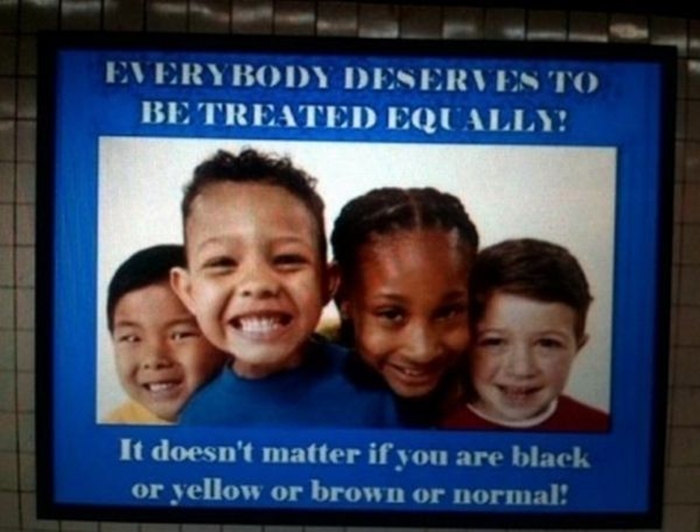
The title of this post comes from the image below, which I see floating around the internet from time to time. It might’ve been from one of Cracked’s PhotoShop contests, I really have no idea.
The reason I’m bringing this to your attention is to underscore the fact that, by and large, “White” really does equal “normal,” at least in North America. You don’t really have to search hard to stumble across that fact, either. Think about how it works when you recount stories to other people-
Imagine you’re talking about this weird dude who sat down next to you on the subway. If he was White, would you bother mentioning that? How about if he was Black, or Asian, or Latino?
The terminology used in this gif aside, you probably never make reference to a White person’s ethnicity.
GORDON: Today, we’re going to be touching on a nerve that’s still pretty raw in the US, even after a century and a half.
Specifically, we’re going to be talking about the ol’ stars and bars- the flag of the former Confederate States of America.
EVAN: I’d like to remind everyone reading this that I am a Canadian. The most experience I have with the Confederate flag is in seeing it on the top of the General Lee from the remake of, and not the original, Dukes of Hazard.
So two days ago I saw the movie, and I’m not going to write the logical continuation of my first post, complaining about how the movie could have been “so much better if only. . .”
What I’m going to write about how I wasn’t in the movie.
I drew this over two years ago for an all-comics weekly publication I used to run.
And no, I don’t mean why wasn’t there a zombified version of me in the movie, because seriously if you guys didn’t know I am deathly terrified of any sort of biting reanimated corpse. What I mean is why, when I watched this movie, weren’t there any dang Asians.
A few weeks ago I stumbled onto a website called The Microaggressions Project and then promptly forgot about it. Returning to it tonight I looked over the “About” page, which had the following paragraph at the top:
This project is a response to “it’s not a big deal” – “it” is a big deal. ”It” is in the everyday. ”It” is shoved in your face when you are least expecting it. ”It” happens when you expect it the most. ”It” is a reminder of your difference. ”It” enforces difference. ”It” can be painful. ”It” can be laughed off. ”It” can slide unnoticed by either the speaker, listener or both. ”It” can silence people. ”It” reminds us of the ways in which we and people like us continue to be excluded and oppressed. ”It” matters because these relate to a bigger “it”: a society where social difference has systematic consequences for the “others.”
A little later on they define what “microaggressions” are, a term that was originally coined to speak about racial experiences. From the essay “Racial microaggressions in everyday life: implications for clinical practice,” which appeared in American Psychologist, Vol. 62, No.4:
“Racial microaggressions are brief and commonplace daily verbal, behavioral, or environmental indignities, whether intentional or unintentional, that communicate hostile, derogatory, or negative racial slights and insults toward people of color.”
One example of this could be a White couple walking down the street and having a Black man pass by them on the sidewalk. The woman clutches her purse tighter against her body, the subconscious idea being, of course, that Black men are prone to crime and should not be trusted.
As an Asian-Canadian I’ve experienced microaggressions plenty of times. I’ve had someone ask me if I was half-White [I am clearly not] with their rationale being that my “English was very good.” It can be an everyday occurrence for non-White people [I deign to use the word minorities, since I do believe that balance is turning the other way], and begs the question: “Why is this such a big deal?”
Writer of the aforementioned article and author of Microaggressions in Everyday Life: Race, Gender, and Sexual Orientation, Derald Wing Sue, PhD, has observed that microaggressions have actually been found to: “(a) assail the mental health of recipients, (b) create a hostile and invalidating work or campus climate, (c) perpetuate stereotype threat, (d) create physical health problems, (e) saturate the broader society with cues that signal devaluation of social group identities, (f) lower work productivity and problem solving abilities, and (g) be partially responsible for creating inequities in education, employment and health care.”
In other words, a Black or Latino man being stopped for a “random vehicle check” by police could be upset, and may even be accused of overreacting. Maybe they should simply be used to this and not let it bother them. The truth is that it makes them feel, even if only subconsciously, like second-class citizens. It’s true in a case as blatant as this one, and in an as subtle an action as hanging a Confederate flag or having a Native American stereotype as a high school mascot.
Microaggressions work in every direction. It’s like going to a Vietnamese restaurant and being given a fork and spoon instead of chopsticks because you’re White and not Asian. Microaggressions are built on assumptions and can make people painfully aware of who they are. They are rarely meant to offend, but often do.
It truly is a shame that so much of the time we send out microaggressions without so much as a second thought, and then defend ourselves by deeming the offended to be “too sensitive.” While we won’t always be aware of how our words or actions can harm others, we can at the very least listen to the people being hurt, and in doing so try to lessen the presence of microaggressions in our society.
I’ve always had a rough time with Fame Day posts. I’m a generally dispassionate guy, and the things that I do like either aren’t around anymore (good rock, for example) or don’t have much to be said about them (beer is good, that is all).
Bitter cynic that I am, it’s a lot easier (and more fun) to rail on things I despise (which is a lot of things) than make a case for what I enjoy. That issue is only compounded by the simple fact that at the end of the day, it’s really just all the little things which get ya.
With that in mind, today’s Fame Day [in lieu of the usual Shame Day] will not be spent dedicated to a single person or group or trend, but rather to a number of things which deserve some recognition, even if it’s just a little.
Middle-Eastern Jesus:
Even with a better understanding of history and geography, portrayals of Jesus are still pretty much limited to the fair-skinned, flowing-haired images of the Middle Ages. Even if we are, at the very least, keeping away from the blonde hair and blue eyes, we still have a long way to go. That’s the reason it’s always so refreshing to see Jesus portrayed with a stocky build, dark skin, dark hair, and a beard one would sooner associate with an Al-Qaeda commander.
He is not gonna tan well…
For everyone portraying Jesus as something more like that below, and less like this above- thank you.
PFC Bradley Manning:
In retrospect, I could’ve simply dedicated this Fame Day to saluting Bradley Manning, the young American soldier who leaked a massive number of documents to Wikileaks. Inevitably however, such an attempt would have simply devolved from a round of applause for Manning into a vitriolic diatribe against the increasingly Orwellian US government. Heck, even here I’m gonna be tempted to do so. Better just keep it short and to the point.
Included in the footage Manning leaked was video of a strike by American forces on targets they mistook for combatants, but who were in reality journalists and civilians. This footage would have doubtlessly been suppressed, as would similar information PFC Manning leaked, and kept from the public eye, perhaps forever. Rather than being given a medal, Manning has been arrested, imprisoned, intimidated, and presented with a host of charges, including “aiding the enemy,” which carries the death sentence. Again, I’m tempted to run off into a wild condemnation of this entire farce, so let’s throw PFC Manning a round of applause and our wishes for his speedy release.
Chill Parents:
In our paranoid world, we have a tendency to attempt to control and protect our loved ones- kids in particular- from any possible harm or danger, no matter how minor. You’ve probably seen it in some form or another. Loading the kids down with every imagine medication, drilling the idea of “stranger-danger” into their disproportionately large heads, heck, even tracking phones or school IDs is viewed as just a logical move in this chaotic and evil world.
I guess that’s why it’s always good to see parents who are okay with their kids getting a little dirty and scraped-up, or even view such things as a healthy part of development. I’m not talking about neglect, mind you, but rather an understanding that keeping kids penned up inside a house or wasting away in front of a TV is just as bad- if not worse- than having to liberally apply the iodine after Jack and Jill fall down some hill.
And there you have it folks- a grab bag of things worth nodding your heads at. Be sure to check in tomorrow for a new installment of “Evan and Gordon Talk,” and Free Bradley Manning!
EVAN: The particular topic of discussion that comes to us today is more one that finds itself passed back and forth within Christian circles, and that is: “Why is Christian media so bad?”
GORDON: I think the problem is self-imposed by the religion (I use the term loosely) itself. We’re not talking about a lack of funding (we’ve got plenty of good low-budget films), or a lack of good directors (there’s plenty of decent talent out there), we’re talking about an issue that runs right down the core of it all.
“Christian” media can’t just be media- they have to drag in everything that goes with it.
EVAN: So basically what you’re saying, and we talked about this a little earlier, is that Christian media more often than not has an agenda, correct?
GORDON: I’d say plenty of it has an agenda, but no, I don’t think that’s the core issue- there’s plenty of other preachy movies out there.
EVAN: So what are you saying, exactly?
GORDON: I’m saying that “Christians” can’t make good media because they won’t allow themselves to. Every protagonist has to fit the moral code to a tee, so that they wind up as either Aslan 2.0 or the epitome of Christian morality: John Smith, the middle class suburban, patriotic family man. Which is why I keep putting “Christian” in quotation marks.
We’re not talking about Catholic peasants in El Salvador or the East Orthodox Church in Ethiopia.
EVAN: Okay, I like that a lot, this idea that those creators of Christian media [and primarily I think we’re talking about films] box themselves in. They’re telling the same sorts of stories to who they perceive to be their audience [and they’re not wrong]: white suburban middle class families.
To sort of break this up a little, I actually saw a Christian film that was reasonably passable at some point last summer.
GORDON: Was it related in any way to Steve Taylor?
EVAN: Is that any way related to “End of the Spear”? It was not, if that’s what you’re referring to.
GORDON: Steve Taylor is the only good Christian musician who ever has or ever will have existed.
But anyway, what was the movie you saw?
EVAN: It was called “To Save a Life,” and it stood out for a couple of reasons:
1) The cinematography was shockingly good for something produced and made by Christians. You can tell which movies they are within the first few seconds.
2) The “villain” of the piece was actually the pastor’s kid. Which was- refreshing, and kind of nice.
It kind of broke out of the whole stereotype you introduced earlier.
GORDON: Huh- interesting. I’ll have to check out the trailer. But let me ask you this:
Can a Christian make a James Bond movie?
EVAN: You mean a movie starring a suave, debonair British man who beds women and guns down henchmen as naturally as he dons his suit jacket every morning?
I’d say no, probably not.
GORDON: I think that’s the problem. It’s not just that you can’t have any explicit sex or graphic violence or excessive profanity (which are overused and abused as is), you can’t have anything even remotely sensual or rough or crude. It rips away reality and humanity in the name of not stepping on anyone’s toes.
Self-imposed legalism.
EVAN: Well, I’d say the difference is that you can’t have a protagonist who glorifies such things as wanton sexuality-
I say that Christian filmmakers will never produce anything like James Bond because of who the character is.
GORDON: Did you like the movie “Fight Club”?
EVAN: I liked it a fair amount.
GORDON: Did you like “Ocean’s 11” or “Snatch”?
EVAN: I haven’t seen the latter, but I very much enjoyed the former.
GORDON: Did you like “Superbad”? “Kick-Ass”? “Ironclad”?
But I think you’re going to have to get to your point-
GORDON: Could a Christian make any of these movies?
EVAN: I think a Christian could, yes. In relation to “Fight Club”, at least, Christian author Ted Dekker has penned novels [sold both in and out of Christian bookstores] which offer a fairly decent psychological thriller aspect to the reader.
GORDON: Ah, Dekker. The whole reason he stands out as an exception is- I believe- that he grew up among Indonesian headhunters, and not in Middle America. Again, it’s about having that different perspective on life.
EVAN: And I think what he’s realized, as a creator of the arts, as someone who has a hand in shaping Christian media, is that you can have these other sorts of exciting, thrilling stories told with a faith-built worldview. People of every religion want a little excitement.
GORDON: Of that there’s no question. The heavy use of the video library at our school stands in testament to that.
But again I think the issue is that “Christian” self-imposed isolation inevitably leads to the vast majority of their work winding up as “White People Problems” or “Chronicles-of-Narnia-minus-the-good-stuff”…
EVAN: Or “Lord-of-the-Rings-but-way-more-heavy-handed.”
GORDON: Exactly.
EVAN: I mean, we’ve talked a little bit about why Christian media can be bad [terrible production values, cookie-cutter story lines, sheer absurdity], but how could it be better [to harken back a little to our last talk]?
GORDON: They have to stop being terrified of the big bad world. They have to realize they can show characters with flaws- real flaws- not drunkard stereotypes and the occasional swear word.
Saying this will get you expelled from Liberty, Pensacola, and BJU
EVAN: I mean, a deeply flawed person who finds redemption is a much more compelling story than a white bread sort of guy with his middle class problems.
And they have to stop coddling their audience. Yes, Christians turn to Christian media for “better alternatives,” but the odd cuss word won’t negate an overall positive message; neither will a fight scene, or two guys sitting around enjoying a beer.
GORDON: There’s this one scene in a (Christian) movie Steve Taylor directed:
A character hurts his hand loading something into the back of van. He lets loose a cuss word and his buddy chides him for it, saying “God don’t like it when we cuss.”
Later on in the film, the buddy hangs his head and apologizes, saying “I’m sorry. I was upset that you cussed- I should’ve just been upset that you hurt your hand.”
EVAN: Wow. That is very, very good.
GORDON: That right there is the problem not just with Christian media, but with the whole religion.
EVAN: Misplaced priorities.
GORDON: More obsessed with present clean-cut paragons of middle class etiquette than anything really real.
That’s why we turn to “secular” movies for actual substance. The struggle for identity in “Fight Club”, the heroism in “Kick-Ass”, the friendship in “Superbad.”
EVAN: I think what’s really ironic is that Christian media-makers have a Christian-made work out there that’s immensely popular. “The Hobbit: An Unexpected Journey” came out just this past December.
GORDON: I again reference an (alleged) quote by Steve Taylor.
“I’m not a Christian artist- I’m an artist who is Christian- it affects what I do.”
EVAN: Really well-put. And something that a lot of us [I speak for many in our graduating class] as writers, musicians, artists, et cetera would benefit from keeping in mind.
And that puts us more than a little overtime.
GORDON: Well, people, you know what that means. Time to vote on our subject for next week.
EVAN: My contribution this time around is . . . wow, I never think ahead . . . masculinity. You’ve done a post about “Manly Culture” in the past, but I want to talk about what it is at present, and how we feel about the shifts and trends and things.
GORDON: Interesting subject. I submit we speculate on the upcoming Star Wars movies.
EVAN: If you think you’re up for it, then yeah, cool. I’ve read quite a few of the post-original-trilogy books, so I know a reasonable amount about the subject.
GORDON: Nerd.
And with that witty response, we’re out! Have a good night, everyone.









 Culture War Reporters