Category Archives: race

Free State of Mind: Actress Nicola Breytenbach on Getting in Character

Free-State-Updated-PosterThis is the second installment of “Free State of Mind”, a series of Q&As with the cast and crew of a South African film currently making the rounds at film festivals. You can read my review here, and find out more about its creation from producer Terwadkar Rajiv here.

Today’s interview is with Nicola Breytenbach, who plays Jeanette, one of the two romantic leads. While she has spent the past several years as a successful model, with her career taking her to runways across the world, Free State marks the beginning of her acting career. Just last month The Blue Mauritius began filming in Montreal, with the US and German co-production being her second ever silver screen role.


Jeanette is first introduced returning home to her father after finishing law school. While it isn’t heavily covered in the film, what kind of impact do you think that education had on how she views life, especially after she meets with Ravi [co-lead and love interest]? 

As Jeanette went to Wits University, which was a more liberal university than many others, it would have changed the way she viewed and felt about apartheid and the immorality act. She pursued higher education as it was instilled upon her by Maria and her father, but her true desire was to be a wife and mother.

Jeanette was raised in the very small remote town of Memel and even though it was a Christian white community it was very sheltered, and as she says in the beginning of the film that’s why she was a real ‘political innocent’. She wasn’t exposed to the reality of it much, except for a few remote incidents which completely shocked her. As her mother also passed away at such a young age and her father had a difficult time reaching out to her because of his grief, she was raised almost solely by Maria who is black South African Zulu.

Hence when she met Ravi, she didn’t think about his race and it didn’t deter her from seeing a friendly man who went out of his way to help her in this traumatic incident of a near accident. She only saw his compassion and how selflessly he had helped her. As time goes on, they both come to the realize the severity of the situation they are in, as well as the fact that they are engaged to others, but at this point it is too late, they have already fallen in love. Continue reading
Free State of Mind: Behind the Scenes with Producer Terwadkar Rajiv

Free-State-Updated-PosterLast month I was offered the amazing opportunity to watch a screener of Free State, and published my review at the beginning of this one. Set in mid-70s South Africa the film revolves around an interracial relationship that would have been illegal due to anti-miscegenation laws of that time.

In addition to that I was also able to interview members of the cast and crew via email, with consequent installments of “Free State of Mind” being released in the following days. Up first is a Q&A with Terwadkar Rajiv, who produced the film alongside Piet De Jager and Sallas De Jager.


When many people think of South Africa and racism their minds immediately go to Nelson Mandela and apartheid. What do you think their reaction will be to Free State, which focuses on relations between White people and South Asians, instead of Black people?

Apartheid was one of the dark patches of South Africa, no doubt about that! When South Africa got independence and Nelson Mandela became the President most of the people were thinking – what will be the future of South Africa? Will whites be kicked out of the country? The way things happened clearly shows that all ethnic groups started living towards one nation, South Africa!

Although there are stories during Apartheid where Indians and blacks were tortured, beaten up or even killed by the Police or Army; some whites used to treat Indians & Blacks respectfully! There are so many stories from Apartheid which prove that inter-racial relationships and friendships existed before 1994.

­Free State is a film which focuses on the relationship between Jeanette (Afrikaans White Girl) and Ravi (Handsome Indian man). This also beautifully shows the motherly relationship between Zulu maid Maria and Jeanette, who she raised as her own daughter, ­­making it truly cross cultural and crossing ethnic boundaries. Continue reading

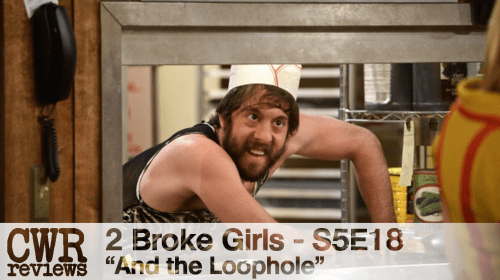
2 Broke Girls, S5E18 “And the Loophole”: A TV Review

loophole

So apart from Max heckling customers, which the show hasn’t used to grace a cold open in quite some time, and every character besides Han poking fun at the diner’s general hygiene, the typical setting of 2 Broke Girls has rarely been a source of specific humour in the way, say, Sacred Heart hospital was on Scrubs, et cetera. We generally know it’s a dump, but the joke doesn’t extend far beyond that.

Honestly, I didn’t even know what I was missing until I got a taste of it [pun only somewhat intended].

It all begins with Oleg calling out that a “tuna malt” is ready to be served, which is honestly such a ludicrous miscommunication that I couldn’t help but smile.

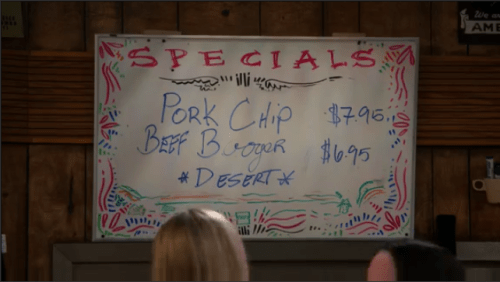
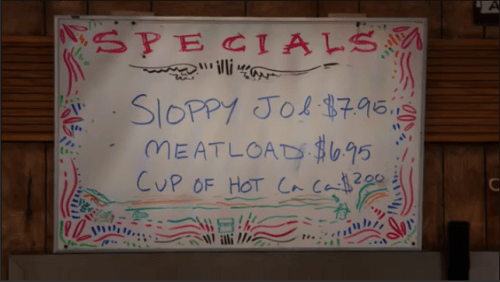
In addition to that there’s the blackboard of specials, which Max’s atrocious handwriting has turned into a list of food that is . . . well, not as special as Han would probably like. They feature such dishes as “Sloppy Jobs”-

sloppyjob

-and “Pork Chips”-

porkchip

-and while the characters kind of run them into the ground a little, they’re all pretty entertaining. Just having it say “desert” instead of “dessert” is funny, especially given that no one makes note of it. The Williamsburg Diner may be a disgusting establishment, but it’s nice to see that it can also be a place where incompetence is present in the food preparation and signage as well.

As for the actual episode itself, Ed Quinn’s Randy is back! I don’t mean to keep harping on how Max’s relationship with him had its parallels with her dating Deke, but this just proves how much the show is shying away from that approach. Not only did their breakup have a resolution, it turns out it wasn’t really the end! He’s back in New York and looking to start a little something. To skip to the end with this particular arc, after Caroline expresses enough concern to actually grill him in a mock trial he admits that he’s committing to staying in the city for one month to try to make things work. A surprising turn of events to be sure.

As for the rest of the episode, Caroline’s movie money finally comes in and the two girls decide to make their Dessert Bar a reality. This means finding some real estate as Han won’t let them expand their cupcake shop into the dish room. Not willing to leave them in the lurch, their boss decides to connect them with Evie [Camille Chen], a realtor who apparently digs him.

Now, this is something I could cover in-depth down below under the “The Title Refers To” feature, but I’ll do it now. Essentially Evie wants to remain a virgin until marriage, but wants to have sex anyway. Now I hate to say it [and to use a slightly NSFW gif after the jump you’ve been warned], but this is actually something that generally terrible show House of Lies did in its episode “Bareback Town”, and that it did pretty well- Continue reading

Not so Nice After All: 4 Examples of Racist Canadian History That You May Never Have Heard Of

Canadians like to think that we’re a pretty nice bunch.

canadasorry2323

Especially now, as Drumpf’s presidential candidacy reveals the racist underbelly of our neighbours to the South, we Canadians pride ourselves on being nothing like the States. We happily disassociate ourselves from the violence and xenophobia that seems to crop up at every Drumpf rally.

It’s just so incredibly convenient to revel in our not-Americanness, as though that in itself makes us not racist. We try to pretend that same kind of racism doesn’t exist here, even though the same fear-baiting tactic was used in our recent election. We try to ignore the recent hateful attack on Syrian refugees, newly arrived in Canada. We try to forget that our country was built upon the exploitation of people of colour.

In case you aren’t sure what I’m referring to, I’ve included a couple examples below.

1. Canada had Legal Slavery

In elementary school the only time I learned about slavery and Canada was when we studied the Underground Railway. Through these stories of escape and hope I, like many Canadians, was led to believe that Canada had offered an escape for Black men and women who were trapped as slaves in the United States.

What I never knew (until recently) was that Canada was not always the beacon of hope that it appeared. As historian Natasha Henry highlights in her article about Slavery in Canada,

“African slavery existed in the colonies of New France and British North America for over 200 years, yet there remains a profound silence in classrooms and teaching resources about Canada’s involvement in the African slave trade. According to available historical documents, least 4,000 Africans were held in bondage for two centuries in the early colonial settlements of New France (Quebec), New Brunswick, Prince Edward Island, Nova Scotia, and Upper Canada (Ontario).”

Luckily, novelists have begun to draw attention to the stories that our history books have overlooked. Afua Cooper’s The Hanging of Angélique, for example, tells the true story of Canadian slave Marie-Joseph Angélique. Meanwhile, Lawrence Hill’s Book of Negros, reminds us that many escaped slaves were actually shipped back to the States by Canadian authorities. He also explores the extreme racism that drove some black Canadians to move to Sierra Leone. Continue reading

Stereotypes and Tokenism: What Daredevil Did Wrong and What Riverdale Appears to Be Doing Right

So right off the bat, I want to say that Arthur Chu of Jeopardy-winning fame has already done much of the groundwork for me with his [spoiler-filled] article “Not Your Asian Ninja: How the Marvel Cinematic Universe Keeps Failing Asian-Americans“. In it he recounts his primary disappointment with the second season of Netflix’s Daredevil, namely that the Asians presented in that show are generally villains across the board.

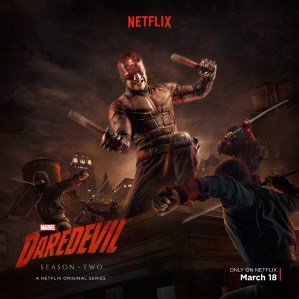
daredevil2poster

Not only are they of an evil persuasion, they’re also, as the title of his piece implies, mostly ninjas. In terms of sheer volume the vast majority of Asians seen on screen during the season’s 13 episodes are that particular brand of martial artist. The rest are, in terms of representation, gangsters, white collar criminals, and crime lords. It is, as Chu says, “Not a good look.”

He picks the Kitchen Irish, a gang of an obvious ethnic background, as his primary example of the show using nuance with a people group. Matthew Murdock, the titular crimefighter himself, is of Irish descent, and another character nicknamed “Grotto” is a former member of the mob who elicits sympathy from both the show’s cast and its audience. While I understand that Irish heritage is unique and distinct from many others, and that people of Irish descent suffered extreme racism in early American history, what shouldn’t be ignored is the fact that on the surface they are White. As are the members of fellow gang the Dogs of Hell. As are Murdock’s friends Karen Page and Foggy Nelson. As is Frank Castle, the Punisher, as well as newspaper editor Mitchell Ellison. Television is full of White people, and with Daredevil being no exception simply stating that there are varied roles within even one subgroup feels like a given.

Unfortunately, Asians fail even when stacked up against other racial minorities. Continue reading

Free State: A Film Review

Free-State-Updated-PosterA film covering “a pair of star-cross’d lovers” is certainly nothing new, and for centuries creators have strived to honour the trope by putting their own distinct spin on it. As a film by South Africans set in their very own country Free State sets itself apart from the crowd at its outset, in particular because it neglects the assumed Black and White mixed couple [and all of the baggage that comes with it] in favour of an Afrikaans woman and an Indian man.

Jeanette, South African model Nicola Breytenbach’s first role, is a law student in the mid-70s returning home to Memel and her father. Ravi, played by Andrew Govender, another model, is a man whose family is currently working out the specifics of his upcoming arranged marriage.

The reason they can never be together is spelled out in the first few minutes of the film in which Jeanette, describing her childhood, relates the story of a man arrested for being Indian in the Free State province after dark. She also shares the details of South Africa’s Immorality Acts that she learned about while in school, which explicitly prohibit sexual intercourse between White and non-White people. It’s racism, plain and simple, and while not the freshest romantic deterrent it’s nonetheless framed in way most viewers won’t be familiar with. Continue reading