The multi-cam sitcom isn’t exactly at the peak of its popularity right now, The Big Bang Theory reaching its 200th episode being a pretty extreme outlier. If you watch TV regularly at all you’ll have noticed that more and more sitcoms are trying to be the next, say, Community, as opposed to a worthy successor to How I Met Your Mother. A big part of that has to do with this older format being seen as looking cheaper, and that’s particularly true when it comes to a change in setting.
-because it was a legitimately great set. I mean, they had sand. It more than stands up to a lot of the exterior shots of Ted Mosby and co. exiting McLaren’s, or getting into hijinks in front of a brownstone. The unfortunate thing is that their other excursions don’t live up to that standard. Continue reading →
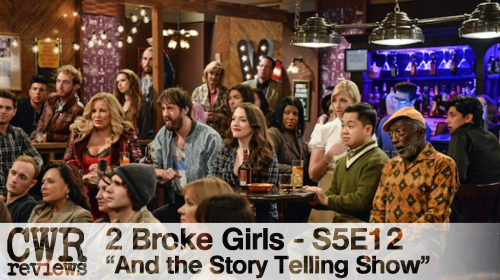
Midway through its fifth season and 2 Broke Girls has finally done it; Max and Caroline, and consequently the show itself, now have a brand new direction. Ever since Season 4 ended with them remembering their dream of owning and running their own cupcake business things have been pretty shaky, narratively. For the most part the two girls have just been killing time, not even really trying to make any extra money.
The best part about the apparent arc they’re going to be starting on come next week’s episode is how far out of left field it is. It doesn’t have anything to do with raising a certain amount of money and isn’t connected to their cupcake business at all. No, this is a fresh, surprising take, and one I’ll get to after I go through the usual recap. Continue reading →
I loved Star Wars: The Force Awakens. I loved it so much that the first thing I thought about doing when I walked out of the theatre was hash out everything that this Star Wars reboot had done right.
Like including legitimately humorous dialogue rather than slapstick CGI sidekicks.
Unfortunately, everyone on the blogosphere had already come to the same conclusion long before I was back from my Christmas break. Still, I couldn’t stop thinking about the film, or reading articles about it. So I’ve decided to write about one of the few things that bothered me about the film, rather than many aspects of the film that I loved.
I was especially excited when I heard that Lupita Nyong’o had been cast. Ever since she won best supporting actress for 12 Years a Slave and was declared the most beautiful person of 2014 by People magazine, I’ve been keeping my eyes peeled for Nyong’o. After witnessing her sudden rise to fame, I was curious to see if she would continue to find roles in major films, or if she would slowly be pushed out of Hollywood because of her dark skin. As Gregg Kilday explains in his article about Nyong’o, few black actresses have ever managed to secure a spot as a permanent Hollywood heavyweight:
While the stage would appear to be set for [Nyong’o] to ascend to the A-list — just as Jennifer Lawrence did after her best actress win for Silver Linings Playbook last year — it’s not that simple. For while there have been a handful of African-American actors, from Sidney Poitier to Eddie Murphy, Denzel Washington and Will Smith, who have reached that status, there’s never been a black actress who has become the equivalent of a Julia Roberts or Angelina Jolie. Whoopi Goldberg came closest, following her best actress Oscar nomination for 1985’s The Color Purple and supporting actress win for 1990’s Ghost, but despite an occasional hit like 1992’s Sister Act, she didn’t maintain that momentum. Hollywood also flirted with Angela Bassett, Thandie Newton, Halle Berry and, most recently, Mandela‘s NaomieHarris, without ushering any of them into its very top tier.
It seems like a habit for major blockbuster films to tick off their diversity checklist by casting a white woman and/or a black man. Meanwhile, actors from other minority groups, especially women of colour, get overlooked because all the non-white, male roles have already been taken. As Evan pointed out in his post about the Martian and racebending, this seems to be the impulse, even when it means casting a white women to play a Korean- American character and a black man to play an Asian- Indian character. Continue reading →
Seeing how I love to pretend that binge-watching comedy sketches counts as research, I decided to follow up on last week’s post about Amy Schumer with a post about Key and Peele.
I find a lot of Schumer’s work funny because I can relate to it. It’s not quite the same with Key and Peele, since I am neither black, nor male, nor American.
Although sometimes their characters aren’t male either.
Even though I have little in common with Jordan Peele and Keegan-Michael Key, I do find their work hilarious. They do a variety of flawless impressions and have a much wider range than Schumer, who generally sticks to one (albeit very funny) schtick.
Like Schumer, they also take on some very serious social issues in their comedy. Since they are both half-black, Key and Peele often touch on the way racism affects the lives of black or biracial individuals. Below, I’ve included three racial inequalities that Key and Peele do a great job revealing via their sketches.
Key and Peele often subvert this “threatening black man” trope in their sketches. In “Flash Mob” and “White Zombies” Key and Peele play non-threatening black men who are mistaken as dangerous by the white people (or white zombies) around them.
Similarly, “Solution to Racial Profiling” mocks the racial double-standard that fames black youth in hoodies as “thugs” while their white peers are described as “misunderstood”.
One of their more serious sketches, “Negrotown,” addresses police violence directly, by imagining a world where police violence and racial profiling no longer existed.
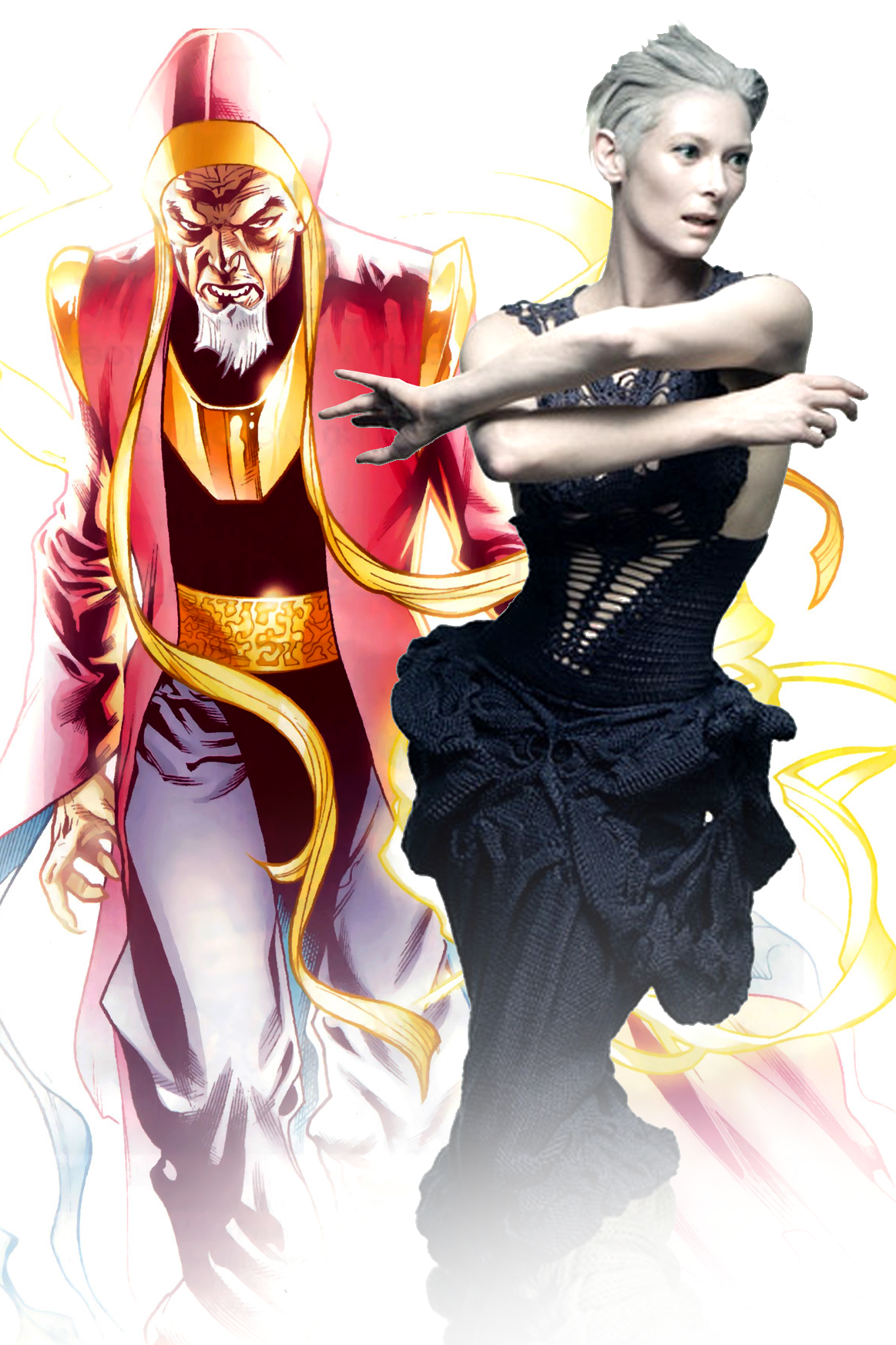
Last week it was announced that Tilda Swinton was in talks to join Marvel Studios’ Doctor Strange, specifically in the role of the Ancient One. For those of you who don’t read a lot of comic books [and even those who do] the character in question is Doctor Strange’s teacher, a Tibetan mystic named Yao. If it wasn’t plainly apparent to you, Swinton is about as Tibetan as Emma Stone is Chinese or Native Hawaiian. The numerous comic book news outlets that I frequent have covered this in as much depth as they possibly can seeing as nothing is set in stone at this point, but I’ve noticed a trend in responses to the presumed casting choice. That perspective is what I’ll be covering first, following that up with how “progressive” Swinton playing this role would actually be-
“Meryl Streep could play Batman and be the right choice.”
Look, we’ve all seen at least one episode of Modern Family, and most of us can remember Cam reciting those exact words when lauding the actor’s ability to be perfect in any role. Like most effective jokes it’s funny because it’s a slight exaggeration of how people actually think and feel, in this case about their favourite talent.
Gordon lambasted the blog “Your Fave Is Problematic” last year, and for reasons that I generally agree with given their penchant of going overboard when finding areas in which celebrities and media have screwed up. That being said, at bare minimum the title of the site is effective in that it forces us to realize that nobody is above reproach. No one is so incredible that they should be given carte blanche to do [or be] whatever they want, yet that’s the attitude I’ve seen so many people give this news.
That’s not to say that people aren’t entitled to their own opinions of who can play what character, but that we’ll so quickly make exceptions when they involve people we love to watch perform. After it was announced that Martin Freeman would be appearing in the Marvel Cinematic Universe the number of people who wanted to see Martin Freeman as Wong opposite Benedict Cumberbatch’s Doctor Strange was staggering. That’s right, Martin Freeman. As a person named “Wong”.
First thing’s first, I’d like to extend all the congratulations in the world to Em Liu of Fiction Diversity for having one of her articles hosted on The Hooded Utilitarian. This is thrilling to me for a number of reasons, listed in no particular order: she’s someone I follow and who I’ve had conversations with between our two blogs , The Hooded Utilitarian is one of my go-to places for pop culture critique on the internet, and the topic she wrote on is one that is very near and dear to my own heart, namely: “Hollywood’s (Real) Problem with the Asian Male”.
I very, very strongly recommend that you read it in its entirety, because with the sole exception of one small portion I’ll be addressing I believe it to be the gospel truth. If you still absolutely refuse to for some absurd reason, and I’m going to ask you to check it out again before moving on . . . the post catalogues the portrayal of Asian men in American cinema, specifically in terms of their desirability. It was particularly eye-opening to me in that one of the earliest examples goes back to the late 1950s with The Crimson Kimono [poster on the right, obviously].
After elaborating on how things have mostly been downhill from there, Liu takes care not to shy away from the fact that one of the cultural reactions to this trend has been “a troubling emphasis on the need for the Asian male to simply ‘get the girl‘ onscreen.” Allow me to take a brief, and very relevant segue to discuss how strongly that idea resounds with me, and how badly I once wanted [and oftentimes still do want] this.
The Thirst Is Real [Leonard Nam Should Be In More Stuff]
I very vividly remember being in my early teens and watching a trailer for 2004’s The Perfect Score-
To stop you before you get there, yes, it is funny that Chris Evans [aka Captain America] and Scarlett Johansson [aka Black Widow] appear together years before their stints in the Marvel Cinematic Universe. And yes, in her dream sequence she does imagine becoming a leatherclad ass-kicker, life is weird, isn’t it? Carrying on- Continue reading →







 I very, very strongly recommend that you read it in its entirety, because with the sole exception of one small portion I’ll be addressing I believe it to be the gospel truth. If you still absolutely refuse to for some absurd reason, and I’m going to ask you to check it out again before moving on . . . the post catalogues the portrayal of Asian men in American cinema, specifically in terms of their desirability. It was particularly eye-opening to me in that one of the earliest examples goes back to the late 1950s with The Crimson Kimono [poster on the right, obviously].


 Culture War Reporters