A film covering “a pair of star-cross’d lovers” is certainly nothing new, and for centuries creators have strived to honour the trope by putting their own distinct spin on it. As a film by South Africans set in their very own country Free State sets itself apart from the crowd at its outset, in particular because it neglects the assumed Black and White mixed couple [and all of the baggage that comes with it] in favour of an Afrikaans woman and an Indian man.
Jeanette, South African model Nicola Breytenbach’s first role, is a law student in the mid-70s returning home to Memel and her father. Ravi, played by Andrew Govender, another model, is a man whose family is currently working out the specifics of his upcoming arranged marriage.
The reason they can never be together is spelled out in the first few minutes of the film in which Jeanette, describing her childhood, relates the story of a man arrested for being Indian in the Free State province after dark. She also shares the details of South Africa’s Immorality Acts that she learned about while in school, which explicitly prohibit sexual intercourse between White and non-White people. It’s racism, plain and simple, and while not the freshest romantic deterrent it’s nonetheless framed in way most viewers won’t be familiar with. Continue reading →
John and I recently found out we were accepted into the education program we’d applied to. I wasn’t exactly surprised that we were accepted (since we both have a great deal of experience working with kids), but I was surprised at just how ecstatic the news made me. Maybe I’m feeling motivated by my student loans, since they’ve just been there, looming. Maybe I’m just excited to move beyond the academic world of writing essays for affirmation. Then again, maybe I’m just excited to start a job that I love doing.
As I head towards my new career I feel a little torn by the stigma the profession carries. Here in Canada, many people accuse teachers of being overpaid for a job they don’t consider very difficult. Then there are the teachers who have worked for years only to be burned up and spit out by the system they dedicated their lives to. Some of them have asked me if this is really the route I think is best. There’s also the general sentiment that “those who can’t do, teach,” so despite my own excitement over my career path, I often feel the need to defend my choice or explain that “I might explore other options later.” Not to mention that, as a woman, it feels like I’m giving in to that traditional cliche of finding the kind of job that people can classify as “women’s work”.
Yet in spite of all the ideas about teaching that I’ve internalized, or at least had thrown my way, I keep feeling drawn back towards the profession. Finally, I’ve allowed myself to recognize what an amazing and rewarding career path it is. Don’t believe me? Well, let me explain.
You get to be creative
Last summer I got a job running a kids’ program at the local library. My role consisted of reading books to kids, encouraging them to read at home, and doing a few crafts with them. Basically I was babysitting them for an hour so that their parents could have a break.
While I knew I would enjoy entertaining the kids and reading children’s books (who doesn’t love reading children’s books?), I had no idea I would become obsessed with crafting and building forts. After a year of focusing my attention on a computer screen, I was suddenly able to make stuff by hand. It was bizarrely exhilarating.
A few things I made out of old fridge boxes for the kids to play in. The Minecraft creeper is a little worse for wear, but that’s because the kids were throwing beanbags into his eyes and mouth. The fishing poles that the kids would drop into the fishing pond also became thoroughly destroyed.
I like the Harry Potter books. I just can’t say I love them [my favourite YA series of novels is Percy Jackson & the Olympians], and after having finished all seven and catching the last few movies in theatres haven’t thought about them much. Certainly not enough to give the Pottermore website, created by Rowling to give HP fans what they continue to jones for, even a cursory visit.
On that same note I haven’t really been following Fantastic Beasts and Where to Find Them, a prequel and spin-off to the film franchise, aside from perking up at the idea that protagonist Newt Scamander might be something other than White. I briefly mentioned it back in 2013 when covering the inherent problem with assuming that White is the norm, but ultimately stopped paying attention after it was officially announced last June that Eddie Redmayne had been cast in the role.
That said, fantasy worlds and the worldbuilding involved in their creation have always interested me, and I didn’t hesitate to click on a link a friend had shared on Facebook stating that Rowling had “[revealed] four wizarding schools, including one in the United States“, with the latter being one of the settings in the upcoming film. After all, if one of the aforementioned magical places of learning was to be in North America chances were that the other three were located elsewhere. Harry Potter and the Goblet of Fire had always been my favourite of the series, with one of the many reasons being that it featured the two other wizarding schools and characters from them, expanding the universe beyond the borders of Great Britain. Continue reading →
Last semester, I took a course called “the Dark Side of Sorry”, which examined the Sorry Movement in Australia and the Truth and Reconciliation Commissions in South Africa and Canada. Since it was a literature course we spent part of the semester reading books that dealt with the effects of colonization in those three countries.
The novels we read explored the effects of apartheid in South Africa, the Stolen Generation in Australia, and residential schools in Canada on the lives of specific characters. In contrast, our critical readings examined the way each of those countries dealt with those events after they were nationally, and internationally, condemned. I want to touch on a few of the criticisms that were raised through our critical readings and discuss why those arguments are particularly relevant today.
South Africa
“Suffice it to say that none of these unconventional projects was intended to lead to any gross violation of human rights […] It can, however, be argued that they did create an atmosphere conducive to abuses.”
– from the apology that F.W. de Klerk, the last South African leader of the apartheid era, gave to the Truth and Reconciliation Commission.While de Klerk apologized for apartheid before the Truth and Reconciliation Commission, he later “withdrew from the commission, saying he had no need to apply for amnesty as he hadn’t committed any crime.” In an interview in 2012, Klerk pointed out that he had not apologized for “the original concept of seeking to bring justice to all South Africans through the concept of nation states”. He also stated that, not all aspects of apartheid were “morally repugnant”.
After apartheid was finally overthrown South Africa attempted to bring healing to a divided nation through their Truth and Reconciliation Commission. This commission, led by Archbishop Desmond Tutu, was meant to be an act of restorative justice, rather than retribution.
In many ways the TRC was a success. For example, it unearthed the truth about many missing persons, allowing families to finally discover what happened to their loved ones. However, there were also many criticisms against the South African TRC, some of which I’ve outlined below.
1) The TRC didn’t differentiate between violence committed by “an illegal state” and “the combatants of a just war”.
“… from the moment the Commission chose to define violation of human rights in terms of individual acts, it ceased – politically and historically – to be viable: ‘There is,’ write Kader and Louise Asmal and Ronald Suresh Roberts… ‘simply no proportionality between the two sides of the struggle, a fact that is lost on the commission’s decision to individualize it’s definition of a gross human rights abuse'” (171).
2) Racial wealth equality was never really on the table.
“Let one’s fantasy roam a little – what really would be preposterous or ethically inadmissible in imposing a general levy on South Africa’s white population? … such an offer could originate from the beneficiaries of Apartheid themselves, in a voluntary gesture of atonement – it need not be a project of the state. Is such a genesis – from within the indicted group itself – really beyond conception?”
3) The TRC remained so focused on the horrific crimes that were being confessed during the hearings that it overlooked the general state of apathy that allowed apartheid to exist for so long. The crimes presented at the TRC trials stood out as “outrageous” acts, and they drew “the nation’s attention away from the more commonplace violations” (162).
“Spread accountability too wide by flattening out the differences between the state and its opponents, then oddly, symmetrically, it will also start to shrink, as the crimes of apartheid becomes more and more the acts of individuals, [and] less and less the machinery of the unjust, and illegal apartheid state” (168).
“We reflect in particular on the mistreatment of those who were Stolen Generations – this blemished chapter in our nation’s history.”
– from the official apology given by Australian Prime Minister Kevin Rudd in February 2008.
I knew the least about Australia’s history, out of the three countries we studied. From what I understand, race relations in Australia were fairly similar to here in Canada, where indigenous peoples were restricted from public areas, treated like scientific specimens, and removed from their families “for their own benefit”.
In May 1997, the Bringing Them Homeinvestigation shocked the Australian settler community by publicizing these historical injustices. It also prompted the Sorry Movement and Sorry Day, which has been held on May 26th since 1998. Below are a few observations critics have made about settler Australians’ “Sorry” response.
1) The Sorry movement is entirely settler-centred.
“These revelations brought about a form of ‘bad conscience’ in the settler Australians… [and] present[ed] them with a vision of a nation improperly formed. They experience the unsettledness of losing their sense of innocent national selfhood. For settlers so afflicted, the postcolonial apology becomes a lifeline to the restitution of a legitimate sense of belonging” (243)
2) The Sorry movement backfired politically for indigenous Australians.
“The era of reconciliation has coincided with a post-native title backlash in which many sectors of Australian society, not least the powerful mining lobby, have responded negatively and often hysterically to the overturning of the doctrine terra nullis (land belonging to no one) and the common law recognition of native title… Federal Government policy, attentive to the electoral and economic implications of such a backlash, has responded by cutting funds to key indigenous organizations and eroding the gains secured through the Native Title Act and subsequent native title adjudications.” (234)
“The treatment of children in Indian Residential Schools is a sad chapter in our history.”
– from the official apology given by Canadian Prime Minister Stephen Harper in June 2008.
I don’t think I’ve ever met a Canadian who isn’t familiar with the trauma residential schools inflicted on Indigenous communities across the country, but for those of you who are not Canadian I’ve included a short video below that sums up some of that history.
In 2008, Canada instituted our own Truth and Reconciliation Commission, which allowed survivors of the residential school experience to speak out publicly. Unfortunately, there were several elements of the TRC that many indigenous spokespersons found problematic.
1) The term “reconciliation” misrepresents our history.
“Re-conciliation refers to the repair of a previously harmonious relationship. The word choice imposes a fiction that equanimity is the states quo between Aboriginal people and Canada.” (35)
2) The majority of the damage had been done by Christian organizations, yet the reconciliation movement rests upon Christian theology and terminology.
“Whether the choice of this world [reconciliation] … is an accidental inheritance, it is ironic, if not sinister, that survivors of religious residential schools … are asked to participate in a ritual that so closely resembles that which abused them” (35)
3) The Western understanding of apology allows us to move on, without necessarily doing anything to rectify our mistakes.
“Cree artist, poet and oral historian and theorist, Neal McLeod explains that there is no equivalent in the Cree language for the Western notion of an apology. The closest equivalent to ‘I am sorry’ is nimihta tân, which means ‘I regret something’. McLeod explains that the word used in reference to the residential school experience is ê-kiskakwêyehk, which means ‘we wear it.’ This is a profound difference. It is visual and visceral rather than abstract. It describes a recognition and acceptance that cannot be washed or wished away.” (36)
4) The government continues to protect perpetrators.
“While many truth commissions are granted judicial powers to subpoena witnesses and the ability to ‘name names’ of perpetrators, the Canadian TRC has neither of these powers.”
5) Activists are worried that nothing will actually be done about the commissions recommendations.
The Canadian Truth and Reconciliation Commission came to a close in June of this year, making many of the critiques we explored in this class particularly relevant. The TRC commission concluded that residential schools were an act of “cultural genocide” and put forward 94 recommendations for the Canadian government. Several weeks have passed and Canadians are now asking, is our government going to act on any of them?
It’s hardly surprising that the one thing in common with the national apologies offered by political leaders in each of these countries is their attempt to distance themselves from the atrocities that took place. The Canadian and Australian prime ministers attempted to do so metaphorically, by referring to the events as a chapter which could be left in the past. In contrast, de Klerk’s non-apology seems to reflect a more blatant refusal to fully accept responsibility.
However, these apologies are certainly better than nothing at all. In fact, many indigenous peoples in South Africa, Australia and Canada have celebrated their country’s national apology as a hard-won victory. But shouldn’t we strive for something more than “better than nothing”? Especially when a a public apology eases settlers’ consciouses and allows us to overlook the systemic problems that led to these injustices in the first place?
“How can we overlook the fact that those admitting to guilt and professing regret continue to occupy, and to speak from, a position of dominance, so that to read abjection or loss of power in their situation would be to misread not merely power relations but the nature of the political apology itself?”
– from “Righting Wrongs and Rewriting History” by Rajeswaru Sunder Rajan
EDITOR’S NOTE: We end this year by each taking a look back and picking our five best posts, explaining both their importance to us and to the world we currently live in. Clicking the banner images will link you to each post, so as 2014 comes to a close join us in remembering how far we’ve come, but also how far we still have to go.
The Jian Ghomeshi scandal was a big deal for most Canadians. Ghomeshi felt like someone we all knew, someone who had been a regular presence in our homes (and cars) as long as he had hosting Q on the CBC.
In October, the CBC put pressure on Jian Ghomeshi to go on a leave of absence. Shortly afterwards, he wrote a post on Facebook accusing the CBC of firing him over his preference for rough (but consensual sex). Many fans believed Ghomeshi when he claimed the women who had accused him were liars who just wanted attention.
Given his popularity, I understood why people jumped to defend him when the first few allegations of sexual violence came out, but there was something about his Facebook post that just felt wrong. It seemed unlikely that anyone, much less more than one person, would make a sexual assault accusation just for attention. As I started to do my own research on the topic, I quickly realized that false rape reports are so rare that they are almost non-existent, and that the tendency to believe Ghomeshi over his (at the time) anonymous victims spoke to a much bigger systemic issue.
It’s really hard to care about how terrible our justice system is unless someone close to you has gone through it. In this post, I discuss some of the things I noticed when I visited someone close to me during his stay in jail. Despite firmly believing that this person deserved to go to jail, that experience opened my eyes to the way prison (and the bureaucracies surrounding it) take damaged people and make them ever worse. As someone who works in special education, it made me even more angry to realize just how many of the adults in prison are individuals with special needs.
The conversation around the purity movement tends to be very divisive; feminist websites like Jezebel have called it creepy, while many Christian communities staunchly defend the practice. Since I consider myself both a Christian and a feminist, I wrote this post to point out the really great intentions that are (usually) behind the purity movement, while still drawing attention to the damage it can cause.
After the Duck Dynasty star spoke out against homosexuality and was kicked off his show, my Facebook wall started to fill up with “I support Phil” memes. This made me really, really angry.
Having grown up Evangelical, I understand how many Christians feel they cannot accept homosexuality as something that honours God. Personally, I no longer accept that dogma, but I can understand it. I didn’t even write this post to argue with that branch of theology. I wrote this post because I was furious that Christians are happy to defend a millionaire because he broke his contract and got kicked off his TV show, but are unwilling to acknowledge that homosexuals are being killed and actually persecuted all around the world.
I’ve written many posts that address the Christian community. I do this because I still consider myself a member of that community, and I want to call out the issues that I believe are distracting from the message of love we claim to be sharing. Despite my many critiques of the church, some of the most amazing people I’ve known are Christians. I wrote this post about my experience living in a missionary community in Niger, where I was surrounded by people who I truly respect.
This post also addresses “voluntourism”, since my own selfish motivation to move overseas was something I felt personally convicted about during my stay in Africa. Recently, however, the discussion of the voluntourism trend has made westerners afraid to express interest in foreign aide at all. I believe both extremes can be damaging to international relationships.
Looking back, it’s sometimes scary to think about how much I have shared with you guys. It’s always a vulnerable step to publicize our personal opinions, it’s even more so with details about our personal lives. Intimidating as it can be, I’ve loved how many amazing discussions the blog has opened up in my life. Your comments (in person and online) have helped me reevaluate my own biases, and challenged me to think more deeply about the social, religious, and political issues we love to debate here at Culture War Reporters.
So here’s to a fantastic year. I can’t wait to see what the next one brings.
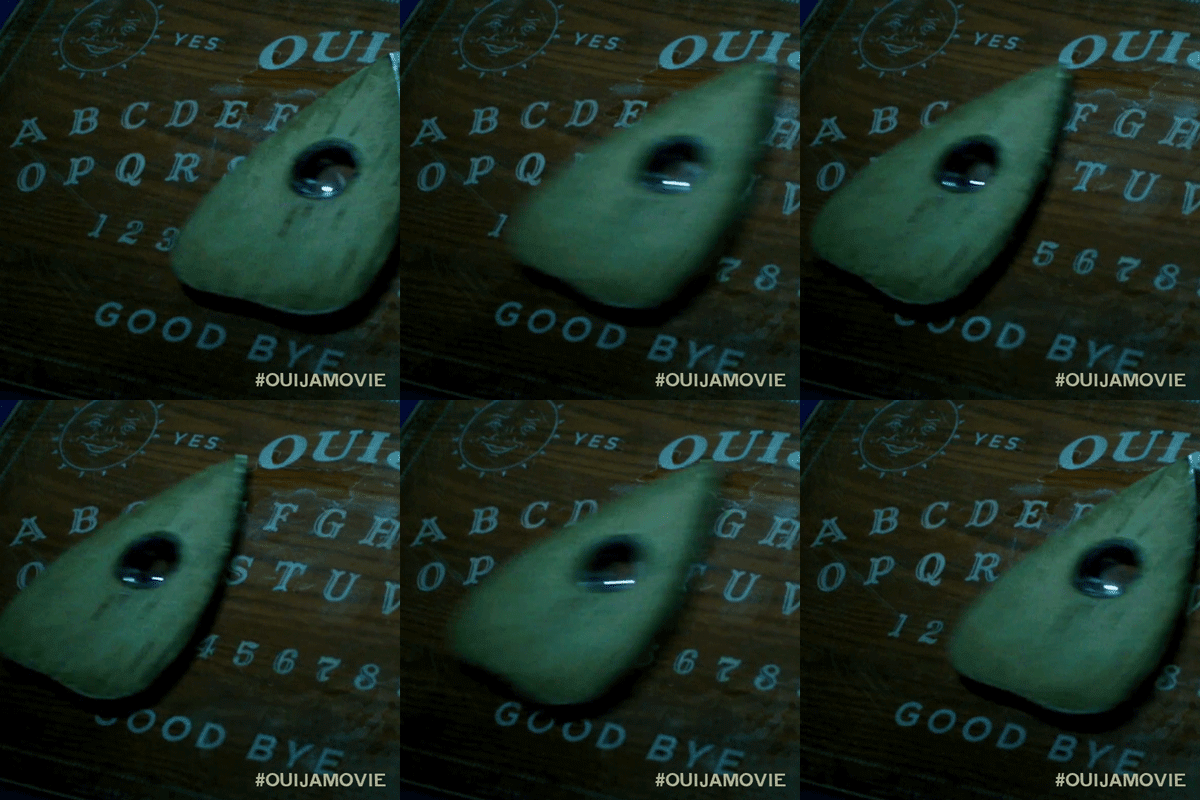
Well folks, October has come and gone, and gone with it is the movie industry’s litter of trope-y, recycled Halloween cash-ins.
Yes, I’m talking about you. Now get out of here. Scram.
This means we can get back to the horror movies being made as movies first, rather than cynical money-grabs.
Excluding the Paranormal Activity franchise, but obviously that goes without saying…
See, say what you like about horror flicks (and there’s no shortage of criticism to be leveled), I do truly believe this is a genre just as important as any other- heck, possibly even more. At the end of the day, I don’t think there’s a better gauge for contemporary culture than the things we fear most as a society. Continue reading →

 A film covering “a pair of star-cross’d lovers” is certainly nothing new, and for centuries creators have strived to honour the trope by putting their own distinct spin on it. As a film by South Africans set in their very own country Free State sets itself apart from the crowd at its outset, in particular because it neglects the assumed Black and White mixed couple [and all of the baggage that comes with it] in favour of an Afrikaans woman and an Indian man.

.jpg/200px-Follow_the_Rabbit-Proof_Fence_(book_cover).jpg)









 Culture War Reporters