Category Archives: history

In Defence of Feminine Strength (Re: In Defense of the Warrior-Princess)

When I initially read Gordon’s response to the post I wrote last week, I asked myself, should I be offended?

You see, my original post was one of my more personal pieces, where I touched on my struggle with self-acceptance (as a rather sensitive person) in a culture highly influenced by what I described as the warrior-princess/damsel binary.

As a child, I believed that I needed to become emotionless in order to be strong, and masculine in order to be taken seriously. That’s why I find characters who are feminine and strong, like those often played by Zooey Deschanel, an encouraging presence in films and TV shows.

So, you can probably see why, being the sensitive person that I am, Gordon’s closing statement came off as a wee bit hurtful:

Deschanel states that “we can be powerful in our own way, our own feminine way” [emphasis added].

No you ****ing can’t.

From what I know of Gordon, he seems like a pretty good guy, so I’m going to act under the assumption that he was not writing an attack on my personal character, but rather a critique of the concept of feminine strength as represented by Deschanel. That critique is what I will be responding to in the points below. If you don’t watch New Girl, then be aware, there are spoilers below.

1. The Critique Begins with Flawed Logic

I have to thank one of our most faithful commenters, Rosie, for pointing out the “strawman argument” made in Gordon’s critique. In “In Defense of the Warrior-Princess” Gordon describes traditionally feminine characteristics using words like “submissive” and “weak”, words that neither I, nor Deschanel used to describe femininity. Using these sort of terms creates a false dichotomy between my argument and his.

He also claims that Deschanel plays “ditzy, emotional, pathologically neurotic” characters “who don’t need no man to help them”. He includes a crying gif of Jessica Day, the character Deschanel plays in New Girl as evidence.

This isolated gif ignores the wider context of the show, where every single character deals with their day-to-day life in a “ditzy, emotional, pathologically neurotic” sort of way.

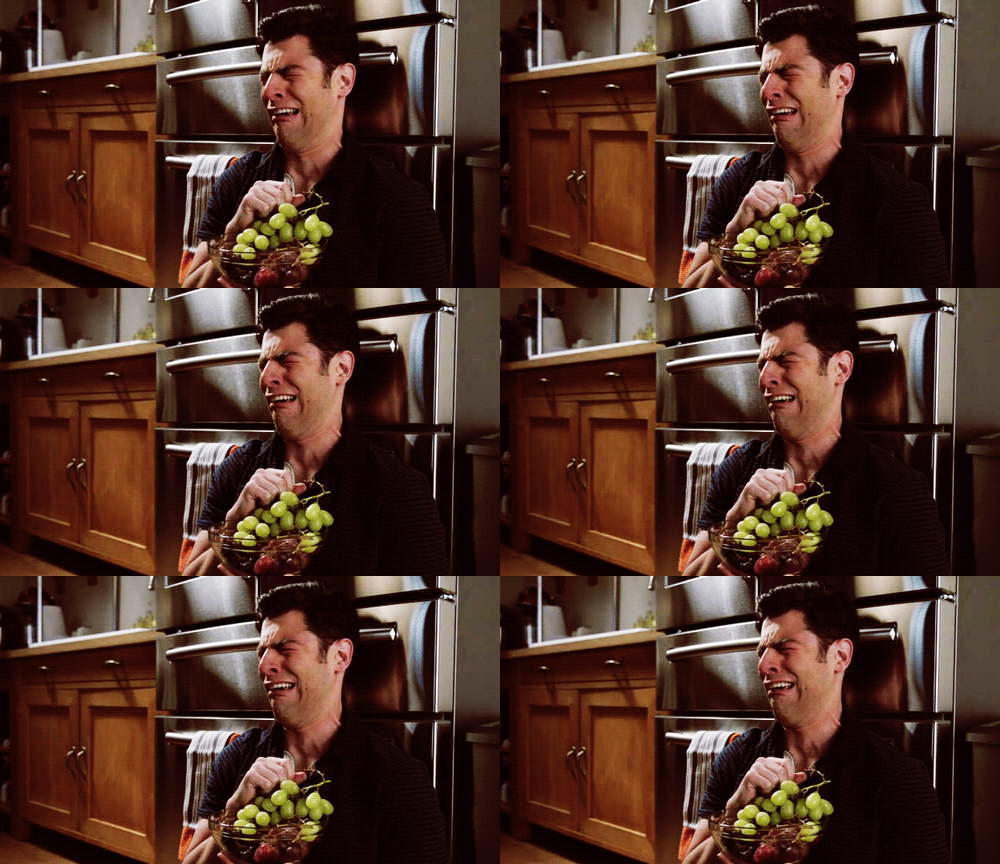
It also ignores how New Girl is not at all about being the kind of person “who don’t need no man”. Instead, this show demonstrates how relationships lead to personal growth. It also shows how every person sits somewhere on a spectrum between sensitive and stoic, and how both of these traits are essential to becoming a healthy individual. Continue reading
Why We Need/Don’t Need Black History

I ran a Shame Day post a while back about “Black History” (or the whitewashed version that gets fed to us), and in it, I referenced this clip with Morgan Freeman:

I promised to shortly address Mr. Freeman’s comments-

-and promptly forgot about it for two years.

Well overdue, here’s why we desperately need Black History, and why we simply don’t.

Bear with me here.

Because We Don’t Have Real History

Again, we’re fed an overwhelmingly whitewashed and simplistic version of history. Lincoln benevolently freed the slaves and then, roughly 100 years later, MLK Jr. led a series of peaceful protests which ended segregation, and everybody lived happily ever after.

In reality, folks largely lost faith in peaceful protest as the 60s wore on, turning instead to self-defense, nationalism, revolution, and other techniques.

Continue reading

The Last 3 Books That Made Me Cry (And Why You Should Read Them)

I love getting lost into the world of a book. You know how it is when you can’t handle taking a bathroom break or stopping to eat lunch because it might mean tearing your eyes away from the page? Luckily, as an English major, reading is a big part of my learning experience. Not every book I’ve been assigned to read has been my style, but some of those books have been so good that they sucked me deep into the story until the next things I knew, tears were streaming down my cheeks.

For the sake of this article, I won’t be focusing on all the books I’ve read over the past year. If you want to read a fantastic overview of a wide span of books, I suggest you check out Evan’s 2014 Literary Awards. Instead, I want to share the last three books that made me cry, and, more importantly, I want to discuss the larger issues that make each of these three books valuable reads.

Each of these novels engages with what it means to live in a post-colonial world. In each story, it quickly becomes apparent that the horrors of colonization do not simply end the moment government policy changes.

While I will avoid any key plot points in these books, I will be alluding to general context around the books. If you prefer to go into your reading experience with a blank slate, I should warn you, Spoiler-ish content below.

Wide Sargasso Sea by Jean Rhys

Generally regarded as the post-colonial prequel to Jane Eyre, Wide Sargasso Sea opens in Jamaica, shortly after the abolition of slavery. Rhys’ protagonist, Antoinette, comes from a family of plantation owners who were brought to financial ruin by abolition. As a child, Antoinette struggles to understand what separates her family from the rising class of British capitalists.

By writing from the perspective of a child on the wrong side of history, Rhys prevents any oversimplification of her narrative. She also challenges the idea that colonial injustice somehow ended when slavery did.

Rhys’ strong narrative style creates a story that will immediately pull you in, but her imagery and carefully thought-through word choices create layers of meaning that make this novel much more complicated than it appears at first read. While it initially seems to be a Gothic Romance, Wide Sargasso Sea also explores a variety of important questions around race and gender. Continue reading

Taylor Swift: History’s Greatest Monster

When I first heard that pop star Taylor Swift had paid off a fan’s student loans, I was honestly and truly impressed. The average student loan debt is around 30 thousand dollars, and can easily pass six digits for some folks, and knowing that struggle all too well myself, that kind of spontaneous kindness struck me as really neat. When Evan wrote about that on Friday, reporting the payment was less than 2 grand, it kinda took the wind out of my sails. Don’t get me wrong- I think Evan hit the nail on the dead in saying that anything good is good, but I still couldn’t help thinking:

“Is that it?”

Still, I decided to suspend my hostilities towards the woman and actually do some more research into her- fully prepared to be proven wrong, or to admit that my dislike stems purely from taste in music.

Still, it seemed the deeper I dug, the more I’d keep returning to that same question.

“Is that it?”

Now back in November, Evan had written another post trying to defend Swift, arguing that her music isn’t for everyone (no argument), plenty of other singers have cashed in on lost-love themes (also true), and at the end of the day, she’s just being herself.

Problem is- I believe that.

While it’s entirely possible that Swift’s just another interchangeable, committee-designed pop figure, I’m completely willing to believe that she’s being who she is. Only who she is isn’t all that good.

Let me break it down here. Continue reading

Clarifying Charlie Hebdo

Let’s face it- there’s no way to avoid this topic. At this point, I don’t know that there’s anything I can say that hasn’t already been said in the past few days. What I’d like to do, if I can’t offer anything new, is at least offer some clarity. Here are the facts, folks:

On the 7th of this month Sayeed and Shareef Kouachi attacked satirical magazine Charlie Hebdo for running cartoons deemed “insulting to Islam”. The Kouachi brothers, armed with AK-47s, a shotgun, and a grenade launcher, killed 12 individuals- most of them magazine staff and cartoonists- in addition to wounding several others. Two days later the Kouachis would be killed by French police after a protracted siege in a warehouse. Other suspects involved in the attack are currently being hunted down.

Since the 7th, we’ve seen an outpouring of indignant outrage over the killings, as well as solidarity marches, both for France and for freedom of speech. Despite the near universal solidarity behind Charlie Hebdo, a myriad of differing conclusions have been voiced in the past few days- some good, some bad, and many missing the point entirely (in spite of genuinely good intentions). Let me try to address a few of these below.

Not All Muslims Are Terrorists/Not All Terrorists Are Muslim

…But I shouldn’t have to tell you that.

At this point, parroting that line is starting to feel almost patronizing. It’s an obvious truth, and it shouldn’t need me to defend it. There are millions upon millions of Muslims in the world, the vast majority of whom want nothing more than to live their lives in peace- among them, Ahmed Merabet, a police officer and the first of the Kouachis victims. Whether the infamous 9/11 attacks (in which American Muslim Mohammad Hamdani died attempting to rescue people from the North Tower) or the thousands of Muslim Arabs and Kurds fighting against ISIS in Syria and Iraq, Muslims shouldn’t have to be “rescued”. From Abdul Haji to Aitazaz Hassan Bangash to Malala Yousafzai– there are just as many heroic actions from Muslims as their are heinous ones.

But this is, again, obvious to anyone actually interested. I don’t know that there’s anybody out there who hasn’t already made up their mind about it (for better or for worse). Continue reading

The 2014 Evan Yeong Literary Awards

My mom taught me how to read when I was 4-years-old, which WebMD, a reliable source if there ever was one, says is about two years younger than average. According to Iowa Tests [American standardized tests that I ended up taking at an American school] I was reading at a 12th Grade reading level when I was only ten. When I inevitably ended up majoring in both English and Writing at a Christian liberal arts college I was, to put it directly, horrifyingly average.

evanyeongliteraryawards2014I write all of that not to share that I was some sort of prodigy [I wasn’t], but that I was good at reading because I loved it. The written word continues to be my favourite artistic medium, and my appreciation for the literary has not faded. Today I start what I hope to be an annual tradition, a review of what was read in the past year to acknowledge the standouts [for better and for worse]. These are the 2014 Evan Yeong Literary Awards.

In 2014 I resolved to read 52 books, and while I only ended up stopping just four short of my goal, I do believe it was an overall success. You can check out a full list [with the exact dates of when I read each one] at this link. Continue reading