Overwatch‘s Doomfist, Terry Crews, and Fan Culture

This blog isn’t even supposed to be back on until next week but you know what they say: strike while the iron’s hot. For some of you at least the first two parts of this title have been flitting back and forth across the internet. “Terry Crews!” whispers one corner excitedly, “wants to play Doomfist!” murmurs another. Because of my search history and their All Seeing Eye Facebook even brought to my attention that thousands of their users were discussing that very subject.

So here I am on a Saturday morning, sitting in front of my laptop determined to bring you literally every piece of information I can find about Terry Crews, Overwatch, and the yet-to-be-released hero Doomfist. Oh, and I’m also going to discussing fan culture so if you want to stick around for that as well that’d be cool.

Who Is Doomfist?

So before I even get into that you should know that Overwatch is a team-based multiplayer FPS [first-person shooter] by Blizzard Entertainment that has a lot of playable female characters [and has been snapping up awards like they’re a limited resource]. Doomfist, as I mentioned in the last paragraph, is predicted to be the newest hero in the game, bringing the roster up to a full 24.

That character has also been hinted at as early as the Overwatch cinematic trailer, which came out November 2014. That’s roughly nine months before the ill-fated ARG [alternate reality game] that Blizzard used to hint at and lead up to the release of Sombra, their 23rd hero.

If you don’t want to watch the whole thing, which is ridiculous because it’s only six minutes long and painfully good, the trailer revolves around two kids witnessing a villainous duo [Reaper and Widowmaker] try to steal an artifact only to be thwarted by ex-Overwatch agents [Tracer and Winston]. The item in question is, like the younger one says, “Doomfist’s gauntlet”. Apparently by wearing it the user “could level a skyscraper.” Continue reading
2 Broke Girls, S6E12 “And the Riverboat Runs Through It”: A TV Review

riverboat

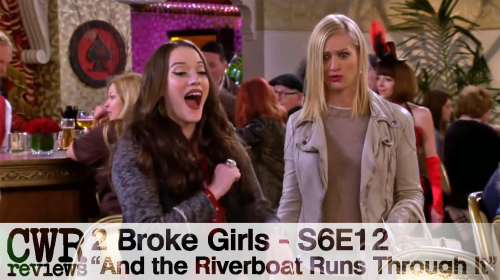
Context is always important. As far as the television landscape in the past two decades we have an expectation as viewers that the midseason finale, which typically airs right before the holidays, marks a significant moment ideally meant to draw the audience back in the new year. The problem with 2 Broke Girls, at least recently, is that being pushed around in the fall TV schedule has resulted in that episode not landing with the weight that it should.

Take Season 5 where the episode at the halfway mark, “And the Storytelling Show”, ends with the two girls heading out to Hollywood to sell the film rights to Caroline’s life story. That would have been a phenomenal way to wrap things up in late November or early December, but instead aired mid-February.

While likewise plagued with scheduling issues, Season 6’s 12th episode actually opens up with another “Previously on 2 Broke Girls“, establishing that the titular duo is in the middle of their quest to get Max and Randy back together. To be fair the last episode of 2015 did end with them plummeting towards the ground in a single engine aircraft, but it’s not like we ever thought they wouldn’t survive the experience. It’s difficult to blame the showrunners for just trying to roll with the punches, but decent pacing is a good way to keep people watching and hopefully buoy flagging ratings. Continue reading

2016’s Cultural Battleground – Evan’s Account

EDITOR’S NOTE: We end each year by each taking a look back and picking our five best posts, explaining both their importance to us and to the world we currently live in.  Clicking the banner images will link you to each post, so as 2016 comes to a close join us in remembering how far we’ve come, but also how far we still have to go.


To directly quote my co-writer, “**** this year” has been an increasingly common sentiment as the days tick by, but even given the relentless, overwhelming flood of bad news that 2016 has embodied what’s particularly depressing to consider is how little some things have changed. It’s also telling that in spite of us collectively writing more blog posts than last year I’m left feeling like I wrote less, and that what was written is generally of a lower quality as well.

With that in mind and given the handful of bright spots I managed to find I decided to address this year and my coverage of it a little differently by using the “sandwich approach”. Instead of being presented in chronological order below are two positive aspects to 2016 that bookend what amounts to one singular, continuous problem, and one that I take very personally.

tf2overwatchThere’s something beautiful about the way a team can run like a well-oiled machine, each of its separate components working in unison to efficiently accomplish a shared goal. While not always my experience with Overwatch those moments, especially when with friends, have been highlights of my year.

With this post I took a closer look at Blizzard’s latest FPS that, since the time of this post being written, has grown the number of playable female characters to roughly 50%, and its place as part of a growing push in video games to expand beyond the male-only titles of the past.

kimmyasianUnbreakable Kimmy Schmidt was a high point of 2015, a Netflix-exclusive sitcom with an unassailably positive young woman at its core. It even took up one of my slots in my last year in review post, where I praised them for including an Asian love interest while scrutinizing how much they truly valued the verisimilitude needed to portray them correctly.

One tragedy of 2016 is that I was never able to make it past the third episode of its second season, the reason being that Tina Fey et al. created twenty-some minutes of television that dragged those who value Asian American representation before running them over with a steamroller, and then putting it in reverse. Friends assure me that it gets better, but how could it not after falling to such great depths? Continue reading

2016’s Cultural Battleground – Gordon’s Account

EDITOR’S NOTE: We end each year by each taking a look back and picking our five best posts, explaining both their importance to us and to the world we currently live in.  Clicking the banner images will link you to each post, so as 2016 comes to a close join us in remembering how far we’ve come, but also how far we still have to go.


I know it’s been said all over, but man…

**** this year.

I’m going to just go ahead and embrace the roiling darkness and present, for your consideration, my own chronicle of our downward spiral. Not counting the French war on religious freedom, American attacks on the 2nd Amendment, Don Lemon’s career, and a host of other blemishes we don’t have room for.

Did I mention **** this year?

Anyways, here’re the major casualties from this year’s culture wars:

thepresidentnotmypresident While I don’t think this was my finest writing by any means, I do think it’s one of the more important posts I wrote this year. And not just because I want my good name vindicated by future historians or alien archaeologists sifting through the ashy remains of the Western hemisphere.

In the face of a lot of folks trying to come to terms with the election of Donald Trump, I make the argument that they just don’t have to.

firstladyIn spite of my own frustration and anger at the results of the election, I nevertheless want to state for the record that voting-for-a-lesser-evil is not now, nor ever will be, the answer. In spite of what Mrs. Obama, Elizabeth Warren, and Bernie Sanders believe, democracy cannot be saved by us choosing not to practice it. Continue reading

The Swinton-Cho Letters, Part 2: Putting Down a Resurrected Argument or: When Isn’t Art Political?

I began the first installment of this two-parter making note of the long and ultimately wearying experience it has been, starting with Doctor Strange going into pre-production and continuing on to the recent exposure of the Swinton-Cho Letters. While I spent time describing the ups and downs of casting news what I neglected to mention, and what I’m going to focus on today, is the outset and ultimate resurgence of an argument in defence of whitewashing.

That’s right, an argument defending what Wikipedia helpfully defines as “a casting practice [. . .] in which white actors are cast in historically non-white character roles.” The very faint silver lining is that the justification here does not revolve around star power and A-list draw, or the idea that “the best person for the role” was hired, the latter of which rarely ever swings in the other direction. In spite of not being deeply rooted in these ways of thinking, however, the argument presented remains deeply flawed.

Before we get into that, however, we should probably get to its origin story.

Like I Said Last Time, “It’s Always Podcasts”

Having to hit all of this again it’s important to be thankful for small blessings, with one being that I don’t need to hear C. Robert Cargill’s voice again due to already having done the research for another post. The person in question was one of the screenwriters for Doctor Strange, and dropped in on the  Double Toasted podcast mid-April to answer a few questions about it.

Eventually, and unsurprisingly, the issue of the Ancient One’s casting was brought up. Cargill’s response, as transcribed by CINEMABLEND’s “The Blunt, Yet Difficult Reason Doctor Strange’s Ancient One Isn’t Asian”, is as follows:

“The Ancient One was a racist stereotype who comes from a region of the world that is in a very weird political place. He originates from Tibet. So if you acknowledge that Tibet is a place and that he’s Tibetan, you risk alienating one billion people who think that that’s bullshit and risk the Chinese government going, ‘Hey, you know one of the biggest film-watching countries in the world? We’re not going to show your movie because you decided to get political.’ If we decide to go the other way and cater to China in particular and have him be in Tibet [. . .] If you think it’s a good idea to cast a Chinese actress as a Tibetan character, you are out of your damn fool mind and have no idea what the fuck you’re talking about.”

In essence Cargill chalked the reasons for the casting decision up to politics and economics, implying that having the character played by a Tibetan would cause Marvel Studios to lose out on Chinese box office sales. He also suggests quite strongly that, conversely, having a Chinese actor play a Tibetan would cause a large amount of controversy. This was picked up by sites from IndieWire to ScreenRant to The Hollywood Reporter, with several using words like “reveal” in their headlines, as if a longstanding mystery had finally been solved.

The justifications he laid out were to become the go-to response for every commenter looking to defend the Swinton’s casting, and why not? After all, as one of the screenwriters of the film Cargill should be a direct and dependable source. The answer to that hypothetical starts with what happened a few short days later- Continue reading

The Swinton-Cho Letters, Part 1: What Went Down and How We’ve Responded

tiredaf

I’m just so tired.

I was tired when I wrote, last June, about how Tilda Swinton was in talks to play the Ancient One in the then-upcoming Doctor Strange, because it was just one of several announcements where a role that could have gone to an Asian person didn’t. And it made me weary to have to read comments like “if any young white woman can pull off an old Asian man, it’d be Tilda Swinton,” and “PLEASE TELL ME HES PLAYING WONG!” after it was revealed Martin Freeman would be appearing in Captain America: Civil War.

Swinton ultimately being cast as the Ancient One, a Tibetan man in the comics, was never far from my mind moving forward. I would inevitably bring it up when discussing whitewashing and racebending in The Martian that very same year, and in many ways it made Doctor Strange a film that loomed in the impending future, a comic book movie I would need to see for myself in order to determine whether or not they did right by the groups they were trying not to offend.

Just to be clear, I can’t honestly say that I was angry when finally watching the movie. Like the title of my write-up plainly states I was left feeling disappointed. It also notes that my expectations were never particularly high, and how could they be when the filmmakers rewrote the character of Wong back into Doctor Strange upon finding that casting Swinton left them without any prominent Asian roles [in a movie that is set in Asia roughly half the time].

It was over a year of waiting for a film whose creators touted the representation of an older white woman to offset what was, without argument, whitewashing. It’s a defence that implies that in some cases the choices are feminism/anti-ageism and racial diversity, and that the two are mutually exclusive. It was, to put it more strongly, exhausting. And it’s easy to say that I should just care about this less and not let it affect me so much, but Asian representation is an issue that directly affects me, and one that will affect my children if and when I have any.

I was already so tired of all of this, and was looking forward to being able to stop thinking about Tilda Swinton and Doctor Strange and enjoy the few moments before we get any closer to Ghost in the Shell being released [difficult as a teaser aired before the Marvel film being discussed]. And what should I find this past week but an email conversation between Tilda Swinton and Korean American comedian Margaret Cho, which I have dubbed the Swinton-Cho Letters, and the internet’s response to the whole thing.

When I first started putting my fingers to the keyboard this was meant to be a single blog post split into two parts, but over a thousand words in and I thought two separate posts might be more efficient. And what better way to end a horrible year than to devote so much time and effort towards such a truly draining topic?
Continue reading