Tag Archives: asian

Asian Comic Book Fan Watches Doctor Strange…: An Addendum

Even though I wrote a little over a thousand words last week on my experiences with Doctor Strange [required reading for this blog post] there were a couple of additional criticisms I wanted to level against both that specific film and the industry as a whole. While I covered pretty thoroughly how Asians were poorly represented in Marvel Studio’s latest offering, what I didn’t really touch on was why.

When Diversity Means Painting With All the Colour of the Wind

In the months leading up to the release of Doctor Strange the conversation about the Ancient One’s casting began heating up. With mainstream news outlets picking up on the controversy there were many waiting to hear from the creators themselves, which brings us to the episode of the Double Toasted podcast that guest starred screenwriter C. Robert Cargill.

While his explanations regarding the character have since been championed by those defending the casting decision, even after his rescinding all comments made, and in spite of them being refuted by others, in particular by Shaun of the No, Totally! podcast, what I want to focus on are what he says right after that:


Now if you don’t want to actually listen to him, which I find perfectly understandable, I’ve also transcribed the relevant quote [emphasis added]:

“But when you start to see this film you’ll see that what we were able to do with Kamar-Taj, we made one of the most multicultural films most people have seen in years. Like this film is [. . .] I’m not certain that there’s a single major race that isn’t represented with a speaking role in this film. It allowed us to bring in, even as small characters to build upon later, a lot of characters from the Doctor Strange universe who come from all over the world. We were able to play with a lot of things and it gave us a lot to work with.”

Continue reading

Asian Comic Book Fan Watches Doctor Strange with Low Expectations of Racial Representation, Is Unsurprised but Writes Blog Post Anyway

This is the second part of a series I began almost exactly three years ago with “Asian Comic Book Fan Watches Thor: The Dark World Expecting Racial Representation, Deals with Crushing Disappointment by Writing Blog Post“. The Marvel sequel in question sidelined Hogun, played by Japanese actor Tadanobu Asano, almost completely, and as the title of the blog post would suggest I had been very excited to see him again.

sir

I can’t not use this image again, it’s just too perfect. Source: platoapproved.tumblr.com

With Doctor Strange, on the other hand, that anticipation was not present at all. Last June I covered the news that Tilda Swinton was in talks to play the Ancient One, the title character’s mentor, in “Celebrity Blind Spots and Fixing Racist Narratives [By Making Everyone White]“. The gist of that post was how, in an effort to be more “progressive” filmmakers have been choosing to “fix” problematic minority characters by simply casting them with white talent. That’s as opposed to simply amending what made them so racist and stereotypical to begin with.

At that point in 2015 Swinton starring in the film had not yet been confirmed, and absolutely nothing had been mentioned about the character of Wong, Doctor Strange’s manservant in the source material. With Benedict Cumberbatch already locked into the role it was a magical time in which there was still the possibility of Marvel releasing a movie with two prominent Asian characters.

Look, my hopes were never particularly high that Swinton wouldn’t land the part. As soon as it was announced she was in talks for the role support began pouring in. That she was a woman in her 50s in a genre that has helped shine a spotlight on men of all ages and women of a very particular age was laudable to many. The thing is, the optics are so bad.

twowhiteys Continue reading

Asian-American Creators in Comic Books As Of July 16th: 2 Out of 3 Ain’t Bad

The last time I wrote a post that was titled in a similar format was back in 2013, which followed another the year before. Both were written because at the time events had occurred in the comic book industry that touched on LGBT representation. Given the fact that Western comic books don’t necessarily have a dearth of Asian creators [Gene Luen Yang, Annie Wu, and Jerome Opeña being just a few examples] it’s actually sort of surprising that it wasn’t until this week that I felt justified in putting together a similar post.

What’s unfortunate is, as you can probably tell by the title, that it’s not all good news. With that in mind I’m going to go with the classic “sandwich” delivery, with the positives buttressing a negative. That said, and without further ado-

Greg Pak’s Totally Awesome Hulk #15 Brings a Tear to My Eye

I should probably clarify that I have not read the 15th issue of Totally Awesome Hulk. That won’t actually hit stands until this upcoming October. That said, the cover was released in the Marvel NOW’s Previews Magazine this past Wednesday [with leaks hitting the internet a little earlier]. You can see the cover below in all of its glory-

marvelasians

Cover art by Mukesh Singh.


Clockwise from the very top of the cover is: Kamala Khan/Ms. Marvel [Pakistani-American], Shang-Chi/Master of Kung Fu [Chinese], Amadeus Cho/Totally Awesome Hulk [Korean-American], presumably SHIELD Agent Jimmy Woo [Chinese-American], Cindy Moon/Silk [Korean-American], and lastly a character I can’t place who Bleeding Cool cites as being Winter Soldier [which I could not confirm through my own research].

What struck me was that this is a comic book cover from one of the the two major publishers [DC and Marvel] on which every one of the many characters depicted is Asian. It’s also not an established team of Asian heroes like Big Hero 6 [the film adaptation of which you know my exact feelings about]. This is especially notable in light of the fact that other comics like Sam Wilson: Captain America #10-

blackmarvel

Sam Wilson: Captain America #10. Written by Nick Spencer, illustrated by Angel Unzueta.


bp7

Cover art by Marguerite Sauvage.

-and the cover to Black Panther #7 [as seen on the right] communicate the ideas that a) Black heroes exist within this universe and b) just like in many real life situations, Black people can and do congregate together.

Even before these respective examples came to light most of these heroes were fairly recognizable by the public [Storm and Black Panther, Nick Fury Jr.], but they also shine light on the lesser-knowns [Misty Knight, Doctor Voodoo, Spectrum].

The cover to Totally Awesome Hulk #15 is the first major step in my recent memory to bring a similar awareness to Asian representation in comic books, and it’s very clear that a conscious decision was made by Greg Pak [a Korean-American himself] to do this. It’s no exaggeration that just seeing the cover made me emotional, and I cannot wait until October to get my hands on the issue.

Frank Cho Stirs Continues to Stir Up Controversy Over Wonder Woman Variant Covers

There’s no such thing as the perfect week.

Frank Cho, a Korean-American artist and the initial collaborator with Greg Pak on Totally Awesome Hulk [their similarities to the titular character further discussed here], announced two days ago that he would be walking off Wonder Woman as variant cover artist with Issue #6. Deciding to go to Bleeding Cool, Cho explained that:

“All the problem lies with [author] Greg Rucka.

EVERYONE loves my Wonder Woman covers and wants me to stay. Greg Rucka is the ONLY one who has any problem with covers. Greg Rucka has been trying to alter and censor my artwork since day one.

Greg Rucka thought my Wonder Woman #3 cover was vulgar and showed too much skin, and has been spearheading censorship, which is baffling since my Wonder Woman image is on model and shows the same amount of skin as the interior art, and it’s a VARIANT COVER and he should have no editorial control over it. (But he does. WTF?!!!)

I tried to play nice, not rock the boat and do my best on the covers, but Greg’s weird political agenda against me and my art has made that job impossible. Wonder Woman was the ONLY reason I came over to DC Comics.

To DC’s credit, especially [Art Director] Mark Chiarello, they have been very accommodating. But they are caught between a rock and a hard place.

I just wanted to be left alone and do my Wonder Woman variant covers in peace. But Greg Rucka is in a hostile power trip and causing unnecessary friction over variant covers.”

For those who are not familiar with comic book journalism websites, Bleeding Cool excels in tracking a lot of what goes on behind the scenes in the industry. That said, they’re also known for rumour-mongering, a practice with a so-so success rate. They have also devoted many an article to the artist’s last controversy over covers, noting each time one of the illustrations made its way online.

While Rucka has made no official response to Cho or to anyone else asking for comment save for the following tweet:

https://twitter.com/ruckawriter/status/753668711211335680?lang=en

As far as an actual example of the “censorship” Cho is decrying, pictured below is the aforementioned cover to Wonder Woman #3, with the final cover on the left and the original art on the right:

frankchoww

Notably absent is the character’s panty line, shown on the right. Apart from the cropping, the art appears untouched.

It should be restated that Cho was not fired from the gig, but instead chose to leave of his own volition. As a creator doing work-for-hire the people at DC comics had every right to ask for edits to be made to whatever iss submitted to them. It was also his choice to approach the comic book journalism site most likened to a tabloid to announce the reasons behind this. The true irony is that the artist’s sensitivity over what occurred feels out of line with his approach to the outrage others have felt about his own work.

Gene Luen Yang’s New Super-Man #1: This Man of Steel is a Boy From Shanghai

Particularly worth spotlighting as the first-ever DC book I’ve decided to buy issue-to-issue, New Super-Man comes from the same writer of one of my favourite graphic novels, American Born Chinese. That book proved that Yang understands a lot of the innate conflict in being Asian-American, living your entire life in a country but never quite feeling like you fit in.

Cover art by Viktor Bogdanovic.

Cover art by Viktor Bogdanovic.

With that in mind, several months ago he wrote a blog post for the DC Comics site in which he admits almost immediately that “I’ve only visited China twice, so my understanding of Chinese culture is through echoes.” That said, he wants to do everything he can to make his portrayal of the character as authentic as possible, and the majority of the post spends time picking apart exactly how and why he landed on the name “Kenan Kong”.

It’s but one example of how committed he is to the authentic portrayals of Asians, and it can be strongly felt throughout that first issue, which was sold in comic stores everywhere this past Wednesday.


It’s my hope that this isn’t the last such blog post that I piece together, and that part of the reason for that will be even more Asian creators working in both mainstream and indie comics. While the news won’t always be positive, the dream is that with even more talent we’ll be able to see the best that they have to offer, especially in regards to pushing representation in my favourite medium.

2 Broke Girls, S5E22 “And the Big Gamble”: A TV Review

gamble

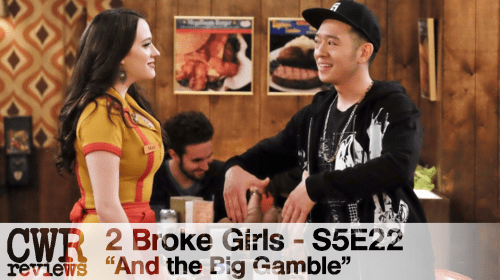
An obvious part of my excitement for tonight’s season finale was the fact that it affords me a break from reviewing this show weekly, which is much appreciated given how busy my life has been lately. As far as the actual content of the episode there was finally finding out if Max and Randy have a future, with getting to see more Asian characters appear on the show [which I only realized when putting together the header image above] trailing far behind.

Let’s just say that I’m glad I wasn’t particularly excited about the latter. To get that out of the way before really digging into the plot points 2 Broke Girls continues to be so bad at dealing with racial minorities, particularly when it comes to Asians. This is particularly surprising when taking into account how many have been featured lately, at least in comparison to other groups. In this season alone we had a flamboyantly gay hotel manager in LA [Alec Mapa] and an anal-obsessed realtor [Camille Chen], both of whom had a decent amount of lines and screentime as side characters go.

While it is very fair to say that the majority of bit parts on 2 Broke Girls don’t allow for much more than a few quick, cheap laughs, regardless of race, the problem becomes noticeable when focusing on the main cast. Han Lee is the only Asian character among them, and can be summed up in a single word: pathetic. He exists to be the butt of every joke, and when every other Asian face can be boiled down to “dramatic” and “really likes anal sex” the optics don’t look too great.

Joining those two is Hwang Hwang, a Korean gangster played by Jimmie Saito. He’s meant to be a threat to Han’s well-being but never actually feels dangerous, and after watching his demo reel sounds like the director told him to play it up, and then just kept repeating that over and over and over again. Anyway. This show not doing well with race. Not exactly news. Continue reading

“Kimmy Goes to a Play” as a Conversation Between Tina Fey and Asian American Activists

The culture war is a conversation.

While it is ultimately a conflict, more often than not this takes the form of ideas and criticism being slung back and forth across the trenches. To be heard is a minor success, but to be actually understood is victory.

Within this conversation it’s undoubtedly artists, especially those who have garnered celebrity status, who have the most powerful voices.


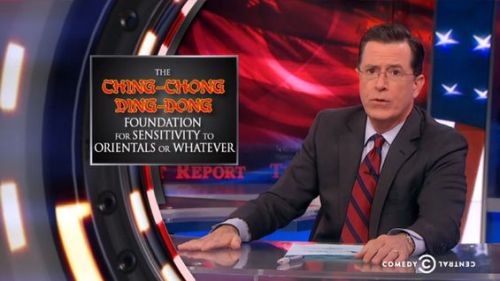
In 2014 the eponymous host of The Colbert Report featured a segment on his show about “The Ching-Chong Ding-Dong Foundation for Sensitivity to Orientals or Whatever”. Given his popularity it reached far and wide, and was eventually viewed by a Twitter activist who created the hashtag #CancelColbert in response.

chingchongcolbert

As it was meant to call attention to and ridicule the outrageous fact that a national sports team is named after an ethnic slur the response was out of line. It was a classic case of [obvious] satire being taken the wrong way, but by inadvertently contributing to what has been dubbed “a fake year of outrage’ this person’s misstep resulted in others who campaign for better representation and the like being worse than silenced, which is to say, ignored.

Despite calling out from what is ostensibly the same side, the misstep of a single loud voice meant that others were unheard.


The exchange between artist and critic is rarely ever an even one, and only becomes more difficult given the sensitivity surrounding such personal creative endeavours.

Lena Dunham is the star and creator of HBO’s Girls, and received enough disapproval about the lack of diversity in a show set in New York City that she was asked about it by NPR. She responded that “[she takes] that criticism very seriously,” and that very same year had Donald Glover playing Hannah’s Black boyfriend on the show.

While the presence of Sandy on the dramedy was a beneficial one, with arguments between the two capturing the tension that can be present in interracial relationships [including such exchanges as: “I never thought about the fact that you were black once.” / “That’s insane. You should, because that’s what I am.”], Glover’s character faltered in that he was very much a response to criticism. Continue reading

Can Casting Choices Promote Global Cultural Dominance? A Possible Explanation for Whitewashing in Cinema

This is a weird, random, and controversial thought, but….

I wonder if this consistent pattern of replacing Asian characters with White actors (even with more and more Asian actors getting more screen time [at least on TV] and all these articles highlighting whitewashing) is a subtle and unconscious battle of cultural and racial dominance? If it stems from a fear-based place of “if you put more Asians as leads in mainstream, worldwide entertainment, then it removes some of the cultural dominance of the status quo”.

I’m really not trying to bash White people, but you really can’t argue that White people overall have more privileges than any other race. And White men are the heads and execs at basically every major company in Europe and North America. And in entertainment, which has major worldwide influence, White people and predominately men are the execs, directors, writers, producers, and agents. Ironically, they welcome foreign money with open arms from Chinese to Middle Eastern investors.

Asians, population-wise, are more than 50% of the world; China and India have enormous populations with a lot of spending power. Asian countries have created very popular forms of entertainment with anime, manga, and video games. They frequently feature characters of Asian descent. Japan has always been a powerhouse country, but their status as an Axis power in World War II has set them up historically as a bad guy. Then their strength in electronics and cars in the 90’s set them up as the “competition” (i.e. not American and not us). And Chinese is ALWAYS the bad guy in the news. “We can’t have factories in China. The Chinese are gonna take over.” There’s a history of US vs THEM. Besides the military, the only industry of world dominance that White America has complete control over is the entertainment industry. American movies make so much internationally. Ironically, the US entertainment industry depends on the income from the foreign markets, but cater very little to their populations by representing them on screen. They know that the foreign populations will come see their movies no matter what, because they aren’t doing huge budget CGI movies where they are. Continue reading