Putting The Martian On Blast – Racebending, Whitewashing, and the Last Straw

The Martian is Guilty of Whitewashing

Last Thursday the Media Action Network For Asian-Americans [MANAA] issued a statement criticizing director Ridley Scott for the whitewashing of Asian roles in his film The Martian. Their judgements are twofold, namely citing that:

  • NASA’s director of Mars operations Dr. Venkat Kapoor as an Asian-Indian character who identifies religiously as being “a Hindu.” The group pointed out that in Scott’s film, his name is changed to Vincent Kapoor, and he’s played by British black actor Chiwetel Ejiofor, who says his father was “a Hindu” but that his mother was “Baptist.”
  • Mindy Park, described by Weir as Korean-American, is played in the movie by Mackenzie Davis, a white, blonde actress.

Now I wish I could proceed on to the rest of this blog post, but people have asked the question as to whether or not this is, technically, whitewashing. It’s going to take a few paragraphs, but let’s get that out of the way-

Okay, The Martian is Guilty of Racebending/Whitewashing

Let’s start from the very, very, very top. The Wikipedia entry for this can actually be found under “racebending”, with “whitewashing” cited as being [citation needed] a more archaic term. Their definition of this practice is:

“when the race or ethnicity of a character, in a story, is altered to an ostensibly more ‘palatable’ or ‘profitable’ ethnicity.”

The reason people have been asking the question as to whether or not this did in fact take place is that The Martian is a film adaptation of a novel by author Andy Weir. As such the source material is devoid of any visual aids in regards to the explicit ethnicities of its characters. Weir himself had a number of things to say about this with MTV News at the Toronto International Film Festival where the film debuted [the interview occurred before MANAA’s statement]:

In regards to writing and describing his characters’ ethnicities-

“So unless a physical description is somehow relevant to the plot, OK, you know he’s missing a leg — something like that, but unless it’s like really important to the plot then I don’t physically describe my characters at all.”

“You can imagine them however you like. Like, for instance, the ethnicity of Mark, I never told you.”

In response to criticisms of Chiwetel Ejiofor being cast as Vincent Kapoor-

“He’s an American. Americans come from lots of different sources! You can be Venkat Kapoor and black.”

In response to criticism of Mackenzie Davis being cast as Mindy Park-

“Whatever ethnicity she has, she’s an American and her family has been in America forever, which is why her first name is just Mindy, but her last name is Park. But Park is also a British surname so the casting people [could have] thought Mackenzie Davis looks like someone descended from Brits. And she did a great job! I’m certainly not complaining about anything related to casting.”

mindyparkWhile not a direct quote, MTV News also shares how Weir envisioned Park while writing the novel:

“He did admit that he’d always pictured Mindy Park as of Korean lineage, but emphasized again that he had never actually explicitly written her as Korean.”

This is all well and good, but problematic in that it doesn’t jive with an interview that took place in May of this year with the blog domesoph. When asked by blogger Sophie Milam about how he approached writing his extensive cast, Weir responded [emphasis added]:

“I didn’t set out to deliberately balance the crew. For the most part, I just wanted them each to be unique enough for the reader to tell them apart without prompting. It’s a real problem in written fiction. You don’t have the face on-screen or voice being heard to remind the audience who’s who. They need to know it immediately from the name.
So there are no two people on Hermes who are the same demographic. There’s one white American guy (Beck), one Hispanic guy (Martinez), and one German guy (Vogel). There are two women of undefined ethnicity (presumably white) but one of them is the Commander, so you won’t get them confused either. Especially since they all call her ‘Commander’.
So it wasn’t any deliberate attempt at diversity. It was really just a shortcut to making sure the reader knew who was who. You’ll find I pulled the same trick with the NASA characters: Teddy (white guy who is in charge), Mitch (white guy who isn’t in charge), Venkat (Indian), Annie (white woman), Mindy Park (Korean woman), Rich Purnell (African American).”

Now I want to be fair and admit that not every author is [or can be] Alan Moore, who has very publicly denounced all film adaptations of his own work. Weir is currently working on his sophomore novel, with The Martian making up the entirety of his current bibliography. As an author with his first-ever book being adapted by Hollwood, and with the film rumoured to be nabbing an Oscar, there are more reasons against than for when it comes to rocking the boat. So let’s discard what Weir has to say, separate from his novel, completely.

All art is open to interpretation regardless of the creator’s intent, so without Weir’s opinions here’s what we know about the characters:

That being said I’m willing to make the concession that free of Weir’s intentions Mindy Park certainly could have been either White or East Asian. When it comes to Venkat Kapoor, on the other hand, most signs point towards him being South Asian, more specifically East Indian. Let’s pull up the definition for “racebending” again:

“when the race or ethnicity of a character, in a story, is altered to an ostensibly more ‘palatable’ or ‘profitable’ ethnicity.”
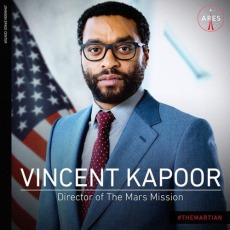
vincentkapoor

Chiwetel Ejiofor is an Academy Award winning actor. He’s also a Nigerian English man, part of a demographic that has not struggled in Hollywood compared to many others. Comparatively speaking I would run out of American films headlining East Indian talent before I ran out of fingers. Are Black men more profitable than Indian men? Everything I know about North America answers a resounding yes. So this is what we’re left with:

Venkat Kapoor was racebent for The Martian.

Mindy Park [given the author’s intent] was whitewashed for The Martian.

To be fair [and I think I have been thus far], East Indian actor Irrfan Khan had been in talks to play Kapoor but had to decline due to another commitment. It’s worth noting that the role had been intended for Khan, and it’s also commendable that- Continue reading

Ms. Marvel, #19: A Comic Book Review

msmarvel19“Qiyamat ka din to nahin hain.” It’s not like it’s the end of the world, Mr. Khan muses aloud to his family in Urdu. But it is, at least until next month when the first issue of Ms. Marvel Volume 4 hits stands everywhere. This issue effectively marks the destruction of the universe for these characters, but it’s everything the finale could be and more.
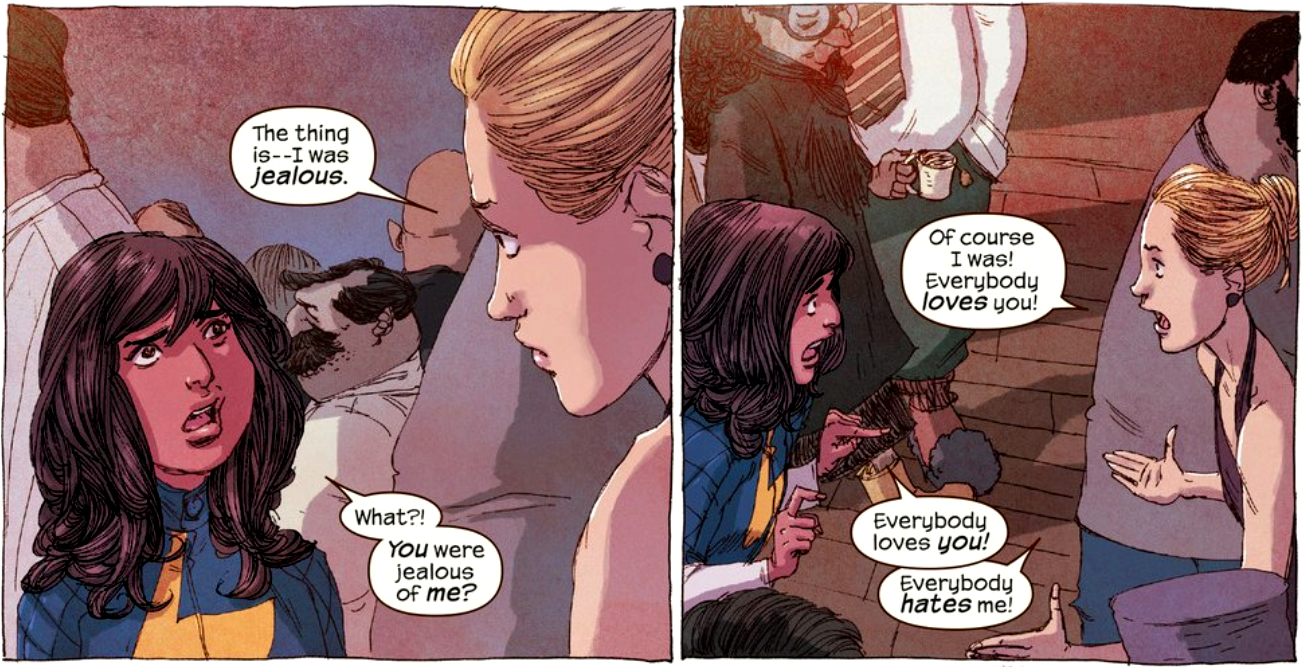
It’s now that I’m forced to eat some of the words I published in my last review, those concerning the “meandering plot as it slowly reaches the end”. Yes, Issue #18 ended with the reveal that Kamala’s mother knew about her vigilantism, but there are so many other relationships that are fleshed out and given the closure they need as this chapter closes [in preparation for the next one beginning].

The first involves, as mentioned, our heroine and her parents of course. Kamala opts not to tell them about the impending apocalypse and simply enjoy their company. Following up with that are two female friends, one of which felt like a blindside but not in a bad way. We’ve seen so little of Nakia since Issue #1 that it’s easy to forget that she’s one of Kamala’s closest friends, and she voices her concerns that they might be drifting apart. It feels real because, as anyone in any kind of relationship can attest to, it can and has and will happen to all of us. And since we’re coming full circle back to the first issue we have Zoe-

zoepology Continue reading

Captain Marvel Pushed Back Again, Company Apologist On Verge of Giving Up

In the beginning, I could not be more excited for Marvel Studios’ upcoming slate of comic book movie offerings. While I noted [and mourned] Black Panther’s absence from their list of Phase 2 films in 2012 I was forced to eat my words a couple of years later, when they announced solo films for both him and Captain Marvel [a female hero!] at a special event.

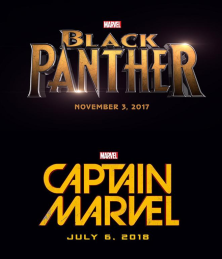
bpcm

Yes, as you can see from the mock-ups they released on the right both were slated to drop on November 2017 and July 2018 respectively, with a good number of years ahead for casting, finding directors, pre-production, extensive post-production for VFX, the whole deal. Like I mentioned, I was ecstatic for what was to come and by no means worried that they were rushing things.

Sure, both films were being released after Captain America: Civil WarDoctor StrangeGuardians of the Galaxy 2, and Thor Ragnarok, three sequels, two of which are the third for their respective franchises, but I could wait! Things were changing for ol’ Marvel Studios, and for the better.

And then the announcement early this year that Sony was willing to cut a deal with Marvel, allowing the latter to use Spider-Man in their cinematic universe! This news was met by much of the internet with a long drawn out finally. Fans had been waiting to see the webswinger alongside other such heroes as Iron Man and Thor and it was all coming to pass! The comic book movie gods smile down upon us!

Except that that wasn’t the announcement in its entirety. Over on their website Marvel revealed that Peter Parker’s induction into their lineup would result in schedule conflicts, namely [emphasis added]:

Marvel’s “Thor: Ragnarok” will hit theaters November 3, 2017. The following year, Marvel’s “Black Panther” will make its way to theaters on July 6, 2018, and Marvel’s “Captain Marvel” on November 2, 2018. Finally, Marvel’s “Inhumans” will now debut in theaters July 12, 2019.

Over at tumblr bookerdewitch summed it up more perfectly than I ever could:

Capture Continue reading

3 Life Lessons I Learned in Church (Or, the Hilariously-Sad Realization that I Grew Up in a Cult)

“Here’s an easy way to figure out if you’re in a cult: If you’re wondering whether you’re in a cult, the answer is yes.” ― Stephen Colbert, I Am America

They say hindsight is 20/20. Never has this cultural idiom been so true to me as the moment that  I realized I grew up in a cult. After conducting some personal and academic research about the characteristics of a cult, the scales fell from my eyes and, hallelujah, I could see.

It wasn’t as earth-shattering as I would have expected, in some ways, it was like I always knew. I just had to step out of the cult closet and see for myself.

A few characteristics of a cult include financial mismanagement, abusive behaviour, and attempts to control members through manipulation. During my time in my childhood church I experienced and/or witnessed each of these concerning behaviours. Don’t get me wrong, we weren’t the kind of horror movie cult that was sacrificing babies, or drinking poisoned Kool-Aid. Generally, it wasn’t even all that bad. But on the spectrum of church to cult, we had more in common with a cult than the typical church.

I learned a lot from my recent revelation, and I wanted to share what I learned with you. Below, I’ve included three life lessons I learned in church, or, as I like to say, the hilariously-sad realization I grew up in a cult.

Life Lesson #1: Your Time is Valuable

“If God is up at five in the morning for prayer… (dramatic pause)… Then you should be, too!”

Time is arguably our most valuable commodity, and it’s your time that a cult will take the most of. For most cults, controlling your time is almost as good as controlling your money. Since I was quite young I didn’t donate a lot of money, but let me give you a breakdown of how I spent my time:

There are 168 hours in a week. We sleep about 56 hours, and work about 40 hours each of the five workdays. That leaves about 72 hours left to do what we like. In our cult, we were told that our time was spiritual money in our spiritual bank account. If we had free time we weren’t doing enough for the Lord.

In a given week we would spend 19 hours in prayer (both communal and private), 6 hours in service, 4 hours doing street ministry (aka knocking on people’s doors and handing out pamphlets), 10.5 hours of driving ministry (picking up families for church programs), 3 hours youth ministry, 4 hours outreach ministry, and 5 hours in worker meetings or music practice. That left 19.5 hours of free time for 7 days, or approximately 2.7 hours of free time per day. To put it another way: if our free time had been money we would have barely made enough to support a child in a third world country.

When I finally committed to not go to church (cult) anymore, I suddenly had time to do what I wanted. It was as if I had discovered my belly button for the first time as an adult, which would be mind-blowing, to say the least.

Life Lesson #2: Question Everything

“When you come in here, turn off your brain.”

Ignorance is bliss, but cult ignorance? That shit is magical.

The first thing a cult takes away is your ability to question. You are not allowed to question leadership, the lack of faith healings, or the way money is being managed. You are discouraged from receiving a secular education and told to “turn off your brain” so the spirit could lead. Asking certain questions could get you ex-communicated. This meant that the Leaders would restrict any communication/contact between the ex-communicated person and the rest of the church congregation. This delicate practice was meant to somehow force the individual into repentance and to return once again to their (dysfunctional) church family.

In order to demonstrate your “true faith” you were required to leave your logic at the door and take everything on faith, no matter how absurd some of the services would get (running around the building and shouting at the top of your lungs was a frequently occurring event). While this kind ignorance was truly blissful, it quickly got out of hand.

Growing up in a cult was a lot like growing up in a tiny magical bubbleMy tiny bubble consisted of a small intimate group of people that saw each other every day. Like most charismatic churches we believed in faith healing, prosperity, and gifts of the spirit (speaking in tongues).

However, we also believed we could:

  • change the weather
  • drive cars without gas
  • teleport
  • pray back a woman’s hymen so she could re-lose her virginity on her wedding night (honest truth)
  • pray away the gay
  • chase demons out of the church (this actually involved physically running around)
  • pray over adult video stores to close them down (it actually did close down two weeks later, BTW)
  • repel bullets through prayer (when the persecution came)
  • pray people out of the grave.

It was a strange, wonderful, magical bubble, to say the least. But it was also a bubble that needed to burst.

For me, the pin that burst the bubble came the day we were asked to pray for a specific group of people to die.

We prayed, and they died, further justifying our beliefs in our magical powers.

It was scary, scary to be in a group of people you love and have grown to know over decades, then, one day, to see them all pray in mindless fervour for someone to die.

This is when the magic ended, I no longer viewed the world through the foggy haze of my magic bubble. I suddenly realized this was all crazy and I had no choice but to leave.

Life Lesson #3: Know When to Walk Away, And Know When to Run

“I don’t trust people with an education, they think too much with their head.”

As cliche as it sounds, things aren’t always meant to last forever. Leaving the safety and security of the community was hard. It was like a divorce; a divorce where you had to separate yourself from every single member of your family one by one. Although I came out relatively unscathed, there were people who I cared about who lost everything: family, money, and community.

The loss of community was the most heartbreaking. It left many bewildered and asking themselves a multitude of questions: What had been the point of all that hard work and time? Why did we pray so much? Why did I give away so much money? And why did I needlessly hate myself for natural body functions? Masturbation jokes aside, after leaving, or rather running, from the cult that I grew up in I learned that I don’t need their edification in my life to have purpose. I could live and make my own choices, without fear that God or church will disapprove. In my cult-free life I have found joy and purpose. Plus, there’s no one trying to steal my money anymore.


The writer of this post has chosen to remain ANONYMOUS.

The 3 Best Parts of a Professional Sporting Event for People Who Don’t Love Sports (i.e. Me)

In case you haven’t noticed, I’ve been struggling to keep up on my weekly posts since heading back to school. This has been primarily due to a creeping deadline at work, paired with more school assignments than I had been expecting from my “easy” filler classes. This weekend, I also had another distraction:

12086836_10156130951545387_450837780_n

It’s no secret that I’ve never been a sports lover. This is probably because I’ve never found a sport that I’ve been good at and I’m a sore loser. Yet somehow, I married a sports lover and, since then, I’ve begrudgingly come to appreciate the pastime. I just don’t always appreciate them for the same reasons that John does. Below, I’ve shared a few reasons why my first NBA (pregame) experience was a blast, and why I hope we can make it a tradition. Continue reading

Why Horror Movies Are Good For You

That’s right, boys and ghouls-

Good for you.

That’s not something you’d expect someone to say about the genre, is it?

Sure, you might hear about horror “classics”. There are plenty of fans out there who’ll talk about their personal favorites. You might even hear critics fondly contemplate how certain horror flicks were telling of their times. But morally edifying?

Well that’s the argument I’m going to be presenting to you today.

Be warned- spoilers may follow.

Now this isn’t the first time I’ve tried to champion the macabre. I don’t expect it to be the last either- not considering the reaction folks give me when I say I enjoy the stuff.

And before we really dig in here- let me get the obvious out of the way.

Yes, a lot of horror movies are garbage. The slasher/”teen-scream” subgenres use cheap gore and excessive nudity as a crutch for plot. More serious attempts still rely on the same cliches that have been around for decades. Plenty are poorly acted and have production values that could be outstripped by a middle school enactment of Romeo & Juliet.

But that’s hardly unique to horror. Continue reading