Tag Archives: work

The Power of Twitter Showcased at the Oscars: #OscarsSoWhite, #YesAllWomen, and #AskHerMore

Twitter has changed the way news is reported. The Black Lives Matter movement has been particularly successful in raising awareness for cases of police brutality that generally would have been overlooked by mainstream news channels.

Arguably the second most important aspect of Twitter is its ability to connect celebrities to their fan base. With the prevalence of these two features, it’s hardly surprising that celebrities and celebrity events have become more politicized.

This year’s Academy Awards are a prime example of this overlap between the celebrity world and political struggles that have been highlighted via Twitter. Below, I’ve included a few notable examples of Twitter flexing its muscles at the Oscars

#OscarsSoWhite

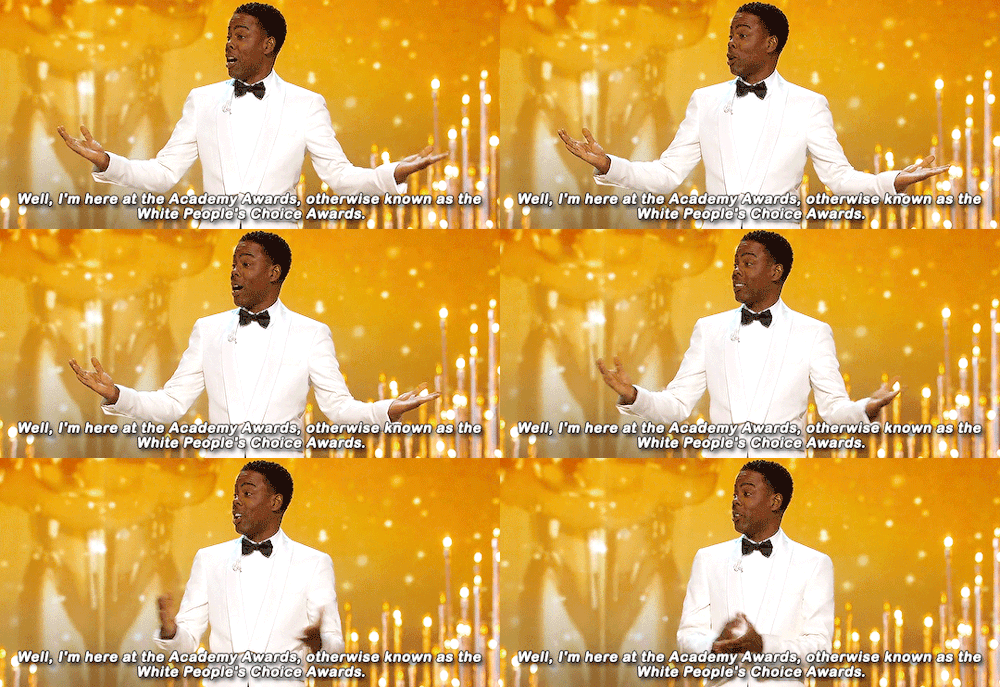
I’m not going to dwell too much on the circumstances of the #OscarsSoWhite boycott, since Gordon and Evan have already thoroughly explained its context. However, I do want to talk a bit about how the controversy was handled by the Oscars host, Chris Rock.
tumblr_o3ajap2ea01rwbf4ro1_500

Overall, I thought Rock did a great job calling out the Academy without reducing his monologue to a humourless lecture. However, in his article for Salon, Arthur Chu points out that,

Acting like caring about day-to-day violence in the streets and the impact media and culture have on that violence are somehow mutually exclusive — a common, frustrating, tired argument anyone who talks about racism in media will inevitably see dozens of times in the comments section — ignores history.

It ignores the many, many arguments that have been made about how the excuses made for the deaths of Trayvon Martin and Mike Brown frequently come verbatim from untrue stereotypes out of TV and movies, how the only way Darren Wilson’s description of Brown as a “demon” who was “bulking up to get through the bullets” could possibly make sense to anyone is after a lifetime of media portrayals of the scary superhuman black man. It ignores Martin Luther King going out of his way to call Nichelle Nichols and tell her not to quit “Star Trek” because having a black woman on TV who wasn’t a domestic servant mattered. It ignores the ongoing civil rights protests around the Oscars back in the 1960s and ’70s, including Marlon Brando making history as the first and only best actor winner to boycott the ceremony, sending American Indian Movement activist Sacheen Littlefeather to accept the award in his place.

Similarly, several activists have since pointed out the one-dimensionality of calling for more black representation only to appeal to Asian-American stereotypes for a laugh. Continue reading
“Hymn for the Weekend”: Appreciation, Appropriation, and the Exotic Black Woman

I don’t know about you, but I can’t stop listening to “Hymn for the Weekend” on repeat.

However, before I had even listened to Chris Martin and Queen Bey meld their voices in a divine mesh of harmonies, I was reading about it on Tumblr.

Cultural Appreciation vs. Appropriation

The first thing I heard about the video was that it had some pretty rampant cultural appropriation. Since there have been a number of music videos and performances accused of cultural appropriation over the last few years, I wasn’t too surprised to hear about “Hymn for the Weekend” being added to the list.

The video quickly split viewers into two groups, those who considered it cultural appropriation, and those who appreciated the video’s focus on Indian culture. The clip below highlights a few of the key elements that have been discussed and criticized.

This discussion is tricky for a variety of reasons. For example, there is a time and place when a white person can wear Indian clothing and accessories without coming off as disrespectful. In some cases, it’s actually much more respectful to embrace local dress customs than to ignore them.

There are even music videos where diverse customs and styles have been featured without any backlash about appropriation.

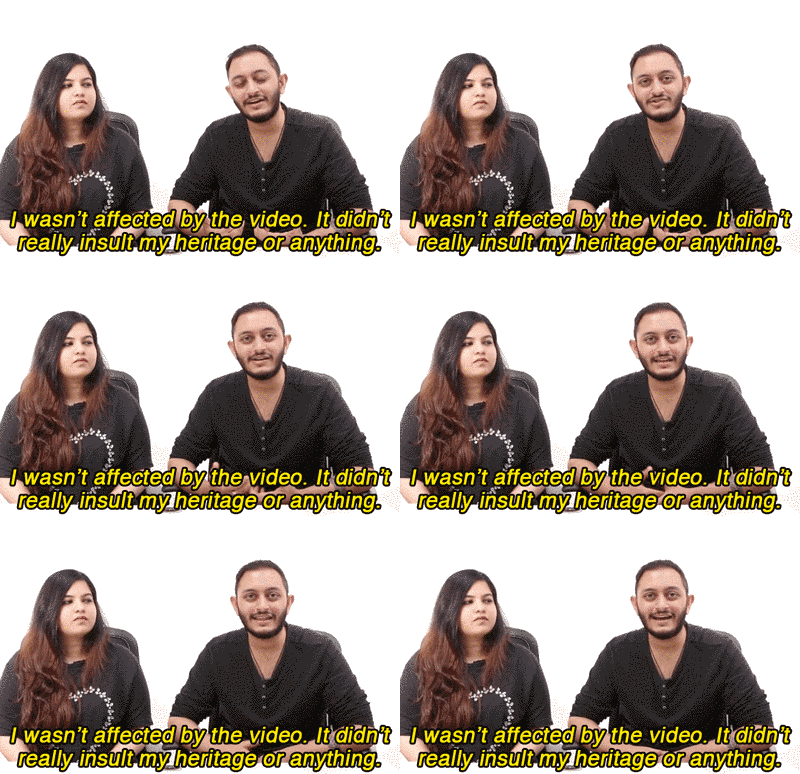
This debate can also seem confusing when Indian fans, or fans with Indian heritage, don’t seem to be bothered by the video’s representation of their culture.

anigif_optimized-20745-1454418987-1 Continue reading

We Need More Women in STEM, But I’m Not One Of Them

Hello everyone, my name is Emily and I am bad at math. Sometimes this makes me feel like a failure as a feminist.

See, I’m a nerd at heart (surprise!), and a lot of my favourite websites and blogs accrete STEM (Science, Technology, Engineering, and Mathematics) news alongside covert footage of the new Millenium Falcon. I certainly don’t mind after all, I follow NASA on Facebook. I really am truly interested in most of the science news that comes across my dash, but it’s like being a child with a crush on one of her parent’s friends: I think it’s so incredibly cool and it thinks I’m kind of silly. Left-brainers range from befuddled to downright arrogant when dealing with us right-brainers.  

At any rate I see a lot of news about how important it is to get more girls into STEM fields, and it leaves me feeling a little guilty.  I would consider myself both a nerd and a feminist, and yet my brain seems to be built like a sieve with number-shaped holes.  Seriously, when my husband was doing his engineering degree he would sometimes vent about the concepts he was learning and even when I was trying very hard to focus and follow what he was saying, my brain would go fuzzy and I’d entirely lose track of his words.  Numbers just make my brain congeal a little.

This, but with math.

I’m not exaggerating.  I can do the same problem four times and get four different answers.  The numbers swim and change places, and working through problems feels like pushing something heavy through something thick, only to find out you were moving the wrong heavy object once the job is done.  STEM types laud math for being so reliable and utterly logical, but it’s always felt rather arcane to me. Continue reading

In Defence of the Dress Code

There are so many things I hate about dress codes. I hate that they usually target girls and their sexuality, implying that a) if girls don’t cover their bodies boys will have no choice but to “lust” after them and b) a girl’s sexuality is something to fear. I hate that they imply that a woman’s character is based on her level of purity.

I hate that they become an opportunity for grown men to ogle young girls in order to better police what those young girls should wearI hate that they project gender roles onto young people. I hate that they go hand in hand with body- shaming young girls just when their bodies have started to change and they are still learning how to deal with those changes.

In contrast, I love seeing young women standing up for themselves on social media with hashtags like #IAmNotAnObject, #MyBodyMyBusiness, and #MoreThanADistraction. I love seeing them reclaim their bodies as their own, rather than some grown (or young) man’s fantasy. I love seeing them call out our education systems for continuing to prioritize boys over girls. I love seeing them call out the innate sexism at the centre of most dress codes Continue reading

The Ladders (Aint Worth Your Time)

Earlier last week the blog’s email address received an email from a representative over at TheLadders.com, a “comprehensive career resource” site for high-end job seekers. We at Culture War Reporters were graciously told by this representative that we were “perfect” for a project the company was hoping to run, and we were asked if we wouldn be able to provide some tips and hints for recent grads out there seeking work. After some research and discussion with my co-authors, I decided to do just that- so here’s my advice.

Stay the **** away from TheLadders.

Seriously. Continue reading

Lisa Nakamura Part 2: Navajo Circuits and the “Nimble Fingers” of Asian Women

In my last post, I told you a little bit about Lisa Nakamura, her research, and the talk she gave at my university about Tumblr activism. I also promised to tell you about her second lecture the next time I wrote.

Both of Nakamura’s lectures were about digital media, but unlike her first talk, her second presentation focused on the physical material of digital technology.

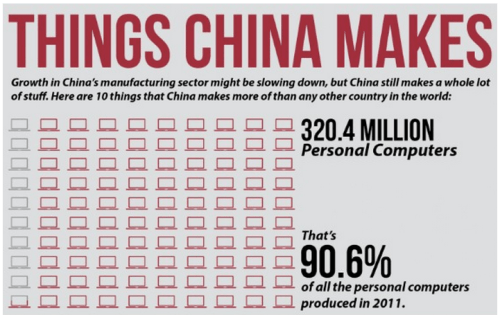
Unless you’ve been hiding under a rock, or recently time-travelled to 2015, you probably wouldn’t be surprised to hear that most of your digital hardware came from Asia. You may even be familiar with the way Asian women have been racialized as innately predisposed to factory work because of their “supposed docility, nimble fingers and attention to mind-numbing detail”.

Screen Shot 2015-03-09 at 8.39.54 PM

Click on the image to view the full infographic.

However, you might be surprised to learn that this stereotype has been applied to women of colour ever since the digital revolution. In her paper on “Indigenous Circuits: Navajo Women and the Racialization of Early Electronics Manufacture”  Nakamura examines the way digital factory work is both gendered and racialized. She refers to the work of Karen Hossfeld when she insists that

“…by the eighties in Silicon Valley, electronic assembly had become, not just women’s work but women of color’s work.” (290)

Continue reading